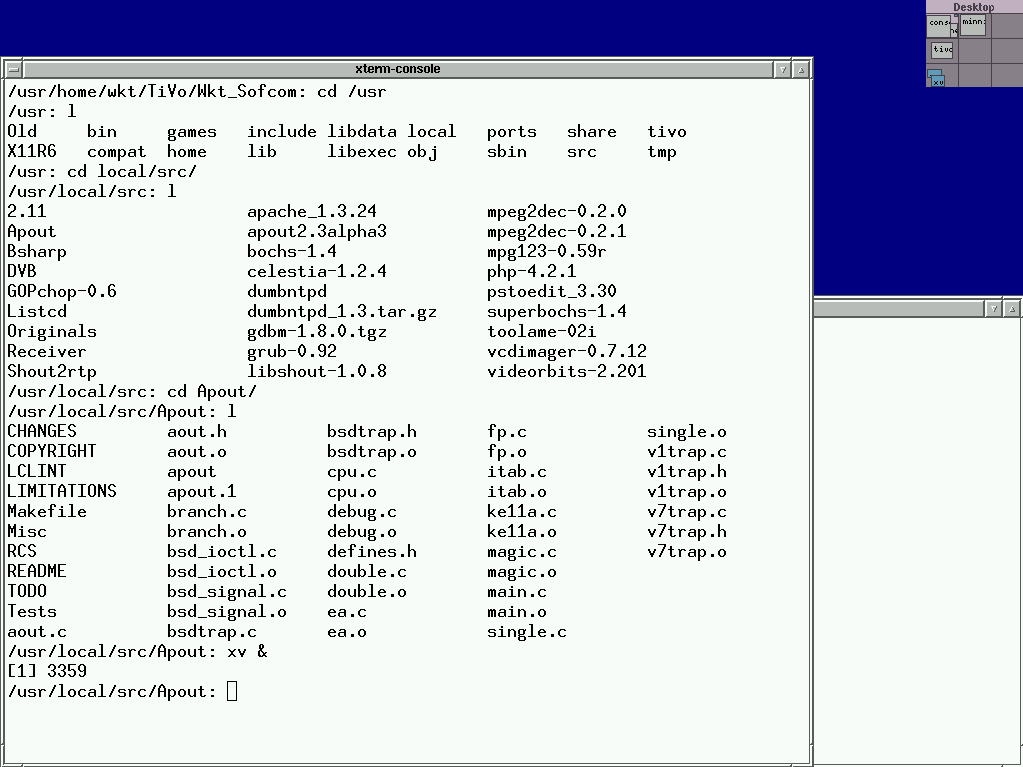
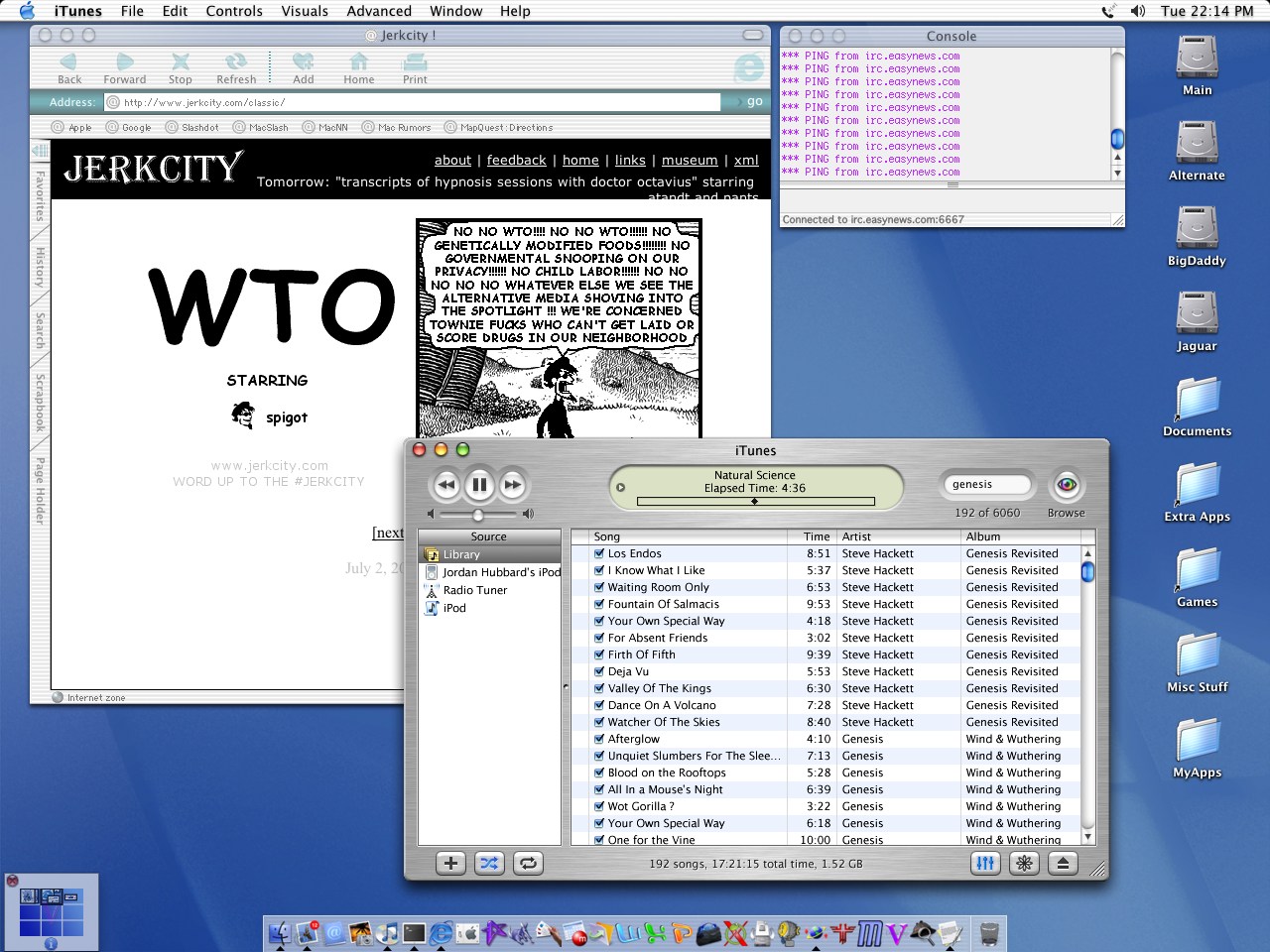
All of the screenshots strike me as "get things done". Little flourish, just windows and text mode apps where needed to finish the day's task. To me, an ideal to aspire to.
> For personal reasons, I do not browse the web from my computer. (I also have not net connection much of the time.) To look at page I send mail to a demon which runs wget and mails the page back to me. It is very efficient use of my time, but it is slow in real time.
For instance, if you refuse to play around with LLMs out of some dogmatic reason that they're not "truly" open (note: I don't know what his true opinions are), then you risk completely missing the boat and can't meaningfully shape the space of modern discourse.
Linus Torvalds often says that he does know how to do X (like install a Linux distribution, or other simple stuff). I wager that it's a status thing.
But that's also the kind of people we need. Companies are not going to compromise on their profits, we need someone to balance that and not compromise on software freedom. With these two extremes we can take an balanced position and that's how we got Linux and distros like Debian: it is free software, but it is also pragmatic. If we only had pure GNU (HURD), we wouldn't get far, but if we didn't have GNU at all, it would be even worse.
Richard Stallman didn't just talk. He actually wrote code, famously Emacs, and started the whole GNU project. I am not aware of recent technical contributions though.
Well, he also created GCC and GNU Emacs.
Linux and the idea that developer tools should be free wouldn't exist without him.
I think you see that with a lot of other revolutionaries. They often take unreasonable positions and behave in unreasonable ways. RMS' tragedy is probably that his side more or less won, so now he's just a weirdo without a cause.
(source: https://www.youtube.com/watch?v=mfv0V1SxbNA )
He seems to want as much stability as possible; while being as minimal as possible; with as little fuss to install and keep up to date as possible. Fedora meets those needs. Gnome is Fedora's main concentration.
Now, there's a separate build to download for KDE. It's likely because Gnome is default install for Red Hat Enterprise Workstation.
Most newer popular distros (Bazzite, CachyOS, Zorin, Asahi, etc.) default to KDE now, and it's very nice that Fedora's not only keeping up, but also providing the basis for some of them.
After spending years with Arch/NixOS/Ubuntu/Sway Im quite happy with Fedora+GNOME now. It just works.
Update: Also on the bottom left here [3]
[1] https://anders.unix.se/images/desktop_warren_toomey.gif
[3] https://anders.unix.se/images/desktop_jordan_hubbard.jpg
Edit: Probably the most visible change is better fonts and font rendering.
Edit 2: To expand on "all I want is code": let's say there is a menu bar with maybe 10 menus and 100 or so items, and a project navigator thingy, and a compiler output window. I would much rather these things not take up permanent space on my screen. Every one of them shows information/commands that I can access with a key combination and in some cases some fuzzy completion after hitting a key combination. Any decent editor can do this and you can learn it in an afternoon, and if you're going to spend the next couple of decades in front of it it's worth getting rid of the pixels permanently allocated to advertising "you can do this thing".
It's probably not worth arguing whether this is the "best" when compared with vscode+LSP+Claude or whatever happens to be en vogue in the moment.
But terminals and editors is sticky in a way that tells me it's probably close to optimal. Those of us in the cult aren't observed to leave the compound except in extremely rare circumstances. I'll be doing the same stuff on my death bed, likely.
Optimal for those users, at any rate. IMO using a terminal editor is so painful compared to a decent GUI (Sublime or even VSCode) that I have a difficult time understanding why anyone would choose such a tool. I just try to repeat the mantra of "everyone likes different things" and stop trying to understand something where I likely never will get it.
I use mostly IceWM these days. I can't use the leaner WMs such as ion or ratpoison and XFCE, mate-desktop, KDE and GNOME are too slow or too crap (KDE unfortunately also now; before that only GNOME was crap. KDE killing xorg-support also means it is one less thing I can use anyway.)
Milo Medin said "Dennis was absolutely livid, and I recall him saying something about shutting off UCB's PSN ports if this happened again."
https://news.ycombinator.com/item?id=31822138
    From: Milo S. Medin <medin@orion.arpa>
    Date: Apr 6, 1987, 5:06 AM

    Actually, Dennis Perry is the head of DARPA/IPTO, not a pencil pusher
    in the IG's office.  IPTO is the part of DARPA that deals with all
    CS issues (including funding for ARPANET, BSD, MACH, SDINET, etc...).
    Calling him part of the IG's office on the TCP/IP list probably didn't
    win you any favors.  Coincidentally I was at a meeting at the Pentagon
    last Thursday that Dennis was at, along with Mike Corrigan (the man
    at DoD/OSD responsible for all of DDN), and a couple other such types
    discussing Internet management issues, when your little incident
    came up.  Dennis was absolutely livid, and I recall him saying something
    about shutting off UCB's PSN ports if this happened again.  There were
    also reports about the DCA management types really putting on the heat
    about turning on Mailbridge filtering now and not after the buttergates
    are deployed.  I don't know if Mike St. Johns and company can hold them
    off much longer.  Sigh...  Mike Corrigan mentioned that this was the sort
    of thing that gets networks shut off.  You really pissed off the wrong
    people with this move!

    Dennis also called up some VP at SUN and demanded this hole
    be patched in the next release.  People generally pay attention
    to such people.

                                            Milo