62 years in the making: NYC's newest water tunnel nears the finish line
125 points
13 hours ago
| 9 comments
| ny1.com
| HN
aizk
10 hours ago
[-]
It's amusing to me watching devs talk about the breakneck pace of AI and LLMS, AGI all that sorts of stuff, what that wild future will give us - when there are far, far more difficult problems that lie directly in front of us, mainly getting public infrastructure projects done in normal spans of time, or hell, getting them done at all.
reply
BurningFrog
9 hours ago
[-]
The problems with getting public infrastructure projects done in time or at all are political, not technical.

There typically are no technical solutions to rhose.

reply
teleforce
2 hours ago
[-]
>There typically are no technical solutions to rhose.

Not that they can't, but they won't.

reply
programjames
7 hours ago
[-]
There typically are, but sometimes the technical solution is bad for those in power, or they're unaware of it, or it hasn't been discovered yet.
reply
awesome_dude
9 hours ago
[-]
Kind of - the art of fortune telling plays a big part in things

It's not needed now, but we think that it will be needed in the future

It's needed now, but we don't know if we will use it in the future

How MUCH will it be needed in the future

Will there be a future technology that makes this investment unnecessary, or even obselete before the project ever completes

For the latter, a big argument of "No need to invest in commuter trains" argument was "self driving cars are 'just around the corner' and they will make mass transit a quaint thing of the past" was used to deny investment in trains.

reply
rayiner
9 hours ago
[-]
> For the latter, a big argument of "No need to invest in commuter trains" argument was "self driving cars are 'just around the corner' and they will make mass transit a quaint thing of the past" was used to deny investment in trains.

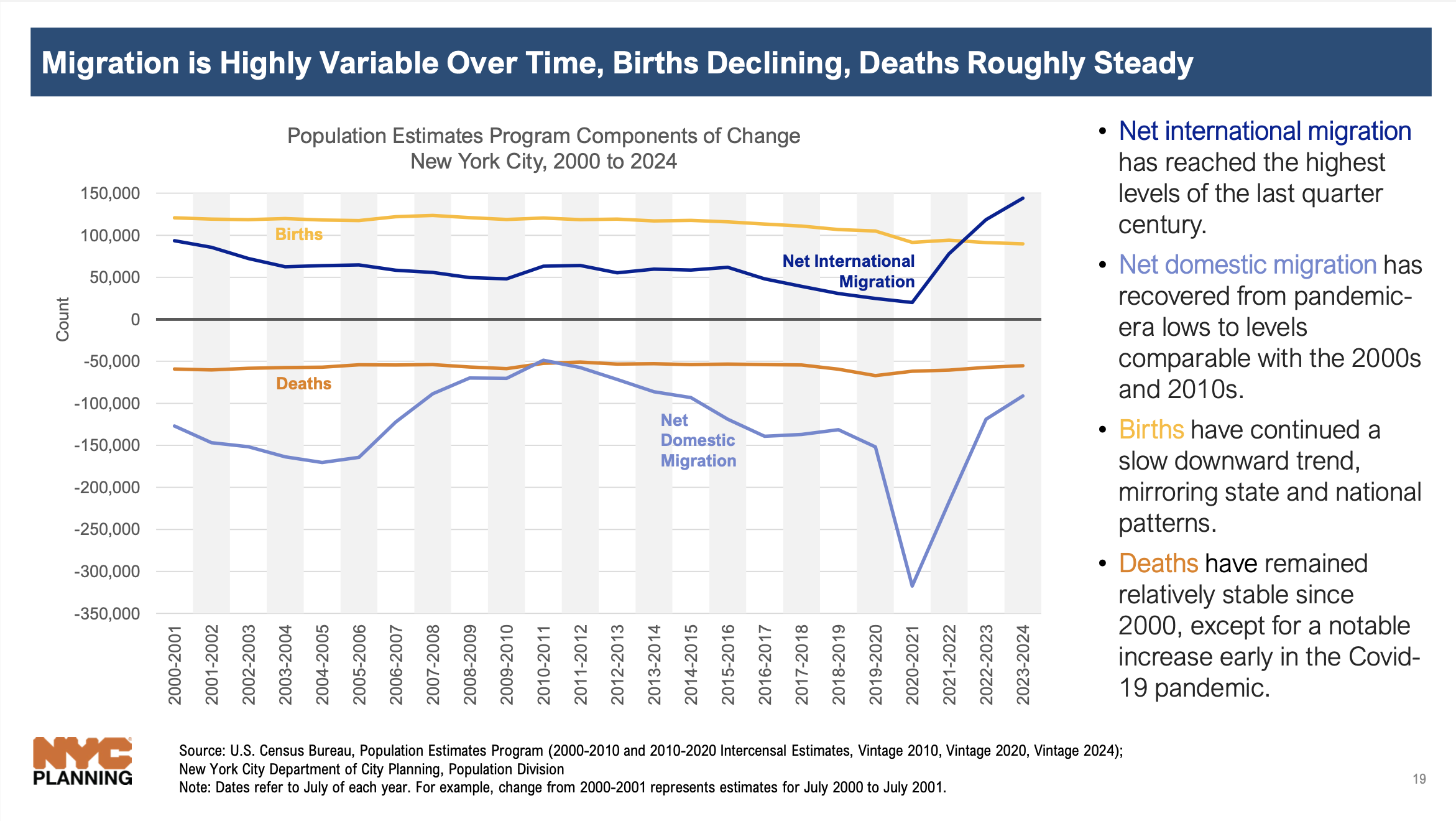
People don’t want to invest in trains because Americans don’t like trains. We have only one real city, and that city’s population consistently has net domestic outmigration. The city’s population is kept stable by a steady supply of international migrants: https://www.cityandstateny.com/media/ckeditor-uploads/2025/0....

Most Americans don’t want to commute sitting next to strangers. It’s not complicated.

reply
mmooss
8 hours ago
[-]
> Americans don’t like trains

They use them heavily when they're available. The NYC subway is very popular and successful, and many see it as a selling point of the city.

> Most Americans don’t want to commute sitting next to strangers.

I never hear city residents talk about 'strangers'. Interacting with others is a pleasure of cities, in fact - it's energizing, it builds social trust. We're social animals. I've never gotten on public transit, or walked down a busy sidewalk, and thought about 'strangers'. Most of those people are pretty sociable.

reply
rayiner
7 hours ago
[-]
> They use them heavily when they're available. The NYC subway is very popular and successful, and many see it as a selling point of the city.

NYC has only 2.5% of the U.S. population and even then it has net domestic outmigration (meaning more people move out every year than move in). The city would be shrinking if it wasn’t for international immigrants, who don’t come to the city for the public transit, but rather the welfare system and ethnic social networks.

reply
woodruffw
7 hours ago
[-]
> The city would be shrinking if it wasn’t for international immigrants, who don’t come to the city for the public transit, but rather the welfare system and ethnic social networks.

I think your numbers are wrong: the city's foreign born population has been stable for at least 15 years[1]. We're not even at historic highs; those were before WWI.

[1]: https://cmsny.org/publications/data-briefing-on-new-york-cit...

reply
ordu
2 hours ago
[-]
> the city's foreign born population has been stable for at least 15 years

This statement doesn't contradict the one about international immigrants keeping the city from shrinking. It is easy to imagine how immigrants come to NY, give birth to natural born Americans, who then move out of the city. This process can come to some kind of a dynamic equilibrium with a stable population of foreign born people.

reply
SoftTalker
5 hours ago
[-]
Did you hear about the woman in Chicago who was set on fire on a train? Not very sociable.

People use the trains in places like Chicago and NYC not simply because they are available but because owning and driving a car in the city center is very expensive and impractical for most people.

Anywhere less dense, people prefer to drive their own cars.

reply
magicalist
4 hours ago
[-]
> Did you hear about the woman in Chicago who was set on fire on a train? Not very sociable.

Did you hear about the other other lawsuit about people burning to death in their cybertruck? Should we compare horrific deaths per passenger? Per mile traveled?

reply
awesome_dude
8 hours ago
[-]
I'm one of the few dozen people on the internet not in America...
reply
8bitsrule
8 hours ago
[-]
If empirical observation is 'technical', then keen eyes can spot the grifters before they can be elected or corrupt the already-elected. Then we just need the will to permanently deter them.
reply
arjie
6 hours ago
[-]
That is true. In fact it relates to one of current America's greatest truths: coordination problems here are much more difficult than many technological problems. This is what makes many of those "oh so you take those autonomous vehicles, put them on a track for efficiency reasons, then link them together so they can transport more people, and voila! you have a train!" comments ring hollow.

Building a train requires coordination. Building an autonomous vehicle requires technological innovation and convincing a few people at the top levels of government. The specifics matter (and the Abundance guys have done a great job summarizing them) but it's due to an entrenchment of certain styles of laws.

So the answer to "why do Americans build self-driving cars to ease transport when Europeans just built subway systems?" is "we do these things not because they are hard, but because they're actually much easier than the other thing you find easy".

reply
llbbdd
1 hour ago
[-]
The other answer is that Europe is tiny and subways are almost useless in America unless you are exceptionally poor
reply
pclmulqdq
9 hours ago
[-]
AGI is easier than getting New York City to complete an infrastructure project in less than a decade or less than a billion dollars.

The corruption and graft run so deep you would have to literally murder a lot of people to get that to happen.

reply
mmooss
8 hours ago
[-]
What indication do you have that the construction time for tunnel 3 is due to corruption or even that it's taking longer than necessary? It seems like a very large engineering project; sometimes those take time.
reply
bee_rider
8 hours ago
[-]
Yeah, I have no idea how long a tunnel of this size is supposed to take, and I’m surprised if many people here do.

It’s a big project, and it is tricky to patch it after release. The thing is supposed to last 300 years, and usually we use infrastructure well past it’s intended lifespan…

reply
euroderf
6 hours ago
[-]
> I have no idea how long a tunnel of this size is supposed to take, and I’m surprised if many people here do.

Ask Europeans ? They're bangin'em out.

reply
earthnail
4 hours ago
[-]
Few things in Europe compare to the size of NYC. A potentially comparable project would be the Elizabeth line in London. Took from 1948 to 2008 to agree on a plan and then 15 years to execute it.
reply
roadbuster
3 hours ago
[-]
The bill in favour of the Elizabeth Line was only put to parliament in 2005, receiving royal assent in 2008. Construction work began in 2009, faced some delays during COVID, but was completed in 2022 (total construction time: 13 years)

Construction on New York's Tunnel #3 began in 1970. It was 28 years before any part of it was operational. A second section came online 15 years later (2013). The final stage isn't expected to be completed until 2032, a full 62 years after construction began. I'm unaware of any comparable tunnel project which has progressed at this slow of a pace.

reply
roryirvine
2 hours ago
[-]
The Thames Tideway Tunnel might be a better comparator.

It's similar in scope to this recently-completed second phase of NYC Tunnel #3, albeit carrying sewage rather than fresh water: 25 km long, 7.2 m in diameter in London vs 29 km long, 4.9 m diameter in NYC. Flow volumes are likely similar (a sewage tunnel will rarely run full).

Planning started in 2001, with construction beginning in 2016. It opened in May 2025, at a cost of around £5bn: https://en.wikipedia.org/wiki/Thames_Tideway_Tunnel

reply
euroderf
3 hours ago
[-]
Sorry. I was incompetently referring to the various rail tunneling projects under the Alps (and elsewhere I think). Several very long tunnels.
reply
Thlom
2 hours ago
[-]
Drilling a tunnel through a mountain is easy compared to drilling a tunnel under a city.
reply
mmooss
8 hours ago
[-]
I wonder how long, unmaintained, it would take to collapse. Would some future civilization find a tunnel?
reply
MangoToupe
7 hours ago
[-]
reply
zdragnar
7 hours ago
[-]
Google claims the original build was supposed to take 50 years, and it will take 62 due to delays from a funding crisis before de blasio.

However, this is only the second phase of the plan, with two more phases broken out into separate projects. I've no idea if those were supposed to be a part of the original 50 year timeline or not.

reply
deaux
4 hours ago
[-]
> What indication do you have that the construction time for tunnel 3 is due to corruption or even that it's taking longer than necessary?

These two questions are casually put next to each other in the same sentence but they're incredibly different. Personally, I don't think that corruption is a significant factor in how long it took. The second question is way too leading/framed - "necessary" doesn't exist past the physical limits.

For example, would the same project have taken the same time in China? No. Does that mean it should've taken as long as it would've in China, as clearly it took longer "than necessary"? Not by definition.

reply
woodruffw
7 hours ago
[-]
Call me crazy, but I don't think $6B for a 60-mile, deep-bore tunnel through the densest urban core in the US is that much money.
reply
rayiner
9 hours ago
[-]
Why is NYC so corrupt when large cities like London, Munich, and even Paris are much less so?
reply
woodruffw
7 hours ago
[-]
It isn't. No evidence has been presented to that effect. Here are some actual numbers[1].

(The classic form of griping over NYC corruption is the MTA which is notable for not being administrated by the city.)

[1]: https://www.vitalcitynyc.org/articles/how-corrupt-is-new-yor...

reply
mmooss
8 hours ago
[-]
Why do people say NYC is more corrupt? I don't know of evidence or reports. To me, it doesn't seem more or less corrupt than other major cities in the US. It's hard to compare to other countries, where city government may have different roles.

Certainly NY's government and budget are larger than other US cities, for obvious reasons.

reply
cyberax
8 hours ago
[-]
They are just as corrupt and/or incompetent. Have you tried Deutsche Bahn recently?
reply
EdwardDiego
5 hours ago
[-]
If you think Munich isn't corrupt, you should ask a Münchner - hell, their airport is named after a corrupt politician. [0]

But as a few Germans have put it to me - sure, there's corruption here, but at least it still gets things built unlike _Italian_ corruption.

Which is an... ...interesting point of view.

[0]: https://en.wikipedia.org/wiki/Franz_Josef_Strauss

As for London, they built an entire industry around hiding money for oligarchs who stole it from their own countries. Maybe it's technically legal, but it's morally corrupt AF.

reply
Semaphor
5 hours ago
[-]
As a German I'll say that even acknowledging there is a corruption problem (while still being unwilling to change it and not voting for the parties that let corruption fester) puts them a good step ahead of all those thinking there's no real corruption.

No studies, personal impressions, so I might well be wrong and maybe they all know but don't care. No majority that cares either way.

reply
mschild
4 hours ago
[-]
As another German, I think there is different kinds of corruption. There is low-level and high-level.

Low-level is when you bribe individual cops, city clerks, etc so they let you go instead of writing a speeding ticket or approving your house building plan.

High-level is when people like Merz receive a political donation from McDonalds, do some self-promotion in one, and then keep/lower the Mwst (VAT) for restaurants.

Germany unfortunately has high-level corruption but as far as I know, very little low-level. I think thats partially why people don't care to vote to differently. Yes, it happens, but there is a large disconnect between what Merz does and how it impacts an individuals bottom line.

If people would have to constantly hand out bribes to anyone then maybe its a different story.

reply
Semaphor
3 hours ago
[-]
Agreed
reply
EdwardDiego
5 hours ago
[-]
Yeah, I agree with that sentiment.
reply
aizk
9 hours ago
[-]
Yes. That's exactly my point.
reply
potato3732842
9 hours ago
[-]
The "problem" here isn't the construction of a tunnel. It's the political reality of the people on top of it.
reply
bongodongobob
9 hours ago
[-]
You have to deal with directly affecting real estate owners, potentially 100s of thousands of different ones in NYC. Not to mention 100s of years of underground infra and all the different companies that own that stuff without cutting service to anyone. It's insanely difficult and I'm not sure I understand why you think it wouldn't be.
reply
aizk
9 hours ago
[-]
You're missing what I'm saying. I'm poking fun at devs that think AGI will magically solve all our problems - they have no idea just how insanely complicated physical infrastructure is.
reply
bongodongobob
6 hours ago
[-]
I could definitely see it helping in this space though. I was a project manager for a telco for a bit and there's lots of data in different formats and systems that even today's AI would be great at splicing it all together for one coherent picture.
reply
notyourwork
6 hours ago
[-]
Coherent and correct or merely seemingly coherent and factually incorrect.

This is where we’re at.

reply
tsunamifury
9 hours ago
[-]
Haha the technical difficulty is not the hold up here sweet summer child
reply
llbbdd
1 hour ago
[-]
Reddit
reply
ChickeNES
12 hours ago
[-]
Wild to think this is the same project featured in the third Die Hard, which turned 30 this year.
reply
linksnapzz
12 hours ago
[-]
Should they ever reboot Die Hard; it'll need a sequence involving CA HSR infrastructure.
reply
wtvanhest
11 hours ago
[-]
Die Hard: The most expensive mile
reply
rayiner
9 hours ago
[-]
They need to do a post-apocalyptic movie with a scene set in Fresno with unfinished CA HSR viaducts hulking in the background against a polluted orange sky.
reply
cogman10
11 hours ago
[-]
The project started in 1954. A 70 year old project.
reply
mvkel
8 hours ago
[-]
Die Hard: The Way of Water
reply
toomuchtodo
9 hours ago
[-]
https://en.wikipedia.org/wiki/New_York_City_Water_Tunnel_No....

https://www.nyc.gov/assets/dep/downloads/pdf/water/drinking-...

https://old.reddit.com/r/nyc/comments/in5lm7/cross_section_s...

Potentially related:

Discussing Waterworks, Stanley Greenberg's Photos of NY's Hidden Water System [video] - https://news.ycombinator.com/item?id=46416871 - December 2025

(Tunnel 3 will deliver 1B gallons/day and has a 200-300 year expected service life)

reply
Animats
12 hours ago
[-]
They finally got Water Tunnel #3 close to completion? Work was stopped a decade or so ago, but apparently it was restarted.
reply
toomuchtodo
12 hours ago
[-]
Still a bit more to go. Hopefully they offer some tours of the final phase before it’s flooded and no longer accessible for decades.

> The Bronx and Manhattan already receive water from it, and the final phase — extending service to Brooklyn and Queens — is expected to be completed by 2032.

reply
senordevnyc
8 hours ago
[-]
I live in NYC, and I'd love a tour like this. Are there other of these kinds of civil engineering tours out there?
reply
toomuchtodo
7 hours ago
[-]
The one that made me think of this is Metropolitan Area Outer Underground Discharge Channel in Kasukabe, but I’m sure there are others. If you find a list of civil engineering tours available, please share!

Tokyo Metropolitan Area Outer Underground Discharge Channe - https://news.ycombinator.com/item?id=43816183 - April 2025 (6 comments)

Tokyo's Underground Discharge Channel - https://news.ycombinator.com/item?id=19785044 - May 2019 (40 comments)

Tokyo Is Preparing for Floods ‘Beyond Anything We’ve Seen’ - https://news.ycombinator.com/item?id=15436943 - October 2017 (210 comments)

reply
mmooss
12 hours ago
[-]
So many questions ... which probably have been asked on prior HN threads ...

I wonder why 800 feet underground: Is that necessary to pass beneath all other infrastructure (to prevent flooding it?)? Remain beneath waterline to create negative pressure and reduce leaking? ?

Also, what is the general mathematical relationship between depth, rock pressure / weight, and energy required to drill? That is, what is the proportion of energy required to drill beneath 800 feet of material compared to drilling beneath 400 feet?

...

reply
Spooky23
11 hours ago
[-]
The depth allows it to be drilled through bedrock, which avoids a bunch of complications on an already complicated project.

This thing will probably be operating hundreds of years from now. What a project.

reply
cap11235
10 hours ago
[-]
I don't know about New York in particular, but Chicago water engineering seems a related topic.

Here you do deep tunnels to avoid the surface, in ways another poster said; everything is easier when nothing is in the way.

For the mathematical difference, 400 feet below sea level and 800 feet below are almost exactly the same: difficulties are water getting in to your pit, but the machines that work on rock, work on rock at the same speed regardless of depth, so the difference between 400 feet and 800 feet is best described as 400 feet difference. A big issue here is that they do not drill; they hammer. Pounding base pylons into bedrock causes dramatic rhythms in the surrounding 500m, but that's to deal with the bedrock, not depth.

reply
KaiserPro
2 hours ago
[-]
> energy required to drill

That depends on the rock type. In london, most things are clay, so not actually that solid (ie it needs shoring up immediately, and will collapse without supports, hence the travelling shield)

manhattan schist appears to be reasonably hard (not granite, but also no clay)

reply
cogman10
11 hours ago
[-]
It's a 60 mile long tunnel and in order for water to flow through it, you need either pumps or a downhill gradient.

I'd guess the reason for the 800 ft is because the reservoir it'll draw from is near sea level.

reply
nuccy
11 hours ago
[-]
Rivers (e.g. Mississipi) work with much smaller gradient of just 0.01% [1], while with your assumption it would be 0.25%, so 25x.

Maybe instead it needs to pass under the rivers [2: cross-section] surrounding New-York, which may be much deeper, especially when it comes closer to the bay passing Queens and Brooklyn [2: map]

1. https://en.wikipedia.org/wiki/Mississippi_River

2. https://gordonsurbanmorphology.wordpress.com/2014/10/26/wate...

reply
woodruffw
10 hours ago
[-]
This piqued my interest, so I checked: Tunnel #3 passes under the Harlem River and then the East River, but the Harlem River is less than 30 feet deep for the most part and the East River is around 40 feet deep at the most.

(The Army Corps of Engineers has great detailed depth surveys for most of NY's waterways[1].)

Edit: There's also a higher-resolution render of the tunnel layout here[2].

[1]: https://www.nan.usace.army.mil/Missions/Navigation/Controlli...

[2]: https://extapps.dec.ny.gov/docs/water_pdf/nycsystem.pdf

reply
SoftTalker
5 hours ago
[-]
The tunnel is a pipe, as long as the tunnel and exit end is lower than the entrance end, water will flow without pumps. Unlike an aquaduct, it doesn't need to be on a continual downward gradient from one end to the other.
reply
woodruffw
10 hours ago
[-]
> I'd guess the reason for the 800 ft is because the reservoir it'll draw from is near sea level.

I believe Tunnel #3 connects to the Catskill Aqueduct[1], which draws from the Schoharie and Ashokan reservoirs. Both are at least a few hundred feet above sea level (the Ashokan is about 600 feet above, since it was formed by flooding a valley in the Catskills).

But I have no idea why they dug it so deep, given that! Maybe to give themselves an (extremely) ample buffer for any future infrastructure in Manhattan.

reply
maxerickson
10 hours ago
[-]
The average depth is more like 400 feet.

One diagram I saw indicated 2 different layers of bedrock. I didn't find anything real clear, but it can be that the lower layer is a more suitable material for the tunnel.

reply
woodruffw
9 hours ago
[-]
Yeah, that's certainly possible for Brooklyn and Queens. Manhattan and The Bronx have very shallow bedrock, but Brooklyn and Queens have lots of clay, sand, and silt.
reply
7thpower
12 hours ago
[-]
Those are… actually some very good questions.
reply
cyberax
8 hours ago
[-]
> Also, what is the general mathematical relationship between depth, rock pressure / weight, and energy required to drill?

There isn't any. It completely depends on the local geology.

Liquids are easy because there are no lateral load transfers, and the structures have to bear the weight of the entire water column above them. But with soil you get lateral load transfer, so the pressure on the tunnel is not easily relatable to its depth.

That's also why you can have mines that are kilometers deep, yet with tunnels held by wooden beams.

reply
sbuccini
7 hours ago
[-]
I recommend reading David Grann's excellent piece from 2003 on the New Yorkers building this tunnel: https://archive.ph/k45QP
reply
larusso
4 hours ago
[-]
Is that the same project shown in Die Hard 3? Where the truck driver enumerates the progress etc?
reply
zhivota
10 hours ago
[-]
My immediate thought is at what point does desalination tech + clean energy reach the crossover where building a 60 mile tunnel over 60 years not make sense?

It feels like very soon, and coastal cities can stop relying on hinterland reservoirs for water.

reply
PLenz
10 hours ago
[-]
Probably never. The tunnels cost a lot to build but, once built run almost for free - they're powered by gravity and will keep running for close to a century before major maintained is needed.
reply
zhivota
9 hours ago
[-]
Yeah that makes sense but if growth dictates another tunnel... And it takes another 60 years, your capital expense starts to look a lot like an operating expense. Not to mention one of the big stated purposes of this tunnel is actually to facilitate maintenance of the other tunnels. There is probably more operation cost hidden here than seems obvious.
reply
cguess
25 minutes ago
[-]
The big reason for tunnel 3 isn't new population growth, it's so that the other tunnels can be shut down for maintenance and inspection. NYC's population is more or less stable over the last 90 years.
reply
margalabargala
8 hours ago
[-]
Close to a century?

There are Roman aqueducts in continuous operation for two millenia.

reply
llbbdd
1 hour ago
[-]
AFAIK there is one still in operation and entirely for tourist purposes
reply
patmorgan23
10 hours ago
[-]
Capital vs operating is a big factor here. The tunnels operations & maintenance cost is probably far lower than a desalinization plant that could produce an equivalent volume of potable water.
reply
Ericson2314
10 hours ago
[-]
Desalination will be a West Coast thing. The East Coast has abundant fresh water.
reply
youarentrightjr
9 hours ago
[-]
> Desalination will be a West Coast thing. The East Coast has abundant fresh water.

It's not entirely accurate to say that the West Coast doesn't have enough fresh water. Oregon and Washington have a lot of rain, and many groundwater resources.

California kneecaps itself with perpetual deeded water rights and mismanagement/closure/lack of improvement to reservoirs and related infrastructure. There's a long history of this kind of stuff in the state (see the watering LA desert, the Salton Sea experiment, and many others).

reply
mattmaroon
9 hours ago
[-]
It’s probably more likely AI will become sentient and kill us than it is desalination and clean energy are cheaper than this.

This was only a 60 year project because of politics.

reply
jmyeet
6 hours ago
[-]
If you ever want to put the cost of something into context, remember that Mark Zuckerberg spent $77 billion on the Metaverse.

I went looking for an article I read a decade ago about the challenges of supplying water to NYC and maintaining the aging infrastructure. Part of the "race" to build new capacity is so they can actually turn off some of this supply for extended periods to repair it. Millions of gallons of water leaks or is just unaccounted for every day.

I didn't find it but this [1] kind of goes into it.

And since you can't turn the water off (generally), you need to do repairs in fairly extreme environments and use materials that don't corrode over very long periods of time. IIRC some pump or valve infrastructure was made out of manganese bronze for this purpose.

[1]: https://nysfocus.com/2024/11/27/new-york-water-leaks-drought
reply