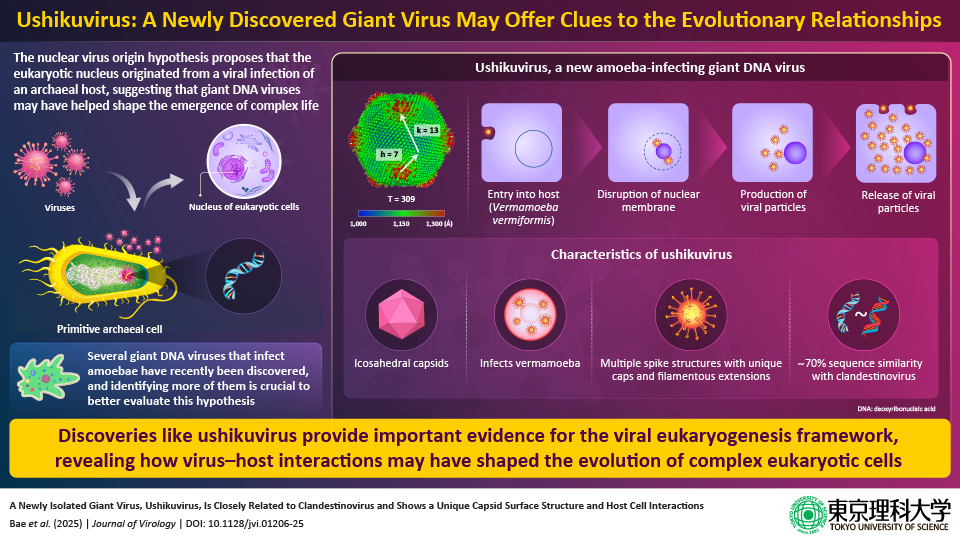
It’s one quarter of an image flipped horizontally and then vertically, you can see the patterns.
It’s a bit odd to do that? Shouldn’t it just be the original EM image?
After a bit of digging - it looks like it's done to sharpen features as one of the standard steps in producing these images. Where there are rotational symmetries in the things they're looking at, they focus on the smallest unit, and then rotate accordingly. If you had a trilateral symmetry, or hexagonal structure, they'd rotate 3 or 6 times around the center.
You're not getting a real image of the thing, but apparently it's got data from those other segments mixed in with the rotations, so you're getting a kind of idealized structure, to make the details being studied pop out, but if you have some sort of significant deviation, damage, or non symmetric feature it'll show up as well.
It's called "imposed symmetry" https://discuss.cryosparc.com/t/what-is-actually-occuring-wh...
Neat stuff, cool thing to catch!
This would more like zooming into one edge of a snowflake and then rotating it.
Perhaps you assumed a "radially" which wasn't part of my analogy? :p
Land animals have a pretty consistent trend of exterior bilateral symmetry which is very noticeable. (Naturally, a completely normal Hunam such as myself cannot speak for how it may work in places other than my home planet Dirt.)
Even faces look weird when flipped that way (there have been studies on this effect too). And that’s before you get into the issue that it’s common to have differently shaped breasts, different sized hands or feet. Ears shaped differently. Non-uniform teeth. And so on and so forth.
A different paper, this figure shows a number of cryo-em images, including a simulation, and they all show the same degree of pattern symmetry https://www.researchgate.net/figure/Central-sections-through...
First figure in this third paper also shows symmetry of small patterns https://journals.asm.org/doi/10.1128/jvi.00990-22
I still think it’s super weird that it looks exactly like an EM image, but is generated. Anyway, good to know!
Publish or perish needs to end.
For example, suppose horizontal gene transfer occurs from organism X to organism Y. Does that mean Y is now a branch of X?
* Does it depend on how much was transferred?
* Does it matter only if the specific sequence was passed down? If so, how much mutation is too much mutation?
* What if the same end-result occurred through a retrovirus instead of a plasmid. Is the virus an ancestor too?
* What if the swap was simultaneous and bidirectional?
* What about transitive links to organisms W, V, U that did the same?
* Are mitochondria "us" yet? If so, are we the ancestors if they redevelop enough machinery to "escape"?
etc.
The LUCA is the common ancestor of bacteria and archaea. That would have existed far earlier, as neither of those are eukaryotes.
IIUC the join with the bacteria is the explanation of the mitochondria (and later chloroplast). But it does not explain the nuclei that is weird too. Is it possible something like this?
  Archaeal + Virus = Pre-Eukaryote (extinct?)
  Pre-Eukaryote + Bacteria = Eukaryote (including animals, fungi and plants)
  Eukaryote + other Bacteria = Plants
You're right ... my mistake.
https://www.ofb.net/~jlm/virus.html
More because it's funny than that it matters.
I believe that Eukaryotes then from Archae.
There are some very important differences between Archaea and Bacteria, in membrane composition and in the nucleic acid replication and protein synthesis mechanisms, but there are several hypotheses about how these differences could have evolved and there is not enough evidence yet to be sure which of them is true, i.e. whether the distinctive membranes, ribosomes and certain enzymes of Archaea have never been like those of Bacteria, or they have evolved from those of Bacteria.
The eukaryotes are hybrids, mainly between some Archaea and some bacteria (the ancestors of mitochondria). It is not completely certain whether the ancestor of the eukaryotes from Archaea belonged to a branch that was sister to all still existing Archaea or only of one branch of Archaea, but here the evidence makes it very likely that the ancestor of the eukaryotes belonged to an interior branch that was nested within the existing Archaea, i.e. it was sister to only one branch of the present Archaea.
In the history of life, there have been many events of hybridization between very distant living beings, so the tree of evolution is only approximately a tree, while actually being a more general directed graph. A part of these events have been the results of symbiosis, the most frequent cases being of symbiosis with some phototrophic organism able to capture solar light or with some bacteria able to consume some unusual substance from the environment.
Other such hybridization events have been with viruses, when the genes for some enzymes have been transferred permanently from viruses to their hosts and they have been retained, presumably for being better than the versions used by the hosts for the same function, previously. Even vertebrates and humans have a small fraction of their genome that originates from viruses.
> Agent Smith: I’d like to share a revelation during my time here. It came to me when I tried to classify your species. I realized that you’re not actually mammals. Every mammal on this planet instinctively develops a natural equilibrium with the surrounding environment but you humans do not. You move to an area and you multiply and multiply until every natural resource is consumed. The only way you can survive is to spread to another area. There is another organism on this planet that follows the same pattern. Do you know what it is? A virus.
ref: "Smith Interrogates Morpheus Transcript" https://scottmanning.com/content/smith-interrogates-morpheus...
---
Edit: Maybe it takes virulence to colonise the galaxy. A sobering thought.
Though it's an interesting quote, I have to disagree. The reindeers on St. Matthew Island continued to multiply and depleted their food resources without any predators, until an extreme snow storms struck. They don't "instinctively" develops a natural equilibrium.
https://www.adn.com/features/article/what-wiped-out-st-matth...
Hunters hunt as much as they can. Wolves regularly kill 10 or 20 sheep while eating one if they get the chance. Foxes do similar stuff with chickens. Nature is brutal and without empathy.
Alternatively, get them a collar with a little bell, and let them try (and always fail) to hunt.
Whenever they do, there is a little tingle tingle, whatever tiny little movement they're trying to do. They end up unable to catch anything basically, I literally never witnessed one of our cats catching anything growing up, nor them bringing any "gifts".
This was an extreme example. Put humans on this type of island and you'll probably end up with them dying out just the same, despite our tendence to radically change the environment to survive. After all that's why the reindeer were there, so humans can survive absent a constant lifeline from civilization.
Humans, and viruses to a degree, are much better at shaping their environment and adapting faster to what's thrown at them to compensate. The instinct is to change whatever possible of the surroundings to survive and thrive.
The only driver that I can really comprehend is the desire for freedom and autonomy in less populated spaces. The problem with this is that the human condition follows us everywhere. We'll recreate the same problems we have here everywhere we go. We can't run away from ourselves.
It doesn't have to be a desirable goal to everyone.
> The only driver that I can really comprehend is the desire for freedom and autonomy in less populated spaces.
You got one of the big ones. But not the only one. Other is survival. Here on Earth we are all one bad infection outbreak away from ending human society as we know it. We have all of our eggs in one basket. Even if we would have a stable foothold on the moon and mars we would still be vulnerable to gamma-ray bursts and crazy despots with nuclear armed missiles.
> We'll recreate the same problems we have here everywhere we go.
We do. There are still benefits to the people who are "taming the frontier". And that is enough for it to happen. We also see that even though human condition follows us different places have a different feel to them. Some places we got some things better while others worse.
> Compared to anywhere else we know about, Earth is an extremely unique utopia.
To a certain extent. We can adapt the environments to us. And we can adapt ourselves to new environments.
When I move to the arctic I leave my parasol at home and buy a coat. When I move to a gas giant I need to rethink more of my biology. Imagine if some of us can become a buoyant sail with manipulating appendages who feels as much home in the red dot of jupiter as a homid feels home on a dewy meadow. If we could I would for sure give it a go for a few hundred years, then come back and write a book about how it was.
The fact that this is not easy is part of the lure of it.
Exploration and seeing what's beyond seems to be innate in some people, not so much in others. Personally, if someone gave me to the opportunity today to "Sit in this rocket and get launched out into infinity and report back what's out there", I'd probably do it, and I'm sure I wouldn't be the only one. Curiosity would be enough for me to go.
We know for a fact that earth is doomed, on top of our own continuous efforts to kill ourselves off. No not recent climate change type of doomed, but the evolution of our sun is continuously pushing the habitable zone outwards. We might be able to deal with that particular annoyance by hiding underground when it becomes an emergency in half a billion years or so, but our utopia won't be as utopic anymore.
Eventually however, the sun will balloon to a red giant at which point we better have a plan in place other than staying on this planet.
If we do find another earth-like planet within travel distance (impossible afaik but let's suspend disbelief for a moment), how do we determine whether it's worth colonising? And how to we measure it?
"The resources on this planet will last 15.6B person-years which means if we send 5 million people there over time, we will have to prepare for their evacuation in ??? years"?
Obviously totally moot if Earth's resources aren't going to last that long, but just had that thought bubble up.
For example, the host star could have variability measured in thousands or millions of years that would render the planet inhospitable to humans but not the indigenous life, which would have been adapted to these cycles.
Similarly, the planet could experience regular asteroid impacts due to passing through a recently broken up rock that intersects its orbital path.
Some of these risks can be eliminated through careful study, but this would require something like a century of painstaking geology, thorough astronomic surveys of its neighbourhood, a full fossil record, etc...