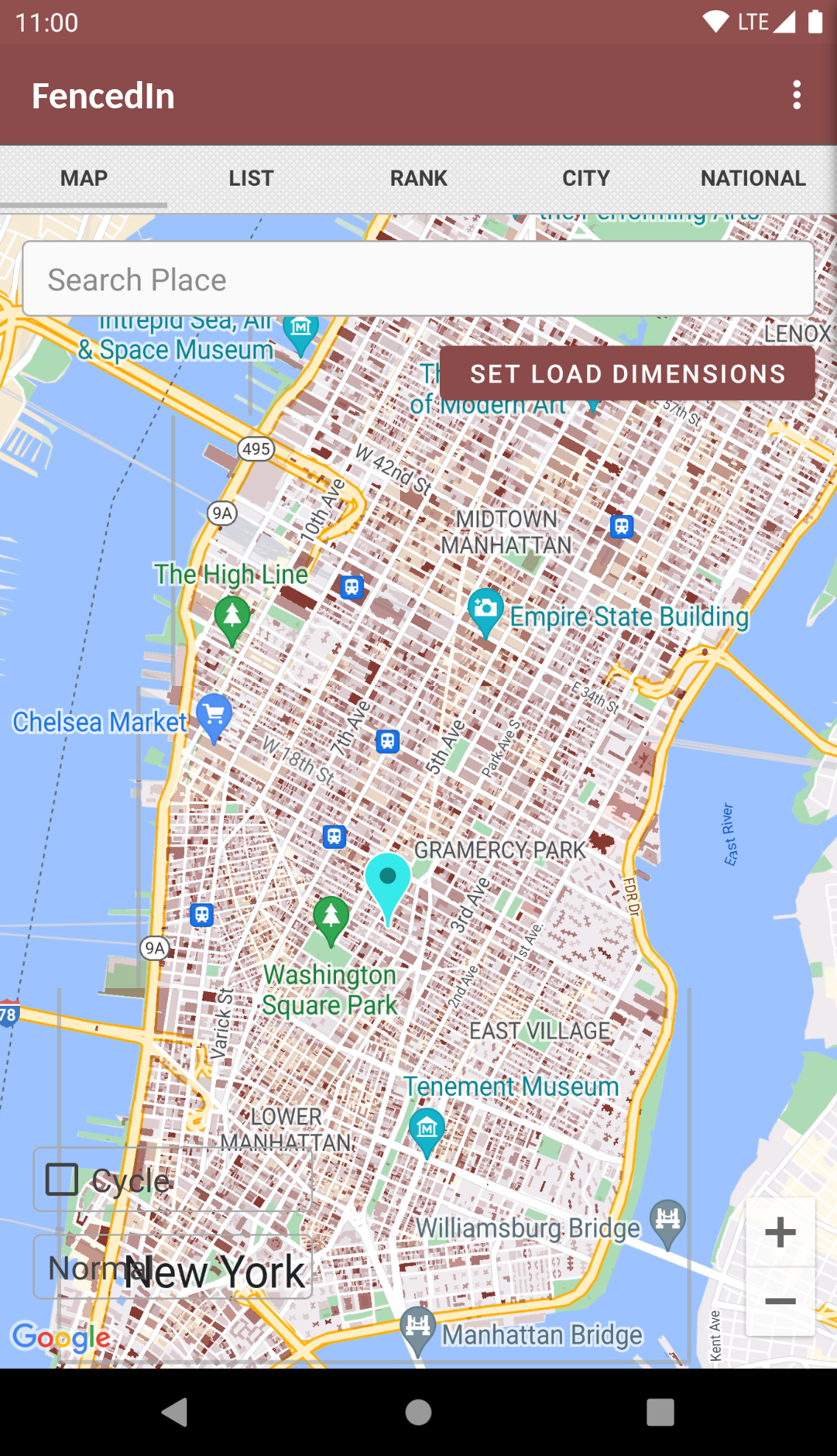
What it does:
- Allows you to load a custom perimeter anywhere on the geographic map (180° E and W longitude and 90° N and S latitude), to cover area any area of interest
- Chat rooms get loaded within the perimeter
- You can chat with people within the perimeter
I developed a mobile app that uses an advanced geofence-based networking system from 2013 to 2019. My goal was to connect users within polygon geofences anywhere in the world. The app is capable of loading millions of polygon geofences anywhere in the world.
https://enterpriseandroidfoundation.com/assets/images/other/...
But people didn't really have a need for this. So after failing, I spent the next 6 years trying new ideas to use FencedIn for. I tried a location-based video app and a place-based app that had multiple features. Nothing worked, but now I'm almost finished developing ChatLocal, an app that allows you to load a perimeter anywhere on the geographic map, which loads chat rooms.
The tech stack is 100% Java (low-level mostly). I have a backend, commons library and an Android app. Java was the natural choice back in 2013. However, I still wouldn't choose anything else today. Java is the best for long-term large-scale projects. (I'm also using WildFly. PostgreSQL and a Linux server.)
This app is still not fully finished, but I think the impact on society might be tremendous.
The previous app to ChatLocal, LocalVideo, is fully up on the Google Play store and can be tested. It has 88% of the features of ChatLocal, including especially the perimeter-based loading system.
The feedback I'm mostly looking for is new ideas and concepts to add to this location-based social media app. And how strong of a value proposition does the app have for society.
Obviously social apps like this are faced with a chicken-and-egg dilemma of how to acquire users. I'm no marketer, so I don't have any suggestions on how to solve this one.
For myself, I avoid non-free/open-source programs in general, but especially chat apps. I think that especially the programs we rely on to communicate should at least be transparent on the client-side. That being said, I would absolutely try this out if the app were released as FOSS (which it doesn't look like it is?).
Then once people exploit the app, that doesn't mean they wont add value (e.g. contribute positive content). Maybe they are just a high school kid that wants to talk to his friends in his last town?
Once you have users, then there will be other easy signals to detect: Is the person teleporting? Do they hit rate limits freq? Is their GPS location the exact 'center' of the city? Is there GPS a nice pretty number? Does their GPS location never move?
But location is already baked into many social media apps anyway, though. https://gemini.google.com/share/68d4fd324d94 ...that'd be the real issue here, perhaps.
Locally produced food is the important one, going forward. It can be much cheaper living away from a city, yet people still want their services. They want to know where the best place to live is.. even to the nearest mile for walking reasons. They want to know where a doctor is, if the nearest hospital is over an hour's drive away. Also language.. how can digital nomads move about and find same-language speakers.
What's wrong with Google maps for this type of stuff? Is there a competitor with downloadable data? What if a war breaks out in your region or the internet goes out or is inaccessible. Need offline data. What happens if service providers don't trust users enough to want to share their data?
A good idea would be for people to take photos of their local community board and share that, so long as the next Pol Pot doesn't see it as well.
Another interesting use-case will be listings of locally tokenized assets. If I need access to a vacuum cleaner or power tools, who would have those nearby? Who has farm land for my heirloom seeds? Where can I buy dairy from pure, healthy livestock? Tokenized assets I expect to eventually grow in size as inequality becomes more K-shaped. People will start selling off these things to the ones with the gold or at least be more willing to rent their stuff out. People are being increasingly homogenized physically, mentally and financially. Location is one of the last areas of differentiation ... and targeting.
In an experimental identity system I prototyped as a civic tech project[1], I paired this with scraping a government "voter registration check" form and comparing against, and it was a two-fold guarantee: someone had to either submit false info to the voter registry or intercept mail. In theory it was very cheap to get very high assurances, for only the cost of a postcard API per user
[1]: https://github.com/patcon/id.c4nada.ca?tab=readme-ov-file#ab...
Many people will refuse, on principle, to provide this information to any company, unless perhaps it's for home delivery of some good.
Also, I hope you're not using Play Integrity (lol), because that means all the old phones you allow can be rooted, hide it from you and/or spoof positive chdck result........ because they're insecure like sieves..... Whilst you'd be banning modern and unrooted phones.
Is that possible on iPhone, or only on Android?
Play Integrity passes for devices unpatched for several years, which makes it a joke.
If it gets very popular, those who don't want to be tied to Google will be excluded from something important.
And the maker of this app thinks it could have a tremendous impact, so...
This seems super counter productive in my opinion. It creates way more friction that I want.
Maybe I want to save a location I have been to as a chatroom, sure but my primary interest would be to have my location determine the chat. So if I enter a university building: boom university chat. I enter Cern: boom Cern chat.
The hard part would be to not just use rectangles but actually make the shapes meaningful. I don't want to walk past a high school or live next to one and then be included in that chat. So yeah. Tricky
It faced a fair few controversies & got taken offline and not sure what became of it...
Always wanted something with that... casual fence... to think of a better word again
It lost quite some activity in the last decade though, gaining fewer users than it loses.
Similarly, in the US YikYak was also popular at colleges but killed itself by forcing user accounts instead of full anonymity.
But the framework itself is still more complex, allowing for very stable long-term Android applications. It includes dynamic configurations parsed from the database on the backend and then used on the backend and Android app via the commons library. Dynamic user messages. A full commons REST framework with REST processing that's in the commons library.
Overall it's a large system. And in fact, I'm getting close to publishing it so that users can build their own 100% Java full-stack Android applications: enterpriseandroidfoundation.com
- LinkedIn story: https://dl.dropboxusercontent.com/scl/fi/trobts37gp4gr1qk9ch...
- LocalVideo: https://play.google.com/store/apps/details?id=com.localvideo...
Why add new features instead of trying to gain traction?
WTF is wrong with these social apps!?!? Who wants to chat on a tiny screen when they have a computer available. Especially for local apps that function only when you're home.
I agree with you personally... But at this point it is clear the answer is "everyone". The average consumer is not using a desktop for personal computing daily, just work.
[0]: https://developer.mozilla.org/en-US/docs/Web/API/Media_Captu...
Instagram had photo filters; Strava had activity stats. What could this have?
Like what is the highest rated/longest Wikipedia article in the area.
Or maybe what's the 3 top radio stations and a link to them.
There is plenty of local content that Google does not surface