I don't get the argument. There are parts of Windows I don't like, so I have chosen a 3rd-party (often open-source) replacement. The exact same process as I do on Linux. I don't see why I have to switch to Linux to have that freedom.
(and to be honest, I don't care where the taskbar is)
Honestly, what I would like them to do is make/support a modern Copy on Write filesystem so that System Restore actually works, and so that it’s easy to roll back when Windows Update borks your PC.
You don’t need Linux for either of these things. You need software engineers to build a modern filesystem or make Windows natively support ZFS or something.
A large part of my complaints about Windows Update have come because it can brick your machine, System Restore doesn’t work, and so you’re stuck spending a weekend trying to back up and fix stuff.
When I ran Ubuntu with ZFS on root, I had it so that I every time apt was run, it took a snapshot. This came in handy when my WiFi driver got borked during an update; I was able to restore from a previous point, it took like ten minutes.
And on a client machine, it's of much less importance overall (to you, it may be super important and I don't want to discount that). And on the server side, that's why we have n+2 failovers. No single machine of importance should ever be a point of failure... I realize that's not always reality but it's more or less Microsoft's position; after all, why sell one Windows Server license when you can sell 3!
There are few pieces of software that are more universally disliked than Windows Update, and while I cannot speak for everyone the main reason I hate it so much is because it's often automatic and I've had it make my computer unbootable multiple times (and it's actually a big reason I ditched Windows completely like sixteen years ago).
If there were full filesystem snapshots and a utility to fully restore from those snapshots, I think a lot of people would be more willing to do the updates. It wouldn't be hard for users that have any tech skills at all; do what NixOS does [1] and on boot allow the user to choose an earlier snapshot to boot from if anything gets toasted.
Windows does have System Restore, but as far as I can tell that never has fixed anyone's problems at any point in time, along with the "Automatic Repair Tools" which has become a running joke in my family.
It just bothers me, because the FOSS community has solved this, a long time ago no less. Back in 2012, I used btrfs + Snapper whenever I would install a "risky" driver like a GPU or Wi-Fi chip, or whenever I did an update. When I did break my video display, restoring from the snapshot took like ten minutes, I'm able to get back into my system and fix the issue, without having to do any major surgery to the internals of Linux. I've never tried it with FreeBSD and ZFS but I suspect it's a similar process.
Microsoft is a trillion dollar corporation, they have a higher market cap than the entire GDP of NYC and Singapore combined. Why exactly can't they just augment ReFS and copy Snapper or Time Machine (with APFS)? They have infinite funds, they have access to Dave Cutler and until about a year ago Leslie Lamport, they already have a CoW filesystem and they could easily afford a license to any version of ZFS if ReFS wasn't up to the task.
[1] I know NixOS isn't doing filesystem interface, but the overall principle is the same in this instance.
Using it for the OS partition is not very well supported right now though (for a consumer), installing etc. works fine, but DISM doesn't support ReFS so adding features generally doesn't work
Besides, ReFS doesn't do data journaling by default.
EDIT: Just to be clear, if you don't understand when you'd use this command, do not use it. I suddenly realised people might not be familiar with formatting, and don't want to be responsible for the destruction.
That’s my belief, and I’m always looking for clues that it’s what develops into their long-term plan. Right now the only thing we could glean is reduced investments in Windows.
What "reduced investments"? They just put out 25H2 with numerous changes and many monthly updates bring new features online.
Just an example. Microsoft developed several browser engines: first Trident, then EdgeHTML. Edge wasn't bad, it was on par with Chrome, may be slightly behind, but nothing that couldn't be fixed with time. But Microsoft decided to abandon it and use Blink, because that was cheaper.
I absolutely could see the same scenario in the future, when they would need to cut expenses. Just get Linux, wine, fix enough bugs to make explorer.exe and OneDrive.exe to run smoothly enough and ship it.
True, but you don't generally need backward compatibility with HTML rendering engines. You definitely do with OS kernels.
That’s not to say you’re wrong.
One would like to believe that as far gone as they are on Windows, they’re not that far gone. But hey, anything could happen.
But that said, I didn't say either were "good", I said that NT is "arguably better".
ETA: I reread my comment; you're right, I actually said that NT "isn't bad at all". I stand by what I said mostly though; that doesn't imply it's "good" necessarily, just that it's arguably better than Linux.
I also don't get why people claim NT is "better." Linux is a modern kernel under very active development.
There are a few interviews of Dave Cutler (NT's architect) around where he explains this far better than I am here.
Overall, you have classic needs and if you don't care about OSS (either for auditability, for customizability or for philosophical choice about open source), it's a workable option with its strength and weaknesses, just like the Linux kernel.
Also Linux being OSS can't be dismissed because it means it'll have features that Microsoft isn't interested in for Windows.
Because it does do some things "better". All I/O is async. No stupid OOM. Personality support. Stable ABI.
> Linux is a modern kernel under very active development.
As is NT, on both accounts.
Much of the discussion surrounding NT's supposed superiority is outdated or superficial at best. Linux, on the other hand, offers several advantages that actually matters. It supports a wider variety of filesystems natively, with FUSE providing exceptional utility. Linux also accommodates more architectures and allows for more creative applications through features like User Mode Linux and the Linux Kernel Library. It also has a more robust debugging ecosystem thanks to its large community and open source nature. All of these things are possible because Linux isn't bound by a single company's commercial interests.
Also, is Microsoft putting as much effort into NT these days? I find it hard to believe they care about NT when they stopped caring about what runs on top of it, leading to articles like this one.
Not nearly to the depth and breth of NT. NT is async I/O throughout. Linux has a bunch of libs that ride on top of pretend async I/O with io_uring as a more recent bonus.
> It's debatable whether NT's lack of memory overcommitting is a superior choice.
NT won't randomly kill a process. That's the winning play.
> OS personalities have never been relevant outside of marketing
Until you've used them for non-marketing purposes, then they're invaluable. Personalities existed when virtualization didn't exist on x86.
> Moreover, the Linux kernel maintains a stable ABI.
The only stable ABI on Linux is Win32.
> It supports a wider variety of filesystems natively,
Most distros suggest ext4 out of the box. Sysadmins are going to deploy ZFS where it counts. Some might use XFS. Having access to a ton of file systems is great, but the usage outside of ext4 is going to be comparatively low. ext4 is the only FS I'd want to see as first-party on Windows as a data drive. But that would have been more important before persuasive networking.
> with FUSE providing exceptional utility
FUSE is also on Win32 via https://winfsp.dev/rel/.
> It also has a more robust debugging ecosystem thanks to its large community and open source nature.
This ignores the debugging tools on Win32 by a country mile.
> is Microsoft putting as much effort into NT these days
Yes. Even if you do the bare minimum investigative effort and follow the "what's new" for each version of Windows, you can see the kernel-level investment. Much of this is around security and isolation of kernel components. There is also Microsoft in talks (finally, again) with EDR vendors to isolate their solutions; hopefully game devs are next.
> leading to articles like this one.
This isn't an article. It's an uninformed blog post.
Is this a purity thing or does it have practical implications?
> NT won't randomly kill a process. That's the winning play.
Every OS will have to when it runs out of resources. No overcommitting means it's less resource-efficient too, so things aren't that simple.
> Until you've used them for non-marketing purposes, then they're invaluable. Personalities existed when virtualization didn't exist on x86.
When have OS personalities ever been a commercial success? Every product that built on it went nowhere.
> The only stable ABI on Linux is Win32.
Containers and Flatpaks prove otherwise. Static binaries exist, too.
Also, if you're extending this Linux / Windows comparison to include the userland, then Windows is no match for Linux. Not when Microsoft is actively sabotaging Windows.
> Having access to a ton of file systems is great, but the usage outside of ext4 is going to be comparatively low.
What on earth? There's more use to filesystems than mounting it at root. Are you really claiming that OS personalities are useful, but being able to mount any filesystem is not? That's absurd.
> FUSE is also on Win32 via https://winfsp.dev/rel/
Which doesn't mean much without an ecosystem of programs using WinFsp that's comparable to Linux. Moreover, the long-term development of WinFsp isn't guaranteed, and there remains the risk that Microsoft could introduce changes that might impede the functionality of third-party filesystems.
> It's an uninformed blog post.
Uninformed? While an official Windows-themed Linux distro doesn't make sense, the observation that Windows is declining and Microsoft no longer cares at all what users think is very much correct and obvious to anyone. The fact that Microsoft hasn't ceased development doesn't negate this fact.
> Every OS will have to when it runs out of resources. No overcommitting means it's less resource-efficient too, so things aren't that simple.
NT does memory overcommit...
> When have OS personalities ever been a commercial success? Every product that built on it went nowhere.
Xceed made money off of it. Yes, every product has a shelf life. Just like every commercial Unix. They were successful at what they did until a replacement came along.
> Also, if you're extending this Linux / Windows comparison to include the userland, then Windows is no match for Linux. Not when Microsoft is actively sabotaging Windows.
You're not saying anything, here. "No match" how, exactly?
> There's more use to filesystems than mounting it at root. Are you really claiming that OS personalities are useful, but being able to mount any filesystem is not? That's absurd.
Absurd, how? Is mounting HFS /really/ that critical to your day-to-day?
> Which doesn't mean much without an ecosystem of programs using WinFsp that's comparable to Linux.
Movin' those goal posts!
> Uninformed? While an official Windows-themed Linux distro doesn't make sense,
You uh... did read the post, right? That's what the entire thing was about!
Or are you claiming that io_uring integrates async IO throughout the OS whereas epoll didn't?
Containers are hardly modern, they trace back to offerings on 1990's, like HP-UX Vaults.
Obviously not built into Windows but readily available since 2004.
The kernel version has to do with process isolation not being fully there when Windows containers were initially supported, so they had the limitation the container kernel dependency had to match the host version.
Since Windows 11 this has been relaxed.
The namespacing approach is based on Jobs API.
Modern Windows security relies on several sandboxed components, Hyper-V is always running anyway, also one of the reasons of the updated harware requirements, while this configuration is optional on Windows 10, it is always enabled on Windows 11.
https://learn.microsoft.com/en-us/windows-hardware/design/de...
https://learn.microsoft.com/en-us/windows-hardware/drivers/b...
https://learn.microsoft.com/en-us/windows/security/hardware-...
I've been on macOS for eons, but I still hope that some day, someone at microsoft will have the balls to make a Windows Redux. Which is just Windows 7 with a coat of paint; and less stuff, installable separately; geared towards speed and not stuffings.
Win32, stable driver APIs (I can still run Win11 on my old Nvidia GPU laptop which Linux doesn't support), COM, good remote desktop infrastructure, DirectX 12, WPF, ClearType or certain Win32 aspects like IO completiton ports (allows true async like uring does but in Windows since NT times) are all has some good engineering and widespread adoption. Many other OSes still copy what Windows offered in early 00s.
They are fucking their last mile a big time. They fuck explorer, they fuck desktop experience. All in the name of stupid fads. Silicon Valley hustler Microsoft is worse than shirts with Ballmer's fluids Microsoft.
At least on what concerns Windows development, everything was much better with him, even if the command.com wasn't great, there were alternatives already.
GUI frameworks have become a mess, .NET, C++ and Visual Studio are now AI tainted as well.
That being said, Azure is already running a lot of Linux. So for backend, it’s somewhere between Linux and Windows depending on what you need to do
But Azure also heavily runs Hyper V.
This article lists a few random grievances (which I sympathize with), says linux is good now for games, and then presents the bombastic conclusion that Microsoft will deprecate Windows, without making any connection between the two.
It follows that, at some threshold number of users, it becomes much cheaper to ship a Linux distro than to continue to support Windows proper.
:shrug:
Guess we'll see in 15 years.
Game studios don't care about Linux on the client side.
Try filling your icloud photos to fill up your space, then try to figure out how to download them all and clean your space efficiently, or don't care it's 100% full, remove any icloud ads.
Just like with CP/M, MS-DOS, UNIX, and any other OEM driven platform, everyone wants to make differentiation part of their story.
Welcome to Asus Linux, Dell Linux, Microsoft Linux, HP Linux,....
Most businesses don't want to be in the business of maintaining their own identity infrastructure. They want a utility. Between Group Policy’s granular control over the endpoint and the tight integration with Exchange/M365, Microsoft has created a "sticky" ecosystem. I've tried the "DIY" route with Linux mail servers, and the friction of maintaining deliverability and security patches manually is a nightmare compared to the "it just works" nature of the Microsoft ecosystem.
I am not a system admin, so maybe this is a crappy take.
Remember that every K-12 student for the last decade is getting it done on the cheapest low bid Chromebook possible. They are true pieces of shit, too-down managed by barely qualified people and yet the kids persevere.
That’s the baseline. Windows is an evolution of 1999, slowly shifting to the shitty cloud based model. It is the worst of both worlds. It’s like Peoplesoft in computer form. Even my IT crew at work is all Mac now.
Apple is an unreliable partner and a sole source. I think Linux is the pragmatic choice going forward.
> They are true pieces of shit, too-down managed by barely qualified people…
I feel like this is even underselling how bad it often ends up being.
I am quite certain there are zero of those devices on my German school neighborhood, or the school on my home district back in Portugal.
And Sweden, and Austria, and there are probably others.
Actually I would love to see a report per worldwide schools, to settle this argument about high adoption of Chromebooks outside USA.
It's really a one-sided argument, I don't need to participate. You assert that this is an America-only phenomenon. Austria and Sweden are just easy examples that falsify your assertion. There is no debate about adoption rates or anything else.
Just because I find some random Chromebooks at FNAC doesn't mean all schools are racing to adopt them.
Thus numbers will be welcomed.
Maybe something like systemd could do something similar which defined policy over all the components they've taken over, but a distro doing it would be pointless, we're not a Linux shop and have at least three different Linux distros in service.
Ansible, FreeIPA, and more can be used individually or together to achieve what AD provides. There are large enterprises that are non-windows...
I'm aware there are large enterprises that are non-Windows. All of them are technology companies. They are well equipped to pay their own developers to compensate for not having Group Policy, and may even be Microsoft competitors who don't want to spend money on them. Ansible being a replacement for Group Policy is very funny. That is like saying Postgres is a replacement for Excel.
https://linuxdevices.org/linux-based-pos-rolls-into-home-dep... (2001!)
https://www.datacenterknowledge.com/data-center-site-selecti...
I know at least one university that doesn't put Windows on its machines either. While Uni requirements are not the same as "enterprise" requirements, it does feel close-ish.
Having said all this, I am very primed to believe that they have a Group Policy-sized hole in their systems. Just thinking they are doing ... something.
Ansible has a defined purpose and it is good at what it does
Except 100 and 1 method of configuring of anything. But not a binary tree because three zealots depend on greping a config into perl2 scripts for some automation.
See for example:
https://docs.redhat.com/en/documentation/red_hat_enterprise_...
https://documentation.ubuntu.com/adsys/latest/how-to/use-gpo...
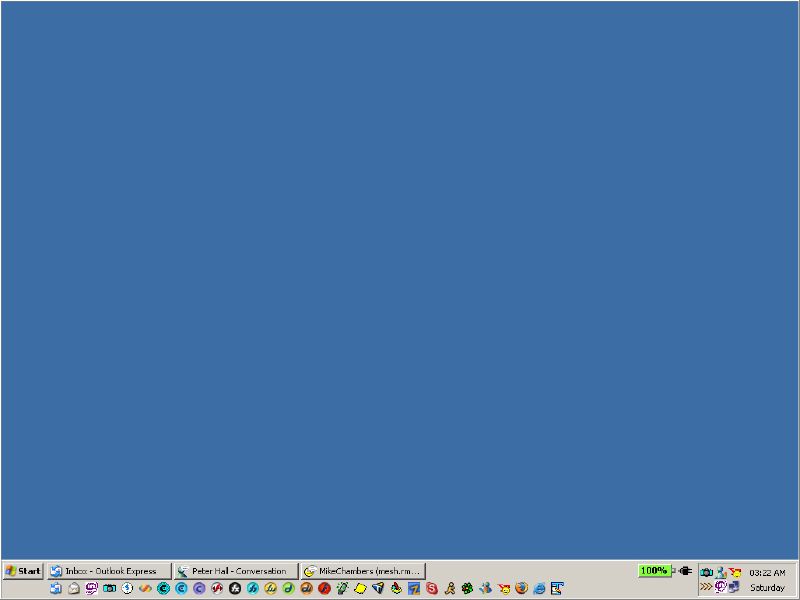
For example, this is my taskbar layout: https://i.ibb.co/1GqKH27L/taskbar-layout.png
To my knowledge, it's not possible to achieve anything like this layout on Windows 11, Linux or Mac. I did try it in various Linux distros a few times but frankly got sick of navigating the maze of window managers et cetera. I think something like XFCE came close to providing a Windows-like taskbar but it was still far, far behind what Windows NT can offer.
[0] https://i.imgur.com/esNjPNg.png
[1] I didn't try to replicate it perfectly; things like smaller icons/etc are settings but cba
Edit: I was able to find a proxy which works and I can see the image.
Your layout is kind of similar but not really - the Windows taskbar can be configured to work in both rows and columns, or a combination of the two.
So you can have a layout like my original screenshot above, or:
* in columns like this: https://i.ibb.co/Y4jJN6jh/image.png
* a mixture of columns and rows like this: https://i.ibb.co/5WsVmLgb/image.png
* at the top or either side of the screen like this: https://i.ibb.co/9mGmjnxs/image.png
* and in any position it can be resized: https://i.ibb.co/HLmh89qF/image.png
Shame they ditched all this in Windows 11 though.
However, if status bars are what you obsess about, Linux would love to have you! Many status bars are available[0], most of them open source and wildly customizable. You can configure one of the existing ones, fork an existing one, or write your own.
[0]: see eg https://wiki.hypr.land/Useful-Utilities/Status-Bars/
The parent comment shows two rows of different types - the upper row consists of the taskbar, and the lower row has the quick launch icons, drive links, and a music bar.
Quite an interesting layout, imho.
The media taskbar player can be added natively from older versions of iTunes, Windows Media Player, or others.
But then, I really doubt the GP is using out of the box Windows.
And probably good layouts too.
I have no idea why anyone would do that, but it was really fun to make my desktop look like it was arranged by someone who hadn’t developed motor skills yet.
https://github.com/home-sweet-gnome/dash-to-panel
It's a very configurable extension for gnome that can do all you described except double stacking...
I've uploaded a video demo and a config file that makes it kinda like what you want, again no double stacking:
https://github.com/amlib/dash-to-panel-config/tree/main
You can also configure it to keep open window buttons separate from the launcher icons, but with the lack of double stacking I rather have it "take over" the launcher.
The way I've set it up it will also only show the open windows for the virtual desktop or screen the bar being shown at, which helps alleviate the crowding issue of only having one row.
On my next attempt at a Linux desktop I'll most certainly try it.
I'll also create a feature request for resizing/stacking of rows.
> I'll also create a feature request for resizing/stacking of rows.
Keep in mind that in the foss world you're not a customer - the people doing the work will be donating their free time to build a feature you're asking for, so please be nice and polite to them - the worst thing you can do on a feature request is have an entitled tone, or insinuate that their software is crap because it doesn't quite do what you want :)
Someone else suggested that adding 2 xfce panels might accomplish something pretty close to what you're after. I had a bit of a play around and agree with that. I didn't replicate your request exactly (because my panel is very different and I didn't want to break my setup too much) but depending on where your priorities lie I think you could probably get something pretty close.
Options that are similar:
a) If you really want the 'start menu' button to span both rows, use a single panel and set "row size" to e.g 48px and "number of rows" to 2. The con of this method is that the task list (list of programs) will span both rows, which is not what you have.
b) If you want to replicate your preferred setup more closely, you might not be able to have the 'start menu' button span both rows. To accomplish this I would add 2 panels of e.g 24px and put them both at the bottom of the screen. In one you'll have the task list and in another you'll have icons.
The media player controls might be an issue in xfce. I'm not sure if anything like that exists. However you definitely can have a systray icon for your media player which pops up media controls when you click on it.
There are other docks with more customisable widgets that will give you media controls like those, but I can't really make a solid recommendation for you unfortunately. The one I used to use was called cairo-dock, but I think that might be dead. Before that I used one called avant-window-navigator. There's also a couple of others that I'm aware of, e.g tint2 and wbar.
I'd be a little bit surprised if there are zero docks out there that can do what you want. The thing is you might have to try screwing around with the config for 20 different ones if you insist on replicating that layout exactly :/
HTH!
Nowadays, I just have as few as visible, and everything is either Keyboard Shortcuts or some form of `CMD + K` or `CMD + Spacebar`, and start typing.
I've always held that switching to Linux is hardest for the most technical people, because you know how to do everything already - figuring out how to do X in Linux might take you literally hours, or you can just reboot into windows, where you know how to do it and it will take 5 minutes. It's hard to make that investment in learning the new stuff when you just want to get stuff done.
(But IMHO it's well worth it - For >15 years I've always been appalled every time I've used windows about how inflexible and unconfigurable it is. There's a thousand things that I've been doing forever that I'm just so used to, e.g the ability to make any window always on top, or to use my mouse wheel to roll them up so that only the titlebar shows. There's lots of things like that that I use every day without thinking about it, and the lack of those things makes windows extremely frustrating for me)
I also predict that Mint still won't ship with a font manager.
That the workspaces tasklet still won't support dragging and dropping tasks into it to move them between workspaces.
That there still won't be a multi-step wizard for creating launchers on the desktop.
That there still won't be a proper shortcut format on Linux and people will be forced to still use symlinks, which are a terrible experience for folder shortcuts. And that file managers still won't support creating hard links.
That some applications still will have 1 pixel of padding at the top that prevents me from clicking the close button by moving my mouse to the top-right corner.
That Nemo still won't tell you that you need to make an appimage executable to run it.
That DE's still won't tell you that you need to install and configure flatseal to make some flatpaks actually work.
That you'll still be able to change your account password without changing the keyring password and then forgetting your old password and losing your keyring.
And that the Linux community will still be telling themselves that the real reason nobody uses Linux is because some lootbox game needs a kernel level anti-cheat, or because the latest gamer keyboard with rainbow-colored LEDs doesn't have a Linux driver, or that the average person just absolutely needs features that only photoshop/microsoft office have.
If there is one thing about Windows that is really good, it is its kernel and driver architecture, and absolute plethora of user-mode libraries that come with the OS, that can be programmed against with a variety of languages from ancient to brand-new, all maintained by the vendor. Doing the same thing on a given distro of Linux is a headache at best, and impossible at worst (which is partly why game developers don't target native Linux).
The problems with Windows have always been in the user-mode (with the notable exception of Vista, and I still maintain that Vista was OK; its problems were due to Intel strong-arming MS into certifying a broken version of Vista for its sub-par integrated GPUs of the time). Windows 11 control panel sort-of gone? There's still the god-mode menu introduced in Vista. Right-click menu gone, or too much Copilot? Go to Group Policy editor, switch off what you don't need; revert what you can. People complain you 'cannot create local user accounts any more'. Also not true, that feature is a fundamental part of Windows and probably won't ever be removed. There are workarounds. Any Windows user or sysadmin worth their salt will have a GPE fleet-wide policy, and registry settings.
Everything one sees on Windows can be stripped out and reverted to Windows 2000 mode. That grey boxy UI is literally still there. Compile a program for 32-bit, set the compatibility mode to Windows 2000, and bam, there you go. If you add in the manifests for UTF-8 and high pixel density, the UI is scaled pixel-perfect by the system.
Speaking of high pixel density, Windows is the only OS that does scaling properly. macOS just pretends non-'retina' displays don't exist, Linux distros are a minefield of Xorg, Wayland, a million different conf.d files, command-line arguments, and env variables.
Why would anyone want to replace their core product with something that a) they cannot control, and b) does not satisfy their business and customer needs?
Not true. I use a high-DPI (~250) MacBook with a non-high-DPI (~100) external monitor [0] and the transition between the two is seamless. Windows are identically sized when dragging from one screen to another. The same holds true when I use the laptop with a mid-DPI (~150) monitor.
I could not say the same was true a few years ago when I tried a high-DPI Windows 10 laptop with a non-high-DPI external monitor; it looked something like this [1]. Perhaps this has since been fixed.
macOS is able to achieve consistent sizing across displays irrespective of pixel density because it uses a compositor to render the whole screen at a high resolution and, if necessary, downsamples it proportionally for each screen. (Wayland on Linux can do the same, though it's certainly a much bigger headache to get consistently working than macOS.) When I tried using Windows 10 at two DPIs simultaneously, it just let me scale the font size and other UI elements on a per-screen basis, but not the screen as a whole, since I assume it does not use a compositor.
[0] Not my setup, but here is someone doing just that with a 30" 2560x1600 (~100 PPI) display and a ~250 PPI MacBook: https://www.reddit.com/r/macsetups/comments/tfbpid/my_macboo...
[1] Again, not my setup, but the Windows UI is rendered at different sizes on displays of different resolutions: https://www.reddit.com/r/computers/comments/16y1dux/how_do_i...
Moving windows between monitors of different pixel densities is a rather difficult problem. Windows handles pixel density per-application, not globally, and it uses something called device-independent pixels (DIPs) for scaling. macOS and every desktop environment I've tried on Linux does scaling globally, or at least globally per-display.
On Windows, when a window is moved across two displays with different scaling factors, a simple algorithm is used. It will choose the display that the greater fraction of the window is in to select the DIP, render, compose and rasterise, and hence and one part of the window may appear too small or too large on the other display.
On the other hand, macOS, GNOME, and KDE take the easy (but IMO very lazy) way out by rasterising the entire application window to the pixel density of whichever display that the greater fraction of the window is in, copying that framebuffer to the viewport of the other displays, scaling with some filtering algorithm, and then composing, leading to blurring on at least one display. I am happy to bet that you're just not noticing the early rasterisation and filtered scaling going on. Having used all 3 OSs across a variety of monitors, I am extremely particular about blurry text; enough that I will stop using a certain setup if it doesn't satisfy me (it's why I stopped using Linux on my personal system).
I'll concede neither is good enough. The real solution here is:
  1. Render the application to as many viewports as there are displays that the application window is in, with the appropriate DIP for each display's scale factor
  2. Compose the application viewports into each display's viewport depending on the apparent window position
  3. The above will automatically clip away the fraction of the window that is outside each display
  4. Rasterise the composed viewport for each display
My bigger issue is other desktop environments not supporting subpixel anti-aliasing, not supporting 'fractional' scaling (macOS is by far the biggest offender), and edge artifacts that result from bad clipping. I have a few photos I took of KDE, where random pixels are lit up at the bottom of my secondary display, with my laptop below it.
And DIPs have their own problems that I first encountered with WPF - rendering an application on a DPI that's not a neat multiple of what it was designed for means that lines and features don't necessarily line up with the pixel grid.
Depending how the app chose to handle this, it either causes blurriness or uneven and changing line widths as you move the window.
macOS renders content on my 100 PPI monitor at exactly 100 DPI; 1:1, no scaling, so everything looks crisp at the pixel level. The scaling only happens on high-DPI displays (I think the cutoff is around 150-200), and for me at least, ~250 PPI is more than dense enough to not see any individual pixels and thus no aliasing artifacts. Since you like pixel-perfect rendering even at very high resolutions, perhaps you have superhuman vision. My eyes are decidedly average. :-)
>I hardly ever use windows spanning multiple displays
Me neither. My issue is that the windows are rendered at different sizes even when they're not spanning both displays: if I dragged the window in the example photo upwards to sit entirely on the top display, it would stay huge, whereas if I dragged it downwards to sit entirely on the bottom display, it would stay small.
I'm just annoyingly particular about this. It's why I accept a framerate hit in video games and don't use upscalers like DLSS, and why I intend to swap my 3840 × 2160 600 × 340 mm monitor for a 5120 × 2880 one of the same physical size. Some really nice ones were demonstrated at CES a fortnight ago.
> if I dragged the window in the example photo upwards to sit entirely on the top display, it would stay huge, whereas if I dragged it downwards to sit entirely on the bottom display, it would stay small.
This is not the behaviour I see. The window upon occupying the larger percentage of a display, 'snaps' to the DIP of that display.
Windows renders the window once at a single DIP resolution. The other side of the window appears either too big or too small.
MacOS renders the window once at a single DIP resolution. Then, the other half of the window is upscaled or downscaled for the other screen. It’s going out of its way to make it consistent; Windows doesn’t bother.
Your worries about blurry text go away when you use nearest neighbor upscaling (this is configurable in the MacOS zoom settings). Nice crisp text, at the right size.
macOS does not do nearest-neighbour when doing pixel density scaling. It especially does not do nearest-neighbour when the 'looks like' resolution of any display is not a nice divisor of the physical resolution. As the grandparent commenter said, macOS renders to a fixed framebuffer. The size of this framebuffer depends on the pixel density of the physical display; at Apple-blessed densities of ≥ 79 px/cm, this framebuffer is four times the 'looks like' resolution (twice in each dimension); below this, it is the same resolution.
After this rendering macOS applies filtered scaling to fit the framebuffer to the physical resolution. If upscaled, this leads to blurry text and UI; when downscaled, this causes ringing artifacts[1].
[1]: https://www.reddit.com/r/mac/comments/12j14ud/macos_vs_windo...
I concede that Windows' implementation is simpler, but I will argue that practically it doesn't matter because basically no one I know uses an application window across multiple displays.
My very strong opinion: text/vector UI should never be raster-scaled to fit varying pixel densities.
For me, the most important consideration is to complete avoid downsampling -- because it makes everything blurry.
On both macOS and Linux, the way I do that is to choose to scale the UI by an integral factor (usually 200% in my case) and then (since 200% makes things a little bigger than I prefer) fine tune the apps in which I spend most of my time (namely, Emacs and my browser).
Specifically, on Linux, Emacs relies on GTK to draw its window, which IIUC cannot do fractional scaling, so if I were to set a fractional scaling factor in Gnome Settings, then Emacs would be blurry whereas there is no blurriness when I set an integral scaling factor in Gnome and use something like (set-face-attribute 'default nil :height 90) to adjust the size of text in Emacs.
The default experience of using windows is downright user-hostile and it reveals the thinking of the corporation behind it. Yeah, you _can_ do all that to make it somewhat usable, but when alternatives exist that are much less of a pain, I'll be taking those.
I don't care about configuration. I've had to do plenty of configuration on Linux as well; it's just different (text files instead of GPO/registry). I'm not sure I can list all the Arch Linux wiki articles I've read trying to get one driver or another feature working.
I am not here to convince anyone to stop using one platform or another. They're different tools that solve different problems, and I run all of them. I have a Linux laptop for work, a Windows laptop/desktop for personal use, a Proxmox hypervisor on my homelab running a variety of LXC containers, Linux and Windows Server guests.
Not from the perspective of Microsoft. It sells OneDrive and Office 365. It makes money from ads.
>so let's run the same user mode with a different kernel?
The kernel is a piece of legacy cruft that isn't necessary for selling OneDrive and Office 365. It's only a cost. Throw that out and replace with an off the shelf Linux kernel. With some minor tweaks, it can sell OneDrive too. Then you can fire a lot of kernel developers. The line goes up.
The kernel is running OneDrive and Office 365. It's making money hand-over-fist.
Yes, I have to disable a lot of stuff to get Windows the way I like it. But that's still exponentially easier than having to add, install, or perhaps even buy a lot of stuff to maybe get Linux/Mac to behave kind of how I want it to.
My experience with paid independent Mac desktop apps (e.g. Little Snitch, Al Dente, Daisy Disk, Crossover, anything from Rogue Amoeba etc.) is that they try a lot harder to integrate well with the system than equivalent freeware apps on Windows. MacOS is definitely "missing" some features out of the box (per-app volume control?) but makes up for it with certain things largely being more seamless, especially with regard to drivers (in my experience).
I also miss Linux DEs some days for their extreme customization potential and low resource usage. But it's hard to achieve compatibility between the "best" applications of each DE and GTK and Qt have their own warts.
Just go with the flow, and if Windows jives with you then more power to you. I can't stand it anymore though.
I've also used all three OS's in anger and largely agree.
I like to call that sort of attitude YOSPOS, named after one of the technology-oriented subforums on Something Awful. It stands for "Your Operating System is a Piece Of Shit."
Which OS? Your OS, whichever one (the royal) You happen to be using at the time. They all stink for different reasons, and it's just a matter of which OS's annoyances you decide to put up with.
That said, good lord, Windows 11 has been rough. I actually don't mind most of the UI changes, but the AI psychosis and the general lack of stability has made Windows 11 one of the only versions of Windows I can remember that started mediocre and kept getting worse with updates instead of better.
It's really really not a new sentiment.
From the description on this 14-year-old video:
An older song, from back in the days of XP and OS X.3.In the context of changes Microsoft could make, that list of instructions is there for demonstration purposes. It's about how if Microsoft wanted to clean up their mess, they have a far far easier method than what's suggested in the article.
> when alternatives exist that are much less of a pain, I'll be taking those
That's a different topic from the article and the comment you replied to.
I think most people agree that current Windows sucks due to a combination of engineering neglect and deliberate enshittification.
But how the OS is put together and some of the debug tooling (WinDbg, ProcDump, Windows Performance Analyzer, ttd, graphics debuggers etc) mean that it's much easier to debug complex apps like games on Windows. Windows had this stuff since forever.
And due to the stability of the system architecture and the QA MS does mean that Windows might be shitty in some ways, but institutional knowledge has built up over the decades.
Linux in contrast is like the ship of Theseus.
A lot of the work Valve has done on Linux was to plug these gaps and had to develop similar tooling on Linux, otherwise its impossible to fix full-stack problems where the user clicks in a videogame, and something does or does not happen on the screen.
I'm not glazing Windows, I'm just infuriated by the persistent feeling of technical superiority of Linux people, who don't even bother to understand the problems, and explain away the lead Microsoft has as some sort of shadowy anti-user conspiracy, rather than the fact that Windows does a lot of things that users care about better than Linux.
Can the horrendous W11 taskbar be reverted to the classic taskbar, with full support for changing its size and screen position etc?
Can classic Explorer, without any OneDrive/Copilot nonsense, be restored?
Can the new "Settings" (*excuse me while I vomit) layouts be junked in favour of the Control Panel, along with all the associated modals such as the WiFi selection sidebar etc.?
What you remove/configure also depends on what you expect. Windows and its ecosystem is GUI-first so I can do most of my customizations using a GUI app like Winaero Tweaker. I can use Powershell to remove certain Windows components too. It usually takes 1 or 2 hours and it stays as it is even with semiannual updates.
With Linux systems I spend much more time to bend it to my wishes but the whole design philosophy is off. Most of the configuration doesn't give proper feedback. It sometimes half works. The API churn rate in Linux world is higher (a lot lower with KDE, to give them the credit). Package management is great. However you don't actually get to choose. Browsers use GTK APIs and cairo, I dislike the libraries (especially the font rendering) but have no choice unless I want to port browsers. I dislike CSDs, again no choice especially with how Wayland turned out (basically CSDs are default, apps opt-in to SSDs). Many things that can have good GUIs are terminal based. The existing GUIs break often. So it quickly turns into me fighting the basics.
I learned a lot from trying to make Linux my desktop and debugging driver issues from ATI cards (anyone remembers fglrx and editing Xorg config?) to Nvidia ones. I used Linux as my primary desktop between 2008 and 2020. I developed many software on it and still earn my living from embedded Linux stuff (I use WSL2 nowadays). However more I look into Linux's "engineering" more I hate it.
If I really want it, I need to spend some serious development time creating a more Windows-like OS out of Linux starting from libc and go up. I dislike almost every library I read the source from Linux world, especially GNU and GNOME ones. I like Qt and KDE's software architecture but the anything below (maybe except systemd) is off. Maybe Redox is a better target for this effort but I need a working system for my desktop now.
Signed, a npm jockey who lives in the world of churn
Woah, back up a bit. In the article, it looks like the blue screen is a 0x0 (iopr) exception, likely a wild jump into the weeds. But back in the day, the majority of blue screens were 0xE exceptions -- page fault in the kernel. Why? Buggy driver that didn't wire down a page and it got swapped out from under the driver. Not under Microsofts direct control... BUT... they had a great example in OS/2. In WinNT, there are 2 security rings, kernel and user space. But x86 supports 4 rings. OS/2 used ring 1 for drivers, so that the kernel could both blame the correct driver and also stay alive. So simple. (Of course, it means it is hard to port to hardware with only 2 security rings.) WinNT drivers are not things of beauty. The dev experience is cranky, and validation is a nightmare -- and the lowest bidding Asian contractor that is writing your driver for your el-cheapo peripheral rarely signs up for that nightmare.
I think one could say the same for any platform; in general, developing drivers is just difficult, full stop. That driver quality for peripherals can be bad is not the fault of the platform. I'm sure I could find dodgy drivers in the Linux tree that were merged in only because 'shrug it makes PineappleCorp's device work, who cares if it is littered with UB'.
And Microsoft has made the least stable of the drivers a recoverable fault, at least.
Now, we could split hairs over where the failure was with that one--whether Microsoft not working enough with Nvidia, or whichever; but the point still stands.
Windows Vista walked so Windows 7 could run, essentially.
Good point. Although I personally have a soft spot for the all the Longhorn castles in the sky that MS were building, and for Vista in general.
Haven't tried Windows 11, but a bunch of Microsoft applications in Windows 10 render text using sub-pixel rendering in 2x high dpi mode, resulting in every character having a two-pixel coloured border around it. That's about as far from "scaling properly" as it gets.
Also Windows 10 LTSC exist (not 11 with all the rounded modern UI BS). It shows how good Windows could be.
We kind of have examples of that already in DOSBox. Even where Windows OOTB compatibility fails, getting some ancient piece of software running in DOSBox is often not an issue.
Sure, but alternatively, you could just lay those guys off and bank the savings of outsourcing to Linus and co.
But seeing how companies have worked in the past, you might be right, some middle manager there might just axe the most valuable part of their product.
Nah, it was "Vista Ready" bullshit to "certify" the utter bullshit of 512Mb RAM and 5000RPM (for the notebooks) machines already built and mostly shipped by the late 2006. Of course it ran like shit if it needed to be in the swap 95% of the time. It's even more drastic if you look at the DRAM market at the time - DDR was dead, DDR2 provided the solution to finally bring to the consumer market a cheap 4/8GB RAM machines from the OTS consumer components and DDR3 was right around the corner.
> People complain you 'cannot create local user accounts any more'.
Also people forgot on how you needed a computer with iTunes for the first use of iPad - otherwise it wouldn't work. Or how the only way to use some Android phones without a Google account you literally needed to take out the SIM card or otherwise you had no way to skip "enter your google account or register one" (reminds anything?) and this was years before current situation.
Sure, MS or more likely some brain-dead manager with the the only KPI in his empty head would push for a total block of the local accounts without some enterprise (Entra?) shitfuck workaround but that would still take some time.
Article did hang a lantern on that. Big issue is that, it doesnt matter how good the Kernel is if you cant use it. I think dropping Windows is more likely than fixing windows. Windows 11 is more than just the usual Headache Edition of Windows like ME, Vista, 8 or what have you. Its definitely a new strategy.
>with the notable exception of Vista, and I still maintain that Vista was OK; its problems were due to Intel strong-arming MS into certifying a broken version of Vista for its sub-par integrated GPUs of the time
Agreed honestly. The reason it bricked my wifes computer was because HP dragged its feet adopting the new driver model. The reason it stuffed my laptop was that Asus refused to release a supported laptop lid driver for my hardware. Games for Windows live was comorbid with Vista which pissed off gamers.
>Windows 11 control panel sort-of gone? There's still the god-mode menu introduced in Vista. Right-click menu gone, or too much Copilot? Go to Group Policy editor, switch off what you don't need; revert what you can. People complain you 'cannot create local user accounts any more'. Also not true, that feature is a fundamental part of Windows and probably won't ever be removed. There are workarounds. Any Windows user or sysadmin worth their salt will have a GPE fleet-wide policy, and registry settings.
I mean, we have the AI stuff blocked at a policy level, they just started ignoring that policy and its everywhere. They have done the same with a few other feature deployments. Group Policy has really turned into "Do you want to enable the grace period for the new thing we are pushing". Windows App, hilariously, just got boned by a windows 11 update except the older Remote Desktop App (Support ending in march) still works, and the Mac version of the App still works fine too.
>Why would anyone want to replace their core product with something that a) they cannot control, and b) does not satisfy their business and customer needs?
Control is a deep topic. But the biggest issue is Business needs. Linux is currently only 50% of the way into being anywhere decent in a Microsoft shop. Microsoft Defender for Endpoint however, is growing like a cancer and is starting to look like a testbed for bringing a lot of Microsoft command and control into a linux environment. This guys making a prediction now, but really theres nothing in Windows that cannot be ported officially by Microsoft to Linux given enough time. Honestly I think the bigger question is "When Microsoft inevitably does this will the FLOSS community get anything out of it".
ReactOS developers use Copilot to extract and copyright launder Windows source code, and then rather than fight it, Microsoft starts shipping ReactOS.
It is the output that could be copyrighted, not potential future output. Otherwise anyone could allready claim copyright on everything.
The future for Microsoft is doubling down on "security" by making the PC as a platform more restricted: requiring a signed boot path mandatory from power on down through the application level code. They can convince OEMs that this is necessary for compliance with internet safety laws in certain countries, some of which require safety checks (like age verification) even on end-user equipment. It looks to me like some of their moves point in this direction: Windows 11 requires TPM 2.0 because the plan is for Windows 12 to be a completely closed platform. Xbox is being phased out because the thing that distinguishes an Xbox from a cut-down PC—the locked-down nature of the platform—is something Microsoft intends to bring to all PCs with Pluton.
Those ARM laptops that people are wishing there were more to chose from.
Now MS just needs to keep working and refining these features that don't sell copilot subscriptions...
It's not any more true now than it was then. Windows isn't going anywhere.
The author talks about Windows getting worse, and cites someone's low-tier computer taking 5 minutes to start an Unreal game. Nah, not convincing when my NVMe drive works fine.
The author talks about games running on Linux. I guess the author missed the part where half of the most popular PC games have been consistently unplayable for 6+ years because the company doesn't believe that they can make anti-cheat work.
Ironically, based on that theory, the author says that everyone will "follow the gamers". Yeah, they're currently following the gamers... to where the anti-cheat works.
There is no point trying to actively compete in a market for guinea pigs. MS has tried going down the ladder (Chromebook competition route), up the ladder (Mac competition route), side-the-ladder (Windows for Mobile), nothing worked.
I agree with the premise of this blog: A compatibility break (which equates to a new product line) with B2C Windows will definitely happen in the next 15 years.
But I disagree it will be a Windows themed Linux. It's too huge an effort and support overhead for guinea pigs.
My prediction is: A merger of Windows engineering division (which exists as a shared division now between B2C and B2B) into the Windows Enterprise workforce, laying off of the B2C workforce, and thereby making Windows B2C a severely dumbed-down version of Windows B2B where it becomes a new line that actually breaks compatibility with games and downloaded software.
Also, NT, the Windows kernel, is actually pretty good. Is that the bit MS will swap out?
Also also, for better or worse, Windows is famously backwards compatible. Will they throw all that out?
But who knows, stranger things have happened.
Sure, why not? Because after all, Windows is not actually backwards compatible; it's why they have something call "WoW" (Windows on Windows). Basically, when you run older Windows software, you're not running it natively, you're running it through a compatibility layer, exactly how "WINE" works in Linux.
Doing the same thing in Linux would be mostly trivial, since WINE already exists, and they could even improve it since they own all the important DLLs.
>Also, NT, the Windows kernel, is actually pretty good. Is that the bit MS will swap out?
It is? How so? It's tied to a crappy and obsolete filesystem, and its device driver support isn't that great since it relies on vendors a lot still, rather than being under MS's control. Perhaps the scheduler is nice, I dunno, but there's a lot more to a kernel than that, and I'd say filesystems and drivers are the most important parts, and parts where MS is behind Linux.
Boring semantics. Windows can run it. That's backwards compatibility.
NTFS is neither crappy or obsolete. Nor is ReFS. exFAT is crappy, but not obsolete. FAT32 is crappy and obsolete. UDF is well, UDF.
I think that's all of the on-disk formats Windows supports OOTB. But you can FUSE if you want more.
> device driver support isn't that great since it relies on vendors a lot still
As does Linux. Who do you think contributes those drivers to the kernel? Linus himself?
They could release all their point and click enterprise tooling on top of a Linux based client. That would be plenty of work but I'm sure enterprises would love to be able to fully manage Linux and Windows machines. Then they could just phase out their own kernel.
People point out that the NT kernel is better in several ways to Linux. But that's not really what is important to a company, it's the effort vs value. Linux is so good at running win32 apps now that a moat is drying up. MS could contribute to that effort, and benefit from the Linux development ecosystem in general.
It probably won't come to pass.
None of the problems in Windows are related to the kernel.
In Fact Windows NT and its display server and compositor, most APIs are fine. In some cases superior to Linux.
Its just that they ship several giant UI turds on top of it, and candy crush copilot apps preinstalled.
The first clue will be a version of the Xbox running an OS with this model.
but that didn't happen either
the highest skilled programmers still make bank. the huge influx of more marginal "boot camp engineers" are in more precarious economic positions, but they weren't in the population of programmers that form the baseline for your comparison.
So at least for us, developers still have a lot of bargaining power.
This post makes lots of sense: Windows is and has always been (but it's getting worse now, as TFA notes) a turd whose level of turdiness cannot be understated.
At some point they may just throw the towel in and use an OS that powers tens of billions of devices (which is where Linux is headed).
Or the only stable ABI, even on Linux - Win32.
Linux running on 'billions of devices' doesn't mean much when Azure is built on Hyper-V and ODSP/EXO/Dynamics on Windows Server and makes gobs of money for Microsoft.
And in a lot of ways the underlying engineering of Windows remains superior, once you scrape away all of the layers of garbage the services offerings have foisted on it. Windows 10 Mobile was so much more performant than Android it isn't even funny. Linux OSes still have an annoying habit of not automatically recovering their disk drive when the power cuts out. The occasional moment you discover that shadow copies/journaling is like... not something Linux machines generally do unless you very specifically choose otherwise...
If someone actually scraped the turds off the top of Windows, everyone would move to it. The problem is the turds are profitable. The primary difference between Linux and Windows is not engineering, it's capitalism.
I don't know how to respond to this, because it seems like a statement so obviously untrue/false it might as well be slander. It's like saying the sky is red.
>The occasional moment you discover that shadow copies/journaling is like... not something Linux machines generally do unless you very specifically choose otherwise...
ext4 is the default and it is a journaling filesystem. The only other default I could possibly imagine is xfs on Redhat, but even that is a journaling filesystem. You must be really going out of your way to pick a filesystem that doesn't support journalling.
Amount of software running on .Net Framework is mind boggling. If there is not 100% compatibility with .Net Framework on Windows running on Linux, forget it. I know of a company still using Visual FoxPro in 2020 and it was still being maintained.
Just like COBOL, across insane amount of businesses/enterprises/government, there are hordes of Windows machines, using technology that last saw updates in early 2000 computing away. Their last supported Windows Server was probably 2008 but somehow they still run on Windows Server 2019 and those licenses are not cheap.
Sure, Windows Desktop is clearly becoming "Whatever" by Microsoft but it's also pretty cheap. NT Kernel and UI work has to be done for server side and until that cash cow is dead, shoving slop into Windows Desktop is cheap revenue stream on work they have to do anyways.
This ignores the fundamental problem: Microsoft has poor taste. It’s everywhere. Cloud products to operating systems. After peaking in 2010 or so, their products have declined to the point that I’ll do anything to avoid using or interacting with them.
Anyways, I cannot stress enough how good Linux is today, hell, using Hyprland is so light years ahead of Windows, it's really like going back to Windows 98 when I try to split my screen across my programs or swap desktops compared to Hyprland (personally use Omarchy although I know people dislike all the stuff it comes bundled with).
KDE Plasma is also beautiful and incredibly customizable, etc. Linux is just a marvel of an operating system nowadays, the missing software (that can be run with stuff like winboat and other program) is really not a deal breaker compared to having to deal with a beyond terrible OS on a daily basis.
It might all be moot tho if nobody can buy RAM and we're all pushed to cloud computing (yay Azure...). Then your terminal's OS will be pretty irrelevant.
In that configuration, I guess you could say it's already a Linux distribution.
I think people who have run UNIX over non-traditional FS get this vibe too. We're used to thinking it has to be some linear progression from FS to VFS to UFS to "all the other FS" and the idea "nah, I can run on NTFS just fine thanks" never occurs to us. But DOSBOOT.EXE to boot unix from DOS...
“X Subsystem for Y” vs “Y Subsystem for X”, where you own one of those trademarks but the other is somebody else’s, is the kind of thing that seems irrelevant to most developers, but pays the salaries of trademark lawyers
The original NT TCP/IP stack was purchased from Spider Systems, which may have been based on BSD.
The Spider Systems stack was completely ripped out for NT 3.5 and replaced with a Microsoft-developed stack that has no basis on the BSD stack.
The massive amount of legacy .NET and older software still running in many enterprises isn’t a problem, but a huge business opportunity.
My prediction is that Microsoft will push hard their “Azure Virtual Desktop” product: remote, virtualized Windows instances hosted on their own servers to these enterprises.
In this model, the operating system running on the client devices will becomes largely irrelevant.
Microsoft is an enterprise, and enterprises will continue to crank out enterprisey stuff. Linux is free and open source, developed by people with passion - some of it, I assume, is out of necessity. Unless the working world dramatically changes over the next 15 years, Microsoft is still going to Microsoft.
Windows sucks, Azure sucks, Office sucks. Microsoft is a corporation designed to make money, they have a deadlock on the market. From an investor's point of view, they're doing just fine. From a shareholder's point of view, uprooting the entire Windows base to make tech people happy isn't worth the investment. Microsoft hasn't been about making tech people happy since it went public. Microsoft makes money and employs people. People half-heartedly go to work to earn a living, they produce enterprise-grade software. Enterprise software makes money. That's all the investor cares about.
Actually, as a matter of fact, having Windows around to drive the continued development of Linux might be a good thing. I know Windows sucks, I know virtually anything technical is dramatically easier on Linux, but anything without competition eventually stagnates. Even if Windows exists simply as a "What not to do" in Linux, it's probably good that it remains around.
Currently typing this on a machine that dual-boots both Windows and Linux. Why? Because my laptop came installed with it.
I just dont buy what the author is selling. Windows NT kernel is _good_. The userland is what is fucked and hated by many. But also Windows is more than just an OS it is an entire enterprise ecosystem. Stuff like Active Directory is a big deal and intimately intertwined with Windows.
Also, if there was a push to replace Windows NT with Linux you would have heard about it nnow. That is going to be a huge project and almost impossible to keep under wraps and without leaks. Microsoft isnt Apple when it comes to leak secrecy.
I don't want it to become a commercially driven, adversarial OS like Windows and Mac OS.
I want it to remain the free, stable and decent OS it currently is, in a comfortable 3rd place.
Wrong. Linux is open-source: if you don't like it, you're free to fork it and do it your own way. If some forces tried to make Linux too Windows-like, surely someone would do this. We already have a bunch of different desktop environments because Linux people can't agree on one (one distro, Mint, even replaced Gnome with not one, but two different DEs: Cinnamon and MATE).
"Corporate forces" aren't going to somehow take over Linux and make everyone use a Linux distro that looks like Windows 11 (or worse, Windows 8). They can try of course, and they might get a ton of new people using Linux that way, but it isn't going to kill off the more traditional distros, just like Android didn't somehow kill off Ubuntu/Fedora/Debian/Mint/openSUSE/etc.
>I don't want it to become a commercially driven, adversarial OS like Windows and Mac OS.
Like Android?
>I want it to remain the free, stable and decent OS it currently is
Its open-source nature guarantees this.
As more and more revenue shifts from desktop/servers to cloud and services, it doesn't seem too far-fetched for Microsoft to decide maintaining the entire OS stack themselves makes less and less sense. A Microsoft Windows linux distro would free up resources to focus on what makes Windows unique.
Azure under the hood is Hyper-V with most services built upon that dependency.
Yes, millions of man hours, monkies, and typewriters you could transform this to Linux. The economics aren't there when Azure/M365 keeps pulling in money running on it's current platform hand over fist.
At some point it will become a burden to develop new technologies on Windows instead of Linux. If that hasn't already happened.
Desktop already is a dwindling revenue stream for Microsoft. Microsoft is already pushing for companies, from small garage startups to mega enterprises, to migrate to online services where the underlying OS doesn't matter.
Windows has inertia, a lot of it. But all things in motion eventually come to rest.
As far as deployed operating systems go, Windows is in the extreme minority.
https://techcommunity.microsoft.com/blog/windowsosplatform/a...
That doesn't make economic sense.
The probability of each event happening is high enough. But the probability of all three happening at once is low. And that is why this prediction is difficult to believe.
I think it is true windows dev is much more difficult now. The platform has an identity split. It used to favor power users. Now it favors the rich mac users. And upcoming kids who are attached to iPhones. And this means… it gets worse … Or it changes audience. The latter will be hard to pull off.
I think Microsoft also has less need for windows. We know this because its core business has been shifting. They are platform agnostic now.
So what becomes the incentive for Microsoft to continue windows?
Linux isn't a corporation; it's really more of an idea. They don't have marketing departments or people trying to sell you licenses. They don't have vendor lock-in or active-directory or a cloud based infastructure. They don't have an entire advertising division or a search engine. There aren't any shareholders to please or paid employees to keep on payroll for government kickbacks. They're not targeting the casual, media-focused, average computer user like Microsoft, which makes a lot of money by doing so.
In my last job, I worked in a mid-sized suburban office. There weren't any "Linux reps" knocking on our door, making sure we were getting the most out of Ubuntu.
That would make sense … if Microsoft didn’t have the second most bonkers track record in history (after Google) in the domain of “fragmenting and releasing competing reimplementations of products already in your core portfolio”!
I feel like POSIX has effectively codified mediocrity. It’s not “bad” but I don’t think it’s the be all end all either. Even NT 1 was arguably ahead of the POSIX standard.
The official Windows POSIX model – from the NT POSIX system, to Interix/SFU/SUA, through to WSL1/WSL2 – has always been that a process is either POSIX or Win32, never both at once. By contrast, the z/OS model is any mainframe process [0] can turn on POSIX mode ("POSIX(ON)"), gaining access to Unix APIs, but still able to call all the classic mainframe APIs.
This is also basically the Cygwin model. But the Cygwin team have to do all kinds of expensive and complex hacks to make it work, while Microsoft could provide the same functionality far more easily.
To give a real example – NT lacks an exec() system call, the ability to replace a process with another executable while keeping the same PID. So Cygwin fakes it by starting a child process, but then maintaining "Cygwin PIDs" separate from the NT/Win32 PIDs, and a child process started by exec() inherits the parent's Cygwin PID, so looks to POSIX code like the same process. Microsoft could just implement an exec() system call. Or if for some reason that's too hard, move this "two PIDs" thing into the OS kernel, where everyone would get it for free.
[0] not quite true, there are some special types of processes which operate in modes which are incompatible with the use of POSIX APIs; but your average/normal/run-of-the-mill process can.
It works well, if you mind the limitiations, but it has existed for a long time, and I don't think it's been a huge game changer.
Really, people want so much The Year of Desktop Linux, yet everyone is busy fighting each other for the last 25 years.
The "everyone will switch in droves into Linux" meme keeps popping up every time Windows sentiment is down, since the early 2000's.
But then nothing really happens, because Linux distros keep being for highly technical people, or those that happen to have free technical support from their children or grandchildren.
Without Proton Valve doesn't even have games for SteamDeck, as they failed to create a business case that even studios that already have games using the technology stack available on GNU/Linux, targeted to Android NDK, don't bother with porting their games.
When buying devices online like the Dell XPS Developers edition, the usual "works best with Windows" was still all over the place.
Year of Desktop Linux is already here, on WSL and Apple Virtual Framework, and those companies have no commercial reason to go beyond that, regardless of Internet wishes.
even if written in retrospect - this would've been interesting to see. since likely some of the reasons wouldn't include A.I
Won't happen in 2026, since AI coding is still dumb, and Cursor failed to produce a working version of a browser (despite claiming that). But soon binary files will be reverse engineered, and the whole NT kernel stack will be transferred to Linux.
At the same time there is a chance that new, AI-produced, fully Windows-compatible operating systems will start to emerge. OS similar to Windows 95.
> As a professional programmer, I no longer consider Windows a viable option for serious work.
Please get over yourself. There's plenty of actually serious programming work being done on Windows.
> If you’re a programmer who’s used to Windows and you think I’m being overly harsh, I encourage you to spend a couple weeks in any other operating system.
For the record, I've spent decades in many other operating systems. It's interesting because the OS used to matter. Now 90% of the apps we use are either on the web or are web apps repackaged as desktop apps. Of course I can still tell when I switch between OSes, but it makes much, much, much less of a difference than it used to.
In enterprise land, managing Windows endpoints is an exponentially larger PITA for the very reason that Microsoft can’t even secure their own OS by default or design, and spend more time shoehorning more surveillance and telemetry into OSes than actually improving them. As “traditional” enterprises increasingly move away from on-prem Active Directory and GPOs in favor of MDM policies and SSO providers, the traditional Microsoft central stack becomes more of a liability than an asset.
From a manufacturing perspective, Microsoft is arguably one of the worst partners you could have - especially if your product has to be operated offline or in restricted modes. I’ve spent two weeks trying to debug kiosk mode on W11 creating wildly inconsistent logon times compared to W10, and this is just the latest wrinkle in a year of triage and wildfires directly caused by trying to use online-first Microsoft kit in offline-only products. I’ve spent my entire year banging on about how Linux solves much of our product line issues, but the old guard is coasting until retirement with no drive or incentive to change until after they’ve left - a cohort that’ll be 90% gone by 2030.
Then you add in the waves made by gaming companies and communities on the platform, and an increasing focus on the OS by developers worldwide seeking to free themselves of Microsoft and Apple taxes, and the memory shortage/AI bubble driving a need to operate with less capable machines, and at the very least it’s plausible that Linux does indeed become the de facto OS.
Really, the only things effectively holding back wider adoption are:
* User experience remaining wildly inconsistent between Linux distros and Windows machines. Enterprise distros don’t focus on bridging that gap at the moment (they’re more aligned to Mac or Unix users migrating to Linux), but I’d be shocked if there isn’t a direct Windows-alike by 2030 with Enterprise support options.
* Endpoint management remains a bugbear for MSPs and Enterprise teams precisely because Linux wasn’t engineered for non-technical usability so much as security. As more distros bake in support for Ansible or other endpoint management schemes out of the box, and more sweatshop-tier technical talent gain experience in Linux, this is going to gradually become a non-issue. The infinitely harder sell will be convincing businesses they don’t need stupid automated scores and algorithms like Microsoft shoehorns into M365, as those are privacy and security (and thus, legal) risks.
* Linux is software-secure but not hardware-secure, as in anti-theft or recovery mechanisms. Businesses want parts-pairing so we can better detect or identify intrusions, as well as remain compliant with the bevvy of frameworks and standards out there that mandate strict hardware controls. This is what mandates Windows and Microsoft tooling in a lot of environments, as they expose and utilize these controls by default. That said, Linux is also making major inroads in addressing these issues, and I expect them to be at or better than parity with Windows long before 2030; it’s also not fair to begrudge Linux about this, since a lot of it comes from Microsoft trying to kneecap competition.
Folks like to point to the gaming situation and say that’s why Microsoft will kill Windows, but I say the opposite: businesses want to kill Windows to save on costs, and will take the first affordable off-ramps they come across. A RHEL/SUSE/Ubuntu Enterprise distro that is immediately compatible with most Windows binaries and is backed with documentation and support will devour Microsoft’s lunch.
Windows being replaced by Linux (or something similar) would make perfect sense. It would reduce their maintenance and development costs by a lot, and for a product that isn't their breadwinner, that is likely very tempting.
That's over 25 billion dollars.
> They make most of their money in cloud services these days.
And why, if you had to take guess, do large companies tend to buy those cloud services?
Microsoft killing Windows would be like Amazon killing Prime. Like, no, it itself is not keeping the company afloat in terms of revenue - but, take a wild guess where most Prime members buy most of their online products?