PS: for those still hesitating to tinker with RISC-V the workflow is becoming quite convenient already, to the point you can "just" boot and install Linux (as mentioned in the article) on it to get a headless server running in minutes.
This is basically what I've been waiting on. Besides the mentioned Milk-V Titan, what are some other good boards people here tried out and could vouch for being good? Ideally European, but happy to receive any recommendations as long as you've actually tried it yourself :)
conda-forge/conda-forge > "RISC-V Support?" https://github.com/conda-forge/conda-forge.github.io/issues/...
What a sad world to live in, stochastic bullshit machines and exploding drones get more computers than I
It may still have a slight price advantage compared to proprietary ISAs like ARM, due to the latter's ISA licensing costs. But it remains to be seen how much of this advantage will be passed to us, the end users.
The license cost of the ISA is not that much per chip. It is not nearly enough to equal the extra cost per unit that is going to be added to any upcoming RISC-V chip due to the small production runs compared to x86-64 or ARM.
On the microcontroller side, we are seeing what you are saying. RISC-V has taken over the microcontroller world and chips are being produced in the billions. Scale, combined with the lack of licensing, means that you can get RISC-V microcontrollers for a couple of bucks.
The other thing is that there will still be license fees for RISC-V. You are not paying RISC-V International. But somebody designed the RISC-V chip and board you are buying and they will want to get paid. Instead of paying ARM, you will be paying SciFive, or SpaceMIT or Andes, or Tenstorrent, or UltraRISC (for the Titan board this story is about).
But compare this to ARM where your choices are licensing from ARM or purchasing hardware from Qualcomm or Apple. Or compare to x86-86 where there is only Intel and AMD to choose from. There will be dozens of RISC-V suppliers and competition will drive innovation up and prices down.
Of course, you can of course always design your own! Or use an Open Source design. No license fees required. But the chips you will actually want to use as a consumer will probably come with licensing fees.
But 3-5 years from now, things may be different. I hope and believe that RISC-V will be successful. As RISC-V chips with competitive performance appear, volumes will go up and we will see the same pattern we have seen in microcontrollers. Many of the niches that are currently filled by ARM will start to be filled by RISC-V. This will include the SBC space and the server space for sure. We may see tablets and phones. With luck, it will also start to fill the periphery of the laptop and desktop space. Prices will be higher at first and then come down.
RISC-V is inevitable. And the competition that will bring will pay dividends to all of us.
Yes. That's exactly my concern too. That can be expected to last until RISC-V application processors are a few magnitudes of order more popular. But it isn't as improbable as it sounds. Just a matter of time.
> But somebody designed the RISC-V chip and board you are buying and they will want to get paid.
Yes, that will be the licensing cost of the proprietary IP, excluding the hardware costs.
> RISC-V is inevitable. And the competition that will bring will pay dividends to all of us.
I hope so too. I'm just saying that it's too early to celebrate right now. It will probably take another half a decade as you mentioned.
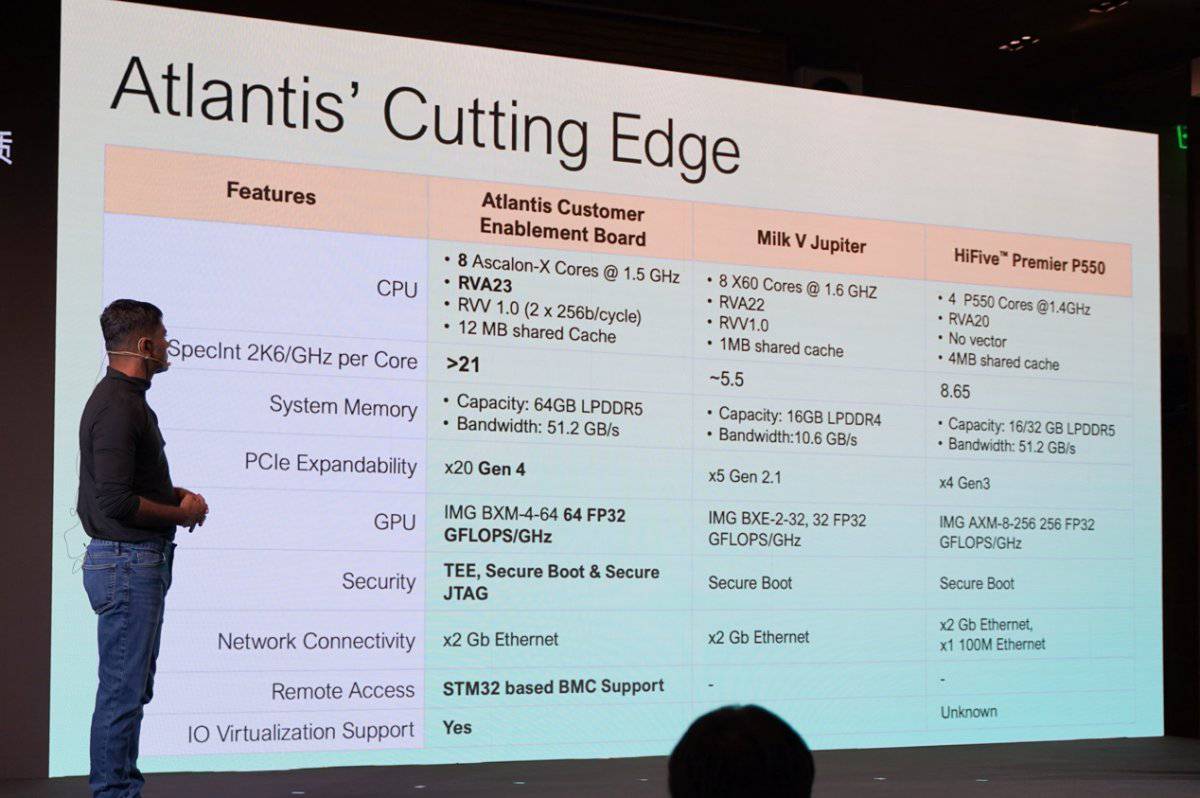
Atlantis SoC/devboard, feat. Ascalon, is Q2.
That should demonstrate sufficient performance for building products around it, and is ultimately one of many RVA23 options that will show up in chips this year.
After that, economies of scale should kick in.
It is not that I expect that Ascalon is going to be faster than Apple Silicon or cheaper than ARM. The price/performance is still likely to be such that these kinds of threads will be dominated with critics still saying that other options are better. Many will continue to wonder what the hype is about.
But what I fully expect and hope for is that Ascalon will put to rest the idea that RISC-V is some sort of toy platform or that it will be decades if ever before it can compete. Specifically, people will not be able to say that there are no RISC-V chips that can even compete with a Raspberry Pi 5.
After Ascalaon, it will not be fringe to propose that RISC-V makes sense for some use cases. Few will see RISC-V as a competitor to Intel, but many more will understand that RISC-V is a viable competitor to ARM.
And for us RISC-V supporters, Ascalon/Atlantis may be fast enough to actually use on the desktop. I have Intel based laptops that I still use daily that may not be any faster than Ascalon. That means that, for me at least, Ascalcon will already be fast enough. That is, if I will be able to afford it or even able to buy one. Fingers crossed.
I can dream of an Ascalon or Babylon based Framework mainboard.
Regardless, the rubicon will have been crossed. RISC-V will only get cheaper and faster after Ascalon. And, while x86-64 and ARM64 will too, there will be many, many RISC-V suppliers. There will be governments directly backing RISC-V research. The better RISC-V gets, the more players there will be and the more momentum the ecosystem will get.
My thesis is that it will be hard for ARM and Intel to stay ahead of all these other players. Certainly it will be hard to out-compete them all in every market. Which means that RISC-V will not only become viable but start to lead. And that is a radically different world than the one we live in now.
RISC-V is the hardware equivalent of the Linux kernel. And we know how that turned out.
Again, fingers crossed.
That's close enough to be unnoticeable for most people for most uses, at least on the CPU side. It'll come down more to how well things such as GPUs and video CODECs are supported.
There are plenty of people using M1 or similar e.g. Zen 2 machines today with no inclination to upgrade. They are more than good enough.
So Ascalon should have M1 IPC, at half the frequency.
A 1.5 GHz Ascalon is still going to be ... I don't know ... Skylake level? More than enough for a usable modern desktop machine and a huge leap over even machines we'll start to have delivered 3 or 4 months from now.
Hopefully it will be affordable. As in Megrez or Titan prices, not Pioneer.
Single core performance is about what you say. But multi-core performance is much better. The K3 scores higher than a 2017 Macbook Air for multi-core on Geekbench 6.
And the K3 can take 32 GB of DDR5 and run a decent-sized LLM, which is not something you are doing on an a 5-10 year old laptop. In addition to the vector instructions, the built-in video codec acceleration and hypervisor stuff make for quite a modern feature-set.
The K3 is still too slow to be a desktop system for most people but there are some of us who would already be ok with it.
As for pricing, it is hard to find info. But it seems like around $200 may be possible for the Jupiter2.
The Framework 13 K3 mainboard will be more:
https://deepcomputing.io/dc-roma-risc-v-mainboard-iii-unveil...
    14m25.56s  SpacemiT K3, 8 X100 cores + 8 A100 cores
    16m55.637s SpacemiT K3, 8 X100 cores @2.4 GHz
    19m12.787s i9-13900HX, 24C/32T @5.4 GHz, riscv64/ubuntu docker
    39m23.187s SpacemiT K3, 8 A100 cores @2.0 GHz
    42m12.414s Milk-V Megrez, 4 P550 cores @1.8 GHz
    67m35.189s VisionFive 2, 4 U74 cores @1.5 GHz
    70m57.001s LicheePi 3A, 8 X60 cores @1.6 GHz
Note that the all-cores K3 result is running a distccd on each cluster, which adds quite a bit of overhead compared to a simple `make` on local cores. All the same it shaves 2.5 minutes off. In theory, doing Amdahl calculation on the X100 and A100 times, it might be possible to get close to 11m50s with a more efficient means of using heterogenous cores, but distcc was easy to do.
RISC-V SBC single-core performance has been better than x86+QEMU since the VisionFive 2 (or HiFive Unmatched) but we didn't have enough cores unless you spent $2500 for a Pioneer.
Is that among the few known to work with open pvr drivers?
No one with any true knowledge of RISC-V would ever make such a claim. Know-nothing marketers might, I suppose, but why would you listen to them rather than to actual insiders?
The current newest RISC-V boards (Megrez and Titan and whatever the upcoming SpacemiT K3 ones are called) are solidly in mid-range Core 2 territory, especially K3 which has SMID/vectors which the other fast chips currently don't.
Older boards using JH7110, TH1520, K1 are closer to Pentium III or PowerPC G4 though with 4 or 8 cores instead of 1, but without an equivalent to the SSE or Altivec SIMD those old, or if they have it with near zero software using it.
Late this year is expected to see RISC-V products with performance in Skylake to Zen 2 performance levels, verging on M1 (M1 IPC but lower MHz).
> they are much slower than similar priced arm systems
Irrelevant to the technology. They are competitive with similar µarch (five years older) Arm systems.
Price can never be competitive (assuming no deliberate loss-making) until production and sales volumes are similar. Which can't happen until performance matches current Arm and X86 performance -- which RISC-V is converging with quite quickly, certainly by 2030.
That said, this is the year.
The Tenstorrent Ascalon is supposed to be as fast as AMD Ryzen 5 (according to the guy who created that Architecture at AMD). It is aimed at servers initially but they say they will release their own silicon sometime in the first half of this year. Even if that is optimistic, sometime this year seems likely. They released the licensable IP last year.
https://m.youtube.com/watch?v=Y3rtN8TTGf4&pp=0gcJCTIBo7VqN5t...
Don't set your self up for dissapointment. Ascalon is supposed to match Zen5 performance per clock, but at 2.5GHz, so will still be at a minimum 2x slower.
Additionally, the announces Ascalon devboard is supposed to be on an older node and have an ever lower frequency due to that. (the 2.5GHz were on SF4X, the devboard may be on something like 12nm)
Ryzen 5 is not Zen 5. So I am not predicting Zen 5 level performance for Ascalon.
I am expecting Zen 3 level performance which is to say about as fast as laptops from 2017 to 2020 or so. That is better than what I am typing on now.
So, not crushing Apple Silicon just yet but "usable" for the first time. Instead of "there are no RISC-V chips as fast as a Raspberry Pi", it will be "Intel is still faster". It may not even be that ARM is faster anymore. It will be more of a chip by chip comparison. At least people will have to admit that it is a race.
I am not looking for RISC-V to be "best in the world" in 2026. Rather, I want to stop hearing that it will never get there. After Ascalon, you will not be able to make the blanket statement that RISC-V is not good enough. It will be good enough in some markets and not in others. It will have a seat at the table.
And I want to be able to use RISC-V. Ascalon bring RISC-V into "good enough for me" territory.
And RISC-V will only get better. It is getting better faster than other chips are. My thesis is that this will continue (though that is certainly a bold prediction).
Even just looking at Tenstorrent, Babylon is not far behind Ascalon. And there is SciFive. And there is Andes. And there is SpaceMIT. And there is Alibaba. And there is Qualcomm. And there are companies I do not know about yet. And there are nation-states. There is a pretty big tidal wave headed for ARM (and maybe even AMD/Intel).
First they laugh at you. And then you win.
The closest thing is probably Orange Pi RV2, but it has an outdated SoC with no RVA23 support, meaning some Linux distros won't even run on it. Its performance is also much poorer than of the RPi5.
There are zero SoCs currently available to buy with RVA23 support, so that's not a mark against the RV2 if you want to buy a machine today.
Initial RVA23 machines available later this year are also likely to cost at least 5x to 10x more.
> meaning some Linux distros won't even run on it
There is currently no other hardware you could buy instead that will run that distro.
Check back in April or so, when Ubuntu 26.04 is actually officially released.
NB I'm currently using Ubuntu 26.04 on RVA23 hardware, but it is remote ssh access to a test board at the manufacturer.
What is the difference in performance?
Titan hw docs: https://milkv.io/docs/titan/getting-started/hardware
To add a 2x20 pin (IDE ribbon cable) interface like a Pi: add a USB-to-2x20 pin board, use an RP2040/RP2350 (Pi Pico (uf2 bootloader) over serial over USB or Bluetooth or WiFi; https://news.ycombinator.com/item?id=38007967
geekbench: https://browser.geekbench.com/v6/cpu/16145076
rvv-bench: https://camel-cdr.github.io/rvv-bench-results/spacemit_x100/...
There are also 8 additional SpacemiT-A100 cores with 1024-bit wide vectors, which are more like an additional accelerator for number crunshing.
The Milk-V Titan has slightly faster scalar performance, than the K3.
It may actually be faster than a Pi5.
The benchmark is well tuned for ARM64 but not so well adapted to RISC-V, especially the vector extensions.
You may still be right of course. The SpaceMIT K3 is exciting because it may still be the first RVA23 hardware but it is not exectly going to launch a RISC-V laptop industry.
So the main difference between this Milk-V Titan and the upcoming SpacemiT K3 is that the latter has better vector performance?
It matters, as the ecosystem settled on RVA23 as the baseline for application processors.
But you are correct that once RVA23 chips begin to appear, everybody will move to it quite quickly.
RVA23 provides essentially the same feature-set as ARM64 or x86-64v4 including both virtualization and vector capabilities. In other words, RVA23 is the first RISC-V profile to match what modern applications and workflows require.
The good news is that I expect this to remain the minimum profile for quite a long time. Even once RVA30 and future profiles appear, there may not be much pressure for things like Linux distributions to drop support for RVA23. This is a lot like the modern x86-64 space where almost all Linux distributions work just fine on x86-64 v1 even though there are now v2, v3, and v4 available as well. You can run the latest edition of Arch Linux on hardware from 2005. It is hard to predict the future but it would not surprise me if Ubuntu 30.04 LTS ran just fine on RISC-V hardware released later this year.
But ya, anything before RVA23, like the RVA22 Titan we are discussing here, will be stuck forever on older distros or custom builds (like Ubuntu 25.04).
The SpaceMIT K3 is rumored to be announced at FOSDEM (January 31, 2026)
https://www.reddit.com/r/RISCV/comments/1qdvw4l/k3_x100_a100...
Also at FOSDEM, mainline support for Orange Pi RV2 https://fosdem.org/2026/schedule/event/VF9CHG-mainline-suppo...
https://deepcomputing.io/dc-roma-risc-v-mainboard-iii-unveil...
Seldom does an SBC vendor want to actually support their products. You get the distro they made at launch, that is it. They do no updates or support. They just want to sell an overpriced chipset with a fucked and unwieldy boot sequence.
Same thing with all the Android devices. Pick a version of Android that you like because that's what you'll have on it forever.
https://fosdem.org/2026/schedule/event/VF9CHG-mainline-suppo...
I mean a board with decent storage and better performance.
The SpaceMIT K3 launched yesterday and Milk-V is advertising an SBC based on it (Jupiter2). It has single core performance about the same as a Pi 4 but with multi-core performance of more than double the Pi 4. And at 60 TOPS, it has the AI performance of a Jetson Orin Nano.
That is this year. The next ring to reach for will be true desktop level performance.
As RISC-V becomes truly useful, volumes will go up and prices will go down. With a dozen interesting players designing and building RISC-V chips, the pace of innovation is not going to slow down. I honestly do not know how ARM is going to keep up.
Is that because the platform itself is very lite, or is just typical for a dev ITX board?
https://www.cnx-software.com/2026/01/12/milk-v-titan-a-329-o...
For 99% users, the only real "benefit" RISC-V can bring to the table is the _false_ feeling that "I am different". Before you start to be excited about those a few cents risc-v MCUs - there are much cheaper MCUs, consider those risc-v MCUs are dead expensive.
Thanks for reading my honest opinions, please feel free to downvote.
I am a user, I like to tinker, I'm fairly confident there's more than 1% of people who care about these things. If you live in a country that is threatened by export embargos and the like it also makes a lot of sense to prioritize open.
in fact, such ISA is only going to fuel more closed ecosystems as it made hundreds of Chinese vendors to join the game for free, they all suddenly got the chance to build their totally closed platforms.
And if you are a country, nobody can kill your RISC-V ecosystem. Worst case, you have to design your own chips but at least all the software exists and is established. And Ooen Source cores exist and are getting better. They may not be bleeding edge but they could be good enough if push came to shove. The BOOM chip just got vector extensions.
High performance implementations, i.e. actual chips you can buy, are going to be proprietary and that's not going to change. Engineering hardware is expensive.
But there are different levels of proprietary. Having your entire software ecosystem impossible to lock-in means something. And competition tends to breed openness.
MIPS certainly did gain a lot of traction. It was a real force at one point and the world is awash in them. But of course MIPS (the company) is RISC-V now.
A cutting edge processor requires personnel across several disciplines and millions in specialized equipment to both validate the implementation of the architecture and the electrical behavior of the circuits and each time it's "compiled" (a batch of test chips fabbed and QAed), it takes a few weeks to be delivered and costs hundreds of thousands of dollars. The ISA being open and royalty-free doesn't affect any of those massive costs.
To use a famous quote: "The answer to any question starting, 'Why don't they...' is almost always, 'Money'" Nobody is offering up that kind of money without practical guarantees of success and some kind of profit at the end of it.
The Linux kernel may be "free" but it represents millions of man hours (or years) of engineering. Creating a viable RISC-V chip would be easier.
Creating the AV2 video codec cost money. I assure you. There is a reason that the Alliance for Open Media is a list of Fortune 500 companies and not a bunch of individual developers.
I have worked in industries dominated by a single chip supplier that made the chips that everybody used. Video surveillance is a good example. It would have been much cheaper for the major players in that industry to fund the collaborative development of chips they could all use and that could maybe be "tweaked" to add differentiated value for the largest players. It would save them money. It would give them more control (even more valuable).
I assume you know what a "chiplet" is. RISC-V is going to change things. In my view, you are focused on the wrong constraints.
We are both saying that money matters. We are simply coming to different conclusions about what that means.
If there were an economically viable number of people who cared about those things (and it would need to be significantly more than 1%), we'd be running SPARC or POWER or maybe SuperH derived systems, all of which have open source, royalty free implementations.
For example, OpenSPARC is something like 20 years old, and covers SPARC v8 through t2. SPARC LEON is a decade older, and is under a GNU license, and has been to space.
And that doesn't consider going the Loongsoon route: take an existing ISA (e.g. MIPS), just use it, but carve off anything problematic (4 instructions covered by patents).
It's a pretty inescapable fact on the ground that in the 'processor hierarchy of needs', an open source license is of no consequence in the actual market.
There are already literally billions of RISC-V chips in the wild. Qualcomm alone has shipped a billion or more. They wrote an article back in 2023 where they disclosed that they had already shipped 650 million of them by that point. Andes Technology has said that there are 2 billion chips using their IP. A recent industry report suggested that RISC-V could represent 25% of the global SoC market by 2030. That is based on growth trajectory, not speculation.
RISC-V is not some obscure ISA that cannot get any traction.
There are a dozen or more credible competitors designing modern 64 bit RISC-V CPUs. Most of them have shipped silicon. Some have shipped multiple generations. Has any ISA ever had so many independent companies independently creating core designs (not designs from a single source like ARM)?
Tenstorrent alone likely made $500 million dollars in 2025. Easier to confirm is that they closed a $650 million funding round.
NVIDIA has announced CUDA support for RISC-V. I do not remember them doing that for SPARC, or POWER, or SuperH.
The current RISC-V standard, RVA23, includes advanced instructions for things like vectorization and virtualization. Many large, important industry players are involved in designing future extensions as well.
RISC-V is an officially supported platform in many mainstream Linux distributions including aggressively commercial ones like Red Hat Enterprise Linux but also foundational ones like Debian and its derivatives (like Ubuntu).
GCC and Clang have excellent support for RISC-V. FFMPEG just released hand-written vector optimizations for RISC-V. Again, can we say this about any of the platforms you mentioned?
It's a pretty inescapable fact on the ground that RISC-V has an absolute mountain of support in the industry. And starting this year, multiple vendors will be shipping cores faster than you can license from ARM.
Honestly, what universe are you living in?
The one where I actually read what I'm replying to.
I never one single time said RISC-V wasn't successful. Not even implied it. What I did say, should you ever climb of your apparently thinking-averse, pre-conceived notions is that its license isn't the overriding reason it's successful, because the world is full of open source ISAs that never gained any traction. Something you might be aware of if you took a brief break from furiously jerking off over RISC-V and paid attention.
you need to be totally autistic to believe that Chinese vendors are going to share anything meaningful with you. they don't hate you, they want their paying customers to be happy, but the brutal competitions in China doesn't allow them to be open in any sense. For products like RISC-V processors and MCUs, the moat is extremely low, being open leads to quick death. It is not about how much stuff they share with you as paying customer, it is about how much they are willing to share with their competitors when there are hundreds of companies trying everything to survive.
as a developer, you just need to ask yourself a dead simple question - how such risc-v platforms are going to be more open than raspberry pi.
They are pushing their RISC-V products into the Linux mainline before those products even ship.
Those autistic Chinese also contribute a rather surprising amount of Open Source RISC-V out of their academic world.
There is (so far) nothing 'open' about RISC-V. and I wonder if there really ever was any desire for it, at this point.
This whole "Open ISA" crap appears to be a thin veneer to funnel quite large sums of investment into an otherwise completely proprietary and locked-down environment that could never harm the incumbents in any meaningful way - while still maintaining just enough of a pretense of open source, that the (regrettably myself included) shallow nerds and geeks could get smitten by it.
Where is the RTL? Where are the GDSII masks? Why am I unable to look at the branch predictor unit in the Github code viewer? Or (God forbid!) the USB/HDMI/GPU IP? I reject the notion that these are unreasonable questions.
I want my SoC to have a special register that has the git SHA ID of the exact snapshot of the repository that was used to cook the masks. that, now that - is Open Source. that is Open Computing. And nothing less!
I dont care about the piece of paper with instruction encodings - the least interesting part of any computer!
Wasn't that the whole point? We're more than a quarter of a century in and we're still begging SoC vendors for datasheets. Really incredibly embarassing and disappointing.
As you note correctly, the ISA is open, not this CPU (or board).
The important point is that using an open ISA allows you to create your own CPU that implements it. This CPU can then be open (i.e. you providing the RTL, etc.), if you so desire
I assume it will be much more difficult (or impossible?) to provide the RTL for a CPU with an AMD64 ISA, since that one has to be licensed. I wonder if you paying for the license allows you to share your implementation with the world. Even if it does, it's less likely that you will do so, given that you will have to pay for the licensing fee and make your money back
Since there is no license to pay for in case of RISC-V, it allows you to open up the design of your CPU without you having to pay for that privilege
So? You've been able to do that since...computers. Anyone can roll their own ISA any time they want. It's a low-effort project that someone with maybe a Masters student level of knowledge can do competently. When I was in school, we even had a class where you would cook up an (simple) ISA and implement it (2901 bit-slice processors); these days they use FPGAs.
So you got your own processor for your own ISA...that was slow, expensive (no economy of scale) and without a market. But very fun, and open source, at least. And if "create your own CPU that implements it" is what you want, go forth and conquer...everything you need is already there and has been for a long time.
But if your goal is "I want an open source ISA that I can produce that's price and/or performance competitive with the incumbents", well, that's a totally different ballgame.
And there are open source ISAs that have been around for decades (SPARC, POWER, SuperH). These are ISAs that already have big chunks of ecosystem already in place. The R&D around how to make them competitive already exists. Some, like LEON SPARC have even gone into something like production (and flown in space).
So, yes, an open source ISA affords the possibility that we can make processors based on our own ISAs on our own terms. It has even in extremely rare occasions produced a product. But the fact remains, the market hasn't cared in the slightest to invest what's required to turn that advantage into a real competitor to the incumbent processors.
Yes, you can create your own ISA. But to run what software?
If I create my own RISC-V implementation, I can install Ubuntu on it. Maybe even Steam.
See the difference?
And, the market has responded with a tidal wave of CPU contenders. Like in the rest of the world, not all of them target the highest end portion of the market. But some are choosing to play there. Have you checked-out Ascalon?
And why did Qualcomm pay all that money for Ventana recently? You do not expect them to release high-end RISC-V chips? I mean, they already ship many low-end ones.
Ventana is an extremely bad example to be used here. It is acquisition price is undisclosed, it could be just some $ for acquiring the team behind it. Secondly, Qualcomm's nuvia acquisition was pretty huge, there is no reason whatsoever to believe the Ventana acquisition is remotely comparable, that proves no one uses RISC-V anyway.
Here is an article from a company called Qualcomm from two years ago saying that they had, at that time, already shipped 650 million RISC-V cores.
https://www.qualcomm.com/news/onq/2023/09/what-is-risc-v-and...
I notice that the three benefits they flag for RISC-V are: flexibility, control, and visibility.
I wonder how they felt about "control" after ARM tried to stop them from commercializing the value of their Nuvia acquisition? I wonder if it had anything to do with their next big acquisition being RISC-V based instead?
I also wonder, why on their Oryon page does Qualcomm never meanion ARM. Not even once. Even to the question, is Oryon x86, they do not answer that it is ARM. Why not?
with the majority players being Chinese vendors (those you can buy, not including those building RISC-V for their own in-house applications), RISC-V is far less open than ARM or x64.
expecting openness from Chinese vendors is like trying to hook up with some virgin bar girls in your favourite gogo bar in Bangkok.
if you search their public media releases, they mentioned that their cores are used by some imaginary vendors for undisclosed platforms. just go and check how CLOSE those junks are. product names and models are always omitted, it is always "certain vendor", "one AI card", no spec no details whatsoever...
searching their names on taobao.com returns 0 hit, searching their names on the largest Chinese second hand platform returns 0 hit. 4 years after they started doing their great open project, you can't even buy one from the OPEN market! that is VERY OPEN to me.
Ok fine. Here is a link to a completely open design:
https://github.com/tenstorrent/riscv-ocelot
And here is a high-performance evolution of it that you can license. They would be happy to take your check today. https://tenstorrent.com/ip/risc-v-cpu
Silicon will be available in a few months.
And just for you, it is not Chinese.
How is that feeling "false"? People running RISC-V systems are different, or at least they have different motivations than you.
this is like saying being homeless is a lifestyle choice. some people argue that with a passion, I just choose to be kind to those people.
Agreed. Boards like this are helpful for getting RISC-V to the next stage, where it could make sense for more users.
Not sure why anybody would downvote your comment
> RISC-V doesn't make sense to 99% users at this stage
Not sure about the exact percentage but your basic point is valid. Adding "at this stage" makes it hard to argue with you.
> ARM is cheaper for 99% use cases
It may be 100% of use cases today. Facts are facts. You probably need to add "at this stage" again though.
> ARM ... has far more choices on the market
Very much so. Again, today...
That said, it is worth noting that almost all ARM "choices" are licensing the same small number of core designs from ARM. Already there are beginning to be enough RISC-V suppliers that some users may like the RISC-V options better in some niches (see automotive and some edge AI for example).
> ARM ... has ... much better performance
Absolutely. But that may not stay true for long. RISC-V CPUs will appear this year that equal or exceed CPU designs from ARM themselves in performance (eg. Ascalon). And we will see where things go from there. It will be a while before RISC-V beats Apple Silicon of course. And even once RISC-V gets there on performance, ARM may lead on price/performance for a while. That is, until RISC-V volumes start to equal or exceed other ISAs...
> greater software ecosystem and tooling
On the Open Source side at least, this is already a weak point. You can get multiple Linux distributions for RISC-V today, including from critical players like Ubuntu and Red Hat. The Linux kernel has a tonne of dedicated RISC-V support. Even though there are hardly any RISC-V chips with vector extensions in the wild, you already see Open Source packages adding support for these extensions. Both Clang and GCC have great RISC-V support. There are already x86-64 emulation layers for RISC-V. Ecosystems like QEMU support RISC-V. Even niche projects like Haiku OS support RISC-V. And on the hardware side, RISC-V players like Tenstorrent are advancing Open Source tooling and toolkits like crazy. The ecosystem is great now and getting better every day which, given the complete lack of real RISC-V hardware on desktops and servers, shows you how excited the industry is for RISC-V and how much support it is going to get.
Remaining gaps in ecosystem and tooling will close quickly. Starting with the board that we are discussing here, Titan, RISC-V is entering an era of being good enough to actually use. Linux and the universe of software associated with it are going to support RISC-V rather robustly. And while some RISC-V suppliers will follow the ARM path, many RISC-V suppliers are being good about getting support into the Linux mainline.
I expect ecosystem and tooling to be better for RISC-V than for ARM in general (though both will be great).
> For 99% users, the only real "benefit" RISC-V can bring to the table is the _false_ feeling that "I am different"
> _false_
False.
Here we disagree. But again, it may mostly be about the percentage. Because most users just want something that runs their software at the highest speed for the lowest price. And see above for how we agree that it will be a few years yet before people that do not otherwise care about RISC-V will find it the best option based on simple price/performance (though I do think that day will come).
But there are many "real" benefits to RISC-V.
Perhaps the biggest benefit is that it is an ecosystem that cannot be truly dominated by a single player or even by a small few. I wish RISC-V suppliers great success, and many will find niches that make them rich. But the amount of market power they can ever wield is limited by competition. I for one want this to be my future and I cannot wait to get on the train.
This is just my opinion but I think RISC-V is very well designed. I want to build software for the platform. I want to use assembly language on it. It seems much more pleasant than x86-64 and even ARM. This is a big benefit to me.
Similarly, RISC-V as an ISA and an ecosystem will be uniquely scalable. The same basic ISA can be used on the smallest micro-controllers or the most complex AI supercomputers. And it can be used in the support chips every step of the way. The expertise that I acquire using RISC-V will be broadly applicable over space and time.
And, while this is a prediction, RISC-V will have longevity. Suppliers can go out of business. RISC-V is not a supplier. Once it takes hold, it is not going anywhere. Many an ISA has dominated the computing landscape only to be abandoned and forgotten. RISC-V was inspired by MIPS (the ISA) and MIPS workstations used to cost as much as a small house. But now MIPS (the company) is a RISC-V supplier. x86-64 may seem unassailable but ARM has certainly kept it out of many niches and now ARM is starting to be credible on desktops and servers. x86-64 could go away (especially if Intel failed--not impossible). And ARM is very vulnerable to RISC-V (if you ask me). But for RISC-V to go away, there would have to be yet another totally open ISA that the entire world rallied behind. That is not how things generally work. Like Linux, RISC-V is destined to become a natural monopoly in my view and to be with us a very, very, very long time.
And, for now at least, RISC-V is just more interesting. Companies like Tenstorrent are doing really interesting things. Universities are doing interesting work and sharing it with the world. Those two things came together just the other day when RISC-V vector extensions were added to BOOM. It is a fun space to watch and it will be a fun space to be a part of.
And just like every school teaches software in Java, every school is going to teach programming and electronics with RISC-V. It is going to be the default technology in the future. And that means that it will be the go-to for start-ups as well. RISC-V will be the go-to technology for innovation.
Finally, what I will end with is that the real inevitability of RISC-V has nothing to do with users. Companies will choose RISC-V. But not to save a few bucks on ISA licensing like everybody imagines. That may be a benefit but it does that amount of cost is not going to drive most decisions. But the more critical issue with licensing is control.
Take the situation with ARM and Qualcomm. Qualcomm wants to release its own high-performance silicon to compete with the likes of Intel and Apple. They licensed the ARM ISA to do this. And then ARM tried to stop them from releasing this technology over a license dispute. Yes, it was over money (which matters) but the much bigger deal is that ARM (a supplier to Qualcomm) tried to dictate how Qualcomm can run its business. Qualcomm recently bought a prominent high-performance RISC-V designer. I think these facts are related.
If you bet your business on ARM, you better hope that ARM likes your strategy. If they do not, they may try to stop you. Why would Qualcomm want to create a business around ARM if ARM is going to represent a strategic risk like this? Why would Amazon or NVIDIA? Building the same business around RISC-V eliminates that risk. You do not have to ask permission for whatever you do with RISC-V. Nobody can file an injunction on a RISC-V supplier for using RISC-V.
This is why China is so into RISC-V. Even for them, it is not really to save on license costs. It is about reducing legal and geopolitical exposure. US sanctions led to ARM refusing to work with Chinese suppliers like Huawei. The US cannot sanction RISC-V as a technology. Fast forward to today and there are now many, many companies around the world rethinking their exposure to US based technology companies. There is a reason that RISC-V International is based in Switzerland even though RISC-V was invented in California. Europe is investing in home-grown RISC-V solutions. So is India. Tenstorrent came from Canada. Andes is out of Taiwan. It is not just China.
So, no need to downvote. But if you really think RISC-V has no benefits, the next 5 years are really going to confuse you.
Like no UEFI, no PC architecture (every board is different), got to x86 complexity (a miriad of instruction sets and extensions) in just a couple of years, needs a special linux kernel to boot with support for newer versions not planed.
Yeah, great software, great tooling. /s
Did you even bother to click the link that this story was about?
The Milk-V Titan supports UEFI, ACPI, CPPC, and SMBIOS. The board is otherwise bog standard PC architecture from the PCIe to the form factor (ITX). You can boot multiple Linux distros on it out-of-the-box. They are pushing support into the Linux kernel mainline.
The Titan supports RVA22 + virtualization (the H extension) which you could also frame as RVA23 minus the vector extension. Another way of saying RVA23 is to say that it is RISC-V with the same feature set as X86-64 v4. Why did I have to say "v4" when talking about x86? Because of the myriad of extensions offered on x86-64 that differ between v1, v2, v3, and v4.
Honestly, what the hell are you talking about?