The US economy depends on the country's position of world hegemon - the US dollar is the world's main reserve currency, the US enforces international order and trade rules via its military strength, it dominates technology and culture through 'US defaultism'.
I dont think AI even factors in to this.
The US economy is priced for global reach - if it manages to lose that through a combination of credible competitors, and loss of goodwill - it's going to be in heaps of trouble.
The looming US debt is also a great question - a lot of economists have argued that since most US debt is good. It's mostly in forms of treasuries purchased in USD that pay in USD - this means the indebtedness creates a huge amount of dollars abroad that foreigners have to then spend on US services, driving demand.
Should the US become an unfriendly power to the rest of the western world, it will find the demand for its currency plummeting, which I don't want to outline is a big issue.
All said, I think if the US continues down the political path it currently seems to be pursuing, 'this time it's different' actually will be.
Strangely enough, this is exactly the opposite of how it works. The dollars abroad tend to stay abroad, as either a more stable alternative to local currencies, or a reserve currency. Likewise, treasuries held abroad tend to stay there as reserves. This is how the US is able to run both a huge debt, and a huge trade deficit. If the dollars were being repatriated, the trade deficit would close, and the influx of money would cause hotter inflation. Same with treasuries, yields would spike as demand fell.
There are lots of second order effects there, good and bad, but, basically, those dollars not coming home has funded America for quite some time.
I purchase a treasury. I have zero product, zero dollars and one treasury.
At some point in future i have zero product, maybe 12 dollars and zero treasuries. Presumably i now either repeat the cycle or use my winnings to spend on us output.
GP’s version checks out, your assertion about dollars staying abroad doesnt track? What am i misunderstanding - How did these dollars get abroad, how did they repatriate to buy treasuries, how did a treasury become a reserve, how did the dollars still exist abroad after being exchanged for treasuries?
Or you sold something to a non-American entity in a dollar-based market, eg. oil. The dollars do come from America to begin with, but once they get "out there" they work as a medium of exchange for whoever wants to use them for that purpose.
https://ipr.blogs.ie.edu/2025/06/27/geopolitics-of-oil-how-c...: This article explores case studies such as Russia, Iran, and Venezuela, illustrating how the petroyuan has been implemented to bypass sanctions and reduce dependence on US financial systems.
As mentioned, there’s also mounting dissatisfaction and distrust in the petrodollar, but the devil you know…
What you are missing is that these dollars can be circulated indefinitely in the global economy without ever repatriating, because they are valuable and useful as actual currency. They may never come back to the US.
India won't accept euros because it's not part of the ECB, not because it doesn't believe in their value. But India has accounts at US banks in dollars.
Banks do this, not countries. Most banks in the world have accounts at US banks to accept dollars with, they don't have accounts at eurozone banks to accept euros with, or Japanese banks to accept yen with. It doesn't matter in everyday practice because it's easy to exchange euros in eurozone banks or yen in yenzone banks with dollars in dollarzone banks. There's plenty of infrastructure for that. It matters in long–term economic trajectories because all those banks are holding US dollars and the US exports inflation to them and they're not holding euros and then ECB can't.
Most of the time this is exactly (foreign or not) institutions do.
Think about it, if the 10-dollar treasury is due and you got your money back, the US debt will go down by 10 dollars. However, in our reality, the total amount of US debt almost never goes down.
Of course some interest will be used in other ways, like spending on the US goods or staying as cash to provide liquidity. But at the end of the day, the most popular way to spend the money got from due treasuries is... to buy more treasuries.
I think you have it backwards. The US dollar can be handled as a more stable alternative only if it's actually stable. As soon as the US government starts to deteriorate goodwill and outright be hostile towards the world, not only does the US dolar lose its value as a stable alternative but foreign governments start to be motivated to dump their assets, which further tanks its value. In the past couple of weeks we started seeing countries outright dump their investments in US dolar to derisk their portfolio, and they did it at the tune of billions of dollars. You also started to see political pressure for foreign governments to demand their gold reserves are pulled out of the US, which means this pressure goes way beyond US dollars.
I don't understand how your argument here goes against mine. If anything you're arguing that I am correct, but things are changing.
Right now this is much more of a maybe, possibly, eventually, over a long enough time horizon.
As of the end of 2025, USD still made up 57% of foreign reserves vs 20% for the Euro and 3% for the Chinese renminbi. Nearly all commodities are still priced in USD and about 50% of trade invoicing is done in dollars, closer to 60% if you exclude the Eurozone. USD also makes up about 60% of SWIFT transactions.
So the demand is still there today and de-dollarization is not really a thing in aggregate as of January 2026, despite all of the events of the past year or so.
So if this time is different, I’m not seeing it yet.
A world order based on rules makes it possible to live at a much higher level of abstraction.
Abstractions like rule of law, democracy, government currencies and stock exchanges are intangible and imaginary. They're mostly just figments of collective belief. But these wispy and unreal ideas that everyone believes in make it possible for most people to live longer, healthier and less difficult lives.
The "rules-based order" was always partly mythical, but as long as everyone kept pretending, it mostly continued to function.
But when we devolve from the rules-based order to the old order of pure power and might-makes-right, kings and dictators, when there's no more collective belief that the rules apply to the rich and powerful, then the tower of abstractions collapses, and we're back to the cold, hard, brutal and difficult real world.
People will find out that life in the real world is a lot poorer and more miserable than life at the top of the tower of abstractions, even if your brokerage account appears to double.
Social reality is always constructed. No single construction is more real than any other.
Just as "real assets" like buildings, machinery and metals are more "real" than abstract assets.
Abstract assets like shares of a corporation, intellectual property, cash in a bank account, promises to deliver a commodity in the future, and other intangible concepts only exist because we collectively believe they exist and trust each other to follow rules.
There are real weapons and prisons at the bottom of this stack of abstractions to force people to comply, but it's mostly collective belief, trust, culture and tradition.
When we devolve from a rules-based order to might-makes-right, those layers of abstraction between us and the weapons evaporate, and ordinary people like moms and ER nurses get gunned down in broad daylight by agents of the state asserting raw power.
Abstractions like law and due process evaporate, and the "real world" underneath is nasty, brutish and short.
These are the same. They are the same because someone has to enforce the rules. The reason why this entire discussion is so obtuse is because you refuse to accept this. If I was wrong and they were different, you wouldn't treat the US and others (say China) by the different moral standards. To bring this back to an individual level, this is the same as saying police don't deter crime. You wish these two concepts were different so you let your political bias blind you to reality. That doesn't effect reality though. Police do deter crime and whoever (the US) enforces the rules based order has to do so (from time to time) kinetically.
You don't know anything about me, but the strawman you're describing sounds like a real dipshit.
> But when we devolve from the rules-based order to the old order of pure power and might-makes-right, kings and dictators, when there's no more collective belief that the rules apply to the rich and powerful, then the tower of abstractions collapses, and we're back to the cold, hard, brutal and difficult real world.
Many have absorbed and believe the argument of the might-makes-right crowd that their vision is 'real' and their enemies' vision is 'imaginary'. Unless people believe in what they seek, they are lost.
There's nothing imaginary about it; that theory is paper thin and doesn't survive simple examination. Obviously, humans are social animals that live in groups, have powerful intellects, and therefore have tremendous ability to cooperate and work together toward greater good; we've done it many, many times. Freedom and democracy have appealed powerfully to people worldwide, in a tremendously wide variety of cultures. That model was created by people who had experienced WWI and WWII; they knew more of your 'reality' than probably you or I ever will, and with that knowledge and experience they created this order.
And the greater good long predates that; religions and similar ethical codes based on the greater good long predate modern democracy and the rules-based order. Rules-based orders predate it. The Gospels in the New Testament are an easy, very familiar example, from 2,000 years ago (and a significant basis of modern freedom and democracy). Similar is true for abstractions like law, government, justice, etc.
We all are biologically the same, essentially, as the best of humanity and the worst - both are in all of us. It's our choice, our moral choice, what we do. That is also a fundamental that long predates the post-war order, democracy, the Englightenment, etc. Inevitability is a cheap tactic long used by those whose ideas are undesireable and don't withstand scrutiny.
Our choice is easier than those who survived WWII, and their predecessors. Our ancestors gave us the tools, the institutions, etc. They had to build them from nothing for a skeptical world.
I agree that religions commonly use the god/god's will as the reason, but I don't think we should take that at face value. It's the argument to trump all others - rulers often claim to be chosen by the will of the supernatural - but not the reason the rule was made, which is a product of the cultures involved.
And humans often come to the same ethical conclusions: The rules against murder and rape, the priority on justice and fairness, as examples, are universal across cultures regardless of religion (look up 'cultural univerals').
Its a farce, of course, but one that can sometimes muster enough support to keep the signs in the shop with just a bit of intimidation and violence to back it up.
Screwing around with Greenland shit, on the other hand, seems riskier.
Politics between countries has always been around interests. Countries have no interest in giving up their sovereignty. They may pretend to respect these "rules" when it suits them and then ignore them when it doesn't. Everyone is focused on how "bad" the US is but a) the US has always more or less done whatever it wants b) Russia and China (and many others) have never even pretended to play or accept these "rules".
Canada's Carney whines about "international order" when just a few years ago China simply abducted Canadians in response to the supposed "orderly" arrest of the Huawei CFO to be extradited to the US. So Canada basically abducts the CFO of a major Chinese company and China abducts Canadians in retaliation and that's a rules based order to who exactly? And we can put together an endless list of an endless number of countries. So when exactly was there ever a rules based order except as a tool for countries to bully each other and for the poorer dictator led countries to try and get a seat at the table because they can vote in the UN general assembly.
This false. They have pretended to play by the rules, and when breaking them, to at least manufacture some pretext, or to deny it was a state activity at all.
One example I can give you is that when invading Czechoslovakia in 1968, the Soviet Union convinced a few Czechoslovak politicians to write a letter inviting the forces for "brotherly help", thus manufacturing a case that it's not really an invasion. They didn't have to do it, the force differential was overwhelming, but they did it because they could point at the letter on international stage.
All this may seem a bit pointless but binding them in international structures brought interesting fruit in the wake of Helsinki conference on human rights. After that they were forced to at least somewhat follow the signed documents which lead to significantly better conditions to dissidents behind the Iron Curtain. And there are many examples like this, when pointing at international rules actually made things better. So let's not throw that away.
> They have pretended to play by the rules
@YZF is unwittingly agreeing with Carney. The rules-based order is partially a fiction. Relevant snips from Carney's Davos speech.
"The system's power comes not from its truth, but from everyone's willingness to perform as if it were true, and its fragility comes from the same source."
"For decades, countries like Canada prospered under what we called the rules-based international order. We joined its institutions, we praised its principles, we benefited from its predictability. And because of that, we could pursue values-based foreign policies under its protection."
"We knew the story of the international rules-based order was partially false ..."
"This fiction was useful, and American hegemony, in particular, helped provide public goods, open sea lanes, a stable financial system, collective security and support for frameworks for resolving disputes."
When the US invaded Iraq, it at least pretended it was following the rules. It appealed to the UN for approval, it justified the invasion in the name of freedom and democracy.
It was all bullshit, but at least the US sustained the myth of a system of rules and a moral order.
But the US no longer pretends. It invades Venezuela and publicly states it was all about oil.
So even the pretense is gone now, and the benefits that came from pretending are gone. That's the "rupture" Carney is talking about, that sustaining the myths is not longer useful, so it's time to stop pretending.
https://en.wikipedia.org/wiki/International_law
"In the 1940s through the 1970s, the dissolution of the Soviet bloc and decolonisation across the world resulted in the establishment of scores of newly independent states.[67] As these former colonies became their own states, they adopted European views of international law.[68] A flurry of institutions, ranging from the International Monetary Fund (IMF) and the International Bank for Reconstruction and Development (World Bank) to the World Health Organization furthered the development of a multilateralist approach as states chose to compromise on sovereignty to benefit from international cooperation.[69] Since the 1980s, there has been an increasing focus on the phenomenon of globalisation and on protecting human rights on the global scale, particularly when minorities or indigenous communities are involved, as concerns are raised that globalisation may be increasing inequality in the international legal system.[70]"
Also the US always made a big deal about not joining various treaties, with their reasoning explicitly being "we actually plan to do a lot of things that would violate that treaty." In that sense, that shows the US actually had respect for those institutions.
Also, the west benefited from this arrangement. Most western countries could benefit from the rules based order, and when they needed a little pump, the US broke some rules and brought home a treat for the home team. You might argue this undermines the whole enterprise, but my counterargument is this is the longest period of relative peace and prosperity humankind has ever experienced, so although it wasn't perfect, it was a huge improvement.
In this case this assumption is completely disconnected from reality. So yes, neither Trump, nor Putin, nor Starmer, nor Macron, nor any US citizen, and likely no citizen, or government of no country with any sort of power (India, China) or with a patron country with power isn't subject to any "international law". I.e. doesn't exist, it's just a word salad to manipulate the masses.
I disagree; I would guess most people assume rich/powerful/etc people aren't subject to laws, no matter the jurisdiction.
> In this case this assumption is completely disconnected from reality.
How many people think the US is bound by international law? I looked for polling but I couldn't dig anything up
> ["international law"] just a word salad to manipulate the masses.
How are people manipulated by this?
But you are right that people assume that. They also assume the rich pay no taxes. So they "assume" a bunch of nonsense. Some once told me assume makes an ass of you and me.
I think people think the US is supposed to follow this thing called international law, or at least they'll express some outrage when it doesn't.
The manipulation is that people believe in this thing called international law as something that anyone has to follow where in practice no country would ever let international law supersede its laws if it went against their interest and there is no mechanism to force this. You keep seeing news about this and that being against international law (be it Israel or the US or Russia, would be the typical use case) and people actually think this is a real thing, like there's some law book somewhere that applies universally to every country. Very few people have the real and correct understanding that these are just norms or treaties or agreements that countries decide to follow or not on a case by case basis as per their interest, i.e. not a law in any real sense of the word.
But, I don't think people have a detailed understanding of these things. I do agree they're at best fuzzy about what international law is (I am also fuzzy on it). I just don't understand what's manipulative about it. Like, what are people induced into doing based on the premise that the US follows international law? I think anyone operating in that sphere (international shipping, piracy outfits, aid organizations, criminal syndicates) is probably savvy enough to know the US will just blow you up and lie about it for thirty years.
There was no dissolution of Soviet bloc during that time.
Laws are enforced by sovereign countries that have police and courts etc. "International law" has "laws" (well very few if any) with no sovereignty. That's what makes it fiction. It's just newspeak to make people think that there are laws that exist outside the system of countries, and there aren't, at least no binding ones that countries can't and don't override. That's not a law.
Ofcourse laws, like any other human constructs, are invented by us and don't have independent existence.
When I drive to work here in Canada the "international police" stopping me for violating the "international traffic laws" is really not a concern.
If the world is governed by rules, why does the United States maintain a considerable number of military bases around the world, far exceeding the total number of military bases of all other countries combined?
Why is the American military budget so much higher than the combined military budgets of all other countries?
It's the other way around. Rules are tools of peace. No peace, no rules. But if you want peace then you have to be ready to wage war. It's called deterrence and the EU is learning this just now, again. That's also one reason why the USA has been called the world police... because it was true.*
If nobody enforces the rules any more, things break down and we close in on violence. It is plain to see on the global scale, e.g. Russia's war against Ukraine, and also the domestic scale, e.g. ICE's violence against their own citizens in the USA.
> Why is the American military budget so much higher than the combined military budgets of all other countries?
The US military budget is about three times that of the EU or China's, or about a third of all military spending on the globe. Obviously, this is much higher than any single entity, but not all other countries combined.
* Frankly, being the world police has had a lot of benefits for the USA. Why they are abdicating this position to run a protection racket instead is for wiser people than me to answer.
Yes- When there is one super power in the world and it says if you don't behave a certain way we're gonna bomb the heck out of you, or boycott you, you get a certain behavior. Even then you might get some actors (like North Korea, or Iran, Yemen, Russia, China and more) that have no problem openly defying and challenging the super power to some extent.
When the balance shifts and you have other blocks with more power that feel comfortable in defying that super power (like China or Russia today) then you see that changing.
There are no "absolute" rules. There are power dynamics, countries, interests, politics. Rules can exist only within a structure that can enforce them, like a country.
"The nature of the LIO, as well as its very existence, has been debated by scholars."
Nobody is throwing anything away and that thing you think they're throwing away didn't really exist.
I agree most countries, certainly western countries, have realized that waging the kind of wars like WW-I and WW-II is not a good idea. But there have been a lot of war and killing anyways since the world wars and there have been a lot of new borders redrawn and countries formed. In more recent times we have Putin invading Ukraine and the general instability of the post cold war Eastern Europe.
So the calculus has changed for many reasons. But "new order" is not one of them. The so called new order was a result of the calculus changing, not the other way around. Countries fight for power in other ways and other societal changes also influence their decisions. I.e. you are confusing cause and effect. Now we have different dynamics, not a collapse of world order, things have shifted very slightly. "The end of the world as we know it" gets a lot of clicks on social media but it's not like we're suddenly having WW-I all over again and it's not like that order you thought was absolute really was. It's just that's how the alignment of interests landed.
Not all demand the same. There are broadly 2 types of USD buyers
1. price insensitive: sovereign banks, who buys for liquidity/storage
2. price sensitive: hedge funds, private buyer who buys returns
Type 1 buyers are bailing out of treasury. Type 1 are marginal buyers, the close auction regardless or rate, this keeps rates low -> debt servicing low. They artificially depress yield to non market rates, without them rate go up because you have more price sensitive buyers who buy for returns. This increases borrowing costs, hence US debt repayment rising massively.
Type 1 buyers, i.e. US allies (and historically even adversaries) soaked up treasuries are now de-dollarizing / buying gold in lieu of _more_ USD. Type 1s underpin the "privilege" part of exorbitant privilege. The more they de-dollarize the more dollars become exorbitant, aka debt like everyone else. Type1, sovereign held 60% of USD to 40% in last 5 years. This large part of why interest tripled and debt servicing went from 350B to 1T in 5 years. Type1s exit to 20% in another 5 years and maybe interest goes to 5%, debt servicing 2T+. It's the difference between 10%/20%/30% debt servicing as % of federal revenue.
This not to mention USD reserve ticking down at 1% per year means meaningful changes in our lifetimes, and velocity may increase with developments like Saudi no longer locking oil to dollar. Less USD as % of global reserve = more network effects of alternate payment = increased potential velocity of USD reserve drop. This doesn't mean other currencies pickup all slack, i.e. central banks seem to be going in gold / commodities with no counter party risk for new storage. The net result is USD will still be around, in large volumes, but the cost/debt to sustain the system will be "normalized" while US budget is historically is built around USD debt being privileged. AKA difference between borrowing money from family vs payday loans.
>Nearly all commodities are still priced in USD
PRICED as in benchmarked in USD, but =/= USD is being spent to settle them. There's a fuckload of commodities where PRC alone buys 30/40/50%+ of global production, and while quoted in USD, increasingly settled in rmb/CIPS, bilateral currencies, BRI infra or other swaps mechanisms that bypasses USD. This one of the largest source of dedollarization - PRC went from single digit % to plurality of cross-border settlements in RMB/non USD. Though this is just very recent leading indicator that USD is functionally circumventable.
And not just to the United States but to other nations, as well. South Africa owes US dollars to Australia, Australia owes US dollars to Brazil, Brazil owes US dollars to Argentina, etc.
These nations are hungry for every dollar we print. Even if every trading partner dropped the dollar for trade tomorrow, and if everyone who owned Treasuries all sold them at once, there would still be demand for US dollars to repay their loans.
The IMF made them an offer they couldn’t refuse, and spun a sticky web of a debt trap as a result.
Three minute video: https://m.youtube.com/watch?v=_SaG9HVXMQg&pp=ygUQZG9sbGFyIG1...
IMO this one of those cases where dollars is ultimately benchmark than requirement, IOU/settlement forms can always be restructured/renegotiated if USD is no longer lender of last resort, i.e. alternative payment systems enables take it or leave it deals in medium/long term.
USD/reserve status snowballed because US controlled techstack postwar which US leveraged (along with military hegemony) to USD controlling primary energy (petrodollar). Civilization/modernity was locked behind USD. Money followed existential goods provider, that's the real USD / unipolarity moat. There's no take it / leave it from US company scrip because leaving eurodollar system = technical default (most usd loans hardcoded on newyork/english law) from eurodollar western financial system = death sentence. Once that lock/dependency erodes all kinds of force majeure geopolitics can rationalize breaking dollar contracts. AKA multipolarity.
If alternate techstack/payment systems pops up and reach tipping point, country A can just say to country B who only wants USD (due to alignment or whatever), I don't have enough USD, here's RMB & cips/Brics+ & mbridge basket of equivalent value. This geopolitical layer, if BRIC+ can offer fossil, food without US and PRC can offer renewable energy, capital goods, consumer goods, technology, including 80% as good semi and civil aviation... etc if chokepoint goods are no longer exclusively under USD perview, then USD enforcement mechanism simply dies.
If we're talking about loans/aid, IMF is really pittance, low hundreds of billions. It's why PRC is now using their 3T USD surplus to basically do their own shadow USD lending without IMF conditionalities... countries now don't need to buy USD from US. And somehow PRC currently lending / providing swaplines with their USD at lower rates than US treasury. Incidentally, this dollar recycling also lowers demand for new USD bonds, further reduce type1 margin buyers. This circles back to other nations own trillions of USD to each other... when you remove type1s, you're left with type2 private sector / non bank financial institutions - these are the buys where each USD bought increases triffin burden, i.e. they are the exorbitant curse / payday loans traps that makes USD reserve more expensive to maintain. Their demand is a trap, not a benefit.
Alternate payment systems aren't even required for this. If other countries are trying to divest US dollars and country B is owed "US dollars" and country A wants to pay in something else, country B would want to accept the something else of equivalent value because it's trying to reduce its US dollar holdings and would just be immediately turning around to resell them anyway.
Conversely, if country B is insisting on US dollars for alignment reasons while other countries don't want them then that's only providing country A with the opportunity to divest its US dollars by using them to pay the debt. Then country B ends up with them, but now what is it supposed to do with them?
The real reason those sorts of debts result in stability is that all the countries owed a lot of US dollars are going to do what they can to prevent the US dollar's value from declining.
That’s the crux of it. Nations can proclaim they are ready to dump the dollar—and indeed, it is happening slowly—but politicians still have a strong appetite for USD-denominated loans.
I am not optimistic for the dollar in the long run, but I no longer fear waking up tomorrow to see hyperinflation.
Assuming of course that the lender is interested in the alternative payment currency. Or that the borrower is willing to accept the consequences of default.
I don’t see accepting other forms of currency to be relevant in the short term—there is little use for the Yuan outside of China, for example. I suppose creditors can use them to buy more trinkets, or trade for dollars with people who want more trinkets.
And defaults can happen at any time, but the credit rating system is still widely respected.
Things can certainly change, but I doubt overnight.
> It's why PRC is now using their 3T USD surplus to basically do their own shadow USD lending without IMF conditionalities... countries now don't need to buy USD from US.
So they’re using US dollars, not Yuan.
That trend is changing; before 2021, most of China’s loans were in USD. After COVID, loans denominated in RMB have grown to 20%.
Again, I can see how that would change conditions in the long term, but not overnight.
I am not optimistic for the dollar in the long term but I used to fear waking up one morning to hyperinflation. Not anymore.
> buy more trinkets
RMB buys capita goods, energy goods... and as PRC domestically moves way from oil, it still has massive refining/petchem infra generating surplus, so they'll likely be net hydrocarbon seller (refined products), as in RMB can even buy oil / oil products. This part important, 2025 PRC has parity/exceeded the US as worlds largest crude refiner by capacity. Together with massive, massive SPR for storage... aka they have like 1B+ barrels of oil in storage which gives them pricing power (as in they have artifical oil field to influences oil prices). They will not be retiring all the oil infra as they electrify, they'll use freed up surplus for reselling hydrocarbon in rmb. Right now, outside of high end commercial aviation and semi conductor, PRC can underwrite 99% of development goods for affordable prices. This not 10/20 years ago where countries still had to through host of western industries to get factory/city off ground, PRC more or less one stop shop now. The TLDR is rmb buys entire physical layer that enables modernity.
> credit rating system is still widely respected.
Respecting western credit rating =/= fear of being locked western credit rating. People don't default from eurodollar because they fear losing access to energy, food, commodities. Things already changed in the sense RU has demonstrated BRICS makes surviving outside of western finance system feasible. Fear is what enforces/maintains system. Respecting is about keeping options open not avoiding death sentence anymore.
>US dollars, not Yuan.
They're doing both, refinancing or inking new contracts in RMB. But main point is PRC shadow dollar lending is part of their dedollarization effort = getting rid of / recycling / lending their surplus USD at expense of US treasury. People may keep using USD, but US gov not getting exorbitant privilege. As long as USD is being used, and as long as PRC can maintain trade surplus, PRC can feasibly maintain pool of USD to ensure USD liquidity remains costly. It's like the oil/SPR reserve, PRC having pool of USD to reprocess/recycle gives them some pricing power to undermine oil/and USD.
>hyperinflation
IMO this more likely than not, and not really something to fear. Not end of society hyperinflation but if US debt gets too unsustainable, geopolitically much better to inflate away debt and fuck creditors than default. Like it's still reputationally technical/soft default, but less "embarassing", and more importantly, because dedollarization takes time, mechanically US can inflate debt faster than holders can ditch USD without crashing value. If things get desperate to that point, USD has the dollar is our currency but your problem nuclear option. Not saying this good for US, but least bad for US.
Yes, but that's the lowest it's been since 1994, in percentage terms. In dollar terms it's been largely flat for the last decade:
https://wolfstreet.com/2025/12/26/status-of-the-us-dollar-as...
Compare those numbers to 5 years ago. Remember, this is the timescale of a country, not a beagle. America has run on the strength of the dollar for decades, and the symptoms of that collapsing are likely to play out over decades.
USD foreign exchange reserves have definitely declined from their peak, but by “declined” we’re talking about going from “overwhelmingly dominant” to “merely dominant” to potentially in a few years “equal to every other foreign currency reserve in the world combined”, and maybe USD foreign exchange reserves will decline even further beyond that point.
1970 (85%) - Up until 1971 [1] the USD was backed by gold by the Bretton Woods system. Other countries could trade USD in for gold at a fixed rate and in exchange would peg their currencies to the USD and trade in the USD. The idea was to prevent the US from ever being able to exploit their power in this system because if we printed too many dollars other countries could just hoover those dollars up on the cheap, convert them to gold, and make a bunch of money. Nonetheless we did print excessive amounts of money and abuse the power this system was granting us. So France dutifully hoovered up those dollars and made a gold call. We said 'nah', defaulted on our debts, and withdrew from Bretton Woods. This led to the famous quote from Nixon's Secretary of the Treasury: "The dollar is our currency, but it's your problem."
1990 (47%) - Following those events, the USD began seeing rapid inflation, and other countries were rapidly dropping the dollar. This 'peaked' around 1990. But then in 1991 the USSR collapsed. This not only left the US as the undisputed and sole 'king' of the world, but also led to these former nations beginning to dollarize once the dust had settled. The USD suddenly again starts to see mass adoption.
2001 (72%) - The adoption reaches its peak in 2001. At this point not only was there the dotcom bubble, but the world order begins clearly shifting with China and Russia developing increasingly rapidly and looking to become viable world powers once again. And there's been a gradual process of de-dollarization since then declining to where it is today to less than 57% and very much trending to where we were right before the USSR collapsed.
2025 (57%) - Where we are today. We're very much trending towards 1990, only 10 points away, which is the level when everybody was dumping the USD, the US economy was shaky at best, and there was another major superpower in the world and nobody was quite sure who would 'win.' This is far more significant than 'random noise' you're implying.
---
I am leaving out plenty of relevant happenings including the transition to the petro dollar, South American economic crisis, and so on - but these only contribute to eras I think, while the above are the main drivers.
Seems you didn't check you calendar hard enough ;)
You got it wrong (I'm sure most economists don't get it wrong and you just misread/misquote). USD is the default reserve and settlement medium for many countries. They buy US treasuries mainly to satisfy the demand of USD itself, not to buy goods and services from the US. That's why the US has such a huge trade deficit. The US doesn't point a gunpoint at other countries to force them buy treasuries[0]. It can lend so much money because the other countries want treasuries.
[0]: Ironically the US tends to do the opposite - forcing other countries to buy US goods and close trade gap.
The importance of USD globally was always on borrowed time. Global GDP has exploded in the 21st century, and the size of the US economy relative to the global economy is shrinking, albeit slowly. The US share of global GDP was like 35% in 1985. By 2030 it's projected to be as low as 12%. It doesn't necessarily follow that this would change the dynamic of strong dollar demand supporting US investments and debt, but it makes it much easier for this dynamic to change as countries become increasingly less reliant in relative terms on exporting to the US. In fact, it's kinda idiotic to rock this boat unless/until we're prepared for some serious fiscal belt tightening. As global GDP increases relative to the US, in theory the rest of the world could support profligate US debt in perpetuity.
This is not true, not at all, it dipped as China grew initially, but looking at the past few years this trend had reversed and the US was again growing as a percentage of the global economy, going from a low of about 21% in 2011 to nearly 27% today. It seems certain now that Trump has put a bullet in this growth, but it was hardly inevitable. In 2024 the US was in an incredibly strong position relative to the rest of the world.
The GOP did a fantastic job of blaming all the shockwaves from Covid on Biden. Don’t get me wrong, his admin made some pretty poor choices, but he did inherit the Covid economy and basically got blamed for it. Whereas Obama inherited the recession and wasn’t blamed for it in the same way.
They also did a good job of making it look like all of these problems were only happening here and hiding the fact that other countries were actually in far worse shape. Relatively speaking, as bad as it all was, we did better than most economically speaking.
https://theecologist.org/2016/mar/14/why-qaddafi-had-go-afri...
All the wars which are said to be for resources like oil are actually over the US financial system’s monopoly over access to such commodities as it tends not to be practical to execute complex resource extraction in countries devastated by war.
It won't happen quickly because no-one would want to tank the market while they're selling.
[1] https://tradingeconomics.com/united-states/foreign-treasury-...
I dont know if this is going to work or collapse. If it does work IMO they still need to reduce the debt - current actions are because we are backed into a corner, so that needs to be corrected.
It's a dangerous plan that relies on keeping allies happy and re-establishing hegemony via a Plaza Accords / Bretton Woods 2.0 type system.
It's not going to work if you simultaneously piss all of the allies off.
[1] https://www.youtube.com/watch?v=1ts5wJ6OfzA by Money & Macro, which is a fantastic economics YouTube channel. Patrick Boyle has also spoken about this in pieces.
It's a flimsy back-filled rationale thrown on top the mercurial (and often sadistic) whims of an American Caligula, so the elite enablers can pretend there's something rational - or even good - about the chaos and destruction they are supporting.
There isn't. It's just chaos and destruction.
Maybe you mean "pro-democracy anti abuse" people? Those yes. But administration and far right are not in corner. They are in full active act achieving exactly what they wanted.
This is pure fantasy. A weak dollar makes it more affordable for foreign capital to buy US assets, yes, including housing. The president himself recently admitted on video that he plans to make house prices rise.
Unfortunately, the data doesn't back this up. The US economy is actually one of the least trade-dependent nations in the world.
27% of GDP is trade-oriented (The value of imports and exports as a function of GDP), while the global average is 63%. The US is so developed, that even if the country was completely cut off from the world and operated as an internal economy it would still remain the world's largest.
At a certain point we have to ask: what is the point of politics? Who are we doing all this civilisation stuff for? Is a nation an engine of prosperity to enrich the lives of its people, or a life support system for the Dear Leader?
That's a pretty enormous assumption. The US economy tends to crash into a smouldering ruin on the tiniest fluctuation in the inputs. The notion that you could abolish 27% of the real GDP and everything else just continues is not reality based. The US is barrelling towards a natural debt limit and that alone is going to be utter catastrophe for an economy that is fuelled by an insane amount of debt spending. The fact that some of the cons, like Trump and Graham, are trying to extract as much as they can as quickly as they can is telling enough.
The US economy is a tenuous mirage. Like Americans constantly love showing the fun charts demonstrating that various backwater, poor, Methville states with negligible business or industry have a higher GDP / capita than most developed nations. Sure they do.
For those who want to return the US to the haydays of manufacturing, the days of cheap steel and people working in mills, a rock-bottom dollar is a necessary first step. To sell widgets, the US dollar needs to be low. And to get workers into low-wage mill jobs the population needs to be hungry.
I remember reading this a lot in 2000-2001 and 2007-2008
That said, overall I sort of agree with your assessment except for having any optimism that the US changes course.
The current looming problems with the US economy are almost entirely unforced errors of the Trump administration (they could have done basically nothing and taken credit for the Biden soft landing and economic growth) but they aren't going to course correct.
Trump has no ability to admit mistakes even to himself and he's now surrounded by lots of people who stand to enrich themselves from the chaos even as the average American is harmed greatly.
Whatever happened to 'TACO'
Admitting a mistake involves some amount of learning not to make the same mistake again.
The reason this is important practically speaking can be seen in situations like chaotic tariffs and threatening allies.
The TACO move might allow us to step back from the cliff in these situations but the fact that we keep being on the cliff on a weekly basis means every other world actor has no choice but to make plans to have us committed in the long term, and this is going to cause huge, long term problems for the US economy.
He chickens out, but can't admit to himself that this is what happened.
Oh, wait, that was THAC0...
All of those are being unwound as we speak, and it’ll take decades to prove to the world that any trade policy and government agreements may be kept longer than 4 years.
The US was quite isolationist up until the end of WW2, so I’d argue global hegemony isn’t that important when it comes to economic performance.
Spanish American war was mostly isolated to the Western hemisphere (although the US gained colonial possessions after).
It took forever to join WW1 due to the small size of the US standing military. Same with WW2.
It wasn’t until after WW2 the US was able to project power globally and through that, set the global power structure with the USSR.
"The US was quite isolationist up until the end of WW2"
Being involved in these wars, regardless of entry time, is on no way "quite isolationist'
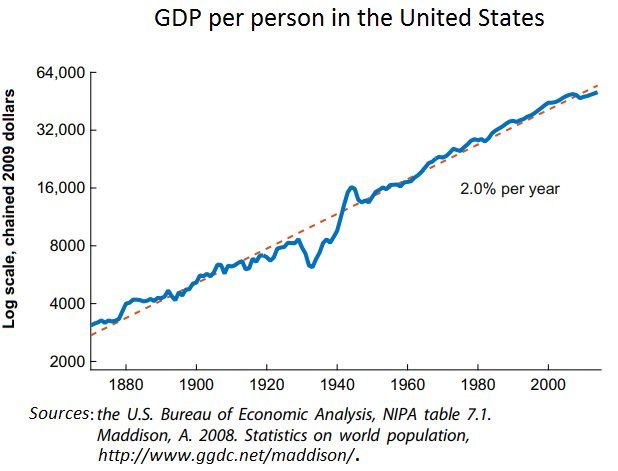
The US growth trend has been fairly constant since the late 1800s. There's no real discontinuity in the trend around the time the US become hegemon.
https://upload.wikimedia.org/wikipedia/commons/0/01/GDP_per_...
Part of why Switzerland is so stable is because of its neutrality. Switzerland doesn't have to deal with Russia interfering in its elections the way the US does.
Trump isn't the problem, he's a symptom.
The recent massive increase in the US governments direct and indirect involvement in business decisions changes things.
Trump is pushing/forcing countries and companies to invest in the US. He's added more restrictions on who they can sell their products. New significant widespread tariffs also exist that forces businesses to decide on how they can handle it while being pressured not to raise prices.
Government involvement in business decisions, even if indirect, is not a market economy. In a true market economy supply and demand should determine prices and businesses and consumers make the decisions on their respective side.
There's also background pressure on businesses to avoid angering Trump and this affects their decision making process.
>attracting talent, innovation,
Trump raised the fee for H1Bs, blocked student visas from 19 countries, and revoked 100k visas for people who were here as students, business reasons, vacation, and other. He also is removing legal status from many groups.
His inflammatory rhetoric and actions have harmed the international reputation of the US. There's also a prevalent anti-immigrant mood in the US and a much smaller
This decreases the pool of people who can choose to come here and for that smaller amount it increases the probability that smart and innovative people may look elsewhere to either study or start a company.
There are also those that had legal status, lost it, and must leave. These are another set of groups that could have contained some talented and innovative people.
Talented immigrants have done so much for our economy and standing in the world. ----
He cut government funding for many scientific research endeavors and government programs. These may or may not be replaced by private industry. It's justified to cut waste as government spending is a problem but speed and extent of the cuts makes it questionable if a proper assessment was done.
----
I'm sure you can point to similar actions in the past but I believe the quantity, speed, and intensity are significantly different than in recent times.
I'm also not arguing that some changes weren't justified. I just believe it's a clear change in the ingredients for the worse.
This is true but not a novelty. The US has been doing all kinds of things to harm its markets for decades, e.g. artificially constraining the housing supply, using tax incentives and manipulating interest rates to goose consumer spending and in the process drive up consumer debt, and let's not even get into all the ways it molests the healthcare market.
That isn't to say that they're good -- those markets are very messed up -- but things like this are bad, not new.
> Trump raised the fee for H1Bs, blocked student visas from 19 countries, and revoked 100k visas for people who were here as students, business reasons, vacation, and other.
The H1B program has been widely abused for a while now and in general the US is in need of significant immigration reform. Many of the things Trump does are stupid, because of course they are, but the general premise of "hey wasn't this supposed to be for researchers and scientists rather than mechanic-level IT work" seems to have something to it here.
You can't say we're importing the best and brightest while also doing everything possible to make it so that someone who is a doctor in another country with a world-class medical system has to basically start over from scratch in order to be a doctor in the US.
And then people will have much to criticize about what Trump is doing. But okay then, so do something better instead of all the doing nothing that was happening before.
> It's justified to cut waste as government spending is a problem but speed and extent of the cuts makes it questionable if a proper assessment was done.
It clearly wasn't. The problem is we need some kind of structural reform -- a system that doesn't allow wasteful programs to accumulate and increase in number over time -- but that would require a functioning Congress, which has instead been doing everything it can for decades to abdicate their role to the executive branch. Which has term limits and therefore the attention span of a goldfish for those kinds of structural problems, and then we end up back in the situation where either no attempt is made to fix it or the attempt is amateur hour because it's attempting a contextual fix to a structural problem.
What's more likely, for a Canadian or European doctor to want to move to the US or for an American doctor to want to move to Europe or Canada? I would say that even with all the current "noise" (which certainly moves the needle a little bit) this is still very true. When we see doctors leaving the US in droves for better careers in China, Russia, Europe or Canada then I would say this is a real problem.
The US limits the supply of doctors by limiting the number of medical residency slots. Foreign doctors are then required to do a US medical residency even if they've already done the equivalent in their own country, which consumes one of the slots. The result is that you effectively can't increase the number of doctors in the US through immigration, you can only change the proportionality in the finite number of slots.
The way for any country to resolve a doctor shortage is to train more doctors, which is the exact thing the US prohibits.
I didn't say that and it's about the amount.
>from scratch in order to be a doctor in the US>>>
Usually no, they have to complete a residency. They are repeating some but it's not starting from scratch and it's probably done to sure about their quality.
If you think it should be changed to make it easier for people to come over that's fine. However this isn't a counter argument to Trump reducing the amount of intelligent and valuable people coming in. I'm not even sure why you mentioned this, it only makes your support of Trump's actions more confusing because it shows me your additional concern about losing innovative, intelligent immigrants
I'm not in power and unlikely to ever be. I can criticize others actions even if I don't have a solution because doing nothing is better than making it worse.
The average person in the US has a living standard higher than the vast majority of the world.
There's no need to make radical changes without careful study as if it's an emergency.
The reason people feel the need to do this is manipulation by the Republican party and it's media supporters that makes people believe their lives are far worse than they actually are compared to other countries.
Sometimes it isn't. Sometimes messing up the status quo forces people to then go back and fix it properly and you ultimately get a better result than doing nothing.
> The average person in the US has a living standard higher than the vast majority of the world.
~20% of people in the US have a net worth of zero or negative. Housing costs are unsustainably increasing faster than wages:
https://www.statista.com/chart/34534/median-house-price-vers...
This prevents family formation because young people can't afford a home. A similar trend exists for healthcare costs.
The US is now spending about as much on debt service as on the military.
The social security "trust fund" is soon to run out and everybody is ignoring it because none of the solutions are fun.
These are actual problems. "It's worse in Afghanistan" is a nonsense reason for not fixing them.
What exactly does this mean?
Do you mean making things worse will cause other to make it better?
How do you know that will happen? Are you claiming that Trump making things worse without plan is beneficial as a catalyst for better?
>~20% of people in the US have a net worth of zero or negative. Housing costs are unsustainably increasing faster than wages:
What's this compared to other countries?
Lots of money will be spent trying to manufacture a replacement, though. That will be fun to watch. If you thought the last-minute rally around Kamala was tough to watch…
Sure, the republicans will look hilarious trying to replace Trump for a while … but those Americans aren’t going anywhere and will gladly vote for the next Trump whenever they show up, same as they voted for Reagan and Bush II.
The American attitude driving this current period is much deeper and wider than one man, and people thinking it will all go away when one old man steps down are going to be “surprised” when we’re dealing with this again in ten years or twenty years or three years.
That being said, I just don’t buy into the notion that the strategy of the party from 2016-2024 (maybe 100 Trump rallies per year?) can carry over into the late 2020s / early 2030s.
If anything, this is me saying everyone is aware that the current window for reactionary politics in America is closing as Trump loses his vigor and gets closer to being too old to do what he did between 2014 and 2024. The reactionaries in the government and behind the scenes may make one last desperate grab at maintaining power.
The US has just finished (maybe?) threatening to invade a NATO allied country. The occurrence rate of that has gone from "never" to "at least once". The delta change on that is infinity: there will never be a world in several generations where that is not a strategic risk the world has to deal with every 4 years.
I’ll admit, I’m becoming confused about the point of our back-and-forth.
All I’m trying to express is that probably by the end of 2026, and definitely by 2028, the people who are trying to enact reactionary change (Stephen Miller, PayPal Mafia, Heritage Foundation, etc.) will have to adjust their strategy. They are losing their charismatic leader, if not because of constitutional limits on presidential terms, then by his very obvious reduced vigor (he will not be able to do 100 rallies in a calendar year again).
On the world stage, yes, America has stumbled. Maybe even worse, some international folks are realizing that the America that they thought existed was just a Hollywood mirage, and that we were always one recession and a few thousand votes in Florida from becoming a global pariah.
They were successful at creating fear and making conflict avoidant people stay home. Despite large amount of protesters, that is real effect.
And it would create real vote suppression. You would had people not voting out of fear. And the opposing side having less votes (even if they win, they win less)
Equally importantly, this is not an operation that could be planned in secret or at the drop of the hat. If the Trump regime tries to do something like this, we'll know weeks or months in advance, and there will be plenty of time to make it clear that anyone who participates will face swift and severe justice.
Also remember it’s not just being charismatic, but charismatic enough to keep people distracted from increasingly unpopular reactionary politics that defy even conservative beliefs (e.g. gun control, speech policing, deficit spending, plenary executive).
They say that they don't like those things, but you can't listen to what politicians and talking heads on TV say. Politicians and talking heads lie all the fucking time. You have to look at what people do.
They aren't stupid in not understanding the hypocrisy.
We are... for thinking that they don't know that they are hypocrites.
You’ve set no time bound so what you say here is essentially irrefutable. It boils down to “on this path we will eventually have a big bust.” You’re right if it happens in 1 year or 30.
You’ve also not defined the bounds of the path. Paths can weave. So essentially that part of it becomes meaningless because anyone can draw a line that starts with today.
Tech has a long history of boom bust cycles. Some busts are much more mild than others. Some upend the whole economy for protracted periods. In reality no one knows when AI will bust and how bad it will be. Those are the key questions, not whether there will eventually be a tech (or broad) bust. Of course there will be if you’re looking out to infinity days from today.
Most economic commentary is like this including the linked article: so poorly defined as to be low worth as even speculation.
Your premise depends on that being true, and you stated that like it's a fact. It's an unsupported opinion.
The US economy was the world's largest before 1890, without anything remotely resembling the global reserve currency or superpower military.
If that is not a red sign to BlackRock, then I don't know...
The circumstances and timing (it's been a while) suggest we are probably closer to a crash happening.
From a loan/interest point of view, the dollar de-valuating a bit is actually not a bad thing for the US. It stimulates exports and inflation. And at the same time that reduces the value of the debt (and that is paid in dollars). The downside is that inflation going up usually also means interest going up. And Trump resisting that because he wants to accelerate the economy might not be a good thing.
The big picture here is oil. The world is slowly moving away from oil as the key driver for economies and paying for it in dollars. China is well on its way electrifying large parts of its economy. To the point where it is starting to import less diesel. And they border on Russia with whom they trade in Yen, not dollars. A world that is going to trade less and less oil is going to be less dependent on dollars.
I'm not an economist though. But planning for some kind of crash/correction seems prudent.
Some of them are, some of them aren't. An economic crash is pretty much guaranteed if international relations break down in such a way that international partners believe trading with the US is a liability. Dollar going down won't stimulate exports if the cause for it was an aversion to buying US products in the first place.
Whether or when that will happen, and to which extent, is another story, all we can say is that the momentum created by the current US administration moves us closer to that point. Will they come to their mind before that happen? Will they be able to restore trust? Will the lingering effect from the damage already done subside? These are hard questions.
It's worth observing that dollars that are never supposed to return to the US don't have the same anti-counterfeiting pressure that dollars spent in the US do. I don't know how much of a market there is in counterfeiting USD for dollarized economies.
Not to mention, that would break fungibility.
Can you provide a source?
A source... for what claim? What do you think I'm saying?
The US economy has had ups and downs and I'm sure will still have but despite the wishful thinking of Marxists it's still the least worst economy around in perhaps the least worst country. It still attracts talent and money. It still leads in many areas. It's still very productive. There are huge ecosystems and a cultural base. It's still the world's largest economy. Where will the balance tilt? China? India?
Anyways, be careful of what you wish for, if the power shifts to China we are going to have a very different world, and not in a good way. I don't think it's even in China's interest to see a large decline of the US, after all they're a big customer.
Yeah aren’t they just Leninist but using us as a signal of what to make? I thought rough shape of the scheme was you get to build a factory using free loans in bullshit money that buys rice and apartments but can’t leave the country, then use that to get real money you can take elsewhere by making shit Americans want to buy. You can’t trade the bullshit money for real money without the factory step.
Sure, the end result will be a deprecation of the dollar. But the interest will be paid.
So the real downside to debt is not-overly apparent. Look at how much money was printed for COVID payments, and the like? And at other economic downturns? I do wonder, when will the merry-go-round stop?
I think another way to look at the expansion of the capitalist economy is the onboarding of people into entry day jobs and transitions of economies upward..
AI may have relatively little to do with the US' tantrums yet I think it has a lot to do with the end of expansion and a fast contraction of the availability of top jobs as the last economies enter the middle of the funnel can't be good.
Citation needed? This feels like a retcon. Remember that the U.S. became the biggest economy in the world in 1890: https://www.digitalhistory.uh.edu/disp_textbook.cfm?smtid=2&.... That was half a century before World War II and the military empire that followed.
Get in power, enrich themselves, kick the can down the road to Democrats, then blame the Democrats for poor economy.
This is why ironically Trump cancelling elections and installing himself as a 3d term president would actually be good. People need to see that no matter how bad they think things were under Democrats, it can get much much worse. Say goodbye to your house value and 401k plans for retirement, you gonna be a wage slave well into your 60s, but hey, at least we fixed "wokeness"
A reasonable scenario right now; rest of the world intentionally collaborates to isolate US, destabilize US, act as a forcing function for US to reassert internal control by swiftly deflating buying power of useless rich[1]. The world is sick of US CEOs who do little but jiggle values in spreadsheets. Sundar and many others have said CEOs are likely a very easy job to automate away; useless pageantry. There is rapidly growing domestic and overseas will to depose those non-contributors.
Fastest way to stem the collapse of reality for 10s of millions of Americans with a lot of guns too.
[1] Americans buying power has been deflated by 300% since 1980... I am sure it is purely coincidence Boomers have run the world for most of it.
no it doesn't.
it's much closer to "you need the best economy to be a hegemon"
Not shown on the chart (and which couldn't have been predicted at the time of writing) is today's crash of almost 30% in that price.
Speculative bubbles happen. The narrative of people losing faith in currency made no sense, because that should pump the prices of durable commodities as well, if not instead of precious metals.
There has been significant recovery in after-hours trading, but check out that "day's range". The low point was around 1:40 PM EST.
After hours has been flat. I think what you meant to say is it recovered a tiny bit from it's regular trading hours low. It's still down over 25% on the day.
most people are long on silver and gold. who cares if there was a slight correction.
I bought the bulk of my silver in the $20-30 range and am still buying. I bought on the way up, I bought at $120, I'll buy at $85. The price at the time I buy really doesnt matter to me. Only when I sell will it matter.
I hope to cash out and buy ~150 acres of land with it to hunt on and live on.
I don't mind getting down voted by leveraged traders who got liquidated.
For disclosure I think gold/silver at this point is way overvalued, just the symptom of what this article is all about.
$15 Trillion gone yesterday
When a dip happens, I simply take 10% of the money, buy the dip, then sell when the price hits pre dip.
So far Ive netted significantly more than any of my peers that actually do investing.
Yes, in a five year span we've had three 20% drawdowns in the stock market that have all recovered which is unprecedented. IMO, anyone who thinks we're going to crash and have a lost decade is not looking at the bigger picture. The Federal Reserve exists to allow the government to spend as much as possible by:
- Making sure that as many people are employed as possible for as long as possible (tax base)
- Making sure that prices keep going up and that the government can borrow below the rate of inflation (so they can spend even more and manage the debt)
What this means is that people need to work to keep up, and that asset prices will continue to go up as people try to protect their wealth from inflation. The government also takes a cut from that via capital gains tax. Regardless, there is simply too much "free money" going around for the outlook to be bearish, IMO. I'm investing across my 401(k), Roth IRA, and brokerage accounts as usual with a little more focus on exposure to international funds this year in my retirement accounts.
You should always take bearish outlooks with a grain of salt especially if they don't put their money where their mouth is and show their positions. Bears don't tend to make a lot of money over the long term: https://www.schwab.com/learn/story/does-market-timing-work
This is reflected in the USD losing value at a higher pace, which means the debt cycle becomes unsustainable.
Hopefully it will gradually managed, but that requires a large amount of political will, tax hikes and budget cuts. Very hard to do fairly and different people have extremely conflicting views on who should get poorer, because that's exactly what cuts and hikes mean.
The current admin is trying to brute force a change, where they keep their cake and eat it too, but they are eroding international trust which just accelerates the issue.
Poorer people and younger people need to work. People with assets and benefactors can rest easy.
"Bears sound smart, Bulls make money"
I’m not sure what the effects of a highly anticipated crash are, but I’d love to discuss what they might be.
It’s priced into gold, which I think reflects negative dollar sentiment. It’s not priced into the VIX, which is implied volatility across the S&P. Suggesting a crash in equities is not priced in.
It's massive and increasing amounts of money that is not price sensitive and keeps growing. There's an underlying bubble message: "the stock market always bounces back, so keep plowing your money into it even when it's down".
Apparently passive funds are 60% of mutual funds / ETFs now https://www.avantisinvestors.com/avantis-insights/has-passiv...
Even more insidious is that this is in part driven by retail who are not paying attention. It's literally the definition of passive, hands off
So at some point, valuations will become increasingly disconnected from fundamentals. Active players will notice and find some way to take advantage. Passive yields will eaten. But at what point will the scales tip and people decide it's a sham and there are better places to park your money? That's when a huge bubble will collapse.
I don't know. Honestly don't know if that will ever happen because I'm not sure what a better investment for average Joe would be than a passive broad stock market index.
If you are invested for the long term then just don't think about it. If you want to diversify a little then go for it - slowly. Also keep in mind your US index fund is full of international companies anyways.
> there is no way going active can help me—I don't have enough access to the right people
It really comes down to this realization. Without access to what all these billionaires and their companies have access to, I just feel like a pawn with everything to lose.
With the rise of ETFs and 401ks people are incentivized (literally) by the US Gov to put their money in the S&P500
And the "instead of picking a needle in the haystack, just buy the whole haystack" only works if there is actual stock picking going on and you get to ride that, but now when there's so much passive investing, it's just everybody buying the haystack, even if there is no needle
Like with the ETFs and 401ks, they will happily buy as much NVDA at its ATHs, it's quite literally massive liquidity feeding orders all the time, coming from retail's monthly paychecks
You basically need the world to decide that EMEA/JAP markets are collectively stronger than the US stock market, and to collectively move their capital outside the US to be deployed in EMEA/JAP. Moves away from Mag7 to US value stocks will be captured by the US stock market index funds; moves into commodities will be seen as opportunities to buy the dip before a market rebound. You can view attempts by US private equity to purchase real estate as attempts to hedge against overvaluation in US markets, but if the US has another Great Depression, those real estate purchases won't be able to fetch high rents or prices anyway.
In short, just follow the normal advice, which is not to put all your money into US domestic stocks, but to also purchase foreign stock market index funds, which help to hedge against the risk of the entire US stock market crashing. In the long run, US index funds are still a good investment - US courts still are quite powerful to settle contract disputes, the US does not have capital flight controls, and American business culture is still one of the hardest working, greediest forces on the planet - a Great Depression v2 would not change that.
Capital is not going to "move away from US capital markets" because those markets tend to over-perform and will likely still over-perform. What companies are you investing in that are not nVidia, Google, Amazon, Meta, Apple, Open-AI, Anthropic etc. etc.?
It's really hard to predict market crashes. I think it makes sense to be more cautious but also that's what could have been said a year or 2 or 5 years ago, in which case you would have missed a lot of potential gains.
I'd like to make a technical note about markets because I see this mistake repeated in the comments. The money doesn't have to move out of the US markets to somewhere else for the stock market to crash. It only requires a destruction of confidence. For a hypothetical example, suppose the S&P 500 closes at 7000 on a Friday, and everyone loses confidence in the S&P 500 over the weekend (for whatever reason). The market can open on Monday 3500 with not a share traded before the open (no money was moved out of the market), and investor portfolio values are now cut in half. Since confidence is broken, nobody buys the dip, and the market closes Monday down to 3000.
It's an extreme example, but it's worth understanding the fundamental underpinnings. The markets are a confidence game. Sometimes we forget because we have good reason to be confident (e.g. in the S&P 500) and so it fades into the background that something like this could even happen, but it's not hard find these sorts of events in history.
The way in which that narrative does not happen is if the capital leaves entirely to be locked up in other investments; in the context of index funds which would anyway rebalance to rise with those other investments, if the capital leaves for other countries, to investments that are not covered by the index funds.
In the past bad news led to jumpiness and people getting out, including retail. Now you have a massive amount of money that keeps going. So if you jump out..you see that so much money continues to plow in, and price starts going back up. So you come back in so you don't miss out. And on we go.
I think it's very possible passive investing is changing the dynamic, where downturns are more muted. It's overall a good thing but again, as I said above, it feels like it's setting up an even bigger ruin down the road
Even if people were to do active bets on equity, what matters is the amount of money flowing in the asset class, so as long as there's an infinite stream of long investments into equity (due to 401k, etc.), the prices will rise.
You'd need people to actively balance their allocation between asset classes rather than stock X vs Y to counter those equity bubbles, but I don't think it's happening (and equity becomes too big to fail given the link with things like pension in the US).
If the right price for equities is 30% of their current value, and if achieving that price means the regime will fall in the next election (or sooner due to civil disorder), then the regime will not allow that to happen.
A regime that controls its own currency has nearly unlimited power to prop up whatever asset classes it wants to, from bonds to equities to housing.
Doing that has consequences like inflation which people don't like, and could cause them to vote the bastards out. But the regime could also print even more money for direct deposits into voters' bank accounts before an election.
So it seems like equities have limited downside until there's a regime change.
The Fed purchases the bonds with cash created out of thin air with a journal entry. That newly created cash is used by private actors to purchase assets, which makes asset prices go up.
The Fed could purchase equities directly, but it doesn't have to own them to influence their prices.
Maybe there will be a "huge bubble" in the future but it doesn't look that huge right now. Forward P/E for S&P500 is about 22. That is 4.5% yearly return even if there is no growth beyond 2026. This is also real growth as earnings raise with inflation so nominal expected return is about 7% even if there is 0 growth beyond 2026.
Meanwhile risk-free rate (basically short term government bonds) is around 3.5% per year right now (nominal). That 7% is quite pessimistic as some "net growth" (growth - costs of generating it) is expected beyond 2026 and you can only get 3.5% "risk-free" I am not sure why people call current valuations crazy or what their expectations for "fair valuations" are. Equity risk premium seems to be still above 4%. Maybe that's on the low side but far away from bubble territory, let alone "a huge bubble".
Passive, (especially global) index funds doing so well and outperforming the vast majority of actively managed, general funds () is not a given, but they point to a different problem.
It means that most actively managed funds are still overpriced (fees), don't deliver efficient price discovery, and in some cases destabilize the market by making consistently wrong bets.
That's not the fault of index funds. In fact they make it easier for high performing investors who have deeper insights.
There are plenty of funds that don't compete on just on beating the index, but have other goals.
If something changes and suddenly foreign equities start consistently beating out US then capital would flow accordingly. But the US still has a massive advantage from passive flows propping it up in perpetuity.
IMO we'll see a correction some time after people get used to the crash not coming. Maybe the narrative will shift back to "money printing means it can't crash" for a while, the market will go "risk on" and then we'll get a surprise correction.
In both those events there was clearly a bubble, and although no one could predict exact dates, corrections were expected.
Exactly the situation now. The problem is predicting the top. Example;You might estimate now is a good time to pull your assets out of the markets, but then the markets go up another 10%. Then a 20% correction happens and you attempt to time the bottom but miss it. Best case you buy back in at about the same point you left. With transaction fees and capital gains you’ve lost money anyway.
I did this in 2007, bought some rentals and missed a lot of gains post 2008.
If you anticipate it, it means you start pricing it in, which means the price is not high enough to crash.
I think many people understands there is a huge capital investment going into AI right now that is speculative and could blow up, but nobody actually knows if its going to pay off or not and everyone just defaults to their personality on how they process this risk.
If you think that everyone thinks a crash is imminent, you need to expand your social circle. Someone is buying the other side of these trades.
I don't know how any self-respecting person can write a blog post that starts with them hand drawing curved on an employment chart pretending they're doing analysis.
Isn't this an indicator of a coming crash, not a counter point.
Doesn't Gold go up, specifically as people buy it as a hedge against a crash.
1 Online shopping market in the range of 5 trillions 2 Electricity and energy price raise 3 Impossibility to lower interest rates 4 Tech market also in the range of multi Trillions 5 Global education and power expansion ...
Meaning that a % of all this money flow goes private pockets destroying medium class, which gets poorer.
It is like a memory leak that keeps sucking resources while growing exponentially until the system crashes. The real question for an economist is how much ram has the system and how much the memory has leaked?
This Legendary site is interesting: https://usdebtclock.org/index.html Especially when combined it´s data with AI.
These aren't even hard problems. Until you meet someone in Congress. Then it suddenly seems hopeless.
I have no idea if this is true (I've asked economists-in-training, they say they'll get back to me), but I've read that the huge increases in tax rates on high income during the war was less to generate revenue (tho more revenue was certainly a need - there was also a growing focus on growing the number of people who paid taxes, which prior had been quite small), but more to ensure profits were not realized and instead kept invested in the economy and the war machine.
A kind of practical "hodl" to keep the wartime economy stock with reinvestment - or really to discourage removing money from industrial investment - to benefit the war-time economy.
Would like links to things to learn more about this line of reasoning.
Would the people benefit from redistributing the things they are hoarding? Corporate stock that pays little to no dividends, mainly? It’s not like they are hoarding wheat. I don’t really get what people think will happen if we redistribute the stored wealth.
All wealth is, is a claim to direct labor and materials, the magnitude of which is relative to the total amount of wealth competing to direct those at present. If some portion of the wealth is locked away, the labor and materials are still being deployed, just the total pool of wealth competing to direct them is smaller than it would be otherwise. Unlocking wealth does not actually bring more stuff into existence.
Now, it could redirect labor and materials used to built yachts or luxury homes into more practical goods. But my impression is that the labor and materials used for those things are minuscule compared to the overall economy, and most of the wealth of the very wealthy is not actually used for those sorts of things.
It’s not. Wealth creates political power, which the wealthy wield to stack the odds in their own favor at the expense of everyone else.
worse, you completely miss the political dimension. hoarded wealth buys the lobbying power to prevent these necessary structural changes. you are engaging in the exact kind of apologetics that has led to american infrastructure collapsing while the capital class extracts rent. thinking that resource allocation is a 'no-op' is economically illiterate
Printing money and spending it on those projects would have literally the same effect.
I’m responding to what I infer as the notion that people must have to say what they say about UBI, which is the implicit “we will pay for X and that will be it” not “we will make other goods more expensive in order to have X, and how we are happening to implement that is by taxing the rich”.
Like how about we just eliminate corporate-government corruption? Like there are a lot of shit business people today with a lot of shit politicians in their pockets, and many of them did not legitimately earn what they have, but is it really better to prevent the accumulation of capital over a certain amount? Then the powerful in your society are <checks notes> people who won a popularity contest.
I’m certainly open to a direct counter argument, but all I’ve seen so far is tap dancing.
Pretty sure the vast, vast bulk of wealth held by the richest US households is indeed “reinvested in the economy at large”.
Where do you think it is instead?
The idea that less than 100 people in the country have some sort of mandated right from the devil to dictate the direction of technology in our country should fill every single decent human being with disgust.
We must correct this. The fact that several hyper scale data centers could provide US school children free lunches + breakfast for a year should be the first immediate sign that something is deeply wrong with our country.
imagine the horror of free loaders eating free lunches, living in affordable apartments close to school, and riding high speed rail each weekend to visit nature. will anyone think of our lords? and what about my iphone? obviously phones will cease to exist once we implement these communist pipe dreams. just look at china, they've got all of this and they clearly hate it. no phones, no brand clothes, oh the terror. you should be locked up in an insane asylum immediately
Amazon is pretty great, too.
Also schoolchildren in my state have had free school breakfast & lunch since Covid.
This is the problem with people like you, you simply lost your humanity because you care more about trinkets than literally shaping a better world for your children.
Unfortunately, going after causes or correcting symptom in any kind of hurry acts as a massive destabilizer at exactly the moment systemic destabilization provides the motive/momentum for taking action.
Hard course corrections at critical pressure, in a complex system, is a value destroying reset.
Companies can do this. Mass layoffs, capitalization sell off, etc. And then recover over time, because the rest of the economy around them is mores stable and the pain gets diluted. Entire countries doing this doesn't work out so well.
But it would appear, that may be the path we are most likely to take.
This is a myopic question only considering the values of securities, gold/silver, etc, which are owned in significance by relatively few.
The working class economy has already crashed. People who have to put in hours to get paid are struggling, and consumer spending is dominated by the top 10%.
The media, ever fixated on the economic welfare of the top 1%, spins a story that if the stock market is doing well, the economy is doing well.
Meanwhile there is an quiet bet that authoritarians will protect interests of capital owners over all else (i.e the bailout OpenAI hinted they might need), while suppressing the primary methods the masses have for expressing their discontent: speech, organizing/demonstrating, strikes, and voting.
> It is like a memory leak that keeps sucking resources while growing exponentially until the system crashes. The real question for an economist is how much ram has the system and how much the memory has leaked?
Needless to say, as an outsider from the inflation bubble, American stocks are not a good investment.
There is a good reason to believe that us stocks will not outperform in inflation adjusted terms over the next 10 years.
In addition, they are all cheaper when priced in USD, so their stock will go up regardless.
This is just counting short term effect of currency devaluation. Long term there are also effects around trade balance and jobs.
Their biggest problem seems to be they're too good at building stuff, whenever a new category of product pops up, they quickly build up both volume and drive down prices through competition so that they saturate their internal markets (see: housing, EVs)
People just have trouble understanding the complexity of China, and assume nothing they say can be true. It has a lot of problems, but progress and ability to make money isn’t one.
If for example, BYD makes a car that's substantially similar between the China and Europe versions, and sells said car for $15k eqv RMB in China, but $30k in the EU, it makes double the revenue for the same 'value'. Even the argument of the EU being generally richer, and thus the car having higher monetary utility doesnt hold - a well-paid EU surgeon wont pay more for it than your average office worker.
So I feel money is increasingly a poor proxy for actual value/wealth etc.
The point of tender is to represent value.
Your water in the desert costing 100 times what it costs where it rains is meant to represent its scarcity here vs over there.
Take cuban dollars vs normal dollar. In there the two tenders aren't proxy for value. Proxy for a political control so that the wealthy visitor pays 10 times, for the same bottle of water on the same shelf.
It's entirely reasonable to expect logistical costs to inflate the price of a good, so the price should reflect the market equilibrium value of the service of bringing water into the middle of the desert, not the good.
Of those, you’ll see that only transport costs are a function of “capitalism” the rest is government.
But I didn't want to get heavily into cars - its a clear and omnipresent feature of modern economics that things cost different amount of money between economic blocks in ways that's not explainiable by the fundamental cost of goods and services rendered. And not only economic blocks - prices of existing concrete (like an apartment that is just there, and been there) goods can increase wildly over time - which in industrial terms would mean society getting less efficient.
I think it's an important thing to discuss, considering the current system's mandate to lead is based entirely around its ability to bring prosperity to the people.
If it's objectively outperformed by other systems, perhaps the system has to at least face the pressure change or be replaced.
But their fiscal deficits have been growing quite a bit, particularly their local governments and they've had some pretty bad deflationary issues recently.
As for deflation - why is it bad anyways? We were taught in school the problem is that if I have $1 in the bank and that will buy me a loaf of bread today, but 2 loaves a week from now, I might want to hold on to it, so deflation destroys consumption.
But that makes no sense, because I can buy bonds or stocks from $1, and capitalize on the gains, so I get the same two loaves of bread - the effects are the same, I dont consume today, and I have money for tomorrow.
The difference is I have to trust my money to either a company or the government, and involve a lot of intermediaries and take on risk.
As for your link you posted, I feel like for finance people, a market they cant make money from is indistinguishable from one thats performing poorly, never mind what sort of lifestyle it supports for the everyman.
If the financial side goes wrong the government can kind of fix it overnight but printing/lending money, nationalizing bust banks and so on. But the physical takes a long time - you can't suddenly have a lot of high speed rail or trained engineers overnight - it takes decades.
The Chinese seem to plan ahead on the physical stuff like houses factories universities and don't worry too much about the financial.
The west seems more to worry about regulating the financial side and leave what to build to the market but that seems to have some aspects that can be inefficient.
Not that it's just east - west. The US has built loads of infrastructure at times and socialists have had many screw ups. Still there may be something to be said for having some sort of long term plan on the physical side.
is demographic in nature. https://www.populationpyramid.net/china/2024/
Also people appear to be blind to the real material limits that really start to be pushed by large populations. You could end up making life materially worse by trying to "fix" the demographics by adding more humans.
China is in a life-or-death race against time. A good number of their decisions are explained when viewed through this demographic implosion-bomb they are facing.
One absolutely would have been able to say the same thing about Japan in the 1990s when they were top of the world.
So I dunno! Anything's possible!
Real estate prices dropped 30% blowing up most people’s savings. The debt overhang is slowly bankrupting various companies. Growth is an anemic 5% (should be double for a country with China’s per capita income) and means it will never enter middle income status. Unemployment, especially for grads is very high and the lack of babies or immigration means the worker base will shrink while the demand for social services will skyrocket.
Doesn’t seem great to be honest.
I happen to agree just because of golden silver prices that it’s going to happen sooner than later, regardless if war breaks out with Iran.
I mean why do you think the FED and Trump are all over each other? Because there is no way out. If they lower rates, inflation. If they raise them, assets collapse.
People have been warning about this exact secnario since 2008 and no one is listening. Back then it was a prediction, but now it is happening.
The stock market being at an all-time high, a crash in the usual meaning of this term is not, by definition, currently happening.
Since apparently this isn't what you mean by "crash", could you define what you mean by this term so we're all on the same page?
However, what I'm claiming is that "all time high" is also quite a stretch. Pretty much all nations have been printing money pretty intensely, so fiat is not a solid anchor to derive "actual value", but CHF might be among those that are less printed, so I chose it.
Even if we chose EUR, EURUSD wins YoY over S&P 500, hence, "stocks are flat". Sure, in the case of EUR, optics are fuzzier and you might pick a point or index showing a small increase over EURUSD, but I don't think it's strong enough to beat the general point, especially if your counter point is "stocks are at an all time high".
It being an all time high was just to highlight how much "not-crashing" they are, but that doesn't really matter. Even if stocks were merely flat over the past year (or even somewhat down), the general point would still be the lack of a stock market crash.
About what though? You haven't explained what you meant by a crash so I don't have much more to go by to understand your point.
If not the stock market, what's the market you mean is currently crashing?
I bought a short sale distressed town house in 2009 for 40% lower than its peak price, and many people told me it was a terrible decision because if I just waited long enough, I'd buy it for a fraction of the price.
I think prices went a bit lower in 2010, but then I gained about 400k in equity over the next 10 years and sold it.
If you know it's coming but don't know when then you don't know anything. Certainly not enough to bet on.
If the market go up 80% before dropping 20% then you want to have bought in.
Everyone knew there was a bubble. People began to get impatient for what obviously was going to happen, as you say.
It's down 12% since a year ago, but that's largely a reaction to the tariffs. It's been fairly stable since July or so and has only seen a small dip (and partial recovery) in the last couple of weeks.
What do you think he will do, given he's one of 12 votes?
- 1987 newspaper ad in major newspapers where he complains about the strong dollar https://www.snopes.com/fact-check/trump-foreign-policy-ad/ (and see the weak yen as something good)
- 2017 "the dollar is too strong and is killing us" https://finance.yahoo.com/news/dollar-tumbling-trump-said-to...
- 2019 deleted president remark from whitehouse.gov https://trumpwhitehouse.archives.gov/briefings-statements/re...
- 2020, mentions of trump "long desired weaker dollar" https://www.forbes.com/sites/williampesek/2019/11/18/dollar-...
- 2024 arguing the dollar being strong is a tremendous burden https://finance.yahoo.com/news/trump-says-dollar-too-strong-...
- 2025 "you make a hell of a lot more with a [weak dollar]" https://finance.yahoo.com/news/trump-strong-dollar-sounds-go...
- 2026 "I think it's great [that the dollar is weakening]" https://www.politico.com/news/2026/01/27/the-dollar-is-sinki... (this one is literally from this week)
If you want to understand the goal of the administration, read Stephan Miran's 2024 paper titled "A user's guide to restructuring the global trading system" (the author is the current chairs of "Council Economic Advisers", the paper is casually called Mar-a-lago accord...):
https://www.hudsonbaycapital.com/documents/FG/hudsonbay/rese...
The TL;DR is something like: use overvalued due to reserve status => devalue 40% via tariffs + threatening to withdraw military protection from allies who don't comply
You can find more sources and videos with fairly basic googling, such as multiple interviews from the 90s (or 80s?) with Larry king, Oprah, and way more, none of that is hidden
False in every sense possible. For starters, the year is only a month old. Second, it’s been pretty stable for the past 6-7 months, and is only down 12% from a year ago - not 15%.
Next report is end of february. So it's minimum 4 months away at earliest.
Stock markets are at 10 year peaks.
Unemployment is a little bit high at 4.5%.
Inflation is a little bit high at 2.7%
US government debt is very high at 125%
PMIs are strong across the board.
Also in context, trillions in declared new investments in the usa. Probably trillions more in undeclared new investment trying to avoid tariffs.
No competitor possible on reserve currency status, Euro in about 2013 was looking like hot stuff but they regulated themselves out of it.
So I consider, the crash probability of the US economy is certainly not going to be happening.
Put the value of gold on the X axis instead of the USD.
So many of the stats you mention are based on potentially-untruthful statements from the Trump administration. When the facts and figures aren't favorable to Trump, his strategy is to shoot the messenger and install his cronies. Works great, right up until it doesn't.
Sure, Mark Carney gave his little speech in Davos. The same Mark Carney, that led Brookfield while its finance arms operating out of US.
But realistically, how is opening up to China more even considered as the alternative? When has any deal with China worked at a strategic advantage for the other side? Is not the whole reason the so called globalization project failed was because players like China did not play by the same rule or did not even have to play by the same rule? What gives they will when you open up the market more to them? All it takes is for them to take your product, copy it and sell it 20x cheaper and flood the market everywhere else.
Whenever I've heard people speculate on the US bond market losing its footing, the suggestion isn't that "Japan will be the new US" (eg) - it's that investor will spread assets across multiple places (US, Japan, EU, etc) to hedge against risk, rather than just the US.
You're not betting in winning, you're betting on minimalizing losses. Huge difference in behavior.
People were literally paying the US government to hold their money because it was better then the alternatives: the options can all be bad, but some can be worse.
ECB is doing one reckless thing after another which will inevitably lead to Germany leaving Eurozone at some point.
We also need to seriously adjust our line of thinking at what they are capable of. The "copycat" era is ending. Our supply chains have hammered their youth with generations of engineering knowledge. If you are relying on an ideological difference to assume they are not capable of innovation, you are making a strategic mistake.
The question is whether China offers long-term stability for external investment. Should US retirement portfolios load up on Chinese equities?
I don't know what that means? Market crashes are changes in speculative value, they don't care about counting literal amounts of currency. Selling US securities doesn't require that the resulting "liquidity" move anywhere else, just that the owner prefers to see a cash balance to a stock certificate or whatever.
Basically this point seems like a big "confused money with value" mistake.
For every seller there has to be a buyer.
> The incentive structure at the ECB has become distorted and favors high-debt countries [that underperform or are risky]
Australia did well out of the Australian-China free trade agreement and then won the subsequent (Australian-caused) trade war.
Turns out being able to produce iron ore cheaper than anyone else and having plenty of alternate buyers when China bans imports means the iron ore price just goes up, Australian miners make more money and Chinese manufacturers get annoyed at Chinese trade policies.
Wasn't awesome for Australian lobster fishers though.
No chance. Unless that happens after a lots of other countries leave
Whoever comes into power next better start thinking about universal income fast. We are gonna get there sooner than expected.
Of course it's very disruptive for people that lose their jobs, but many of them will get similar new jobs, and the overall impact is higher output.
The impact of that transformation remains to be seen.
(1) Laying off people increases margins immediately.
(2) Creating new initiatives pays off in years, if initiatives are taken on carefully, not just thrown at walls.
That means even if (2) is happening, the signal won't show up for years, but (1) will happen immediately, regardless.
This is not a reasonable premise.
Why would CEOs care?
Or put it another way, if you were a CEO, would you care?
Politicians at least would pretend to care.
Why would the Jevons Paradox not apply here?
There will be loads more people who will want software customized to themselves and their needs!
The catch, of course, is that there are, all of a sudden, a whole lot more people who will now be able to create that software.
How will it all land? No idea. But it just feels like a bad idea to go long on software development when weighed against the opportunity cost of going long on domain expertise.
For instance, from 1980 to 1990, the number of secretaries doing all the typing and filing in the workforce severely constricted. That said, the number of actual typists in the workforce skyrocketed!
No one lost the need for typing and filing services. Tools, (PC, word processors, databases), simply became more available. Which decreased the need for people who were formerly doing the typing and filing as a service. Now people could reliably do the typing and filing on their own.
Jevon's paradox in action! Exponentially more typing and filing is happening today than was happening in 1976 or 1980. At the same time, there are infinitesimally smaller numbers of actual secretaries out in the workforce today than were in the workforce pre-1980. And the ones that are still in the workforce are doing much different work than they did pre-1980.
If any of these tools did 10% of what their proponents claim they would become trillion dollar companies overnight and not you know... struggle so hard selling the amazing elixirs and perpetual labor machines.
Source?
What you're claiming is completely untrue. There have been claims like this circulating on the internet recently, and they're all based off this one chart:
https://fred.stlouisfed.org/series/IHLIDXUSTPSOFTDEVE
There are a few major problems with this. First, all of the data comes from one source: Indeed. Indeed SURGED in popularity in the Covid years and interestingly fell off in popularity at exactly the same time as the FRED chart topped. Hey look - the chart for total jobs posted on Indeed looks similar:
https://fred.stlouisfed.org/series/IHLIDXNEWUS
Beyond that, the effect is further exacerbated by the fact that tech hiring went absolutely fucking bonkers during Covid as everyone was convinced we would be stuck inside forever and money was literally free to borrow. The FRED chart only shows us the data during Covid. The inability to see realistic developer hiring numbers before that limits your context and gives a false impression. Here's a chart that goes a few years further back (first one on this page) and shows that hiring has simply normalized:
https://www.dallasfed.org/research/swe/2024/swe2406
Finally, look at the first chart again. Claude Code was released in May 2025. The chart has actually been RISING since that point.
But the software sector was cut in half by Claude Code. Right. And the false narrative marches on. It's honestly amazing to me how people just soak up false information with literally zero filter and zero critical thought or willingness to do some research.
USD Currency futures have already collapsed.
World trade will move to (not a good idea) RMB or (mistakenly) crypto.
Euro is the only real option left and it’s beautifully positioned in the center. Great leadership too.
Now, when I say live like you're poor, I mean do it smart. Don't grocery shop at a gas station, do your necessary purchases in bulk (actually poor people can't or won't, but would be better off if they could.). Don't but the cheapest boots, but rather the best value. But when choosing how many vacations to take, maybe pick camping locally more often than exotic vacations. Eat simple foods, don't order out fancy stuff and get accustomed to such luxuries. Don't automatically buy the latest consumer toy just because it looks fun. Don't move into a nicer apartment just because you got a raise. You get the idea.
Get used to using public transit, if it’s at all an option for you. Going down to being a one-car household instead of two saves us at least 5k EUR per year, even counting the additional cost of two unlimited local transit passes.
Avoid habit-forming conveniences like restaurant delivery, and instead learn how to grocery shop with a list and to cook things you like to eat. If you’re really pressed for time, order your groceries online and pick them up, or get them delivered (that’s an easier thing to back away from if money gets tight than restaurant delivery).
Develop non-consumerist hobbies, where you can get a lot of enjoyment out of little marginal expenditure. I’m partial to fiber arts (free/cheap sheep fleeces I clean with dish soap, then spin and crochet/knit), but there are plenty of relaxing ways to spend time that don’t involve spending much money or being convinced to spend money (like most media consumption - everyone is susceptible to advertising, to some extent)
Painfully I’ve learnt that you want to work in an industry that is largely recession proof.
Focus on industries that sell things that people need and will try to keep buying right down to their last buck.
Food, utilities, insurance. People don’t like sitting in the dark. People need water. People need to eat. People really don’t like living without insurance cover or to let cover lapse.
They don’t need Netflix, Disney+ or Prime. They don’t need Spotify. They don’t need training or e-learning. They don’t need luxury goods. They don’t need new motor vehicles. They don’t need holidays. They don’t need new iPhones or new computers.
Try and move now to an industry that has some security.
Investment wise diversification is key. Just pray that it doesn’t get so bad that banks start to fail.
They plummeted to next-to-zero, and in addition to the injury I had to endure the insult of the people who hadn't seen it coming gloating about their low standard variable rates.
Ofc I clearly didn't have much real economic understanding but I guess I am saying that beyond normal common financial sense (the lack of which at scale leads to these situations) which you should be using anyway, we don't really know which way the wind is blowing, and what the exact consequences will be.
That you can do anywhere as long as you have a collateral/guarantor.
The Trump admin has floated the idea of allowing prepayment penalties in home mortgages, BTW.
Every home owner in the US would be against it (especially the ones who got their mortgages in the past two years at relatively high interest rates).
One argument is that it could allow for lower rates, BTW. (This is true, it very well could).
And also, if it happened it would be for newly issued mortgages. Existing mortgages have language in the contract that you couldn’t just unilaterally change
If you look through the bond market you will sometimes see bonds issued by the same company or agency both as callable and non-callable, the callable bonds are usually .5-1% lower even when issued on the same date.
Consumers have a tendency to pay loans back early when the bank doesn’t have any more profitable alternatives. Consumers also have a tendency to NOT pay loans back early when the bank does have more profitable alternatives.
But you know that the first situation is worse for the bank than the second situation. So they do account for this, to a degree, when they give you a loan. In theory they would be willing to give you a lower interest rate if you gave up your prepayment option. In theory. In reality? Who knows.
Demand for mortgage varies over time, regulations change. It's a long term product, banks like to know with high certainty that when someone signs up it will be X earned over a period, not maybe X minus we don't know over an unknown period.
They are in the business of capital efficiency. Lack of control makes capital less efficient, or at least more expensive to keep efficient.
Overpayments (in the UK) are often not allowed, when they are, the borrower needs to arrange it when the loan is taken, and for a fee.
Refinancing is a right, but the fine prints told borrowers at what penalty.
(This might sadly be rhetorical given what I hear of '08, but perhaps there are new channels open to take advantage of. Or at least old channels to raise awareness of).
Have you considered applying?
What do you recommend applying to? I work in games so I guess I'm playing on hard mode (especially in these times), but the common wisdom of "normal software jobs love taking game programners in" hasn't rung true this time around.
----
Life story: Laid off mid 2023. I took a few months off when I got laid off, but the last quarter of 2023 wasn't kind to me.
2024 got me some freelance work, so I wasn't out on the streets, but it was a complete circus of an interview racket. Honestly worse than my first job hunt out of college. Its bad when you feel deep down there was someone better than you, but when you go 5 rounds in with good vibes to hear... Nothing back? That's truly disrespectful. And it sadly wasn't a one off.
Then in 2025 I hit some medical emergencies so I needed to urgently find anything. So I found part time work outside of tech and made due with that as I paid down those debts. That totaled up to a part time freelance gig, a part time job, and a few (failed) attempts at some hustles over 2025 only to end up making maybe a third of what I made back in 2022.
Now it's 2026 and I'll try again next month. My freelance work covers any gaps I would have had, I have a website almost ready with some personal projects to point to, and I'm overall more adjusted to the realities of this current market and will approach accordingly. I'm optimistic, but I know we're still in the thick of the weeds here. So I'll take any leads I can get.
This advice is from half a century ago. The times have moved on.
The person saying gold and mining stocks may or may not be correct - it's still a risky position. Precious metals could be in a commodity bubble right now (or not). It's had to predict anything with perfect accuracy, which is why diversification matters.
You probably shouldn't be jumping completely in or out of anything because that requires timing, which is also not easy to do. What you can do is change he weights withing your portfolio. For example, reducing your US equity exposure to increase your bond exposure. Or reducing your US growth exposure to increase your US value and Eurozone dividend exposure. It's best to listen to several financial companies reports to weigh what to do.
In the meantime, keep investing to avoid eroding the value of your money as the dollar drops in value. It also prepares you for the possibility the crash doesn’t occur for a very long time, long enough to grow your net worth substantially to be better insulated.
This all depends on what timelines you work on, how many assets you are trying to protect.
Alternatively you protect yourself by lowering your dependence on steady income.
Ads from the World Gold Council are becoming very frequent, targeting consumers. That must mean something (looking for exit liquidity)
Also (not a financial advisor), when a crash occur there is a so called "flight for quality" where people move money they made by cashing out the assets to stable (A+ assets). So look for companies that have solid financials and can weather the storm.
Finally, diversify not only on the industry, but also geographically. EU, Swiss, Asian. I personally stay a bit away from emerging markets stuff as I don't have enough knowledge to make informed decisions (I don't even consider Emerging Market ETFs which should be run by SMEs).
That sort of rules out an easy or known way to predict and avoid bubbles. That said, it's worth noting our current historic period marked by being post financialisation (taking out a bunch of investment regulation) of markets in the 80s exhibits a lot more economic crashes (the real reason we should car about bubbles) than most of history (although most of history also does not exhibit any economic growth, so be careful what you wish for).
In particular, the period between around 1930-1975 showed extremely high growth with almost no bubbles or market crashes[1].
So my semi-knowledgeable but definitely not expert view is that: - Bubbles and crashes are not easy to predict, and therefore avoid - That said, our existing market rules have effects on the number of crashes/bubbles we see (but there's debate around whether you actually would want an economy with less crashes/bubbles if that meant left growth)
[0] https://www.hbs.edu/ris/Publication%20Files/Bubbles%20for%20...
[1] You can find this discussed a bunch of places but Ha-Joon Chang's Economics: The User's Guide talks about this very fluently.
Edit: I think your question might actually have just been about personal protection again bubbles, rather than protecting the economy as a whole. In which case, having margin in your spending so you'd be able to live if things were some portion more expensive against your earnings is probably the only sane suggestion.
But, keeping both feet on the ground, I'm tempted to think that if the economy collapses I'd not be very interested in buying precious metals. I'd be looking for food, a roof to live under and safety.
My grandfather lives in a great depression in Manhattan. He told me some crazy stories, but you know what most people made it through. I think this time our system is more fragile, but I have no doubt that human survival is much stronger than me think as well as human socialism.
For instance, I am homeless living with schizoaffective disorder and I’m not worried so why should you be?
https://www.cnbc.com/2026/01/30/silver-gold-fall-price-usd-d...
On January 26, 2026, silver experienced its largest one-day jump in 45 years, with front-month futures soaring by 14%. Spot silver prices surged to over $109 per ounce that day, driven by heightened safe-haven demand and industrial usage. The rally continued to push silver prices toward $120 by January 29, 2026.
And regardless, silver is still at an all-time high.
When you start saying that the news is biased against certain commodities or equities, you’ll start to see how the game is played. This is a tactic of JP Morgan.
Volatility is expected. Always remember that. Volatility is expected in fragile economies.
IMO Paying your debt always seems prudent - whether we'll see huge inflation or even deflation - when you can live in the thing you're paying for.
Holding asset yourself (gold) causes logistical issues and massive buy/sell split on your side, but it has some advantages too.
a) massive GDP growth with real consumption rising 22% between 1944 and 1947.
b) fiscal discipline where the U.S. actually ran primary budget surpluses in the late 1940s
c) financial repression with the Federal Reserve capping interest rates at around 2.5% while inflation averaged 6.5%. This meant the government was paying back debt with "cheaper" dollars, effectively "inflating away" the debt at the expense of bondholders.
Fast forward to today, there is an often stated belief that the US will grow the economy again, this time with a dramatic expansion into a space economy including orbiting data centers, solar power plants, asteroid mining, space manufacture - all leveraged with robotics and AI. Let's be generous and assume this actual happens and that it happens soon - what mandate is there that this massive space economy will be denominated in US dollars or even be part of the US economy? SpaceX has already launched numerous satellites for foreign countries. What is to stop them launching a space economy that will be owned under a "Flag of Convenience" from an offshore tax-free zone, perhaps even denominated in crypto? Will we then confront this massive off-planet economy with "space-tariffs" in order to import the value-added component back into the US? The U.S. debt can only be "grown away" if the value-added activities (mining, manufacturing, computing) remain registered in the U.S..
As for whether it is better for everyone, that question became a lot harder in just the last year. Who is «everyone»? And what do we mean by «better»?
With the US wanting to annex territory from its NATO allies, and engaging in extortionate tariffs, it is harder to argue that the US is good for Europe. Which is why Europe has already started to look eastward. Starting with a comprehensive trade deal with India.
What’s happening is good for Russia and China. Not so much for the rest of the world.
China alone has a higher population than Europe and the USA combined. I'd say that even if things got worse for Europe, to humanity it still constitutes a net benefit. Lives aren't of less value just because they're in a (gasp) communist country.
This goes for Asia in general. Korea, Japan, and China spent centuries fighting and making them the de facto super power makes it easy to resume the Korean war or try to overtake the (military wise) crippled Japan should they be emboldened by the faltering/collapse of NATO.
Are their global fishing fleets sustainable?
Where do the precursors for fentanyl come from?
As in any developing country, China has relied on cheap fossil fuels for rapid growth. Now, China is a global leader in reducing emissions, essentially blowing every other country out of the water.
> Are their global fishing fleets sustainable?
Is literally anything about the US sustainable?
> Where do the precursors for fentanyl come from?
You mean the legal drug that is absolutely 100% necessary for use in hospitals? Yeah, don't care.
It seems you're supremely focused on "China bad" gotchas as a desperate final gasp because you may be realizing that you don't actually have anything interesting to add to any conversation on any topic. Perhaps think more before opening your mouth.
That’s not great, but it is a positive. And certainly better than we feared a decade ago.
The world isn’t static.
New things need new words to describe them, I know people love to call bad guys "nazis" or "communists" and that everyone seems stuck with 1939 lingo but come one. 1950s china isn't 1980s china which isn't 2026 china, yet they're all ""communists""
Yes, I know, they have moved away from historical communism, and it's more of a "brand name" than an ideological description. Still, it is their chosen name for what they're doing.
It's also why Democracy and unbridled Capitalism leaking into Hong Kong is problematic for them. Though, to be fair, Hong Kong is also why Shenzhen has been such a success for them.
It's essentially a dogwhistle to spot idiots. Anyone who says "China isn't communist" completely lacks even the most basic comprehension of ideological concepts.
Authoritarian. Totalitarian.
https://en.wikipedia.org/wiki/Red_fascism is an OLD term.
> Authoritarian. Totalitarian.
Yes these apply, but they're not synonyms of communism. The Iranian government is authoritarian, totalitarian and absolutely not communist
> Red fascism is an OLD term.
But surely you see how dumb this sounds? Fascism is by definition a far right moment, communism is by definition far left moment. By definition fascism is opposed to communism... Of course if we start using literal American propagandists buzzwords ("red fascism") as a basis for modern political discussions we're not going to get anywhere...
The Nazis weren't socialist. They appropriated the term as a propaganda tactic, a means of appealing to the masses. North Korea calls itself a democratic republic, but is obviously neither. One can't simply assume political labels to be correct. In terms of their actual policies and beliefs, the Nazis were vehemently anti-socialist.
https://en.wikipedia.org/wiki/Corporatism
This was their economic "Holy Bible"...
https://en.wikipedia.org/wiki/Labour_Charter_of_1927
If you really want a rabbit hole, compare the Labor Charter of 1927 to Project 2025 while assuming the free market rhetoric in the later is deliberate misdirection.
Make of that what you will. Power isn't always tanks and soldiers. Sometimes its bureaucracy and contracts.
The lines are still being drawn, but its doubtful one single power will emerge.
But as a trade partner? China, markets love reliability and stability. Not every 4 years wondering if there will be another trade war for reasons unknown.
You'd be very surprised the amount of malicious behavior countries will ignore to allow trade. Look at Saudi Arabia.
Even with a "return to normalcy", the trade and military agreements being forged are permanently diminishing America's influence. Especially given that we're never more than 4 years away from this happening again.
Cooperation among the rest of the world is rapidly progressing in response.
Which faction that emerges as a dominant ever says "Oh no! We better stop using our advantage to improve our condition".
Apparently their worst offence so far was calmly outgrowing and out competing their peers while benefiting global consumers with he fruits of organized labor of their own society.
And I was just speaking of what I think about China, not saying the current US administration is any better. I don't think it will be there forever though.
When faced with credible threat of islamic terror in their country China implemented some harsh, systemic ideas about what to do with it.
I'm sure if they just started two wars in the middle east instead the western community would be way more lenient towards them.
China did what it though was the correct thing and the west happily classified it as racism and religious persecution.
However when the pandemic came China had zero restraint towards applying harsh measures on the bulk of their population regardless of race and relligion. And while their solutions are harsh and possibly incorrect is it really unique on the global stage?
US, the shining city on the hill, when faced with a problem of having inadequate social support systems to help the more recent immigrants decided that it will try to build concentration camps on the teritorry of one of their closest vassals. This can't be correct or humane solution either.
And when it comes to surveillance, China is on the forefront, but US and UK closely follow. What's different is that China does their surveillance overtly and tries to make it socially useful. I don't for one second believe that technologically Palantir and such are more than one step behind.
But that doesn't make what China does better in any way. And those millions of Uyghurs they locked up couldn't possibly all be terrorists. That makes it racism and religious persecution.
Ps how is Cuba a vassal state of the US? When you speak of a concentration camp I assume you refer to Guantanamo?
> And those millions of Uyghurs they locked up couldn't possibly all be terrorists.
They were unassimilated population that China believed (while watching the west) might breed trouble. This alone makes the comparison with what US is doing right now pretty fair.
> That makes it racism and religious persecution.
Chinese was locking up all ethnic and religious groups during the pandemic. That might point to an explanation that maybe religion and race is irrelevant. Only safety matters.
If westerners did that it would be racism and religious persecution. But in a culture that gives a very little thought to both race and religion saying that might be just western projection.
> Ps how is Cuba a vassal state of the US? When you speak of a concentration camp I assume you refer to Guantanamo?
No. I'm talking about Salvador and a place built with US money where people that ICE has no idea where to send back are kept indefinitely. But I don't want to discuss that, to avoid whataboutism. I'm just telling it to provide background for evaluation how terrible were the things that China did.
Yes, they want Taiwan, but that’s a silly national pride thing. It would not really benefit them to take it by force.
We thought the same about Putin, and yet he went and invaded Ukraine.
We thought the same about Trump, and yet he went and abducted the president of a sovereign country.
Never underestimate nationalist BS or outright mental deficiency.
Xi is not facing those challenges. He wants Taiwan, but the Chinese play long games so he can wait.
He is facing other challenges, a lot of chickens are coming home to roost - chiefly the demographic collapse, the inevitable result of the one-child policy, but also the rise of wages leading other countries to be the outsourcing target, decades of selling out nature / the environment, a crashing real estate sector, brain drain...
Xi controls the politburo standing committee which is packed with loyalists. Loyalty is centralized and based in ideology. The state, functions as the embodiment of Xi’s ideology. There exists no independent power base. Military or otherwise. And this is the most important reason Xi is pretty safe. China’s elite is deeply invested in the system (wealth, family, careers). They lose everything if the party fractures. So the choice for those who don’t like Xi is between Xi and chaos.
In Russia power is split. Between oligarchs, security services, military and regional elites. All of which represent a threat to Putin’s power. Just look at Prigozhin’s mutiny: armed forces hesitated, elites stood back to see who would win, system didn’t close ranks. Institutions are hollowed out with no clear loyalty. And loyalty itself is highly transactional. Never ideological. There is zero cohesion in the elite. Zero.
It is also important to look at the histories of China and Russia respectively. In Russia power has _always_ been fragmented. Even under Stalin, considerable power was in the hands of criminal organizations and the communist regime had to co-exist with the criminal classes. In fact, during Stalin, they actually got a worse as the harsh political climate forced them to become more resilient.
And yet they got themselves into a demographic death spiral
Swiss Franc is generally very stable so a good yard stick for other currencies over the long term
It will suck even for us in europe due to shortsighted pension funds having invested in AI as well. But we'll just have to deal with it. I'm sure it will happen sooner rather than later.
PS: I'm not an AI hater as such. It definitely has its usecases where it shines. The problem is like with all hypes; it's not good at everything and it won't be all golden mountains tomorrow like the investors expect. This overhyped investor circlejerk is what screws up technology. It happened to blockchain, it happened to metaverse. All things that have their merits but somehow investors thought it would change the world overnight and make them insta-rich. Obviously didn't happen and it won't happen now.
I don't think AI is comparable to these technologies.
AI had a real impact on certain daily activities, such as search, coding, etc. While the metaverse was just a fantasy with no tangible benefit other than Zuck trying to create his own platform to take on Apple and Google.
Blockchain had some potential in certain fields, but it wasn't user-friendly or usable by many people.
You aren't addressing the issue at hand, the problem isn't a total lack of impact, it's the cost of that impact, both the actual and the opportunity cost of it.
Currently, the AI "revolution" is running on pure credit - as every other bubble - even the operating costs of the AI supply chain exceed its income and economic impact. Their capital expenses are orders of magnitude higher and constitute a severe drag on the rest of the economy.
There's no indication that anything would change in the future, more AI leads to less employment, less disposable income and less income for the AI providers - it's a race to the bottom.
If this isn't reversed, it will soon end in bank bailouts, more inflation and income degradation for those bellow the top tier.
It’s not like I can even leave for greener pastures, there’s nowhere to go.
Not a trick, if banks fall everything falls. what is infuriating: that we can see the value isn't there to justify the cost, yet that unprecedented amounts continue to flood into this tech segment, especially to the loudest and popular and over promising flavour of it: GenAI.
He wasn't early with a good thing; he was unfathomably disconnected from reality with a bad thing
It's amazing for gaming though, and for architecture, 3D product design collaboration. I use it a lot daily and I have 5 headsets (plus two AR ones) but I also know it's not for everyone. It's also really good for porn which somehow in America isn't seen as a real industry but in my view it's a good usecase for the tech too. Anything that relies on immersion benefits from it.
AI has its niches too where it's genuinely useful (and coding really is a niche, it's not a mainstream activity) but just like metaverse they're trying to cram it in situations where it doesn't really add any value.
Only to a very small degree and systems like Germany THANK GOD do not have any AI exposure at all.
The real problem is that when the US sniffs, Europe gets a full blown cough. We are way too dependent on the US, we have seen that 2007ff, and we haven't changed a single darn thing.
Well put, and it makes sobering reading to see the impact of what happened the last time Germany was deeply reliant on money from the US.
If every idiot (I'm including myself in this) on HN/Reddit/Youtube/Tiktok/mainstream news/etc. thinks we're in a bubble and is crazy pessimistic and thinks economic collapse is near...it means we're not actually in a bubble.
When the bitter, frustrated pessimists on HN shift their tone to being neutral or even mildly optimistic, then I will start worrying. Because that will mean the general public must be reaching 1999 levels of euphoria for a hint of optimism to show up here.
That seems to have happened around 2023 or so as people chose to laud over AI instead of understanding the underpinnings of society coming undone in real time.
So, should I be worried?
I find it amusing that, even when directly calling attention to the overwhelming pessimism that is the default-state on HN, I'm met with a pessimistic comment with zero self awareness.
So me pointing out optimism in discussion strengthens your claim, because it's specifically my feelings that prove your point.
Well I'm glad you can prove yourself right, if nothing else:
>When the bitter, frustrated pessimists on HN shift their tone to being neutral or even mildly optimistic, then I will start worrying.
Denial sure is a worrying point.
People are moving out of Bitcoin and into Gold currently. I see this trend continuing (Bitcoin falling).
The markets today are indestructible at the moment as you have witnessed over the last 3-4 years. This year will be similar to 2025 according to many different and smart people. I tend to agree with them and we are still in a bull market.
-not an expert, not investment advice, your mileage may vary.
The economy is still growing from the quarantine lockdown. It's why we didn't see a collapse, it would have to be worse than what happened during the lockdown for the economy to be in a recession. That's not the case, and I don't see a collapse or recession for at least 3 years.
For most of us, we work remotely and some people might be out of touch. Don't take this the wrong way, but people are just recently recovering from cottage syndrome. We're still in the transition period with the layoffs and AI doomerism being growing pains.
Or we burn the oil -> heat into the atmosphere via silicon doing things like routing “wyd” texts around dozens of network devices across the country when the message doesn’t have that value.
The economics of how we allocate energy makes no sense and we debate how to fix this via policy.
Apologies for quoting all 3 sentences of parent, but the poorly-drawn conclusion depends on the full sequence of seemingly rational statements.
The context this sequence is missing is that approximately 70% of the US economy depends on consumer spending. [0][1] If the lower stroke of the K-economy diverges too much from the upper, the economy is going to grind to halt.
Consumer spending of the bottom 90% cannot (easily?) be replaced by the top 10%.
[0] https://govfacts.org/money/broader-economy/economic-indicato...
[1] https://www.npr.org/2025/11/23/nx-s1-5615222/consumer-spendi...
The article’s core argument is that the U.S. dollar isn’t going to lose global dominance in some dramatic, headline-friendly collapse; instead, like every reserve currency before it, it will slowly erode at the margins as users quietly reduce reliance on it. Historical transitions (sterling to dollar) didn’t happen because of declarations or crises, but because the world gradually found alternatives that were good enough for specific needs. What’s changing now isn’t that the dollar has “failed,” but that the global financial system has evolved past some of the assumptions that made dollar dominance frictionless. The freezing of Russia’s reserves in 2022 shattered the idea that reserve assets are politically neutral, prompting central banks to hedge geopolitical risk via gold, bilateral trade arrangements, and non-dollar settlement systems. The result isn’t de-dollarization as revolution, but de-dollarization as creep: a long, largely invisible process that only looks obvious once it’s mostly done.
TSLA is like a snowball down a hill. It morphs from EV to autonomous driving to AI to robots to space to tera fab to space datacenters. Rolling in the next big narrative or gov handout as it speeds down the hill.
Of course the market will go down at some point.
With all these charlatans predicting imminent collapse it is always imperative to consider how strongly they believe in their revealed preferences, based on how much they have invested in their position. That said, how much money does OP have invested e.g. in shorting the S&P 500? Or any equivalent. Let me guess, zero dollars.
The slope in 2024 and 2025 (the data that we already have) is much lower than the orange line drawn.
Following the real visual trend, the next peak would be maybe another 5-10 years in the future. (Not that this is a good way to predict the future, as also stated in the article, "not very scientific").
Uh, that's not accurate. Hathaway is sitting all cash because of it and so far they have been the one losing. Even if you assume (and correctly I think) that the market is overvalued, their stock pile of cash is eroding: https://newzsquare.com/warren-buffett-warns-of-fiat-currency...
> A year ago there were a few signs. Right now, it feels like everything is primed to blow. Is that new?
The market is unhealthy. Too unhealthy that I think it can no longer self-heal the usual ways (recession/crash/etc.) and we'll instead move to more advanced stage of hyperinflation, global war, etc.
I'm not saying all this will happen. Just that capital doesn't have to "go" anywhere for a crash to occur.
So the law of supply and demand just magically reverses itself?
This was the multi-decade problem Japan ran into after its hot economy imploded, and unleashed the "lost decade" (which became decades). It was not a marginal issue, and for year the Japanese government tried everything it could think of to get people to invest in things - to little effect.
Claim: people will just choose to not invest capital at all
Response: that’s the opposite of what we know about supply/demand. When a supply of something (desirable investments), goes down, with demand steady, prices go up
It’s the same thing that happened during zero interest rate environment - huge supply of capital, few places to put it, so it piled into tech which drove up prices
So I guess my answer to “where will the capital go?” is “the next best thing” which drive up prices of that thing
No. Claim: People will have less capital to invest.
Most portfolios are not cash-heavy. They own assets. If they want to invest in something they borrow against the assets or sell them and get cash. If the assets' prices crash they can't get as much cash for those assets.
Cost of borrowing - which is what you're referencing from the ZIRP era - is another factor into how much people can borrow against assets. But if the assets themselves trade at an average P/E of 20 instead of 40 then people can only borrow half as much money at 1% interest rates.
In 2008/9 people became paranoid there was nowhere safe to go and that really screwed things up on top of everything happening in the stock market.
https://www.investopedia.com/articles/economics/09/money-mar...
So you are predicting everybody will escape into dollars. Which by themselves are extremely risky because the world is at the verge of ditching dollar as global currency.
There was already double digit inflation just because during the pandemics US overprinted dollars in relation to the size of the global economy. Imagine what the inflation will be if the dollar economic domain shrinks by half or more.
Like with the implosion of the Japanese economy, people will just not invest, instead parking their money in low-yield bank accounts. It was, in some cases continues to be, an issue for that country.
My guesses would be "everyone's assessments go down together because OpenAI et al's predictions of their future revenue are observed to be consistently vastly overinflated vs actual performance, but everyone was previously assuming they were roughly correct" or "some political thing happens which makes OpenAI et al's services obviously much less valuable or makes them much less able to provide services".
You know that the reason things bubble and burst is because speculation outpaces reality at too high a rate, ie : too much "capital" is make up of hopes and dreams.
When reality hits and the numbers make sense, all that hope and dreams go pop.
Scotty doesn't know!
It’s not just people. Central banks are buying precious metals due to the dollar and new Basel rules. Gold needs to be allocated if you want it to be considered a tier 1 asset.
Why did you feel the need to post this article? It totally lacks substance. The above quote says it all.
There’s the looming threat of geopolitical world war that has been overhanging the world since the combination of the pandemic isolating different countries and Russia’s invasion of Ukraine.
It’s really a mixed bag, but it’s not clear to me that we are headed into a total economic crash as the government is definitely focused on doing a lot of good things for the economy, but also is creating lots of different headwinds.
They have managed to significantly lower expectations for global economic growth which brings down energy costs, but that's hardly a sane way to accomplish that goal.
From a demand side, they aren't looking to restrict demand, but want to have ample supply to meet the demand.
You can alter forward looking policy sensibly in a day. But you can't redline years of cooperative investment on the same day without destroying tremendous value (of the kind you claim to be working toward), credibility and trust.
I am baffled that performative flailing gets interpreted as progress, with such thin narratives.
The deeply counterproductive actions taken ostensibly to increase US investment in manufacturing are more of the same.
The destruction of valuable US research and capabilities, in the name of fiscal responsibility, only to continue fiscal irresponsibility is more of the same.
The destruction of diplomatic and defense alliances and influence, in the name of being stronger, is more of the same.
The private masked army roaming cities, harassing people with low relevance to their purported purpose, in the name of making the country safer: more of the same.
They all involve some truth, and then loud damaging counterproductive execution. Unless loud chaos is value.
It’s like a roofer working for a contractor that’s a millionaire and the contractor is upset because he’s paying the roofer while having a higher standard of living because of the profit made off the roofer’s labor.
No one is working for that rich contractor if his money is worthless. Isn’t a weaker dollar for America a disaster? The world works to serve America right now because of the dollar. Life’s going to be tough when America has to “get a job” and start earning their keep with real productivity contributions, isn’t it?
Maybe I’m just dumb, but all I can see is a massive drop in the average standard of living if the US maintains their current trajectory. It might even be too late already.
For the majority of average Americans trying to scrape by and save enough for a dignified retirement, yes.
For the ultra wealthy, no. A weak dollar leads to an asset firesale to prop up their wealth even further.
The ultra wealthy have captured the US government completely.
Very rich people control the narrative in the US and get poor people to repeat their claims. Hence where we get statements like this from.
>“John Steinbeck once said that socialism never took root in America because the poor see themselves not as an exploited proletariat but as temporarily embarrassed millionaires.”
The thing is the billionaires/trillionaires don't care as long as they get more power. They'll eat the goose that lays the golden eggs.
You see a ton of this with Trump voters like my grandma that are getting screwed over with medicare changes and live in some kind of grand delusion that Trump is doing exactly what he said he was going to do in cutting benefits, and yet somehow it's all the democrats fault (???).
My read of the last year is that the current government's goals and outcomes are somewhat different, but I could be wrong.
I'd rather say it's hell-bent. It doesn't look like a laser focus to me... or maybe it's just all disco ball reflections dizzying me, and there is indeed a laser focus somewhere I just can't quite pinpoint.
I’m optimistic on the US. We could realistically print a 5 handle GDP, oil at rock bottom prices, lower federal income taxes this year. As far as Gold and Silver I just see it being propped up by speculators. Silver spot is down 15% this mornings and gold down 8%.
I predict double digit gains in the S&P by end of year and strong financial conditions with mag 7 continuing their lead. Tesla also will be a big winner.
Ignoring everything else in terms of oredictions: the US simply doesn't have that spending buffer anymore to really outspend yet another crash. Its at what, 37 trillion right now? And it's only rising more and more by the month.
The only thing worse than a crash would be the US defaulting on that. And then we'd be screwed in ways that we don't recover from in any of our lifetimes. Nearly a century of trust and soft power completely down the drain.
I do not understand economics and from engineer perspective whole thing doesn't make much sense.
The tech bubble is another story and to be study on it's own, but it was summarized well that is < its a cycle of delusional capital invested over and over. Along with the numerous indicators of "what ifs"> The housing market is simply stupid, im sorry i don't have another word for it that better describes the current take on this matter. Home prices are outrageous because of market driven assumptions. A house is technically worth $150 is now on the market for $350 and why is that. from 2 years ago. People truly think that home prices are expected to keep rising and to what extent and why? They couldn't tell you<< " my zip code is the place to live at the moment, the person living in the next zip code is saying the same thing about hiss home, Homes in silicon valley were above and beyond the national average and it was the only thing on the headlines during 2021 - 2022 but for good reasons that cant be argued too much/ Today it is the rest of US in the same mindset.
All of the US economy seems to be in protection mode right now. As to say it's the mother that doesn't want you to go out again after falling of your bike and scuffing your knee on the pavement.
tariffs were used the wrong way this time around, inevitably the very purpose of them was not so effective, it backfired, Damage is done and reputation is broken in a lot of ways. Britain is renegotiation relationships with china, Canada is renegotiation relationship with China, EU is renegotiation relationships with India and China. All with successful results.
There is a lot of stake here the US has a lot to offer to the world and to use that as weapon is tends to not have a good outcome. The market is large, yes it is resilient to some factors but not all/ When collapse takes place there will be tremendous momentum and its going to be hard to stop.
Home prices aren't rising, the value of dollar keeps, and is expected to keep, falling.
1929 silent generation decade or depression after.
1967 post war Baby boom from The Greatest Generation, followed by decade plus of stagflation and recessions.
1999, after a two decade run of the stock market going from 1000 on the Dow Jones in 1980 to 10,000 on the Dow Jones in 2000, the baby boomers born to the greatest generation, peak, earning ears, leading to the lost decade afterwards.
Two decades of stock market returns from 6000 on the Dow to 60,000 on the Dow, followed by post peak millennial earnings…
One does not speak unless One knows.
You know nothing Jon Snow.
Who is "we" in that sentence?
[1] https://www.longtermtrends.com/home-price-median-annual-inco...
There are tariffs everywhere, all the time. Canada just dramatically cut its 90% (or something) tariff on Chinese cars. Tariffs haven't just started happening because someone you don't like did them.
This neglects the scale, cost, and unpredictability. His tariffs are far from being the usual seen elsewhere. Of course, you should already understand this.
Results are not the same.
Sure, it might have been used as a delicate lever previously but in its current brazen form is just bad diplomacy.
> Tariffs haven't just started happening because someone you don't like did them
Nobody said they have, throwing ridiculously high ones with your allies and trading partners is new though.
1. Market crash
2. AI bubble bursting
3. Year of the linux desktop
Have I missed something?
- I'm genuinely a lot more pessimistic than is accurate around what is and isn't a bubble - Bubbles are just slower to burst than I expect
Possibly some combination of both. But even ignoring AI which is relatively new, it seems "obvious" to me, that whatever value Bitcoin has, investment in the asset is detached completely from that value. I'd have expected to see Bitcoin crash a long, long time ago, and have been thinking it's "just around the corner" for years and year.
And yet, the bitcoin price as a whole, although it's dipped recently, and is clearly volatile, still remains something like 10x what it's value was 5 years ago[0].
We only would see a real valuation if there was a sudden need for liquidations, or a loss in faith in value, which would need some kind of an event, either rapid liquidation or some sudden shift in sentiment
I'm guessing it will be part of a larger sell-off in Tech and BTC will be lumped in⁶
1. All the tarriff reactions cause US companies to import a huge amount of stuff for 2025. From what I understand, we're about to exhaust all of those imports.
2. The unemployment reports (especially the U3 numbers) hide quite a bit of turmoil going on under the hood of the job market.
- If you lost your job and switched to Uber/Doordash, you're not unemployed.
- If you are riding on severance pay instead of filikg for unemployment, you're not unemployed.
- If you got tired of throwing out hundreds of apps only to get automated rejections and take a break a month, you're not unemployed.
- If you just graduated into this hellscape and can't qualify for any unemployment, you're not unemployed (you're technically not part of the workforce yet).
There's a lot of these small shifts in how jobs work that make U3 less reliable in reflecting reality. And I only touched the surface of these issues.
3. Continuing on the U3 with a point worthy of its own bullet: the unemployment appears flat, but the makeup of what's happening per industry really lays down the reality. The only industries growing are hospitality (aka food service and similar sorts of duties) and health care. And to top it off these "growing" industries shift more and more to fractional work. Pretty much every other industry is down. So people are getting laid off/fired and moving to part time work to get by. "Stable" by unemployment numbers, but very unstable on the day-to-day. Add in the recent congressional bills for healthcare subsidies and we're throwing more gas on rhe fire.
4. I'm sure it's been said so much by now, but AI in the US is the only thing holding up the GDP. Without that massive investment, the GDP would be at best, dead flat. The US isn't growing in a way that reflects actual yields to anyone outside of a select few shareholders. We're not building more houses, mining more materials (on the contrary, we've resumed ransacking others'), manufacturing more machinery, nor even producing more service value for customers and businesses. We're putting all hedges on one thing with an uncertain outcome. If that industry declines, so does the rest of the US.
5. The K shaped economy. I have to check these numbers again, but I believe that spending is indeed up, but the makeup of spending per income band is more stark than ever. The too 10% income households makes up half of US's spending. But there are signs that even many high income houses add also starting to hunker down on spending.
----
That was a lot and it still only scratches the surface. But the TLDR version is that there's a lot of statistics massaging over the real struggles of life and many industries reaching a breaking point they did a good job putting off. But by this point it will only take a needle to break this camel.
We can’t know when it’s going to happen, but there is a good chance that one is going to be super bad.
We basically borrowed our way out of the 2008 crash and through covid, but we havent repaid the debt. It is so high I doubt we can do the same next time.
Key Answer
As of early 2026, there is no consensus forecast for an imminent crash of the U.S. economy. The prevailing view among major institutions is a period of moderated growth or a "soft landing," not a severe contraction. However, this outlook is balanced against significant and rising risks, including labor market fragility, unsustainable fiscal debt, and persistent inflationary pressures that could trigger a more pronounced downturn. Key Findings
    Consensus Points to Slowdown, Not a Crash. Major institutional bodies like the International Monetary Fund (IMF), Congressional Budget Office (CBO), and large investment banks project modest U.S. real GDP growth for 2026, generally in the 1.8% to 2.5% range. This baseline scenario is supported by expectations of resilient consumer spending, continued investment in technology like AI, and an anticipated easing of monetary policy by the Federal Reserve as inflation moderates. Optimistic forecasts from firms like RSM US and ARK Invest even anticipate a growth rebound to 2.2%, viewing the economy as a "coiled spring" fueled by technology spending.

    Labor Market Fragility is the Primary Downside Risk. Despite a low headline unemployment rate, the labor market shows significant signs of weakness. Analysts describe the current environment as a "low-hire, low-fire" equilibrium, characterized by slowing job growth and concerns over employment quality. A critical warning sign is the growing divergence between strong reported GDP figures and weakening labor market data. Historically, such contradictions are often resolved by downward revisions to economic growth, suggesting the economy may be weaker than headline numbers indicate. Capital Economics highlights that a cooling labor market, if not offset by productivity gains, could initiate a self-reinforcing cycle of lower employment and reduced consumer spending.

    Unsustainable Fiscal Debt Poses a Systemic Threat. The U.S. federal debt has surpassed $38 trillion, exceeding 100% of GDP. Net interest costs are projected to consume nearly 14% of all federal spending in 2026. The Brookings Institution projects this trajectory is unsustainable, with debt potentially reaching $170 trillion over three decades and interest payments consuming over a quarter of tax revenues within a decade. This creates near-term risks, as FTI Consulting warns that "bond vigilantes" could push back against perceived fiscal profligacy, driving up government bond yields and, consequently, borrowing costs for the entire private sector, independent of Federal Reserve actions.

    Stagflationary Pressures Complicate Monetary Policy. The economic environment is characterized by a difficult mix of slowing growth and persistent, albeit moderating, inflation. This presents a stagflationary challenge for the Federal Reserve. Policy measures such as new tariffs are expected to add to inflationary pressures while simultaneously acting as a drag on consumption and investment. This dynamic severely constrains the Fed's ability to stimulate the economy; cutting interest rates aggressively to support growth could risk re-igniting inflation, while keeping rates high to fight inflation could accelerate a downturn.

Negative Public Sentiment Contrasts with Macro Resilience. While macroeconomic indicators like GDP have shown resilience, public sentiment remains overwhelmingly negative. Polls from Pew Research and YouGov show that a majority of Americans rate the economy poorly, driven by persistent affordability challenges related to housing, food, and healthcare. This sentiment is exacerbated by 2026 policy changes, such as cuts to social programs, which directly impact household budgets. This disconnect between headline data and public experience is a vulnerability, as deteriorating consumer confidence can lead to pullbacks in spending that are not yet reflected in aggregate data.As a US citizen, I will vote to bring him back once again just to fix this mess.
> 1. Markets are just slower moving than ever before, big players just like to sit on their big piles of money
> 2. There are one or more bubbles in the stock market. Almost everyone agrees that AI is a bubble. It funds itself in a circular fashion, and capex cannot be recovered with profits any time soon, even with optimistic outlooks.
It’s a bit of both. The impact of political instability in the US (read: Trump pissing off as many people as possible) may not be felt in the markets quickly, if even within his term. He has severely dented confidence in the US as a trading partner and as an arbiter of the global rules-based order. That will have decades-long implications, the result being a pivot away from dollar-denominated commodities trading, and export markets for US goods being increasingly unfriendly. The value of the dollar will probably decline, and in fact that is a goal of many in his administration. That could actually be good for US equities if it’s in moderation.
The biggest risk I see is flight of capital away from US treasuries, which would drive up interest rates, leading to a sovereign debt crisis in the US. The likely solution to that would be money printing and resultant inflation. The high treasuries rate would drag capital away from equities.
In the grand scheme of GDP, the US hasn't done much growth in anhtjjg else this decade, all while massively increasing spending to prevent post COVID recessions.
It certainly doesn't look good. But this was being setup for 30 years as we outsourced our strong manufacturing wing to make the top brass richer in the short run. So I do think the house of cards falls if AI does.
The sad part is that we may have been able to whether the storm under the right leadership. But that sure isn't the leadership in the White House right now.
- At points, AI investment has actually seen more spending that US consumer spending[0], there's some debate on this[1] but if true, that leads to a narrative of the US being 'propped up' by AI investment.
- US GDP growth was strong last year, but behind quite a lot of other similar countries like the UK, Germany and Japan, which doesn't suggest a comparatively strong economy.
- The US is actively increasing it's borrowing substantially (Big Beautiful Bill) while lowering it's currencies value through trade wars and unpredictability (see bond market). That reduces its ability to use its wealth to borrow its way out of a financial crash (like with the 2008 crash, or Covid).
This could be a little overblown and is hard to tell, the US is definitely an extremely wealthy country, even if its less wealthy comparatively that a few years prior.
[0] https://fortune.com/2025/08/06/data-center-artificial-intell...
[1] https://www.cnbc.com/2026/01/26/ai-wasnt-the-biggest-engine-...
AI investment is propping up capital flows, the GDP statistic, and responsible for most of the gains on SPX, but its still a small fraction of the economy.
Most of the activity is with the same old big tech stocks, and the largest investment by far is not even market driven. Stargate is defense spending.
AI doesn't have to sway consumers, and it doesn't even have to work that well now or ever for governments to keep pumping money into it. The whole point of Stargate is to de-risk with reduced need for security clearances to handle big data (whistleblowing) and eventually get away from foreign tech. Also, there are a ton of businesses who have always done things on-premises for compliance and they can now cut costs by migrating to these government vetted data centers.
It genuinely shocks me how rarely anyone brings this up. It's been very loudly said by Trump and OpenAI since he took office, and it was going to happen regardless of who was elected.
Besides, basically every company had been desperately shoving AI into all their products. Throwing all of that out when the bubble pops won't be pretty.
So yeah. I am not getting a job at a financial firm anytime soon.
That said, the societal gestalt seems primed for something to go horribly wrong. AI boosters are positing their models as solving all of society's ills, which first requires acknowledgement that these are in fact problems facing society requiring solutions. Everyone is broadly on the same side - wealth inequality is a problem, climate change is a problem, energy dependence is a problem, job security is a problem, housing is a problem, etc - but we're all varied on the approach to solving these problems based on personal biases and perspectives. YouTube is infested with AI slop, social media is filled with doomers and preppers, and subcultures are simultaneously splitting off from larger groups (like those leaving Twitter/X for BlueSky or Mastodon) while also forming newer alliances and communities around shared goals or ideologies. Even those in positions of power acknowledge the polycrisis before us, while exacerbating it further by firing swaths of workers to fund their own bunkers, yachts, and contingency plans via share price bumps.
It's in the air, this horrid pit in the stomach that doom lingers just around the corner. It's been there for a decade, long before COVID, festering beneath the surface. Hell, for many of us pre-9/11 Americans, it's been a gradual decline since the heydays of the maximum-employment 1990s. So many of us feel it that it just cannot be ignored, and thus it becomes a sort of self-fulfilling prophecy: enough of us believe something bad is coming, therefore something bad must happen to quell those feelings.
There's two things that give me (and my OCD) solace of a sort:
* We'll all find out together, regardless of status or strata
* Most of us - statistically, generally, based on prior events and barring any explosive escalation - will likely be relatively fine
Yeah, the shifting of geopolitics is likely to result in more violent conflicts with the potential to kill billions if things go NBC. If we don't address climate change, millions will die from wholly preventable causes and tens of trillions of dollars of property will be destroyed over the next century. Misuse of AI could result in doomsday scenarios that Sci-Fi has warned us about for decades. Wealth inequality appears poised to create a modern version of the Coal Wars, if current events are any indication.
Technology alone won't save our asses. Neither will some mythical billionaire genius, or AGI deity. It'll have to be us, regular humans, rejecting the present and choosing to build a better future together.
And I think we can do that.
That’s how the news does it.
But OTOH, if Trump is erratic enough to trigger a world-wide de-dollarization trend, and close down markets that were traditionaly open (e.g. Europe), then US would be facing an unprecedented storm that would be much harder to navigate.