Everybody thinks somebody else should help, so nobody does.
Only humans should have freedom zero. Corporations and robots must pay.
From 2010 to February 2024, it was sponsored by Quest Software according to the history page[2].
[1] https://github.com/sudo-project/sudo/blob/main/LICENSE.md
Greenpeace is a (non-profit) corporation. Unions are corporations. Municipalities. Colleges and universities.
* https://en.wikipedia.org/wiki/Legal_person
Should they have to pay?
With that logic why should non profits have to pay for anything at all?
After all, people in these companies don't work for free and are able to spend a lot of money for other services.
Not open source, but an interesting counterpoint, I think.
- https://lgug2z.com/articles/normalize-identifying-corporate-...
- https://lgug2z.com/articles/i-started-identifying-corporate-...
The post-open source space is indeed a very exciting space in 2026
The constant fear of lawyers that using some GPL lib will infest entire codebase of their project with GPL is a real problem that stops many corporations from contributing in the first place.
It's copyright law which should go away.
Say, I clone sudo. Clearly, a human applying freedom zero. I use it in my projects. Probably still freedom zero. I use it in my CI pipeline for the stuff that makes me money... corporation or human? If it's corporation, what if I sponsor a not-for-profit that provides that piece of CI infra?
The problem is that "corporation or not" has more shades than you can reasonably account for. And, worse, the cost of accounting for it is more than any volunteer wants to shoulder.
Even if this were a hard and legally enforceable rule, what individual maintainer wants to sue a company with a legal department?
What could work is a large collective that licenses free software with the explicit goal of extracting money from corporate users and distributing it to authors. Maybe.
It's "worked out" in the sense that it still doesn't really work for a lot of maintainers.
The problem with commercial software is the lock in.
Isn't it done and finished, after 30 years of development?
I encourage you to peek at their changelog (https://www.sudo.ws/releases/changelog/) for more insight into why this project is still under active development.
No one[1] changes what product they are using based on funding or not of open source software. Companies will step in and fund it if they want control, like with Rust, or if the maintainer finally stops giving them free labor and they actually need the software.
[1] not enough people to alter finances
Also, I disagree that every company needs to pay the man. Funding is important, yes, but a *nix system is not crippled without sudo. You can change the permission systems. The superuser can do so too. It is not black magic. The permission system is trivial. sudo is simply a feature of convenience, not a "if sudo does not exist, nothing works" - that just makes no sense.
If you want to fix it, you need organizational heft comparable to the companies using it, and the ability & willingness to make freeriding a more painful experience.
Sudo is kind of a UX tool for user sessions where the user fundamentally can do things that require admin/root privileges but they don't trust themselves not to fat finger things so we add some friction. That friction is not really a security layer, it's a UX layer against fat fingering.
I know there is more to sudo if you really go deep on it, but the above is what 99+% of users are doing with it. If you're using sudo as a sort of framework for building setuid-like tooling, then this does not apply to you.
… and sudo is a common tool for doing that so you can do things like say members of this group can restart a specific service or trigger a task as a service user without otherwise giving them root.
Yes, there are many other ways to accomplish that goal but it seems odd to criticize a tool being used for its original purpose.
It's roughly the same complexity (one drop-in file) to implement.
And doing cross-role actions may be part of that production environment.
You could configure an ACME client to run as a service account to talk to an ACME server (like Let's Encrypt), write the nonce files in /var/www, and then the resulting new certificate in /etc/certs. But you still need to restart (or at least reload) the web/IMAP/SMTP server to pick up the updated certs.
But do you want the ACME client to run as the same service user as the web server? You can add sudo so that the ACME service account can tell the web service account/web server to do a reload.
https://www.millert.dev/therm/
Server exhaust fan temperature was typically 94°F (ranged 92°F to 96°F) over the previous week and has climbed to 97°F.
For my part, I want none of it. I find this reduction of a significant philosophy to some kind of base tax-and-distribute mechanism distasteful. I don't like communities were this stuff is big and they always want to run some taxation scheme where they redirect money to their own personal pet projects. It is fortunate that modern tools are good enough to build personal insulation from this stuff.
Imagine the farce of Apply HN repeated continuously. Simply awful.
The Largely Untold Story Of How One Guy In California Keeps The World’s Computers Running On The Right Time Zone: https://onezero.medium.com/the-largely-untold-story-of-how-o...
We need to find better models. Even if it is just "low(er)" payment; that would still be better than zero or near zero payment.
may also fund retirements for certain individuals, and there is for sure enough free juice to get it started in a very reasonable way. these people really deserve it, the same way Nobels extist, etc.
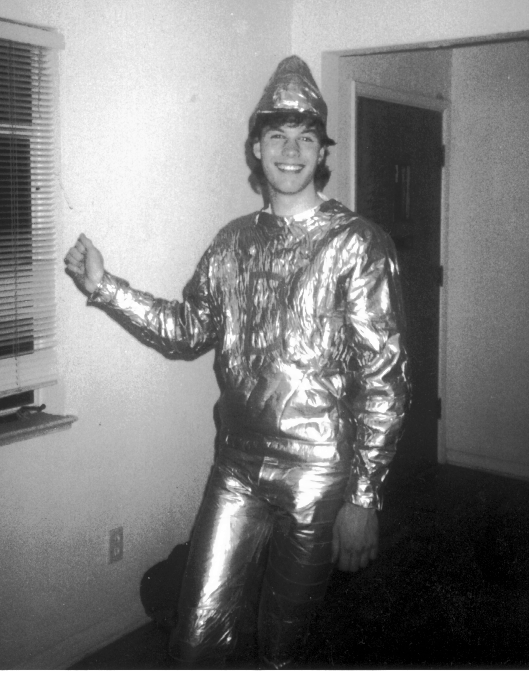
https://www.millert.dev/images/photos/todd_ducktape_man.gif
Uhm, how did Todd relieve himself in that costume?
"Paypal keeps $0.30 + 2.9% of every donation, so please keep anything less than $0.32 as they have enough money already."
i think Cash App has the lowest fees i've seen at like $0.01 which would still be too much.
not saying it is impossible - but likely not viable directly with the current payment providers.
Sure, I think a lot of those donations would amount to a few pennies or so at once, but I feel like a lot more people would be willing to support creators if they didn't have to constantly choose which to support.
That might be why he hasn't mentioned it.
It's disgusting that maintainers of critical projects have to go through the humiliation of begging for money, and absurd to suggest they all hang out Kofi or PAtreon banners. Realistically nobody is going to go through their bash history working out what utilities they use in order of frequency and allocating funds to the maintainers proportionally. I'm baffled that some entity like the Linux Software Foundation isn't administering this already.
For a lot of open source projects, if you have a normal day job and spend a few hours per week on a project, then the project just never gets very big. It exists, may have a few users. But on a larger scale, nobody knows it exists.
The exceptions are projects where developers spend a lot of time on the project at the expense of a day job. Though there is the possibility that they may have a hard time having a day job in the first place, which may have let to the situation with the open source project.
In general, I think we do have a culture problem where we think projects need to be successful. And people working on a project 'need' to support users (who in general don't pay).
And that expectation of free work happens throughout the open source ecosystem as well. Distributions expect projects to fix bugs for free. Open source projects expect libraries and compilers to be maintained.
Ultimately, change has to come from people who refuse to work for free. Doing something as a hobby for free is perfectly fine. As long as it stays within the scope of a hobby project.
Not if we don't make it easy for them. I had Claude whip up fundcli a while ago, but this post got me to finally upload it. It goes through your http://atuin.sh/ history (raw .bash_history/.*history doesn't have enough information) and generates links to projects for you to donate to.
    git clone https://github.com/fragmede/fundcli
    uv run src/fundcli/cli.py analyze
    uv run ./src/fundcli donate --amount 100
Unfortunately, it seems like either the moneyed folks don't care or the current financial structure simply does not support this.
but the mascot for sudo is terrifying
IBM should be able to send a decent amount to Todd once in a while, but based upon how much IBM supports ssh ($0), all they are proving is they are very cheap and only wants be a parasite living off other's work.
https://www.freedesktop.org/software/systemd/man/256/run0.ht...
The fact that sudo is a critical security pillar for trillions of dollars of global infrastructure but this guy gets bupkis for it screams volumes about the current state of technology.
We must do better, or it’ll be closed systems (OpenAI, Microsoft, Apple, Google, Oracle) all the way down as maintainers age out, go bankrupt, or die without succession plans in place.
Sudo is one of the poster children for creeping featuritis, to the point that the sudoers man page is a meme ("Don't despair if you are unfamiliar with EBNF ...")
Even OpenBSD gave up and implmented their own simplified replacement (doas).
Of course, 20+ years ago a big feature was platform compatibility, and since then we've gone from 10+ to 2ish, so if it's not explicitly enabling retrocomputing, it should be getting simpler, right?
Because new needs arise over time. For example, when I started in IT the "sudoedit" functionality was not present and so allowing someone to do "sudo vi …" would allow them breakout of the editor when it was running as root.
With sudoedit you can give people permissions to edit particular files with elevated permissions.
> Even OpenBSD gave up and implmented their own simplified replacement (doas).
They did not "give up": they found they needed only much simpler functionality shipped in the base OS. For example, sudo has functionality to talk to LDAP (which I've used at multiple jobs over the years), but is not needed for a local-only box. Once you need centralized account and privilege management, doas becomes much less useful.
I can't remember the name, but I read about a rust project a few months ago which claimed that even doas had too much feature creep.
That is scary! I may need to look more at openbsd
I would expect another system to query ldap.
On a long enough timeline, those fixes become fewer and less frequent as the codebase improves, but there is no "done" in software unfortunately. Hell, entropy itself means nothing is ever done, just in an ever-changing state.
Maybe that's somehow related to why so many companies are shoving AI into a bunch of stuff that doesn't need it. Gotta keep everything on the hype train. Working and fulfilling people's needs is no longer good enough.
If a see a project with recent activity, best from multiple people it is a strong signal that this will happen, if the last commit is a year ago I must assume it's completely abandoned because most of the time it just is. Sometimes it's clearly communicated that it is the way because the authors see it as essentially feature complete, there are some examples of this but not that many honestly.
Software is never "done".
The underlying APIs are always changing. The compilers and system libraries are changing.
Featuritis is a thing, but rolling it back is non-trivial as there are folks who depend upon it.
I'm not sure what can be gained for further development of the OG c sudo, add security patches of course.
But fund adding yet another feature 99.9% of users will never use? I can't fathom the justification for that. Just adding attack surface at this point.
Rightly both doas and the *-rs drops ins intend to drop most of those unnecessary features.
What if the exploitative aspect is open source itself? Trick some above average but naive developers into giving their talent, effort, insights and time away for free or very little? Maybe open source or something similar could have been organized in a way that wasn't exploitative and wasn't (possibly) unsustainable, but that is not how things ended up with what Richard Stallman and others organized.
People having control over their computer (and even having the right to share what they run on their computer!) is completely compatible with people paying for software labor.
You give it away for free so don’t be surprised to get abused. Human nature working at its best and worst here.
You need to have an alternative, and it needs to be a credible and reliable one, to ensure that it does not end up being the case that one scam is replaced with another scam.
We have carved out a class of engagements, labeled it deeply asocial, criminalized it and now we pursue people who engage in it through legal means.
Business really doesn't have this. Personal example - last week I was at a place where the business owner tried to overcharge me by an order of magnitude and then verbally attacked me when I caught him and backed out of the transaction.
His google and yelp reviews are full of people claiming false charges and all kinds of fraud, refusal to correct and repeated abuse until they closed their cards. It's wildly obvious what's going on here and I was on the ball enough to catch it.
I contacted the police and they said "well you should call the BBB or something". It's dozens of reviews of clear credit card fraud and for some reason because he's a merchant, doesn't seem to hit the radar.
These are purely criminal matters - people acting habitually in bad faith with ill intent in a brazenly dishonest manner.
Whether it's plundering the commons, polluting the public discourse, or breaking other types of social compacts, these should be treated the same as any other crime.
You do have points, though, but there might at least be some actions that you and others can take in this case. Maybe a medium change like changing the law on this specific point might make sense.
If there's an accumulation of complaints against this merchant then that should warrant an investigation.
The police have like half the local city budget, can't they do their job?
Release it for free, no barrier to entry, no legal liability, the entire world can use it instantly. This is why free software spreads and catches on - precisely because it's free.
There is no way to form a business around FOSS without becoming a gatekeeping high-barrier entity. You can release for free then charge extra for consulting or special features, which many have done and continue to experiment with.
But the core reason why FOSS spreads and took over is precisely why it is difficult to fund. No one is going to pay for something when the alternative is free. And the moment you start to charge some free alternative comes along and your prior users spurn you as greedy
Practically nobody downloads and installs sudo directly from the project website; people install it with their distribution of choice. The agreement could be automated and included in the licensing process. ie: the license gives specific distributions access to the software (either via paid or other agreed-upon terms appropriate to the distribution) and perhaps individual licensing terms for non-commercial entities.
Of course, the bigger ask in this decade is in use for training LLMs. OSS shouldn't be laundered through an LLM (IMHO) for license avoidance. Maybe some projects are OK with that (eg: many BSD licensed works.) There are some that likely aren't.
That seems like an area that's ripe for innovation. What does it take to get setup on a platform like Patreon? Seems like something similar ought to be setup for open source/independent development, probably an idealistic nonprofit.
> and the barrier for someone to use your product is suddenly extremely high, simply because it costs something.
All the organizations who really ought to pay are already setup to do all that, and do it all the time.
> But the core reason why FOSS spreads and took over is precisely why it is difficult to fund. No one is going to pay for something when the alternative is free. And the moment you start to charge some free alternative comes along and your prior users spurn you as greedy
What we need is innovation. Maybe a license that has a trip-wire? If not enough money is voluntarily deposited into a tip jar over a certain period of time, the license requires a modest payment from all for-profit organizations of a particular size.
That's up-front, is for the most part free, and incentivizes some payment.
Even if you add functionality to phone home, it can be removed by all but the dumbest offenders.
about the current state of Big Corp vampires who are happy to bleed everyone dry to put more $$ in their own very fat pockets
People aren't vampires because they're on top, they're on top because they're vampires.
Shit flows downstream
One approach is to have expectations to not only the economic system, but also other systems, and the different people involved, no matter if they're on the top, on the bottom, or somewhere in the middle.
Not trying to be glib here. This feels like the embrace, extend, extinguish pattern that we jokingly used to think was only Microsoft. It is now becoming more and more obviously the modus operandi of the entire enterprise software ecosystem.
I believe you are correct to be frustrated and ringing the alarm bell. This is a "death of the commons" moment for OSS.
What about the Rust rewrite (sudo-rs)? I think it shows people are interested in maintaining and/or modernizing tools taken for granted.
Edit:
To specify, new projects like sudo-rs may seem promising, but going by observation and experience with similar projects, there is no guarantee that sudo-rs and similar projects will be successful, good and continued to be maintained. The problems with old projects can end up applying to new projects as well. And projects in Rust are no exception, going by experience with existing, older Rust projects.
Aside, a pet peeve I have is that for instance Ruffle has not turned out as successful as I had hoped for, even after several years and many sponsors. The proprietary Flash runtimes written in C still outperform Ruffle greatly in some cases, causing problems for some users that want to use Ruffle instead of other runtimes.
This seems like a bit of a non-sequitur; the state of non-sudo-rs projects/libraries says nothing about the state of sudo-rs itself.
Not to mention that I'd imagine a similar statement would probably be true for projects and libraries written in any reasonably popular language.
Sudo uses the OpenBSD license, while sudo-rs is dual licensed under MIT and Apache 2.0. Both licenses seem equally permissive to me.
The Rust smokescreen is mostly being used to slowly eradicate the GPL.
Like Lenin said, "Who stands to gain?"
sudo should have been a near complete tool after it was written.
Maybe we need a license that's even more onerous to corporations than the AGPL, like something with a revenue share clause.
Or maybe the problem is the naivete of software engineers. In aggregate, there was so much embrace of libertarianism that no groundwork was laid to protect ourselves from things like AI and offshoring.
It's...frustrating, but those who do the work are the most qualified to explain what they need. For the rest of us, it's encouraging them to seek reasonable compensation for their work from those who exploit it for profit, and that doing so doesn't necessarily go against the spirit of open source.
The US economy of the 1980s, 1990s, and 2000s made it possible.
In my opinion, libertarianism in software is a hollow dream that leads people to make foolish decisions that can't be protected. This makes it easy for corporations to exploit and quash any barely audible opposition.
Almost as if by plan, the libertarian mindset has eroded and weakened open source protections, defanging and declawing it every step of the way.
/s
Really though, it is remarkable just how high we've built this towering house of cards on the selfless works of individuals. The geek in me immediately begins meditating on OSS funding mechanisms I've seen in the past, and what might work today. Then I remember that I don't believe it can work, but hope desperately that people like Todd can keep paying rent and continue getting some satisfaction from the efforts.