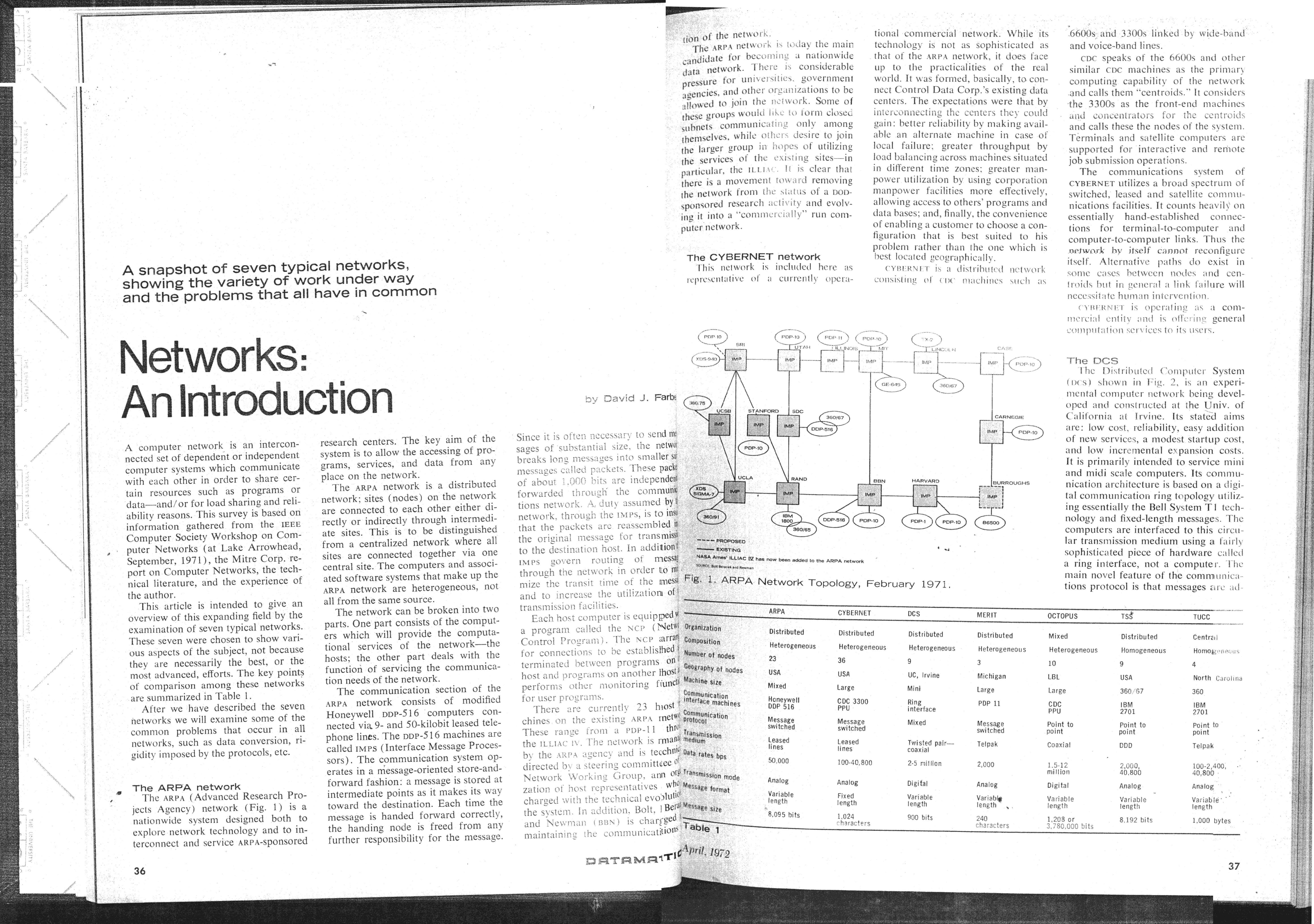
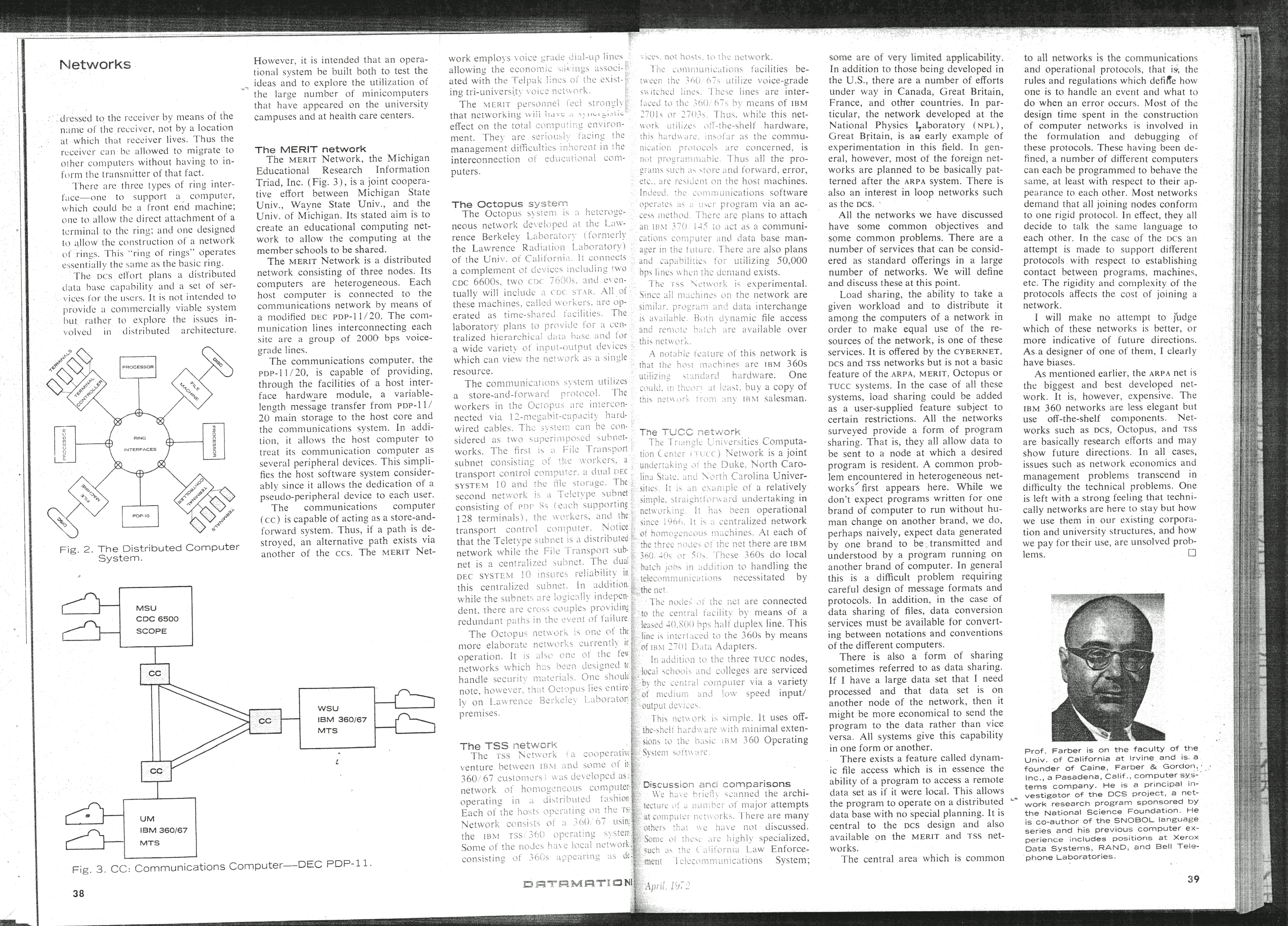
His name pops up a lot during the 60s and 70s as an author on numerous articles about networks, often regarding many competing, now defunct alternative networks to the Internet.
Examples of scans I personally made: https://siliconfolklore.com/internet-history/farber-datamati... and https://siliconfolklore.com/internet-history/farber-datamati...
He's one of those people where you go through archival industry journals and are like "oh look there he is again"
For instance, SNOBOL https://en.wikipedia.org/wiki/SNOBOL
I would have paid serious money to have gotten that
This is the article btw https://siliconfolklore.com/internet-history
Here's the one other large project I've got at that domain https://siliconfolklore.com/scale/
It for a history talk in 2024. I worked months on that
It was like attending a funeral for someone I never was able to track down. Feel kinda terrible about all of it. Really sucks, sounds like he was a very friendly guy.
At CCRC, one of his most enjoyable activities was co-hosting the IP-Asia online gathering, which has met every Monday for more than five years and has addressed many aspects of the impact of technology on civilization.''
https://lists.nanog.org/archives/list/nanog@lists.nanog.org/...
and apropos this moment:
You should always go to other people's funerals, otherwise, they won't come to yours. -- Yogi Berra
What a life lived.
I wonder what his life in Tokyo was like! Did he ever write about it?
https://seclists.org/interesting-people/2018/Jun/35
> Dave was the longest-serving EFF Board member, having joined in the early 1990s, before the creation of the World Wide Web or the widespread adoption of the internet.
[1] https://www.eff.org/deeplinks/2026/02/rip-dave-farber-eff-bo...
Ok I chuckled
Based on what exactly makes you think this?
Judging by https://news.ycombinator.com/item?id=46923612 and https://news.ycombinator.com/item?id=46901862, I expect unsupp0rted's logic is closer to "we'll build superintelligent AI servants some time next week, and that will usher in a new golden age"; but that doesn't make the claim invalid.
We built the first calculating machines yesterday, and a few hours later they took us to the moon. Now we’ve got vastly more powerful ones in our pockets and they have the sum total of all human knowledge and infinite patience for our questions.
Give it a few more minutes. We’ll know soon enough if the sand we’re imbuing with life is our salvation or our doom or something else entirely.
Even in domains where (virtually) all the knowledge is available, and most tasks are exact variations of what has come before, like programming, the most powerful AI systems are mediocre, bordering on competent. Outside this idealised case, they may have "infinite patience for our questions" (up to the token limit, anyway), but they largely lack the capacity to provide answers.
Medical research is about the best example you could pick for something that current-gen AI systems cannot do. Most of the information about the human body is located in human bodies, and wholly inaccessible to every AI system. An extremely important part of medical research is identifying when the established consensus is wrong: how is AI to do that?
There is no reason to believe that LLMs will ever meaningfully contribute to medicine, in much the same sense there is no reason to believe that lawn ornaments will. Pen-and-paper calculations, and the engineering / manufacturing / etc work of humans, took us to the moon: the computers acted as batch processors and task schedulers, nothing more. Medical research done by humans is responsible for the past century of medical improvements. As much as I like computers, they won't be people for the foreseeable future.
Death is horrifying, but an unfounded belief that AI will save you is not a healthy coping mechanism. If you're looking for religion, there are far better ones. And if you don't think you're looking for religion, perhaps the "death gives life meaning" philosophies might suffice? All Men are Mortal by Simone de Beauvoir was presumably some comfort to its author, who also wrote:
> There is no such thing as a natural death: nothing that happens to a man is ever natural, since his presence calls the world into question. All men must die: but for every man his death is an accident and, even if he knows it and consents to it, an unjustifiable violation.
(quotation from A Very Easy Death via https://martyhalpern.blogspot.com/2011/04/j-r-r-tolkien-quot...)
Original email mentions “too young age of 91”, but IMO that’s a beautiful age to reach, especially for a life seemingly well lived!
I never knew him, but I've been lurking on his IP list since the nineties. It was always informative, even as the web made tech news pervasive. Black bar, I reckon.