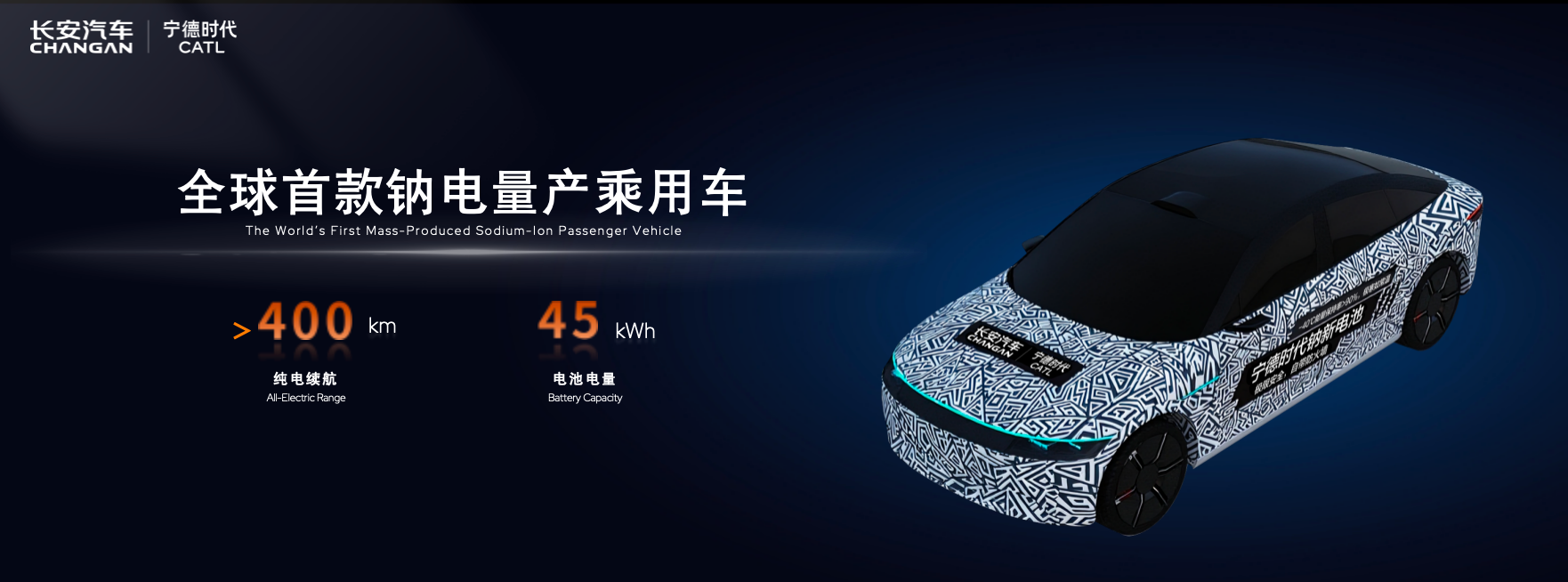
The CATL Naxtra sodium-ion battery will debut in the Changan Nevo A06 sedan, delivering an estimated range of around 400 kilometers (249 miles) on the China Light-Duty Test Cycle.
It delivers 175 watt-hours per kilogram of energy density, which is lower than nickel-rich chemistries but roughly on par with LFPThink of it this way, Sodium metal is abundant and cheap with 30x the energy storage (and energy transfer) of other solutions yet nobody has used it in almost any product ever (including as a coolant). The volatility of Sodium is why. Unless they have a solution to this, then I would be shorting whoever is insuring these batteries.
You should also consider shorting Morton [0]. They sell sodium, combined with chlorine, one of the nastiest elements around! And for products that go in people's homes! On food!
It should be noted that most manufactures aren't doing pure Na-ion. They are mixing in a little Na with the Li to stretch Li supplies and gather data on the impact of the increased volatility on safety. I wouldn't expect their first use to be in cars. I would expect them to be in grid stabilizing batteries.
I was thinking of the aqueous sodium ion batteries, which do not have the issues described. I thought those were the ones that are commercially available, but that's not the case.
Nowadays, the manufacturers of refined table salt present you with a digusting proposition: sprinkle this worthless elemental sodium-chloride onto your food, because it is "salt" and they are 100% trading on its ancient reputation. Perhaps it is better to simply trample it underfoot?
Unfortunately, all the trace minerals are missing from refined salt. That pure white, homogeneous, translucent quality gives it away. The refining of salt is done purposefully, because the trace minerals are more valuable to supplement vendors.
All those trace minerals are separated out and sold out to companies who will assemble them into expensive dietary supplements. Your magnesium, and selenium, and zinc that you pay $30 a bottle for.
And that is also why sodium has such a nasty reputation in 2026. If you get CVD then you avoid sodium. If you get hypertension then you avoid sodium. Sodium is avoided like the plague. No physician will recommend sodium or table salt for a diet! Why should they? Adding sodium no longer introduces trace minerals or nutrition, it only introduces saltiness.
It is still possible to find unrefined salt. It may be sold as "sea salt" or "kosher salt" but you'll need to find it in transparent packaging. If it contains impurities that look like pepper or dirt, then it is unrefined. If it is imprinted with the obligatory fake warning about iodide, then it may be unrefined. (The mandatory FDA "iodide" warning is not only fake, it's misleading and downright malicious.)
Good luck with your salt! With love from your eponysterical HN noob!
However, the information is false. The amount of nutrients in unrefined salt is negligible. Yes it contains trace minerals but not in any significant quantity.
I have never seen or visited that website ever in my life. Why would I? I wrote my comment completely originally, and your accusation of bad faith is, in itself, bad faith.
In fact, none of the content which I typed into my comment is found in that blog article. How and why did you even find it? Anyone else here can read and confirm that I copied nothing. I quoted nothing. I owe nothing to anyone. My comment is original and copyrighted by myself (c) 2026, all rights reserved.
With respect to the content or other materials you upload through the Site or share with other users or recipients (collectively, “User Content”), you represent and warrant that you own all right, title and interest in and to such User Content, including, without limitation, all copyrights and rights of publicity contained therein. By uploading any User Content you hereby grant and will grant Y Combinator and its affiliated companies a nonexclusive, worldwide, royalty free, fully paid up, transferable, sublicensable, perpetual, irrevocable license to copy, display, upload, perform, distribute, store, modify and otherwise use your User Content for any Y Combinator-related purpose in any form, medium or technology now known or later developed.
If they have not solved the problem, I still wouldn't recommend shorting any companies. Shorting a stock and waiting for years for it to drop is not a great strategy.
Huh? See https://www.terrapower.com/natrium/ -- and it's not exactly a new idea.
Also not uncommon to use sodium-filled exhaust valves in car, motorcycle, and aircraft engines.
In 75 years we won't need to extract more lithium - except the fraction needed to replace permanently-lost batteries.
Incidentally, you should be very careful when talking about "<resource> reserves", because the definition of a reserve is usually "<resource> that is profitable to extract" - and when we "run out", prices will go up and thus currently-unprofitable sources will become profitable, and POOF! Our <resource> reserves have increased, purely through the power of semantics.
Also, over the decades resource extraction becomes cheaper and thus more sources become profitable.
Personally though, I don't think any of that will matter -IMO the future is proton batteries, AKA Hydrogen batteries (which use an electrolyte of "ionic hydrogen", H+, which has 1 proton and 0 electrons - people claim lithium is the lightest metal, but it has 3x the protons of hydrogen). I think that the recent TABQ batteries, or something like it, will become commercially viable within 75 years (although who even knows what batteries will look like in the year 2101).
As for reserves, while you understand the economics you are missing the physics. For example, there is Li (and U) in the ocean. We don't extract Uranium from the ocean not only because it isn't economical, it isn't even energy efficient. This is because moving a billion tonnes of water takes more energy than the 3 tonnes of Uranium you would harvest from doing that. For Li, its takes just as much energy (and money) as its just as rare. In other words, there is a floor on that economic extraction argument specified by a positive EROEI (energy returned on energy invested).
If you have any other sources or information on why we can't recycle lithium please let me know. As far is battery failure goes it's a mechanical failure on a chemical level
The Li that comes out of the process you describe wouldn't be recycled. It would still be mostly exhausted. Specifically, something we don't understand about the structure of their electrons causes the batteries made with such material to have a far lower capacity than if you used freshly mined Lithium. My source is a Material Engineering class at MIT.
The lithium ions are the chemical process that actually store the charge, They move from the anode to cathode in charge and discharge. The loss of these ions is what causes the degradation of the battery which is a function of entropy here. It is simply that the concise arrangement that we required for this electro-chemical to take place falls out of balance.
Entropy problem is easily solved by mashing a battery up and reconstituting it into a new battery.
To put this all simply this is all fairly basic chemistry, even if there was some kind of structure being created that has a high bond enthrall we can still undo that with enough energy.
If you could maybe share some research or other information to back up your claims other than you went to a class at MIT i would really appreciate it also the company i was saying is called Li Cycle
They are always revising estimates up and down a bit. But Li demand just keeps rising and rising. And a single grid scale battery takes 10 years of current Li-ion battery production worldwide to build.
So do we have enough Li at current rates, sure. We don't have anywhere near enough to do anything like replacing even a fraction of FFs with renewables. I guess that's the real headline here. That's why people are experimenting with Na-ion. Putting it in a production car today, that seems...what's the word...homicidal. Making a grid stabilization battery (not for backup) with large amounts of space between cabinets to see what happens, that seems more wise.
I've seen that repeated a lot but I still can't buy sodium batteries cheaper than lifepo...
This is a big difference because there are all kinds of other factors besides energy capacity that can affect the efficiency of the whole system, and therefore affect range.
Most notably, air is about 28% denser at -40°C than at 25°C, so drag is about 28% higher. So you would expect roughly 28% less range at high speeds even if the battery has no capacity loss whatsoever.
As someone else mentioned, climate control also consumes a lot more power when it has to maintain a larger temperature difference between inside and outside.
With my gas car, I haven't noticed 30% worse fuel consumption at –30°C compared to +30°C [0]. To be fair, I haven't closely measured the fuel consumption at different temperatures, but I probably would have noticed such a big difference. This is just anecdotal of course, so your values may actually be correct.
[0]: It does occasionally get down to –40°C here, but my car won't usually start then, so I've slightly shifted your temperature range to the values where I've driven most.
>your values may actually be correct
Note that a 28% increase in drag results in a roughly 22% decrease in range, because 1/1.28 ~= 0.78. Also there are other losses (like rolling friction and constant loads like headlights or cabin heat), so range doesn't scale perfectly with drag. Drag is the main source of loss at highway speed, however
But TBF same factors affect ICE cars
I'd add though that rolling resistance tends to be higher, on average, in winter too. When there's often a bit of snow on the roads... Less so on high speed highways admittedly.
[1] https://www.reddit.com/r/askscience/comments/l2cq6b/comment/...
Even at 30kmph it's already the majority of the resistance and it scales exponentially with speed so you can imagine how much it matters.
That's not exponential because the speed (v) is not in the exponent. In fact, it's quadratic.
Corollaries: The power required to push the car at speed v will be proportional to Fv ~ v^3. The gas spent over time t ~ energy spent ~ power time ~ v^3 * time.
Those two things very different.
As long as you have a heat pump harvesting the waste heat to keep the battery up to temp.
But might be significant on short drives, 10kW for the first 3 km is massive.
https://electrek.co/2026/02/05/first-sodium-ion-battery-ev-d...
AFAIK most EVs already use heat pumps today, so the future happens whenever sodium batteries become mainstream.
Nope, the Mach E and Lightning both have a heat pump (well, just the Mach E now, I suppose, since the Lightning is out of production).
Obviously Tesla and the like are more luxury cars but if EV is to become mainstream they need to compete with ICE Kia's and Volkswagen.
Interestingly, the Hyundai Inster (20k EUR) and Renault 5 (25k EUR) both have heat pumps as standard equipment.
But if they add buttons back as planned, I might be willing to try a new id.4 in 5-10 years.
https://www.energy.gov/energysaver/fuel-economy-cold-weather
At -40F (-40C), it's generally good practice to just stay inside and not drive at all...
'22 Ford Escape hybrid
The remaining miles thing shows less than that on a full tank, but I've been pretty consistently getting upper-600s between fill-ups.
I suppose it would probably be less if I went on the interstate more.
Assuming a 1000km range is a very strange thing to do, as it's a fringe feature that almost no one needs or wants! Recall that "almost no one" means that there's still some, an existence of a handful of people on HN is quite consistent with "almost none."
Which I would expect to typically find something that's, um, fairly typical on characteristics I wasn't selecting on.
The point you are DESPERATELY trying to miss is you can easily "recharge", a "dead" ICE at home too
Eh? All I can see is you DESPERATELY trying to push the narrative that it’s common for people have barrels of fuel at home which is a pretty weird thing to try and prove since everyone reading this will know it’s not true.
It has an 18.8 gallon fuel capacity (https://www.volvocars.com/lb/support/car/xc60/article/dfc6f0...)
That’s a max range of 470 miles. You would need much greater fuel efficiency above 34 mpg to get to 650 miles on an 18.8 gallon tank.
Also you are quoting a value for the B5, which is not what I have, mine is a T8(and before you ask - no, I didn't have any opportunity to charge it anywhere on the way).
Is that actually true once the engine has reached operating temperature?
> Fuel economy tests show that, in city driving, a conventional gasoline car's gas mileage is roughly 15% lower at 20°F than it would be at 77°F. It can drop as much as 24% for short (3- to 4-mile) trips.
Not sure the engine ever reached "operating temperature" on that drive.
I had a car that developed a stuck-open thermostat and did the cardboard trick to get by until I could replace the faulty part.
1) winter blend fuels have less energy per volume, that doesn't make your engine any less efficient by energy but it does by volume of gas
2) lots of temporary cold effects: fuel vaporization, thick lubricants, etc. these things become less of a problem as the engine warms up but some energy is still lost on long drives
3) air resistance: all aerodynamic forces are linearly proportional with air density. At a constant pressure there's about a 15% difference in air density between the hottest and coldest places you can drive (and thus 15% less drag on a hot summer day than a cold winter day). aerodynamic forces are proportional to the square of your velocity and they become the largest resistive force around 50mph -- so at highway speeds you're losing efficiency because you have to push more air out of the way
4) energy used to maintain temperature: this is hard to calculate but some engine power is lost because the energy is used heating up the engine block and lost to the environment
5) the Thermodynamics 101 engine efficiency goes UP with increased temperature, but it's got a lot of real world effects to compete with, no spherical cows and all
Since the Lithium battery prices dropped, there are many Sodium battery companies simply abandoning the research or shuttering. Not a good sign when smart people jump ship.
The Na cells also have lower energy-density, and currently fewer viable charge cycles. One can still buy evaluation samples, but it takes time to figure out if the technology will make economic sense.
Best regards =3
There could be other reasons. Maybe they just cannot compete with CATL.
we can always afford to wait and see.
Have a great day =3
https://carnewschina.com/2026/01/22/catl-unveils-worlds-firs...
(The motorcycle is real, and has been out for years. This is just a battery upgrade.)
[1] https://insideevs.com/news/786388/verge-motorcycles-donut-la...
There's a lot of reasons to think that that battery might be a scam... unlike most batteries, including sodium ion ones... If it's not a scam it will certainly upset the battery market eventually.
"Chinese battery giant CATL and automaker Changan Automobile are preparing to put the world’s first passenger car powered by sodium-ion batteries on public roads by mid-2026."
CATL is more credible than Donut, but both are making forward-looking statements.
CATL is "we're going to mass produce this specific well known technology" and while there's some question as to precise numbers for their implementation of it they aren't claiming anything surprising. A worst they're somewhat over optimistic and fail to be a commercial success. At best they're slightly under optimistic and are slightly more successful than anticipated. We can be confident they aren't flat out lying (though they may be exaggerating) because the claim is so mundane.
Donut is "we're going to produce a technology capable of achieving targets that haven't even been demonstrated in a (public) lab. We won't tell you what specific technology. We're going to put this miracle battery in motorcycles, because we can". At worst they're flat out lying to scam investors - but if they're not lying, even if they're over optimistic, they've made a significant advance in the state of the art that will eventually (once it's not just put in motorcycles) have widespread repercussions.
OTOH, there are seemingly more lithium iron phosphate (LFP) battery ev options now - rivian now uses LFP, Ford mustang mach-e has had a LFP variant since fall 2023 (and should have other models using LFP in 2027), I think the 2026 chevy bolt uses LFP, etc.
The US administration has basically told them to do so.
So don't expect any innovation on this front from the middle of the North American continent. It's being actively sabotaged.
Any US automaker relying on Trump staying in office is playing with fire. Yes, you may see reduced or zero press releases and budgets for EV research being "reallocated" on paper so the toddler in chief doesn't get a public tantrum - but assuming there will be free and fair elections this year, it is highly, highly likely that Congress will be solid blue and reinstate a lot of what Trump has cut down, only this time as an actual law that is far harder to cancel than executive orders.
And everyone not hedging for this possibility will wreck their company's future.
Don't expect any movement on EV legislation unless and until Democrats take back the White House in 2028
Vehicle sales subsidies frankly just end up rolled into the price as a markup.
The Canadian government here partially has the right idea in only subsidizing vehicles under a 50k CAD ($36k USD) price tier -- unless they're manufactured in Canada. But I don't think that barrier is low enough. Should be $40k or even less. Our subsidy also takes the form of a direct cash subsidy instead of a tax credit -- which is regressive and helps people less in lower income tiers who don't pay much in income taxes.
That and threw tariffs on the auto makers parts and imports such that their businesses are under threat?
GM just axed the Bolt again. The only domestic affordable EV. Stellantis killed all of theirs, from what I hear. And Ford has pulled back as well.
Anyway I'm still curious about the mechanism the administration used to direct manufacturers to stop producing EVs, and how they could invoke such a power without covering Telsa or Rivian. Nothing about the administration would surprise me, but I'm surprised there hasn't been more noise made about it.
Rather it's a series of policy decisions to try and stunt reemerging technologies
Anyway that doesn't answer my question, I was asking the other poster what was targeting EV manufacturers except for Telsa or Rivian. Seems like blatant Musk and Scaringe corruption if that was so.
But yeah, if you have a garage with a charger and you never exceed your winter range then it’s fine, per my previous comment.
> most are within 100 miles of a fast DC charger
That's not good enough. No one can spend 3-4 hours to drive 200 miles round trip, or even 100 miles, to charge quickly.
There needs to be a good solution for the 33% of households that don't have access to EV charging as part of their home. Until it becomes really plentiful, part of the solution may involve fast charging that only the 33% can use or that favors the 33%; people who can charge overnight at home should charge overnight at home.
https://www.energy.gov/eere/vehicles/articles/fotw-1268-dece...
Can you charge at home? Do so. Can you charge at work? Do so. Can you charge at a grocery store or other location your task will take longer than the charging? Do so. This works for most Americans, while charging infrastructure continues to be rapidly deployed. The gaps will be filled, how fast is a function of will and investment.
US Gains 11,300 Ultra-Fast Chargers in Bet to Lure More EV Drivers - https://news.ycombinator.com/item?id=46815932 - January 2026 (11 comments)
"Orders" may be an exaggeration but one order of magnitude isn't.
Agreed. However, the number of people who live 100+ miles from a fast charger rounds to zero. Something like 85-90% of the US population lives within a metro area, and even in the least "EV friendly" states probably has a fast charger within 10-20 miles at most.
For the record, I’ve been an EV owner for 5 years in the northern US. I still like my EV and things get better all the time, but I don’t understand the people in this thread saying that cold weather battery performance is fine.
I used to keep a 100ft 120V heavy duty extension cord in the frunk to charge due to how few charging options there were in 2018, and no longer have to (having driven across most of the continental US).
If an EV is not feasible today due to limited charging options, certainly, procure a hybrid until battery chemistry and charging infrastructure improves in your area. I admit cold weather performance might be hard for some, but Norway has achieved 99% BEV monthly sales, so it can be done. It’s just a matter of where you are on the global adoption curve.
I wouldn't recommend EVs in any climate without home charging.
Needing to buy a different kind of car and dying from cancer are ever so slightly different experiences. But thank you for the kind of absurd HN take that inspired my username.
It’s not absurdity, it’s analogy. If you can’t distinguish between the two then HN may indeed not be for you.
I'll be the first to say we need less range anxiety, and Norway is awesome. But we need to be careful comparing the US to Norway here.
This means you can't really make deductions about EV performance in very cold weather in those very cold regions without getting data on what the EVs are being used for. It could be most of them are in households where they have ICE cars to handle things where they need long range or when they need to tow or haul things, and the EVs are just used for things where loss of range and capacity doesn't matter much.
I was only disagreeing with another commenter who claimed the status quo was fine. There’s a pretty big gap between “not fine” and “not workable”.
I assume it's just that its internal resistance rises when it's cold, but I might be wrong.
Yes. It's mostly wasted as heat inside the battery. I think there's also a temperature relationship to open-circuit voltage? But the predominate effect is from elevated internal resistance.
You can read about EIS here: https://www.gamry.com/application-notes/EIS/basics-of-electr...
Sodium would need to be more efficient to be lighter, which it isn't
The capacity of storing energy does not depend at all on area, but only on the mass of sodium contained in the battery and on the efficiency of using it (i.e. between full discharge and full charge not 100% of the sodium or lithium is cycled between the 2 oxidation states, but a fraction, e.g. 90%).
Any battery has both an energy density and a power density, which are weakly correlated and the correlation may have opposite signs, i.e. for some batteries it may be possible to increase the power density if the energy density is lowered and vice-versa.
For a given stored energy in kWh, the required mass of sodium is several times greater than the corresponding mass of lithium, by a factor that is the product of the atomic mass ratio with the ratio between the battery voltages. The voltages are similar, with a slight advantage for sodium, so the required mass of sodium is about 3 times the corresponding mass of lithium.
If the complete batteries have about the same mass, that means that other components of the sodium-ion battery are smaller and/or lighter.
Na will be big in grid storage, it's a perfect fit.
This means that if you do not use the car for some time, you may need to recharge it before you can use it again. This may be a problem if the car is left far from a charger.
Otherwise I agree with what you said.
A lot of EV drivers optimize to minimize waiting time. Mostly you try to charge while you are doing something else (sleeping, working, eating, shopping, etc.). So, you are not actually waiting for it and sitting in the car bored.
Charging speeds are non linear. The last few percent take a bit more waiting. But you don't actually have to charge the battery to 100% all the time. Two 10-80% charge breaks might be a lot less less time than one 10-100% charge break and it will get you a lot more miles.
When you are driving long distance, you can plan to top up while having breaks, lunch, etc. Just top it back up to whatever the time allows. You don't have to drive the battery to empty either. And destination charging is a thing as well.
You can trade off not having to stop for a bit more against the charging time. Charging to 100% at night is a good use of time. Because you are probably sleeping/resting. Interrupting your journey to do the same is probably not a great use of your time. Two 10-80% charge breaks might be a lot less less time than one 10-100% charge break and it will get you a lot more miles.
Of course on longer journeys, planning for 45 minute charging breaks is a lot more annoying than planning for 15 minute charging breaks. Which is what 5C charging should enable given the right cell and charger combination. With a normal EV (medium sized battery) that's once every 3-4 hours roughly. A bit longer if your car is more economical with the battery. That's actually not a horrible frequency for taking a short break. Even if you drive a petrol car.
And if you are really anxious about that, get an EV with a bigger battery. 300 miles. 400 miles. There are even some 500 mile batteries in some cars now. It will cost you of course. Financially it's probably not a great choice for most people.
interested in hot desert weather performance which often gets lost in the averages.
Decided to keep my battery devices in a cooler with cool and frozen water bottles to drink when I return. Phone, camera batteries, and a portable vehicle starter.
[0] https://cdn.motor1.com/images/custom/worlds-first-mass-produ...
[1] https://insideevs.com/news/719013/2024-tesla-model3-epa-rang...
The reason this is so exciting for me personally is for stationary energy. Because the raw materials are so abundant and have good cold weather performance, both grid and home level energy storage costs should come down significantly as this is commercialized further.
Since it's also cheaper, it's likely that Na-ion will be adopted by cheaper city runabout type EVs, while premium long range EVs will continue using Li-ion.
There are already large battery swapping schemes in China with thousands of stations. Even if we don't get to 5-100 charging at 5C+ there's nothing stopping this from not being a problem.
If the arrow of time is to be believed, many of the complaints and gripes and "well aktuallys" from 10 years ago are solved already. And there seems to be no slowing down.
Fast charging would fix it. If you could go from 15 to 80% in truly under 10 mins that would work too.
Battery swapping is talked about a lot but AFAICT it hasn't really been successful anywhere. It just seems like a lot more hassle than plugging in, and with charging speeds constantly increasing the payoff is shrinking too.
Looking into it more. Maybe something like supersaturated solution of sodium acetate (plus water) in a sealed pouch with a metal disc. Bending the disc triggers crystallization, releasing stored heat (around 130–140°F for 20–60 minutes). Boil them to reset.
So you could boil and reset them during charging and click them off if needed in cold weather.
Granted, you have a minor bootstrapping issue wherein you need the battery to be warm before you use battery power, but at very low % of the battery's power capacity I suspect it's less of an issue.
A quick search suggests that sodium acetate used like this stores 230kj/kg (i.e. 64 Wh/kg in the units used for batteries) [1] which is significantly worse than the sodium ion batteries being discussed. Same order of magnitude though, so maybe there's a better material that would make it work.
[1] https://www.sciencedirect.com/science/article/abs/pii/S13594...
Crustal abundance up to 1000x that of lithium - pretty much every nation has effectively unlimited supply, it's no longer a barrier or a geographically limited resource like lithium.
No significant damage going down to 0V, can even be stored at 0V - much safer than lithium which gets excitable once out of its prefered voltage range.
Cold weather performance down to -30C - northern latitude users don't have as much range anxiety in the winter.
Basically, the only problem I see is that companies that have made significant long-term investments in lithium could take a big hit. Countries that banked on their lithium reserves as a key future resource for will have to adjust their strategy.
Lithium batteries will likely still have a place in the high performance realm but but for the majority of run-of-the-mill applications - everything from customer electronics to EVs to offgrid storage - it's hard to see how sodium-ion wouldn't quickly replace it.
I don't doubt that sodium ion has a place... but whether it takes over as the dominant battery type for portable applications strikes me as very dependent on the future of lithium extraction. It seems like a place that has a lot of room to grow more efficient and thus more competitive on cost.
https://battery-news.de/en/2026/01/26/catl-presents-sodium-i...
So lithium-ion batteries will never be replaced in smartphones or laptops by sodium-ion batteries.
But there are plenty of applications where the energy density of sodium-ion batteries is sufficient. Eventually sodium-ion batteries will be much cheaper and this is why they will replace lithium-ion batteries in all cheap cars and for most stationary energy storage (except when lower auto-discharge is desired).
However, sodium-ion batteries and lithium-ion batteries do not have metal electrodes (because for now it is not known how to ensure that those will survive an acceptable number of cycles), so the actual mass and volume of the electrodes are significantly greater than that of the sodium or lithium that is used.
Because of that, the difference in energy densities is much lower than the mass ratio seems to imply.
The parent article claims that the energy density of the Na-ion batteries is in the same range with that of the LFP batteries (i.e. lower than that of the Li-ion batteries with Ni or Co based electrodes).
I think (hope) this niche will start to make a comeback as the underlying tech continues to get cheaper. You are starting to see glimmers of it in the low low end with some micromobility cars in Europe just providing phone holders instead of screens.
Theres some EV owner costs because of infrastructure, but the base cost is not as luxury. Its luxury because americans refused to see value.
Given the difficulty of radiating heat away I would have expected the opposite.
Especially considering the incentive to send up as little battery as possible, and the very predictable day/night cycle leading to the ability to precisely predict how small a battery you can get away with...
Rated: 230 miles
10°F with 70°F climate: 160 miles
10°F with no climate: 190-200 miles
Most of the winter it tells me I can only do between 100 and 120 miles. It is definitely half the EPA range with climate controls disabled at 0F. (Ask me how I know).
I love driving it in the winter. I don't have a pressing need to go long distances, so that is not a current concern. Not having to stand outside in the bitter cold to fuel up in absolutely awesome.
There are EVs on the market that do much, much better than mine in cool weather and I now know what to look for.
To really penetrate the midwest it will take a car that can realistically do a road trip to Florida from say Duluth, MN or Michigan's UP in the winter.
Because not only do folks in the midwest drive long distances without a second thought, they sometimes do it in the cold of winter so they can get a break from the snow.
So yes still getting 90% of the range at -40C does sound attractive.
That right there is a big problem to begin with. The headline EPA number only reflects reality if you have a mix of city and highway driving. The problem is that people only care about range when driving 75mph. I think the headline EPA number should reflect that reality.
The EV described in the article has a standardized range of 250 miles. This isn't a range monster in any condition. There is some gesturing that Sodium batteries don't require as much active heating in cold conditions. But nothing is quantified.
As usual with sci-tech broadly and batteries specifically: it's exciting that sodium batteries are coming to market; we can be optimistic that maybe in the future they will provide lots of range, or be less expensive, or maybe less flammable than today's lithium batteries. But the marketing hype is running miles ahead of reality.
That is exactly the substance of the headline.
If we put aside the politics, what are the actual statistics behind lithium battery fires today? And don't LFP's have negligible fire risk?
I feel like my gasser F250 had a higher risk of spontaneously combusting.
No one burned to death inside a Tesla while driving normally. It's always following a crash.
And I've been following Polish firefighters reports about EV fires and they are very interesting - basically saying that in all recent cases of EV fires they were contained so quickly even the interior was largely undamaged - something that practically never happens with regular cars. Some of these have been in underground garages too, with difficulty of access - but nowadays they just know how to approach an EV fire and containment isn't a problem.
"The Long-Range Version sets a new record for light commercial vehicles with a single-pack capacity of 253 kWh, achieving a maximum range of 800km."
That would be some 720 km at -40 C if the numbers are correct. I'm not well versed in this area and not sure if these batteries are comparable to those in personal vehicles, but the ones I've heard owners talk about have a reach at about half that if it's cold at all.
You are correct that range for many cars with Lithium (NMC) batteries is halved when the ambient temperature is below about -10 C. But an important caveat is that this applies principally to short trips where the battery never warms up such as driving 10 km into town and back to do some shopping. On long continuous journeys the decrease in range is much less marked.
This text is not present in the article. Are you looking at a different article?
The marketing hype is the true range monster