It's not like LinkedIn was great before, but the business-influencer incentives there seem to have really juiced nonsense content that all feels gratingly similar. Probably doesn't help that I work in energy which in this moment has attracted a tremendous number of hangers-on looking for a hit from the data center money funnel.
https://www.marginalia.nu/junk/linked/games.jpeg
https://www.marginalia.nu/junk/linked/json.png
https://www.marginalia.nu/junk/linked/syntax.png
(and before anyone tells me to charge my phone, I have one of those construction worker phones with 2 weeks battery. 14% is like good for a couple of days)
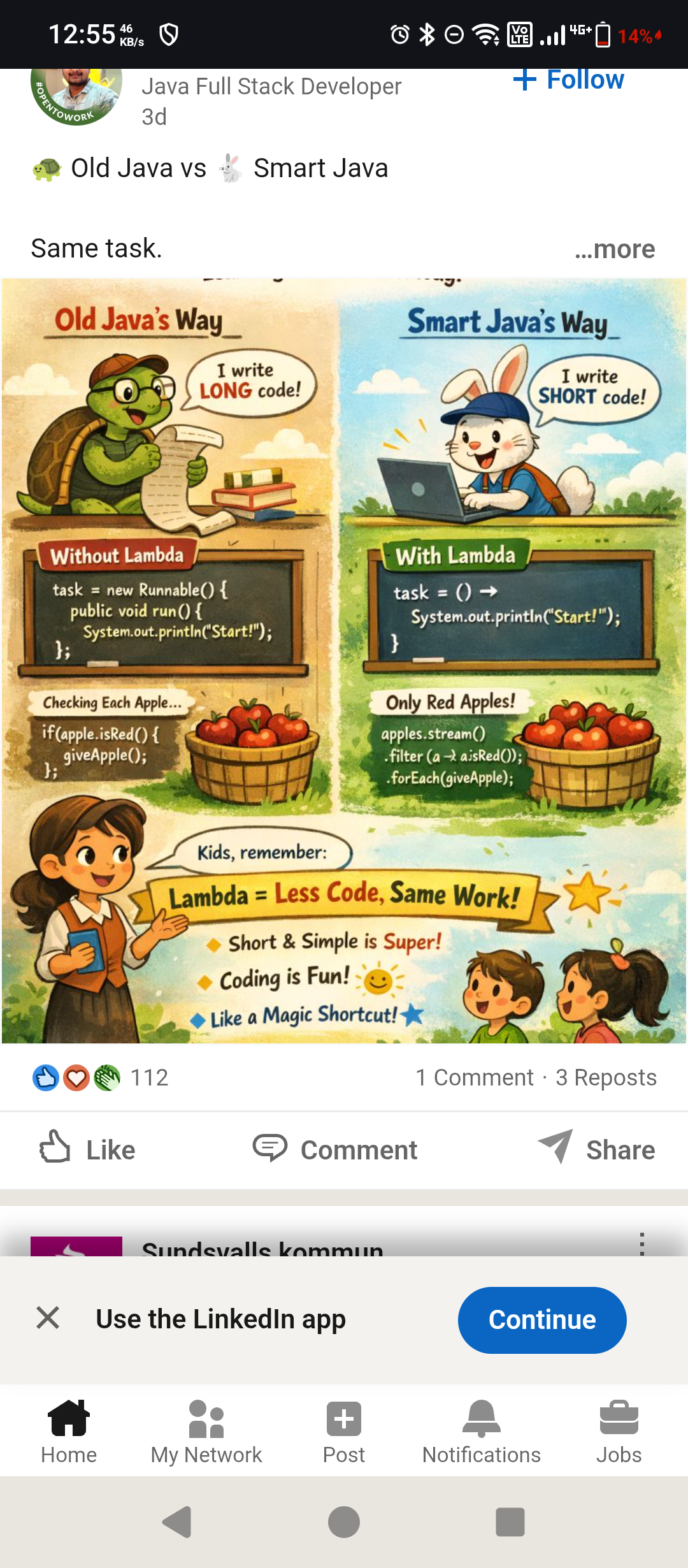
Lambda example is to the best of my parsing ability this:
  apples.stream()
    .filter(a -λ a.isRed());  // <-- note semicolon
    .forEach(giveApple);
  apples.stream()
    .filter(a -> a.isRed()) // or Apple::isRed
    .forEach(a -> giveApple(a)); // or this::giveApple
- missing ")" on the left side
- extra "}" on the right side
- the apples example on the right side ("Short code") ist significantly longer than the equivalent "Long code" example on the left side (which might also be because that code example omits the necessary for loop).
- The headings don't provide structure. "Checking Each Apple" and "Only Red Apples!" sounds like opposites, but the code does more or less the same in both cases.
Not mentioning the pain of debugging the streaming solution is also a little disingenuous.
I use block option there quite a lot. That cleans up my experience rather well.
Daniel Stenberg Jason Fried David Heinemeier Hansson Nick Chapsas Laurie Kirk Brian Krebs
I wish I could say I’m making bank off this strategy - but pretty-much all the slopposters (and the most insufferable of the AI boosters) are all working for nonpublic firms, oh well.
I'm surprised they are able to care so little. Somebody actually published this and didn't care enough to even skim through it.
The people who got Cs in your English class are functionally illiterate.
It's a pity that such a weird artifact/choice has made its way into a branching model that has become so widely implemented. Especially when the rest of it is so sensible - the whole "feature-branch, release-branch, hotfix" flow is IMO exactly right for versioned software where you must support multiple released versions of it in the wild (and probably the reason why it's become so popular). I just wish it didn't have that one weirdness marring it.
Maybe I’m overly cynical but I think git-flow was popular largely because of the catchy name and catchy diagram. When you point out that it has some redundant or counter-productive parts, people push back: “it’s a successful model! It’s standard! What makes you think you can do better?”
There’s a nice write-up of the trunk-based style at https://trunkbaseddevelopment.com/ that you can point to as something better.
I've never seen an organisation that insists on release branches and complicated git merge flows to release their web-based software gain any actual benefit from it that isn't dwarfed by the amount of tooling you need to put around it to make it workable to the dev team, and even then, people will routinely screw it up and need to reach out to the 5% of the team that actually understands the system so they can go back to doing work.
Then you can merge to master and it's immediately ready to go.
That's what tags are for, QA tests the tagged release, then that gets released. Master can continue changing up until the next tag, then QA has another thing to test.
What are you trying to achieve here, or what's the crux? I'm not 100% sure, but it seems you're asking about how to apply a bug fix while QA is testing a tag, that you'd like to be a part of the eventual release, but not on top of other features? Or is about something else?
I think one misconception I can see already, is that tags don't belong to branches, they're on commits. If you have branch A and branch B, with branch B having one extra commit and that commit has tag A, once you merge branch B into branch A, the tag is still pointing to the same commit, and the tag has nothing to do with branches at all. Not that you'd use this workflow for QA/releases, but should at least get the point across.
It sounds like you are doing a monorepo type thing. Git does work best and was designed for multiple/independent repos.
Of course, there are ways to enforce a known-good state on master without a dedicated develop branch, but it can be easier when having the two branches.
(I just dislike the name “develop”, because branch names should be nouns.)
Imagine you have multiple contributors with multiple new features, and you want to do a big release with all of them. You sit down a weekend and merge in your own feature branch, and then tell everyone else to do so too - but it's a hobby project, the other guys aren't consistently available, maybe they need two weekends to integrate and test when they're merging their work with everyone else's, and they don't have time during the weekdays.
So, the dev branch sits there for 2-3 weeks gradually acquiring features (and people testing integration too, hopefully, with any fixes that emerge from that). But then you discover a bug in the currently live version, either from people using it or even from the integration work, and you want that fix live during the week (specific example: there's a rare but consistent CTD in a game mod, you do not want to leave that in for several weeks). Well, if you have a branch reflecting the live status you can put your hotfix there, do a release, and merge the hotfix into dev right away.
Speaking of game mods, that also gives you a situation where you have a hard dependency on another project - if they do a release in between your mods releases, you might need to drop a compat hotfix ASAP, and you want a reflection of the live code where you can do that, knowing you will always have a branch that works with the latest version of the game. If your main branch has multiple people's work on it, in progress, that differs from what's actually released, you're going to get a mess.
And sure you could do just feature branches and merge feature branches one by one into each other, and then into main so you never have code-under-integration in a centralized place but... why not just designate a branch to be the place to do integration work?
You could also merge features one by one into main branch but again, imagine the mod case, if the main code needs X update for compatibility with a game update, why do that update for every feature branch, and expect every contributor to do that work? Much better to merge a feature in when the feature is done, and if you're waiting on other features centralize the work to keep in step with main (and the dependency) in one place. Especially relevant if your feature contributors are volunteers who probably wouldn't have the time to keep up with changes if it takes a few weeks before they can merge in their code.
Besides a bit of a puritan argument about “git gods”, you haven’t really justified why this matters at all, let alone why you care so much about it.
On the other hand, the model that you are so strongly against has a very easy to understand mental model that is analogous to real-world things. What do you think that the flow in git flow is referring to?
I’m sorry that you find git flow so disgusting but I think your self-righteousness is completely unjustified.
> If this pattern is so pervasive, and so many people care enough to attempt to explain it to you, yet you remain unconvinced, I’m not sure how you reach the conclusion that you are right, and correct, and that it’s such a shame that the world does not conform to how you believe that things should be.
The reason nobody has convinced me otherwise isn't that I haven't listened, but because the people I talked to so far didn't actually have arguments to put forth. They seemed to be cargo-culting the model without thinking about why the branching strategy was what it was, and how that affected how they would work, or the effort that would be put into following each part of the model vs the value that this provides. It seemed to me that the main value of the model to them was that it freed them from having to think about these things. Which honestly, I have no problem with, we all need to choose where to put our focus. But also, all the more reason why I think it's worth caring about the quality of the patterns that these guys follow unquestioningly.
> Besides a bit of a puritan argument about “git gods”, you haven’t really justified why this matters at all, let alone why you care so much about it.
Apart from that (apparently failed) attempt at humor, I did in fact attempt to justify later in my comment why it matters: "instead of demoting the master/main branch to that role, when it already has a widely used, different meaning?" To expand on that, using the same names to describe the same things as others do has value - it lowers friction, allows newcomers (e.g. people used to the github branching model) to leverage their existing mental model and vernacular, and doesn't waste energy on re-mapping concepts. So when the use case for the master/main branch is already well-established, coming up with a different name for the branch you do those things on ("develop") and doing something completely different on the branch called master/main (tagging release commits), is just confusing things for no added benefit. On top of that, apart from how these two branches are named/used, I also argue that having a branch for the latter use case is mostly wasted effort. I'm not sure I understand why it needs to be spelled out that avoiding wasted effort (extra work, more complexity, more nodes in the diagram, more mental load, more things that can go wrong) in routine processes is something worth caring about.
> On the other hand, the model that you are so strongly against has a very easy to understand mental model that is analogous to real-world things. What do you think that the flow in git flow is referring to?
"very easy to understand mental model"s are good! I'm suggesting a simplification (getting rid of one branch, that doesn't serve much purpose), or at least using naming that corresponds with how these branches are named elsewhere, to make it even easier to understand.
You say it's a model that I'm "so strongly against". Have you actually read my entire comment? It says "Especially when the rest of it is so sensible - the whole feature-branch, release-branch, hotfix flow is IMO exactly right for versioned software". I'm not strongly against the model as a whole. I think 80% of it is spot on, and 20% of it is confusing/superfluous. I'm lamenting that they didn't get the last 20% right. I care exactly because it's mostly a good model, and that's why the flaws are a pity, since they keep it from being great.
As for "flow", I believe it refers to how code changes are made and propagated, (i.e. new feature work is first committed on feature branches, then merged onto develop, then branched off and stabilized on a release branch, then merged back to develop AND over onto master and tagged when a release happens). Why do you bring this up? My proposal is to simplify this flow to keep only the valuable parts (new feature work is first committed on feature branches, then merged onto master, then branched off and stabilized on a release branch, then tagged and merged back to master when a release happens). Functionally pretty much the same, there's just one less branch to manage, and develop is called master to match its naming elsewhere.
> I’m sorry that you find git flow so disgusting but I think your self-righteousness is completely unjustified.
Again, I don't know where you get this from. I don't find the model disgusting, I find it useful, but flawed. I don't know why you think suggesting these improvements justifies making remarks about my character.
A less rigid development branch allows feature branches to be smaller and easier to merge, and keeps developers working against more recent code.
A more locked-down, PR-only main branch enables proper testing before merging, and ensures that the feature and release branches stemming from it start in a cleaner state.
I've worked with both approaches and I'm firmly in the camp of keeping main stable, with a looser shared branch for the team to iterate on.
There's this. There's that video from Los Alamos discussed yesterday on HN, the one with a fake shot of some AI generated machinery. The image was purchased from Alamy Stock Photo. I recently saw a fake documentary about the famous GG-1 locomotive; the video had AI-generated images that looked wrong, despite GG-1 pictures being widely available. YouTube is creating fake images as thumbnails for videos now, and for industrial subjects they're not even close to the right thing. There's a glut of how-to videos with AI-generated voice giving totally wrong advice.
Then newer LLM training sets will pick up this stuff.
"The memes will continue" - White House press secretary after posting an altered shot of someone crying.
It wouldn’t happen to be a certain podcast about engineering disasters, now, would it?
Except when it was delivered, this one said "hug in a boy" and "with heaetfelt equqikathy" (whatever the hell that means). When we looked up the listing on Amazon it was clear it was actually wrong in the pictures, just well hidden with well placed objects in front of the mistakes. It seems like they ripped off another popular listing that had a similar font/contents/etc.
Luckily my cousin found it hilarious.
That this was ever published shows a supreme lack of care.
"What's dispiriting is the (lack of) process and care: take someone's carefully crafted work, run it through a machine to wash off the fingerprints, and ship it as your own. This isn't a case of being inspired by something and building on it. It's the opposite of that. It's taking something that worked and making it worse. Is there even a goal here beyond "generating content"?
The model makers attempt to add guardrails to prevent this but it's not perfect. It seems a lot of large AI models basically just copy the training data and add slight modifications
> looks like a vendor, and we have a group now doing a post-mortem trying to figure out how it happened. It'll be removed ASAFP
> Understood. Not trying to sweep under rugs, but I also want to point out that everything is moving very fast right now and there’s 300,000 people that work here, so there’s probably be a bunch of dumb stuff happening. There’s also probably a bunch of dumb stuff happening at other companies
> Sometimes it’s a big systemic problem and sometimes it’s just one person who screwed up
This excuse is hollow to me. In an organization of this size, it takes multiple people screwing up for a failure to reach the public, or at least it should. In either case -- no review process, or a failed review process -- the failure is definitionally systemic. If a single person can on their own whim publish not only plagiarised material, but material that is so obviously defective at a single glance that it should never see the light of day, that is in itself a failure of the system.
Then slow down.
With this objective lack or control, sooner or later your LLM experiments in production will drive into a wall instead of hitting a little pothole like this diagram.
- I can't, moving too fast!
Completely with you on this, plus I would add following thoughts:
I don't think the size of the company should automatically be a proxy measure for a certain level of quality. Surely you can have slobs prevailing in a company of any size.
However - this kind of mistake should not be happening in a valuable company. Microsoft is currently still priced as a very valuable company, even with the significant corrections post Satyas crazy CapEx commitments from 2 weeks ago.
However it seems recently the mistakes, errors and "vendors without guidelines" pile up a bit too much for a supposedly 3-4T USD worth company, culminating in this weird random but very educational case. If anything, it's indicator that Microsoft may not really be as valuable as it is currently still perceived.
It doesn’t.
Person A, possibly a vendor, pushed the content. Person B, working for MSFT, approved this process where the vendor could just push content, and vetted/instructed the vendor, and trusted that this vendor/process would represent the standards of the MSFT brand even amid the temptations of new tooling. Thus, at least 2 people screwed up, and probably more, because MSFT is a large corp and the vendor might be, too.
A common word for saying "2 or more" is "multiple". Multiple people screwed up. Learn to fucking count.
There’s also a service that rates your grammar/clarity and you have to be above a certain score.
> that is in itself a failure of the system
... and add some Beer flavor: POSIWID (the purpose of a system is what it does)
Ortho and grammar errors should have been corrected, but do you really expect a review process to identify that a diagram is a copy from another one some rando already published on the internet years ago?
We aren't talking about just some random image from some random blog. The article we are talking about is about a specific topic, which when searched online one of the first is the article containing the original image (at least for google, bing seems to be really struggling to give me the article but under images it is again the first).
I would cut some slack if this were a really obscure topic almost noone talks about, but it's been a thing talked about in the programmer space for ages.
The original content is highly influential... which should be self-evident by the fact it is being reproduced verbatim ten years later, and was immediately recognized.
[0]: https://www.reuters.com/technology/microsoft-defend-customer...
(But the main issue is that the diagram is slop, not that it's a copy.)
I’ll never understand the implied projection.
(I don’t think this was reviewed closely if at all)
Here is the slop copy: https://web.archive.org/web/20251205141857/https://learn.mic...
The 'Time' axis points the wrong way, and is misspelled, using a non-existent letter - 'Tim' where the m has an extra hump.
It's pretty clear this wasn't reviewed at all.
Now that's an interesting comment for him to include. The cynic in me could find / can think of lots of reasons from my YouTube feed as to why that might be so. What else is going on at Microsoft that could cause this sense of urgency?
For example, I know of an unrelated mandate Microsoft has for its management. Anything security team analysis flags in code that you or your team owns must be fixed or somehow acceptably mitigated within the deadline specified. It doesn't matter if it is Newton soft json being "vulnerable" and the entire system is only built for use by msft employees. If you let this deadline slip, you have to explain yourself and might lose your bonus.
Ok so the remediation for the Newton soft case is easy enough that it is worth doing but the point is I have a conspiracy theory that internally msft has such a memo (yes, beyond what is publicly disclosed) going to all managers saying they must adopt copilot, whatever copilot means.
Only if this is considered a failure.
Native English speakers may not know, but for a very long time (since before automatic translation tools became adequate) pretty much all MSFT docs were machine translated to the user agent language by default. Initially they were as useless as they were hilarious - a true slop before the term was invented.
They're chasing that sweet cost reduction by making cheap steel without regard for what it'll be used for in the future.
Vibing won’t help out at all, and years from now we’re gonna have project math on why 10x-LLM-ing mediocre devs on a busted project that’s behind schedule isn’t the play (like how adding more devs to a late project generally makes it more late). But it takes years for those failures to aggregate and spread up the stack.
I believe the vibing is highlighting the missteps from the wave right before which has been cloud-first, cloud-integrated, cloud-upselling that cannibalized MS’s core products, multiplied by the massive MS layoff waves. MS used to have a lot of devs that made a lot of culture who are simply gone. The weakened offerings, breakdown of vision, and platform enshittification have been obvious for a while. And then ChatGPT came.
Stock price reflects how attractive stocks are for stock purchasers on the stock market, not how good something is. MS has been doing great things for their stock price.
LLMs make getting into emacs and Linux and OSS and OCaml easier than ever. SteamOS is maturing. Windows Subsytem for Linux is a mature bridge. It’s a bold time for MS to be betting on brand loyalty and product love, even if their shit worked.
And that's exactly what happened here.
Morge: when an AI agent is attempting to merge slop into your repo.
Do your part to keep GitHub from mutating into SourceMorge.
Or, alex_suzuki's colorful definition.
But really, whoever goes to Urban Dictionary first gets to decide what the word means. None of the prior definitions of "morg" has anything to do with tech.
brb, printing a t-shirt that says "continvoucly morged"
Resistance is futile.
It's a perfectly cromulent word.
I have been having oodles of headaches dealing with exFAT not being journaled and having to engineer around it. It’s annoying because exFAT is basically the only filesystem used on SD cards since it’s basically the only filesystem that’s compatible with everything.
It feels like everything Microsoft does is like that though; superficially fine until you get into the details of it and it’s actually broken, but you have to put up with it because it’s used everywhere.
Nope.
TFA writes this: "The AI rip-off was not just ugly. It was careless, blatantly amateuristic, and lacking any ambition, to put it gently. Microsoft unworthy".
But I disagree: it's classic Microsoft.
> I have been having oodles of headaches dealing with exFAT not being journaled and having to engineer around it. It’s annoying because exFAT is basically the only filesystem used on SD cards since it’s basically the only filesystem that’s compatible with everything.
I hear you. exFAT works on Mac, Linux and Windows. I use it too, when forced. Note that bad old vfat also still works everywhere
It took me a few times to see the morged version actually says tiന്ന
  $ python -c 'print(list(map(__import__("unicodedata").name, "ന്ന")))'
  ['MALAYALAM LETTER NA', 'MALAYALAM SIGN VIRAMA', 'MALAYALAM LETTER NA']
  $ pyp 'map(unicodedata.name, "ന്ന")'
  MALAYALAM LETTER NA
  MALAYALAM SIGN VIRAMA
MALAYALAM LETTER NASo these services depends on journalists to continuously feed them articles, while stealing all of the viewers by automatically copying every article.
I honestly don't get it. All I want is for it to quote verbatim and link to the source. This isn't hard, and there is no way the engineers at Google don't know how to write a thesis with citations. How did things end up this way?
It is not a carefully designed product; ask yourself "What is it FOR?".
But the identification of reliable sources isn't as easy as you may think, either. A chat-based interaction really makes most sense if you can rely on every answer, otherwise the user is misled and user and conversation may go in a wrong direction. The previous search paradigm ("ten snippets + links") did not project the confidence that turns out is not grounded in truth that the chat paradigm does.
This is obviously a big, unanswered, issue. It's pretty clear to me that we are collectively incentivised to pollute the well, and that it happens for long-enough for everything to become "compromised". That's essentially abandoning opensource and IP licensing at large, taking us to an unchartered era where intellectual works become the protected property of nobody.
I see chatbots having less an impact on our societies than the above, and interestingly it has little to do with technology.
This is the part that hurts. It's all so pointless, so perfunctory. A web of incentives run amok. Systems too slick to stop moving. Is this what living inside the paperclip maximizer feels like?
Words we didn't write, thoughts we didn't have, for engagement, for a media presence, for an audience you can peddle yourself to when your bullshit job gets automated. All of that technology, all those resources, and we use it to drown humanity in noise.
> people started tagging me on Bluesky and Hacker News
Never knew tagging was a thing on Hacker News. Is it a special feature for crème de crème users?
An LLM driving mermaid with text tokens will produce infinitely more accurate diagrams than something operating in raster space.
A lot of the hate being generated seems due to really poor application of the technology. Not evil intent or incapable technology. Bad engineering. Not understanding when to use png vs jpeg. That kind of thing.
I sometimes ask Claude to read some code and generate a process diagram of it, and it works surprisingly well!
Microsoft just spits in this creator's face by mutilating his creation in a bad way.
It took ~5 months for anyone to notice and fix something that is obviously wrong at a glance.
How many people saw that page, skimmed it, and thought “good enough”? That feels like a pretty honest reflection of the state of knowledge work right now. Everyone is running at a velocity where quality, craft and care are optional luxuries. Authors don’t have time to write properly, reviewers don’t have time to review properly, and readers don’t have time to read properly.
So we end up shipping documentation that nobody really reads and nobody really owns. The process says “published”, so it’s done.
AI didn’t create this, it just dramatically lowers the cost of producing text and images that look plausible enough to pass a quick skim. If anything it makes the underlying problem worse: more content, less attention, less understanding.
It was already possible to cargo-cult GitFlow by copying the diagram without reading the context. Now we’re cargo-culting diagrams that were generated without understanding in the first place.
If the reality is that we’re too busy to write, review, or read properly, what is the actual function of this documentation beyond being checkbox output?
And there ist another website with the same content (including the sloppy diagram). I had assumed that they just plagiarized the MS tutorials. Maybe the vendor who did the MS tutorial just plagiarized (or re-published) this one?:
https://techhub.saworks.io/docs/intermediate-github-tutorial...
> So we end up shipping documentation that nobody really reads
I'd note that the documentation may have been read and noticed as flawed, but some random person noticing that it's flawed is just going to sigh, shake their heads, and move on. I've certainly been frustrated by inadequate documentation before (that describes the majority of all documentation, in my experience), but I don't make a point of raising a fuss about it because I'm busy trying to figure out how to actually accomplish the goal for which I was reading documentation for rather than stopping what I'm doing to make a complaint about how bad the documentation is.
This says nothing to absolve everyone involved in publishing it, of course. The craft of software engineering is indeed in a very sorry state, and this offers just one tiny glimpse into the flimsiness of the house of cards.
https://web.archive.org/web/20250908220945/https://learn.mic...
I can't find a link to the learn page so can only see what's on the article. Is this a real big deal? Genuine question, driveby downvote if you must.
Even if this was a product of AI surely it's just a case of fessing up and citing the source? Yeah it doesn't look good for MS but it's hardly the end of the world considering how much shit AI has ripped off... I might be missing something.
I don’t even care about AI or not here. That’s like copying someone’s work, badly, and either not understanding or not giving a shit that it’s wrong? I’m not sure which of those two is worse.
> the diagram was both well-known enough and obviously AI-slop-y enough that it was easy to spot as plagiarism. But we all know there will just be more and more content like this that isn't so well-known or soon will get mutated or disguised in more advanced ways that this plagiarism no longer will be recognizable as such.
Most content will be less known and the ensloppified version more obfuscated... the author is lucky to have such an obvious association. Curious to see if MSFT will react in any meaningful way to this.
Edit: typo
Please everyone: spell 'enslopified', with two 'p's - ensloppiified.
Signed, Minority Report Pedant
Seems to be perfectly on brand for Microsoft, I don’t see the issue.
so standard Microslop
"Don't attribute to malice what can be adequately explained by stupidity". I bet someone just typed into ChatGPT/Copilot, "generate a Git flow diagram," and it searched the web, found your image, and decided to recreate it by using as a reference (there's probably something in the reasoning traces like, "I found a relevant image, but the user specifically asked me to generate one, so I'll create my own version now.") The person creating the documentation didn't bother to check...
Or maybe the image was already in the weights.
These people distilled the knowledge of AppGet's developer to create the same thing from scratch and "Thank(!)" him for being that naive.
Edit: Yes, after experiencing Microsoft for 20+ odd years, I don't trust them.
EDIT: Worse than I thought! Who in their right mind uses AI to generate technical diagrams? SMDH!
That pretty much describes Microsoft and all they do. Money can't buy taste.
He was right:
Edit: Apparently you didn't.
Ref: https://www.reddit.com/r/technology/comments/1r1tphx/microso...
LOL, I disagree. It's very on brand for Microslop.
lmao where has the author been?! this has been the quintessential Microsoft experience since windows 7, or maybe even XP...
A noun describing such piece of slop could be „morgery”.
Seconded!
On the other hand, it makes sense for Microsoft to rip this off, as part of the continuing enshittification of, well, everything.
Having been subjected to GitFlow at a previous employer, after having already done git for years and version control for decades, I can say that GitFlow is... not good.
And, I'm not the only one who feels this way.
The author of the Microsoft article most likely failed to credit or link back to his original diagram because they had no idea it existed.
This is just another reminder that powerful global entities are composed of lazy, bored individuals. It’s a wonder we get anything done.
Please don't say things like this in comments (see https://news.ycombinator.com/newsguidelines.html).
I don't think "LLM" and "hallucinated" are accurate; different kinds of AI create images, and I get the impression that they generally don't ascribe semantics to words in the same way that LLMs do, and thus when they draw letter shapes they typically aren't actually modelling the fact that the letters are supposed to spell a particular word that has a particular meaning.
Is it about the haphazardous deployment of AI generated content without revising/proof reading the output?
Or is it about using some graphs without attributing their authors?
if it's the latter (even if partially) then I have to disagree with that angle. A very widespread model isn't owned by anyone surely, I don't have to reference newton everytime I write an article on gravity no? but maybe I'm misunderstanding the angle the author is coming from
(Sidenote: if it was meant in a lightheaded way then I can see it making sense)
not at all about the reuse. it's been done over and over with this diagram. it's about the careless copying that destroyed the quality. nothing was wrong with the original diagram! why run it through the AI at all?
I mean come on – the point literally could not be more clearly expressed.
> In 2010, I wrote A successful Git branching model and created a diagram to go with it. I designed that diagram in Apple Keynote, at the time obsessing over the colors, the curves, and the layout until it clearly communicated how branches relate to each other over time. I also published the source file so others could build on it.
If you mean that the Microsoft publisher shouldn't be faulted for assuming it would be okay to reproduce the diagram... then said publisher should have actually reproduced the diagram instead of morging it.
what's the bet that the intention here was explicitly to attempt to strip the copyright
so it could be shoved on the corporate website without paying anyone
(the only actual real use of LLMs)
See also: Copilot.