I thought it was near universal that everybody staring at the microwave was engaged in a game of chicken where you try to open the door as close to zero as possible while preventing the beeps.
The beeps must not sound.
I have no idea why it’s important to prevent the beeps, but it feels like a deep primal compulsion. Our ancestors must have learned that the beeps attracted sabretooth tigers or something
However, about 25 FRBs detected mainly by the Parkes Radio Telescope and a few other observatories presented signatures that were very different. Although they covered a wide frequency range just like the other FRBs, the frequency-time structures of many of these events defied any physical model, and they did not show differences in the arrival times between the higher frequencies and the lower frequencies of the burst. Also, the location of these FRBs was difficult to pinpoint; the radiation seemed to come from all directions. The Parkes astronomers, mystified, dubbed these "abnormal" FRBs "perythons" after a mythical figure invented by the Argentinian author Jorge Luis Borges. The perythons’ signatures caused astronomers to doubt the extragalactic origin of FRBs [PDF] althogether. They might originate on or nearby Earth, the scientists began to believe, and some astronomers even suggested that these strange bursts might be produced by extraterrestrial civilizations.
Not long after focusing their attention on the perythons, the Parkes astronomers noticed that these FRBs seemed to take off during weekends. In 2014, they installed a radio frequency interference monitor at the observatory and decided that the culprits were probably some microwave ovens inside the observatory building. Tests with these microwave ovens yielded nothing—they emitted no radio pulses while they were running. The astronomers were flummoxed—that is, until one of the testers, during a third attempt, opened the door of a microwave oven before the magnetron was shut off by the timer.
https://spectrum.ieee.org/microwave-ovens-posing-as-astronom...
He was also involved in the development of radar/microwave comms after the war.
He and colleagues did the same - warming their hands in front of microwave antennae.
He developed and later died of some unknown neurological issues related to nerve transmission in the early 1990s. He had been exposed to so many different possible dangers that it's impossible to tell.
After he died I helped clean out and save/donate the double-garage full of ham equipment and home-built telescopes - one was ~.75metre diameter and ~3 metres long, just huge - I was just a teen and let most of it go as my grandmother didn't care by then.
There were also many containers of classified documents, related to WWII and after. Those were appropriately dealt with.
I've always HAD microwaves but have been aware of the issues. I'm a ham as well and still occasionally use the morse key he gave me when I was 7. Still miss him, he taught me so much.
72s
> According to legend, one day while building magnetrons, Spencer was standing in front of an active radar set when he noticed the candy bar he had in his pocket melted. Spencer was not the first to notice this phenomenon, but he was the first to investigate it. He decided to experiment using food, including popcorn kernels, which became the world's first microwaved popcorn. In another experiment, an egg was placed in a tea kettle, and the magnetron was placed directly above it. The result was the egg exploding in the face of one of his co-workers, who was looking in the kettle to observe. Spencer then created the first true microwave oven by attaching a high-density electromagnetic field generator to an enclosed metal box. The magnetron emitted microwaves into the metal box blocking any escape and allowing for controlled and safe experimentation. He then placed various food items in the box, while observing the effects and monitoring temperatures. There are no credible primary sources that verify this story.
I thought they were actually, like, certified? How can this not have been tested and fixed... shutting down the magnetron can not take long, right? Making it react fast enough doesnt feel like an intractable problem at all!
Something that becomes more apparent the more you listen (but also if you actually pay attention to diagrams of how a microwave works): the magnetron is a spinning thing with its inertia. Even if you immediately cut power to it, it still spins on its own for some amount of time. Given how much energy and wall clock time it takes to spin up to full speed, it shouldn't be surprised it needs similar wall clock time, if not energy to full stop.
But also, yeah the door pull sensor is a classic analog latch detector that has a slower sensing time than a button would by its very nature (and trying to avoid false positives from a loose/vibrating door). It's an easy thing to cut corners on and some sensors are worse than others.
(And also, safety certifications include a margin of error that it still "generally regarded as safe", what's a few extra microwaves escaping into your body among friends as long as it isn't full power?)
(And, of course, you don't absorb all of what leaks).
I can sort of understand why beepers where a cool sales gimmick back when the microwave was the only appliance with a micro controller, but really -- it doesn't make sense: Firstly, immediate attention is not critical when the time is up: unlike a stove or an oven, energy transfer stop the moment the magnetron is de-energized. Secondly, the microwave (at least my microwave) is not exactly silent: if you are not deaf, chances are you can easily tell when it is done.
Maybe I should apply the Joe-treatment from my old lab: whenever there was a new shipment of frequency meters for the lab (we always needed more), Joe would meticulously unbox them and stick a pointed screw-driver through all the piezo buzzers to make sure the would never make a sound.
[Edit] microtron (sic) -> magnetron
Because, for at least 40 years, it has always been something you can turn off. It's like two sentences in the manual. They often have more options than off/on too.
It's astonishing to me how often people own something, don't read the manual, and then complain about something that already exists.
I read every instruction manual I ever had access to. There used to be tons of great info in them, niche use cases explained clearly, things to watch out for, how to know if it needs maintenance etc.
But nobody every read it, so now manuals have nothing, and the people who used to be paid to write all that important info are gone, and all the features they helped sell and the quality they helped emphasize is gone. I'm so sad.
I was never able to trigger it again, so I have no idea whether it was a race condition or some other random one-in-a-million happenstance, but it makes a fun theory at least.
To go easy on the door switches, which operate at high voltage and can wear down if they're being used to break the circuit on every run, it's better to press the Stop/Cancel button instead.
But believe me, it is a hard, hard habit to break.
...or not far enough, if there's anything that a smart microwave would have any benefit it would be this, lol.
> a valuable skill
a) It's either Super Mario Brothers or Super Marios Brother
b) SMB2 (aka Super Mario USA in Japan) has the Bonus Chance slot machine after each level, SMB3 does have the Goal card at the end of each level with a match 3 mechanic, but I don't consider that to really be a slot machine.
But that said, I wouldn’t mind a microwave that could be quieted without completely muting it. They could mute the buttons but still let it beep once when a timer or cooking cycle finishes. On the other hand I have a phone that I can time things with, so I’m not really looking to replace my microwave merely for that.
Edit: file under "design problems you didn't know you had until you became a parent"
<checks YouTube>
What!
I guess I should have read the docymantasion.
Analog SF, April 1970 - available here: https://www.luminist.org/archives/SF/AN.htm
(BTW, that site is one of the hidden treasures of the Internet, on a par with Archive or Wikipedia...)
I think I'm getting the screwdriver out this weekend.
It's kinda hard to find them though. Most manufacturers hardly list this but Bosch seems to have inverters in most of their mid and higher-end ones. My favourite is the Bosch BFL634GB1. Bosch BFL7221B1 was a huge downgrade due to the shitty touch screen and wheel along with a multi-second boot time.
In any case, all that I have ever used have 2 dials, one for power and one for time (and a button to allow to chain multiple time intervals, each with a different power level). I have always used only these 2 dials and I have never used any other buttons that may exist for preset programs.
For many years I have used microwave ovens only for reheating food. Now I consider that I was stupid and I cook all the food that I eat in a microwave oven, from raw ingredients.
This is much better than by traditional means, because it is much faster and perfectly reproducible. Moreover, cooking in a microwave oven removes the need for continuous or periodic stirring that is required in many traditional cooking methods, because the microwave-cooked food is homogeneous (without lumps etc.) even with no stirring, if the time and power level are chosen correctly.
Curious to hear more about your personal experience
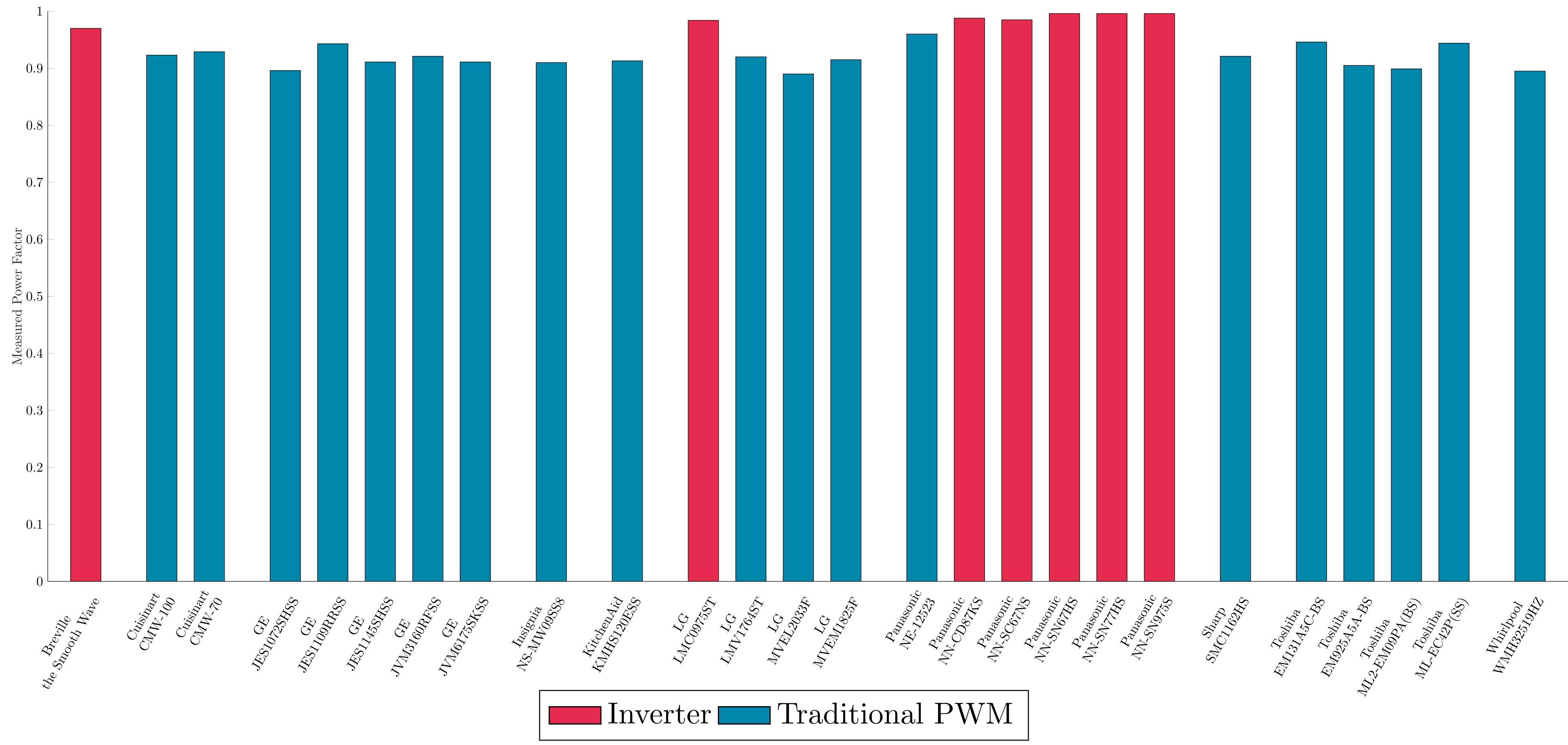
> The inverter models are marginally better at converting the total power they draw from an outlet (the apparent power) to useful work (the active power). However, your residential electricity bill is calculated based on active power use, so an inverter microwave won't save you any money.
If any power company has the ability, much less the inclination, to not charge you for your appliances waste heat that would be news to me.
[1] https://en.wikipedia.org/wiki/Power_factor [2] https://www.rtings.com/assets/pages/hRDTskis/power-factors-l...
Inverter microwaves have an actual power consumption that more closely resembles what you see at the wall. Non-inverter microwaves will appear to draw more power from the wall than is actually delivered to food, but it doesn't matter that much, because that "extra" power is stored inductively in the magnetron, which gets returned to the grid when the microwave shuts off. There are some minor conversion losses from this, but not nearly as great as one might initially think looking at wall vs radiated power.
Is that correct?
I don't know offhand what the power factor of a microwave looks like, but I bet it's not great. I can see an inverter style having better power factor.
I also could never get traditional ones to heat potatoes well. Scalding hot on the outside, cold on the inside. With inverter ones it's simpler: just a lower power setting for longer.
A cavity magnetron is a block of metal with some holes drilled in, two bits of glass glued on, and all the air sucked out. They're hard to tune to exact frequencies and hard to regulate to exact powers, and modulation is as you've already discovered kind of limited to just turning them on and off - but they're extremely cheap to make, last a very long time, and require minimal support circuitry to generate double-digit kilowatts of RF.
You don't need to be cock on frequency to heat up a pie.
Microwave ovens with such transistors have been demonstrated, which have the advantage of modulating the microwaves in such a way as to achieve a more uniform heating throughout the oven, than can be achieved with the fixed-frequency magnetrons.
At least for now, such microwave ovens with transistors might be encountered only in some professional applications, because these transistors together with the associated control circuits remain much more expensive than magnetrons.
Like I have said, the advantage of transistors is that it is easy to modulate in frequency the microwaves. This avoids to have standing waves inside the oven, which cause cold spots and hot spots, so they ensure that heating is uniform everywhere in the oven.
I assume that this advantage is more important for a big industrial oven, where many portions of food are cooked simultaneously and it is desired that all of them are cooked uniformly.
But for home users, magnetrons will not be replaced any time soon.
(Side note, modern very high power radio transmitters might also still use some vacuum tube technology - my latest information is that there's a slow transition going on)
A transistorized solution is, simply, inappropriate. The RF section alone will cost more than an entire microwave off the shelf, and plus that you need all the control circuitry and high speed crap to generate a 2.4GHz tone. Not to mention that putting kilowatts through silicon creates a much higher risk of catastrophic failure: transistors blowing out into a plume of plasma and such.
You're asking why we haven't reinvented the wheel. There's simply no improvement to be had.
You want high power RF in a given frequency band, you want a magnetron. It's just a lump of iron with some wires. You don't need any electronics. At all.
I try and tell friends about it and they all think I am crazy. I've had more luck with induction cook tops, probably because there is more general buzz around them.
I really with Alex on Technology Connections would do a video on inverter microwaves to get the word out!
I hate every microwave I have ever had the displeasure to operate during my lifetime, except the old stuff witn the teo mechanical knobs.
With a rotary encoder we can get second precision and minute granularity at the same time.
Is that time for a Kickstarter?
Both of them match your description. They had some other buttons, which I have never used. Besides the 2 rotary knobs, I use 3 buttons: start, stop and a button for chaining multiple time intervals, each with a different power level.
I cook all the food that I eat in the microwave oven, from raw ingredients.
Here's an article from the head chef from a commercial microwave oven company, on how to get more done faster.[1] Commercial microwave ovens have about 2KW-3KW of power, and some of them have true variable power, not the on/off thing most home microwave ovens use. "I’ve shown teams how to make mug cakes, molten chocolate brownies, and steamed puddings with just a microwave. The reactions are always the same: "I had no idea a microwave could do that.”"
[1] https://totalfood.com/revolutionizing-microwave-cooking-comm...
(gas reconnection was hard. Electricity, for reasons I never entirely understood, was easy to get reconnected to squats, at the time)
My co-occupants had a lot more experience than I of this life on the edge. I learned a lot.
If you were illegally occupying a house scheduled to be demolished, with only electricity and a judges order to quit over your head, what would you do? Go and buy a full oven or cook in a microwave?
So it's difficult for me to relate to those issues.
For years, I would get up insanely early and be the first in the office, with no-one around other than the cleaners. My breakfast every day would be microwave-cooked oats - but it wasn't quite as easy as the recipe from the book makes it out to be, mostly because of the milk.
Unlike water, when you heat up milk to a high temperature in the microwave, it behaves just like it does on the stove top: it wants to crawl out of the container and nicely spread itself everywhere.
So, I developed sort of a technique that consisted of short bursts of microwaving at full blast, then stopping and stirring, and back in with bowl. I repeated that a few times, but after I had the technique down, it didn't require much attention any more, it worked quite reliably.
The oats got cooked nicely, and thanks to the pectin of an apple that I also added in, it also thickened. (And in case you wonder, the apple's acidity does sometimes split the milk somewhat, but in most cases it doesn't.) However, there's definitely a difference in smoothness between microwaved oat meal and one that's made slowly on the stove top - the latter being much nicer in texture.
But it was a quick breakfast that I really enjoyed (with a dash of cinnamon) at my desk every morning while I was going through my email from the night before.
The typical workflow is: power button > number button 1-9
My daily driver is a bit more fancy, and has a single button to cycle through the available power settings.
For your milk oats I’d suggest a power setting around 30 to 40% and increasing the cooking time by a factor of 2.
Good microwaves, with an inverter (see the thread above!) actually adjust the power being output. You can evenly heat a cup of liquid to any desired temp using these microwave ovens. They are well worth the few extra $s (although mine actually cost less than a fancy smart microwave!)
Rolled oats don’t need to be cooked.
If you want soft outs you can soak them over night in the fridge.
No heat required.
The great advantage of microwave ovens is that even if the first time when you cook something that you have not cooked before, you must experiment carefully to find the optimum time and power level for a given amount of food ingredients, once you have determined good values you can use them forever with perfect reproducibility and the food will be good every time and there will be no incidents with food exploding or overflowing in the oven.
Once the oirriois cooked (it really should be already) add a teaspoon or two of salted butter to the middle and stir, then sugar to taste.
Suprisingly delicious, quick and repeatable.
I won a few people over who couldn't believe that porridge made with water would be any good, but it was a great winter staple, especially after cycling in, in the cold.
Revelation hey.
When polenta is made traditionally, you have to stir it continuously, which keeps you occupied and can even be physically demanding. In a microwave oven, you can make perfectly homogeneous polenta without any mixing (except for a few seconds, before putting the vessel in the microwave oven).
You can also bake bread in a microwave oven, and it grows tremendously with yeast or with baking powder. Even without a leavening agent, unleavened bread still grows well enough in a microwave oven, if you use excess water for the dough.
Nowadays, my standard breakfast consists of a polenta made in a microwave oven, which contains not only maize meal, but also sunflower seeds and whey or milk protein concentrate, so that it has an adequate balance of starch and protein, while also providing my daily intake of essential linoleic acid and vitamin E. After this breakfast, I am not hungry again until late in the evening, when I have my main meal.
I'm worried I'm going to burn a hole in my wallet searching for a pyroceram skillet that I'll end up using for a week and then forget about it.
On the other hand my brother in law got himself one of those smokers that burns wood pellets. I could buy one of those and eat nothing but smoked pork shoulder for the rest of my life.
But as the solo meat-eater human in my apartment, I ended up buying a gas-canister camping grill to barbecue steaks on my terrace on weekends and then I reheat the rare steaks through the week in the microwave. They get the Maillard reaction and flavor, they get to the correct doneness point when blasted with RF later on.
Cats get happy with the barbecuing, I also grill mushrooms and tofu for my wife and it’s very easy to clean afterwards.
There is nothing like sitting on the tailgate up at a remote hilltop site on a pleasant spring day, drinking a cup of tea outside in the sunshine while you wait for the third attempt at a firmware recovery on a radio repeater to finish, contemplating chucking some sausages on for lunch.
Except, possibly, sitting inside the transmitter shed has it gets buffeted by storm winds listening to the rain battering against the roof and drinking a nice hot cup of cocoa as you wait for the 17th attempt at a firmware recovery to finish.
And if you run out of the expensive special magic Coleman fuel, it runs just as well on mogas so you can pop the inlet hose off the injector rail, scoosh some into the stove tank, and get right on back to cooking your dinner.
Me? No, I'm going to be out on site all day long, I won't be in your Teams call. Tell you what, want to come with? It'll be good for you to see some of the hardware in use. Grab a steak or something to do for lunch.
[edit] youth...not you. That read weird.
With such a grill, the meat is cooked only by the hot air that comes from the flame without contact with something at higher temperatures, so the meat is browned only moderately at most.
Nowadays, I can cook meat in a microwave oven in a way that makes it pretty much equivalent with the meat cooked using that kind of grill with indirect heating.
I cut the meat in bite-sized pieces and I put them in a glass vessel covered by a glass lid, without adding water or anything else, except salt and seasonings spread on the meat.
Then I cook the meat in the microwave oven, using a low power, e.g. 400 W, and long times, e.g. 20 to 25 minutes for chicken meat and around 30 minutes for turkey meat.
I consider that meat cooked in this way has an optimum taste, but of course preferences vary.
Didn’t expect the missile nosecone.
Dad worked for Corning; when they hired him, he bought a house one town over. It came with a Corning electric range in the kitchen. This was effectively four electrical resistance grids embedded in a giant sheet of pyroceram.
Like an induction cooktop, there is no visible indication that the "burners" are "lit", unless you looked at the control panel off to the side.
Somewhat like an induction cooktop, only certain cookware was compatible with it. Luckily, the primary requirement was "the bottom needs to be flat". You might be surprised at the number of pots which have concave bottoms... or develop them over time.
UNlike an induction cooktop, it does get up to arbitrarily high blackbody temperatures.
Pretty much every accident you can think of synthesizing from these conditions occurred. Nobody in my family would ever buy one. (I love lots of other Corning products.)
Oh, and as for the easy-to-clean surface? Very true... as long as you ignore the case of scorched proteins. Anything else, you wait for everything to cool and then wipe it with a slightly soapy sponge, then mop with a damp cloth. I don't remember the night the grey scorchmark appeared, but it lasted about fifteen years. Then Dad sold the house.
- Cooking dry goods (quinoa, freekeh, couscous)
- Single-serving coffee mug surprises (omelettes, protein brownies)
- Low-carb cheese crisps (via parchment paper)
- Not-fried rice (day-old rice, light sesame oil, soy sauce, bits of egg, leftover veggies, random seasonings)
- Frozen breaded chicken (wrap really well in paper towels to absorb moisture, overshoot on time, unwrap as soon as they're out to avoid sticking - they come out like 66% as crispy as using a convection oven)
I do draw the line at pasta because the texture never seems quite right when you boil it in the microwave.
> they come out like 66% as crispy as using a convection oven
Sadly, I've never been able to read the book in the correct order as I don't know what system it came from - it's something that is single-sided, 77 tracks, FM (single density) encoded with 26 sectors/track, but the text is there in a hex editor.
It makes it pretty obvious that it isn't a joke or trick; someone saw it fit to fill up a 250kB disk with this, so somebody must have thought it was a good idea.
In an unrelated endeavour, my dad told me he once tried to cook an entire turkey in one of those huge 80's microwaves. He said it didn't turn out very good.
The two dial microwave was peak UX. Quick, painless, no wondering what sequence to press on a strange 'wave, zero time delay between input and cooking, and easy use of the (essential) power function.
It even lets you change time or power mid-cook. For maximum laziness it's possible to leave the door cracked with time on the dial, throw in the food, and adjust the dial while it's already on (slightly reducing the wait before eating). Using the microwave becomes forgiving instead of foreboding, because it's so easy to change your mind.
The only downside is that it's slightly less precise, but getting the exact time down to the second is probably less important than you think. It's also a mechanical part to fail, but I've had microwaves die because the push buttons failed too, whereas my dial unit is still going strong. YMMV
[0] https://www.cdc.gov/infant-toddler-nutrition/formula-feeding...
But I disagree with the idea that we don't need precise times on a microwave. The article / book disagrees with that, and the think I most regularly microwave (milk for my kids) needs 1 minute 50 seconds. 2 minutes and they'll reliably complain it's too hot.
The real problem with microwave UX is that the interfaces are often simply bad. People think the power/time dial interface is good but that's because it's difficult to mess it up (though they usually manage anyway by having them go up to 30 minutes or whatever).
It's really easy to mess up a button interface but you can also do it well. My microwave is close to doing it really well. You press a high/med/low button, then 1s/10s/1m/10m buttons to the desired time, then start. The only things they got wrong are that it requires pressing the power when 99% of the time you want high, and you could probably get a more useful distribution of time increments (I'm literally never going to use the 10m button).
But apart from that it's nicer than dials, which are often very cheap and imprecise.
>they're easier to clean
>though they usually manage [to mess up the interface] anyway by having them go up to 30 minutes or whatever
>My microwave is close to doing it really well. You press a high/med/low button, then 1s/10s/1m/10m buttons to the desired time, then start.
Enter time on the keypad, optionally press Power and enter that, press Start. Also needs a Plus 30s button. This is the one and only correct way to implement a push button microwave. ;)
I count five presses instead of 3 to get 90 seconds, including one way that's just pressing the same button 3 times (+30s).
>needs 1 minute 50 seconds. 2 minutes and they'll reliably complain it's too hot.
The dial microwave I use can distinguish between those two. It helps that the shorter times are given more room, so you can adjust them more precisely. 1:50 vs 2:00 will make a difference in my experience, but 7:50 vs 8:00 generally won't.
You could have a hybrid approach of course, but then I suspect the engineering tendency would be to "lock in" the time after starting the oven, so it can't "accidentally" be changed.
Looking for a photo of my microwave dial, I came across this surprisingly relevant post:
https://ux.stackexchange.com/questions/90769/why-do-microwav...
Really? What for? Anyway the vast majority of microwaving is going to be in the 1-5 minute range. By making the dial linear and giving it a huge range up to 30 minutes, you end up making e.g. 30 seconds and 1 minute impossibly close.
The commercial microwave oven someone else linked had a solution - make it logarithmic.
> Seven presses?
Eight actually, but it really is quicker and easier than doing the same with a dial though. I agree it could be optimised though. It shouldn't be necessary to select the power and a 30s button would be good (down to 5 presses).
For cooking, times from 10 to 15 minutes are more frequent, though things like potatoes or sweet potatoes need only 7 to 8 minutes. Only a few delicate vegetables or fruits may be cooked in the 1 to 5 minute range, e.g. onion, garlic, leek, parsley and dill, etc. Meat needs to be cooked at low power, which in turn requires long times, typically over 20 minutes. There is also a very small number of vegetables that need cooking times over 15 minutes, e.g. the common beans, for which even times of 30 minutes may be needed.
That said, all the microwave ovens that I have used (in Europe) had rotary knobs with variable resolution, fine for short times and coarse for long times.
Which is most people, as the article notes!
> had rotary knobs with variable resolution
Eh fair enough. Maybe I have just happened to only see bad ones.
Only a few years ago I began to experiment with cooking raw ingredients in the microwave oven. After discovering how much this simplifies cooking I regretted very much that I had not tried to do that earlier.
Because cooking at microwaves is much faster, nowadays I cook most food immediately before eating it.
They had a finer resolution of 10 seconds for short times, then the resolution was progressively coarser for longer times, e.g. of 30 seconds for times over 10 minutes.
This is perfectly adequate for finding optimum times, and I cook in a microwave oven all the food that I am eating, from raw ingredients.
What's amazing is how the vibe of using the microwave completely changed. Before it was:
"Okay, how much time?? I've gotta get this right, I only get one shot. Think!!"
to:
"Probably 2 minutes." moves knob, cooking starts "Eh, maybe 90 seconds actually." moves knob again
That alone probably reduces the error rate, and it certainly reduces annoyance.
With the new stoves, I've noticed people are starting to dread using their stove the same way they dread the microwave. Hopefully we can fix both.
I do prefer the mechanical wind-up timers though.
Consumer-grade microwaves are made to look cool, not to use. Commercial microwaves are made to make money. One dial, no bullshit.
And check out the scale on the dial. That’s modern, no old-skool 2-dial microwaves can do that, AFAIK.
I have one of Panasonics upper model flatbed microwaves that also acts as a fan forced oven with traditional oven element and fan, and as a grill with two overhead halogen grilling elements.
I picked it up for 50% RRP as it marked down for a minor defect I can’t even recall.
It’s 1900 watt on full microwave power, if I recall correctly, where most on the market amend here are 1400 watt. Makes a lot of difference, browning the top of food is easy with a bit of oil.
I can’t really fault it, it’s super easy to keep clean and works great for baking where using full size oven is overkill.
Many microwaves will let you set the power to 0% by pressing the power button then 0 or 00.
You can then put a cup of hot water from a kettle or the hot water tap in the microwave on 0% power for two minutes and it will come out colder.
Bonus points if you have a thermometer at hand.
If one person in the house can't tolerate very hot foods, it could be useful for eg cooling off grandma's bowl of soup so she doesn't need to wait.
The microwave does have a van in it, so potentially yes.
Light builds doing emit light, they suck dark - https://ultimatecampresource.com/campfire-stories/funny-camp...
Know the popcorn button? Ever wondered why every popcorn manufacturer tells you not to use it, or, if you don't make a habit of taking orders from a paper bag, why it works on some microwaves, but fails miserably on others, either burning the popcorn to a crisp or, more often, leaving half the kernels unpopped? Humidity sensor. In microwaves with a humidity sensor, the microwave runs until the humidity stops rising, (which means the kernels stopped popping) then stops (well, actually mine sets ~30 second timer, then stops). This produces perfect popcorn every time. Doesn't matter the brand of popcorn, it just works.
Unfortunately, because this feature was so great, it got imitated on every microwave, regardless of whether it has a humidity sensor or not. On those microwaves, it just sets a flat timer, which cannot adapt to variations in popcorn. Since popcorn manufacturers have no idea which camp your microwave falls into, and can't assume you have any idea either, they just tell people to neglect a fantastic feature.
If you're gonna brown some onions, microwave them for a bit before tossing them into the pan. The first step of browning onions is just boiling away the water, which microwaves are great at. You may find that it begins to brown sooner this way.
https://www.reviewed.com/ovens/features/we-tried-an-oven-tha...
The first is that it is not easy to make a mental model of how it works. The second is that since it takes little too cook the food, it is unforgiving and you have to be very careful with both timings and amounts.
This makes it hard to learn how to properly use it just by trial and error. Also since now we have inductive stoves there is even less reason to use it.
I’m surprised almost everyone I’ve shown this to in real life hadn’t known, and goes on to never use it.
This was less of an issue when more microwaves had two knobs rather than buttons only.
If our lives are to efficient, say because we do not have to butcher a pig and cure it’s meat to get ham, we start to become obsessed with all kind of strange diets from cocovorism to paleo.
[1] Here's an example: https://www.allrecipes.com/recipe/241038/microwave-chocolate...
I'm partially living in this alternative timeline as an accomplished microwave chef thanks to this thing. I mostly use it to steam veggies.
Didn't think the Maillard reaction was possible in the microwave (and that's what I miss the most). The tin-oxide pans are fascinating, though pre-heating them doesn't seem terribly convenient now that we have induction stove-tops.
Also, the number of paper towels used...
Although I will never use anything of what I learned from this article, I feel a better person since I’ve read it.
In one of the alternate universe I like to imagine, AI slop doesn’t exist and the Internet is filled with gorgeous pieces like this one.
I know nothing about these things, but I still only use it to heat my cold cup of coffee - and I’m standing way back while I do :) I even own a pyroceram skillet.
Cooking in general affects the nutritional value of food—some nutrients are easier to absorb when cooked, so cooking effectively increases their amount, while other nutrients are destroyed [0] [1]. But given that you're probably cooking your food anyways, there's nothing specific to microwaves here.
Microwaves might actually be slightly better than other cooking methods here, since they produce a lower heat that's less likely to destroy nutrients, but the cooking method has such a minor effect that I wouldn't really worry about it either way.
> Or if radiation can leak and affect you body if you stand very close to it while it’s running.
Microwaves are classified as non-ionizing radiation [2], so their main effect is just heating things up. So if you're standing near a microwave and your body starts heating up, then something bad is happening; otherwise, you're probably fine.
The only health risk from microwaves (aside from a hypothetical accident involving someone being cooked inside one like a rotisserie chicken) is cataracts [3]. But this usually only affects radio technicians, who put their heads beside much bigger and much more powerful microwave emitters than a domestic microwave oven. And even cataracts are only due to the heating effect.
[0]: https://en.wikipedia.org/wiki/Cooking#Effects_on_nutritional...
[1]: https://www.healthline.com/nutrition/cooking-nutrient-conten...
Moreover, at microwaves it is easy to cook without adding water (whenever you are cooking meat or vegetables with high content of water, e.g. potatoes; when not adding water, using a glass vessel covered with a glass lid is normally mandatory), or only by adding a minimum amount of water, which avoids the leaching of water-soluble nutrients.
These properties ensure that food cooked at microwaves in the right way (e.g. without water whenever that is possible) is frequently tastier than when cooked by traditional means. The only exception is for people who like burned food, as this method for degrading food is more difficult to do at microwaves.
While the fact that food is less affected by microwaves than by most other methods of cooking is intuitively obvious, there have been published several research articles where it was investigated the degradation of several essential nutrients, e.g. vitamins, during cooking by various methods, and they confirmed a minimum degradation during microwave cooking, caused by shorter cooking times and lower peak temperatures.
When cooking at microwaves, you normally do not cook everything together, because meat requires different parameters than vegetables and there are 3 or 4 classes of vegetables that require different parameters. So you typically cook the ingredients separately and you mix them after cooking, when you also add ingredients like oil, which should better not be heated.
You can cook multiple classes of vegetables together, if you start with those that require the longest cooking time, and microwave them for the time difference vs. the next class of vegetables, then you add the next vegetables and microwave them for the next time difference, until you add the last kind and microwave again everything for the remaining time.
Meanwhile, throw stuff in the pan, move it around, adjust the temperature, add in some stuff as it goes, is a much more interactive type of cooking that is much more likely to take me where I want to go (tasty food).
If you want to make curry from scratch you can either do the whole thing in one pan and get "homestyle" curry - which is good - or you can make an onion paste by either cooking a very mildly spicy but ultimately rather bland onion soup for an hour to make the "base gravy", or by just chopping three or four onions and sticking them in the microwave on full blast for ten minutes before mooshing them with the hand blender.
Then you just bloom your spices in a bit of oil, chuck in some garlic and ginger paste (literally about the same amount of peeled garlic cloves and peeled ginger root mooshed up with the blender in a little oil and water) and let it bubble a bit, chuck in whatever veg and meat you're adding, and then slowly start adding your onion gloop, and boom, restaurant-style curry.
If you make the garlic and ginger paste in advance, and precook the meat a little (beef kind of wants to be stewed until it's tender, and then you can fire in the stock it's stewing in) then you can knock out an incredibly tasty curry in the same amount of time it takes to cook the rice.
And that's how restaurants do it, because you're not going to wait two hours for a homestyle curry to cook off properly.
>Unfortunately, this product is discontinued
:(
But somehow modern microwaves always have a button on the front with a picture of a roast chicken. Why are microwave UIs so delusional? Just need power %age and time.
Microwaves are good for making porridge (oatmeal) though. And I've had some success with scrambled eggs, if you get the method right results are very consistent.