One, the article asserts that too many stops is the main cause of low ridership in the US. I didn’t even see a correlation (which would still not prove one causes the other) between number of stops and ridership. This is the central thesis of the article.
Two, removing stops will likely not make the remaining stops nicer. Cities aren’t thinking about how to allocate a fixed bus budget. They’re asking themselves how much they have to spend on buses. This is the core of the problem: low cost services are in a death spiral in the US. Budget cuts -> services get worse -> reduced users -> more cuts.
In my experience, the bus is not a nice experience. The bus feels dirty, unsafe and hostile. Further, the arrival times are not reliable and are often a long time apart. This means you need to arrive ~10 minutes early and time your bus so that you also arrive at your destination early. You will be wasting possibly 20+ minutes each way. Of course you are also standing in the sun or the cold or the rain while you wait, and probably walking on a hostile stroad and across several lanes of traffic before that point.
So while the number of bus stops might matter at the margins, we’re not talking about a system where marginal improvements will matter. If you want to improve ridership, you need to make the bus an attractive option for more people.
Even if every current person's mind has been completely made up based on past experience, there are always "new adults" learning to get around and forming opinions.
So I strongly disagree: marginal improvements DO matter. And I agree with the author that this would be a relatively easy improvement to deliver for many cities.
I live in Chicago with the third-closest stop spacing per the article. I'm personally able to walk a block or two further to a bus stop no problem. Bus stop consolidation would save me a lot of time over the course of a year!
Decreasing the number of As and Bs by half might reduce that 20% start/stop time by half, shaving 10% off the total time. (This is ignoring the fact that more people will need to board and leave at each stop, which might mean in reality you’re saving like 8%.)
But you will also increase the distance walked to the bus stop. That means battling cars and weather.
I simply don’t believe that eliminating that closet stop would worsen my commute. When I’m leaving home, I would walk a block further, but probably 80+% of the time it would not increase the time I spend out in the elements because I’d just replace time standing at the bus stop with time walking to the next one. The only time it would hurt me is on the rare occasion that the bus passes me while I’m walking that extra block. (Pessimistically assuming 2 minutes to walk one block, and with buses coming every 10 minutes on average, is how I get 80%.) But I bet doing that all up and down the route would make the bus much more predictable. That closest stop is within the distance that cars back up from a traffic light at that next intersection when there’s traffic, and when the bus stops at my intersection it can often get pinned in the stop for a while when motorists aren’t in the mood to let the bus re-enter traffic. Multiply that phenomenon by, say, 20 extra stops and you get to some pretty unreliable service for people trying to get to work in the morning. I bet most of us would happily walk an extra block if it means we no longer have to leave for work half an hour early. 2 minutes extra walking on either end adds up to 4 minutes “wasted” time walking (I also am not sure I count walking as wasted time, by the way - physical activity is good for me) is a lot less than 30 minutes wasted time padding my commute to account for less reliable service.
And then when I’m coming home I get off at that stop that’s a block further away anyway. Because there’s a light at that intersection but not at the one where the close stop lies. I can easily spend more time waiting for a gap in traffic large enough to cross a busy street during the evening rush than it takes to walk that extra block.
Just like a little 4 seat bus you could just have all the time. I bet that would be popular!
I’m really curious how this would pan out here, but it can’t be the only solution.
And beyond that, the 6% of average time savings seen in studies of similar systems would be about the same improvement as adding curb bump outs which would save the bus time by not needing to repeatedly merge back into traffic. And that work is already happening across the city without inconveniencing anyone or causing users with disabilities from being discriminated against by armchair urban planners.
Until there' a snowstorm, and no one shovels. And you have a broken leg, or are elderly, or disabled. Sure, it might save you personally some time, but we live in a society and should try to help out the one's who need help.
And this is why point-to-point transportation is almost always faster and more convenient, if you can afford to use it. (That load-bearing "if" is important, though.)
Point-to-point transportation is faster and more convenient because:
1. we don't have bus lanes so buses are forced to sit in the same traffic as cars and 2. buses are often underfunded so have slow/infrequent service.
Point to point transportation is often slower and less convenient if buses and public transit is done right. I can count on my fingers the number of times I used an Uber or drove a car in the 1 month that I stayed in Europe - this was going out every day, in multiple cities, rural and urban, and across different countries.
This is a good thing! If more people use public transit when it's possible, it opens up the roads for the handful of people who actually NEED to use a car.
If you have enough density to justify a bus lane, you have enough density to justify a subway.
Not at all. Building a subway in most US cities right now is very expensive. Raising the tax revenue alone is probably a non-starter.
Moreover you're going to have to close the road down anyway to do any form of cut-and-cover or even deep bore construction, which means every business on the corridor and every person who lives on it is going to get angry for as long as the subway is being built.
There's no painless way to do infill public transport. The problem is that nobody in the US is willing to compromise.
This is true but seems like a problem worth solving. It's also true of more than subways; we have the same problem with bridges, housing and many other things. Better to get on with fixing it than use it as an excuse for doing something worse.
> Moreover you're going to have to close the road down anyway
That's a one-time cost, and you're not required to close a 500 mile stretch of road for years on end. Dig one block, install the tunnel, cover it, dig the next block.
IMO it comes back to the fact that Americans are just not willing to accept change of any kind right now. The economy feels too shaky, the electorate too divided (even within states and municipalities), and there's too little faith in government to architect the kind of change you'd need to build subways, underground metros, or even BRT. We need a larger feeling of unity even at a state level to make the changes necessary, which is why municipalities continue to do bare minimum maintenance of roadways and pretty much nothing else. The last big set of constriction in dense urban areas was funded by the Obama stimulus from the GFC which was passed 17 years ago.
That assumes a linear city, where everyone lives within a short walking distance of the same street.
In actual cities, bus lines from different neighborhoods converge on main streets. While individual lines may have 10–15 minute intervals, bus traffic on the main streets may be high enough to justify dedicated bus lanes.
Then, as the city grows, it can make sense to replace the bus lanes with light rail and direct bus lines with collector lines connecting to the rail line. Which should be cheap, as a dedicated lane is usually the most expensive part in building light rail.
But you generally want to avoid building subways until you have no other options left. Subway lines tend to be an order of magnitude more expensive than light rail lines. Travel times are also often higher, as the distances between stops are longer and there is more walking involved.
Isn't that the assumption you're making? That there is a single primary street that everything converges and then diverges from which is common to every bus route? Meanwhile in practice any given person standing on the You Are Here dot could want to go in any of the eight directions from where they currently are.
A route that goes east-west isn't going to have much in the way of shared route with one that goes northeast-southwest except for the one point where they intersect, and isn't it better to have multiple routes intersecting in multiple places in terms of minimizing trip latency and maximizing coverage?
> Which should be cheap, as a dedicated lane is usually the most expensive part in building light rail.
But that's the thing that makes the bus lane so expensive!
By the time you have an area with enough congestion to be considering a bus lane, the problem is generally that you can't add a lane because the land adjacent to the existing road is already developed and not available, otherwise you would just add an ordinary lane that buses could use too. But converting one of the existing lanes in an area which is already congested makes the traffic exponentially worse than putting the new thing underground.
Essentially, if you can add a lane then you add an ordinary lane and if you can't add a lane but need one then it's time to dig.
A typical direct bus line starts from somewhere, goes through a number of neighborhoods, reaches a major street, and follows it to a central location. The number of directions that need a bus line is typically much higher than the number of streets reaching the central location. (For example, you need ~10-degree intervals at 10 km from the center to guarantee a reasonable walking distance to the nearest bus stop.) Hence the bus lines eventually converge.
Once you have enough bus traffic that a dedicated lane makes sense, transforming an ordinary lane into a bus lane will make the traffic faster for the average person. It's not a Pareto improvement, as the traffic will become worse for those who drive on that route. But it's not a huge loss for them either. If you already have 20+ buses/hour making frequent stops during the rush hour, the throughput for that lane will already be much lower than for the other lanes.
Public transit depends on the assumption that there is enough density along a given route to justify its existence. Take a look at the NYC subway map. In the highest density boroughs (Manhattan and Brooklyn) the routes basically go from everywhere to everywhere. Even more so for the Manhattan bus map. That's what you want in a large dense city.
In smaller cities, the "build a high density core surrounded by lower density areas" model is the thing that causes more congestion, because then the core ends up as a bottleneck but people don't want to take transit to get there because it doesn't have frequent service to the areas outside the core at one of the traveler's endpoints. For those cities it's better to have medium density everywhere than try to make transit work in a city where a large proportion of the population is coming from an area with density too low to make it viable.
And if the whole "city" is low density, i.e. it's a rural small town, then it's not likely you're going to make public transit work there whatsoever. The best option there is to use mixed zoning so people so inclined can live within walking distance of shops.
> It's not a Pareto improvement, as the traffic will become worse for those who drive on that route. But it's not a huge loss for them either.
It is though? The premise to begin with is that road is already too congested and is slowing down the buses. Removing a third to half of its capacity is going to make it dramatically worse. That's what many of the proponents of bus lanes are after -- they want to force people onto the bus by snarling the cars.
They refer to this as "induced demand" by inverting the sign when what they really mean is to suppress demand for driving by making it more miserable, but don't want to call it that because it would be unpopular.
Consider a low-density urban area with 1500 people / square km (~4000 people / square mile). You could achieve that with a uniform sprawl of single-family homes on half-acre lots, or with a network of towns / villages / neighborhoods surrounding the city center. The former generates more car traffic, while the latter makes public transit useful for a large fraction of trips. And the latter also makes local services viable, as there will be enough population within a walking distance.
And if you have a 2+2 lane street with enough bus traffic to justify bus lanes, most of the capacity is in the inner lanes not used by the buses. Urban buses stop frequently, making the traffic flow much worse than in lanes without buses.
Only if you're also intentionally making point-to-point worse.
Note that I'm not comparing to "get in your own car and drive", which has the disadvantage of having to park. I'm comparing the ideal taxi-shaped thing to the ideal bus-and-tram-and-train-shaped thing.
I feel like you missed my last paragraph. If public transit is better then more people would use it and there would be fewer cars on the road. Can you imagine how terrible point-to-point traffic in SF would be if everyone was driving to work instead of relying on Caltrain or BART?
I'd suspect most car trips today are 1 or 2 passengers with the back seat and trunk empty; we'll eventually see new form factors of on-demand vehicle that trim off unneeded space. If you need to get from A to B alone, no cargo to speak of, you order a ride that covers that class and it's small. If you're taking a shuttle from the airport with your whole family and luggage, you order a ride with those specs.
They make even more sense if they are a bit larger and can accommodate multiple people at once. Something like a large van or small bus.
(Also, tunnels are useful not just for the increase in traffic, but for moving car traffic away from non-car traffic, which makes both kinds of traffic safer, faster, and more efficient.)
Even the rush hour traffic is trivially solved by mild carpooling (small vans for 4-6 people).
We're talking about cities, of course; in rural areas, nothing beats cars.
This is a false argument. Think about this: a bus every 10 minutes is effectively 500-900 meters long! It easily "takes" as much space as 100+ cars. In other words, nothing would change from the traffic perspective if instead of 1 bus every 5 minutes, you had 100 individual cars.
The "people in the shape of a bus" argument makes sense only when you're talking about the performance in a very narrow case of transporting people in a steady, uninterrupted stream of buses. Or if you need to size your traffic bottlenecks.
Moreover, a bus route necessarily is unoptimal for at least some people on a bus. They are effectively "thicker" than other people because they take up more "effective space". But wait, there's more! Buses also necessarily move slower due to stops, so the "effective length" of a bus becomes even longer because cars will clear the road faster.
But wait, there's even more! A single bus needs about 3 drivers to be effective. So with the average daily busload of around 15 people, you have almost 20% of the bus taken by the drivers on average. This makes bus trips pretty expensive. Not quite to the level of Uber/Lyft, but surprisingly close.
And these problems are fundamental. That's why urbanists like NJB don't like to talk about that.
Ultimately the thing you want to transport is not cars, it's people. Walking fits the most people in a limited amount of space, then bikes, buses and other forms of public transport, then cars with 4 people in them, then cars with 3 people in them, then cars with 2 people in them, then cars with only 1 person in them, and finally empty cars. More cars will never reduce congestion.
But to address your point: A bus in a dedicated lane takes up more space than a bus that's stuck in car traffic, you are right about that. On the other hand, when congestion is so bad that cars simply don't move, no matter how many lanes they have, getting people out of cars into more efficient forms of transport, will also help cars. And a bus that actually goes, can do that. If you look in cities with good public transport, more people go by public transport than by car. In cities with good bicycle infrastructure, more people go by bike than by car. That means even cars are less likely to get stuck in traffic in those cities. Even if you take away a car lane.
I don't know where you got the idea that a bus needs 3 drivers.
And? There are also buses that trundle around with nobody but the driver in it. Or unused bikes and e-scooters that litter the sidewalks.
> Ultimately the thing you want to transport is not cars, it's people.
Yeah. And let's make it efficient. Put these people into 3-level bunk beds. This way they can travel all together in just 1 bus to their assigned workplace. And you don't need to run buses until they're allowed to clock off their shift.
Efficiency!
> On the other hand, when congestion is so bad that cars simply don't move
In this case you close the downtown offices and force them to work on alternate days, like they do in India with cars. Remote work already can replace 70% of all work, and with AI this number will grow.
Apart from that, mild carpooling will decrease the number of cars by 2x. Small vans with 6 seats can _easily_ remove all congestion.
> no matter how many lanes they have, getting people out of cars into more efficient forms of transport, will also help cars.
Just one ask for urbanists. Can you just stop lying, please? Just one thing. Don't say that "transit help cars". It doesn't. There is a lot of research from _you_ (e.g. https://archive.strongtowns.org/journal/2020/1/7/does-buildi... ) that proves this. Transit does NOT decrease the travel time for cars ("traffic") it _increases_ it by increasing congestion due to increased housing density that transit forces.
You want to pack people into 3x3 jails ("microapartments")? Fine. But be honest about it.
uhhhhhh what. What does every 10 minutes have to do with this at all
> It easily "takes" as much space as 100+ cars.
are you ok??? have you seen a bus before??
> A single bus needs about 3 drivers to be effective
I have never ever seen a bus with 3 drivers in it. If you're talking about 3 drivers over the course of 24h, those drivers are not in the bus at the same time, and therefore don't make up 20% of the passengers on the bus. If you're saying the average bus route serves 15 people per day, you are certainly mistaken.
Definitely mistaken for London - currently (according to DFT's numbers) about 18 people per bus average (not per day, though.)
See the word "effective". Think about the road space that a bus requires but doesn't use if it is just once per 10 minutes.
> I have never ever seen a bus with 3 drivers in it. If you're talking about 3 drivers over the course of 24h, those drivers are not in the bus at the same time, and therefore don't make up 20% of the passengers on the bus.
Yes, I'm talking about the drivers that are needed for a reasonable 16-hour bus service. And the typical ratio is actually a bit more than 3 drivers per 1 bus.
> If you're saying the average bus route serves 15 people per day, you are certainly mistaken.
No. I'm saying that on _average_ there are 15 people in a bus. More during the rush hour, fewer during the off-hours.
Excepting the case of a dedicated bus lane, the amount of road space a bus is preventing other cars from taking up at a given time is equal to the size of the bus. Technically, it's less than that in the case of bus stops littered amongst parking. In the case of a dedicated lane, it reduces the maximum throughput of the thoroughfare, but it's not a simple thing to model as there are other effects that the bus can have to reduce the number of cars when the rate limit of thoroughfare would be pertinent (i.e. usually rush hour). Just saying "think about it" when saying a bus takes up the space of 100+ cars doesn't really substantiate such a bold claim.
> Yes, I'm talking about the drivers that are needed for a reasonable 16-hour bus service. And the typical ratio is actually a bit more than 3 drivers per 1 bus.
> No. I'm saying that on _average_ there are 15 people in a bus. More during the rush hour, fewer during the off-hours.
If there is an average of 15 passengers on the bus during the operations of the bus and there is an average of 1 driver on the bus during the operations of the bus, then it is 1/16th occupied by driver(s). For it to be taken 20% by driver occupancy, then it would require there to be an average of 4 passengers on the bus during operations.
> If there is an average of 15 passengers on the bus during the operations of the bus and there is an average of 1 driver on the bus during the operations of the bus, then it is 1/16th occupied by driver(s)
No. For the bus to be viable, all 3 drivers have to be "virtually present" there. A bus _has_ to be available at all times with a reasonable interval, otherwise it might as well not exist.
Or in other words, a passenger needs to be paying the salary for even the missing drivers.
until this moment, you were only claiming.
> the section about computing the efficacy of bus lanes
> Excepting the case of a dedicated bus lane
Not all buses require a bus lane. A bus lane is a deliberate choice that doesn't make sense in all areas and for all bus routes. It is disingenuous to reference the reduction in throughput due to a bus lane as a blanket claim that an individual bus takes away the room of 100+ cars on the road.
> you have almost 20% of the bus taken by the drivers on average
> No. For the bus to be viable, all 3 drivers have to be "virtually present" there.
Your claim is about how much of the bus is taken by drivers, which while having some correlation to cost, really doesn't have anything to do with the cost of operating the bus. An oversimplification of this is to posit a magic bus that runs 24 hours a day with 8 hours shifts by 3 drivers. That means that the drivers take up 24 person-hours of capacity on the bus. If we say they have 15 passengers on average, then the passengers take 360 person-hours of capacity on the bus. Thus, drivers take up 24 / 384 or 6.25% of the capacity.
Honestly, I never really cared enough to convince you that transit is a good thing because that feels like a fool's errand. But these weird claims and fallacies bother me. If you want to claim that a bus isn't cost effective, then great. Just cite an actually relevant metric and actually calculate it correctly.
Where I grew up in NW Scotland, it's a five hour round trip to go to the supermarket. You pretty much need a car for that.
Where I live right now it's a five minute walk to the supermarket, but I still need a car because the things I work on are a long way from where I live, often up steep muddy mountain tracks.
When I lived in the middle of Glasgow people used to come up and have a go at me about driving a massive V8 4x4 in the middle of a city. What am I supposed to do with it? Bike to the suburbs and then go and drive up a mountain?
"But why not get a job where you don't need to drive hundreds of miles in a massive 4x4?"
Because then the things on the tops of mountains don't get fixed when they break, and the radios don't work properly, and then people like you die in a fire.
Sometimes it's hard for people to grasp that just because their not-really-a-job tapping numbers into an Excel spreadsheet all day can be done from home or from an easily walkable city centre location, it doesn't mean that everyone's job looks like that.
I do wish I could usefully use a cargo bike. Those things are awesome.
We just want there to be viable public transportation options for situations where it makes sense. This even makes it easier for the people who do have to drive, like you, as there will be less congestion because a single bus can replace literally dozens of cars, combine that with a single tram and a single metro car and you're replacing literally hundreds of cars that would otherwise be on the roads instead.
But growing up in a rural area where there are two buses a day none of which are useful for anything other than high school pupils (although they're not school buses) it does tend to limit everyone's options.
I find this statement utterly hypocritical. Sure, we're not killing off driving. We are just choking off the roads with bike lanes, forcing extra-high density ("just build more"), removing parking, forcing the drivers to pay for transit that they don't use, and just to pay in general.
But no, we're not preventing driving. Not at all.
Urbanists want to stop people from using cars as much as they can force that.
Suburbs are _cheaper_ than dense cities. In fact, they generate most of the wealth of the country. It's easily proven by checking the amount of personal income taxes from suburbs versus cities.
People who claim that "suburbs are subsidized" typically check the _corporate_ taxes that are paid (surprise!) usually at their headquarters' locations. Usually in downtowns. But _people_ who create wealth overwhelmingly prefer suburbs.
And yeah, if your goal is to maximize the profit that you're extracting from companies by exploiting people, then dense cities are perfect.
Consider that the "one size fits all" approach into forcing people out of cars breaks down very rapidly once you get out of sight of the sickly LED glow of streetlights.
If you live in a city, you probably don't need a car.
And the fact that you're complaining about "removing parking" is hilarious. Street parking is objectively the most useless, wasteful allocation of already limited public space imaginable. You expect cities to dedicate premium real estate to act as a subsidized storage locker for your private, empty vehicle for the 95% of the day you aren't even using it. Then you complain about non-drivers "forcing" you to pay for transit, while everyone else's taxes are literally subsidizing the free public storage of your personal property.
Let's also talk about your entitlement to those roads. When you complain about "choking off" streets, what you're really whining about is that cities are finally prioritizing actual residents over commuters who are just driving through. Most car traffic in urban centers is just people transiting. Why should a neighborhood sacrifice its safety, noise pollution levels, air quality, and public space just to act as a high-speed shortcut for people who don't even live there?
And please, spare me the inevitable "but what about rural areas" argument. We are talking about dense cities. Nobody is coming for your car in bumfuck nowhere; you can keep driving there all you want. (Though honestly, here in the Netherlands, you don't even have to drive in the countryside because you can usually just grab a train or get anywhere by bike, but that's beside the point.) Urban planning applies to urban areas.
I live in the Netherlands. Millions of people here take transit and ride bikes every single day. And guess what? Nobody banned cars. In fact, it's widely considered one of the best places in the world to drive specifically because everyone who doesn't want or need to drive isn't forced to be on the road getting in your way. We just realized that sacrificing huge swaths of our cities so commuters can treat our neighborhoods as a shortcut is incredibly stupid, and there are infinitely better ways of using the limited space in cities than to let drivers park their cars there.
Giving people viable choices isn't a totalitarian conspiracy to oppress drivers, it's just good urban design. It's wild that you are so used to forced car dependency that simply offering people an alternative feels like a personal attack.
P.S., I'm also a driver, I just don't need to do it 90% of the time because I live in a sane country where I can just bike to the other side of the city in 20 minutes.
Except that bike lanes in the US, on average, carry fewer people than car lanes that they replaced. So yes, it's indeed "choking off". It's done to force the density increases. After all, if you can't commute anymore (roads are sabotaged and transit is slooooowwww), you'll have an option to live closer to the workplace. In a new expensive apartment in a high-rise.
Bike lanes also kill businesses. There were studies showing otherwise, so I replicated them, and they now show the opposite. Places in Seattle and Portland with bike lanes that displaced traffic lanes are declining faster than areas around them. The previous positive results were caused by spurious correlations during the general upswing in the urban economy after the 2008 crisis.
> Then you complain about non-drivers "forcing" you to pay for transit, while everyone else's taxes are literally subsidizing the free public storage of your personal property.
There is no free parking around me anywhere. And I'm also paying around $2000 a year in car tab and property taxes for transit that I don't use. And before you ask, in my state user fees pay for 90%+ of the total road maintenance expenses.
> We are talking about dense cities.
Yeah. They need to be _de_-densified in the longer term. But even dense cities will benefit from removing bike lanes and adding self-driving taxis.
> I live in the Netherlands. Millions of people here take transit and ride bikes every single day. And guess what? Nobody banned cars.
I got my driving license at the age of almost 30, and I lived in several large cities. And I _also_ lived in Amsterdam. People ride bikes in Amsterdam because there usually are no other comparable options. Transit typically takes ages longer, and car parking is non-existant. Of course, people justify that by telling themselves how they love to ride bikes even in cold wind and rain.
“A block or 2” each way at the start and destination is a significant difference (4-8 blocks) for most elderly people.
Busses fill two different roles, as primary means of transportation and arguably more importantly as a backup means of transportation. They can serve a vital role for cities without the kind of investment it would take to make most typical HN reader consider them as a primary means of transportation.
As such latency isn’t necessarily as critical vs coverage here.
In the US, buses (and public transport in general), are thought of as social programmes. Anyone can use them, but they are really for people who can't drive or are too poor to own a car.
The rider makeup then looks like that. The elderly and the poor, sadly. Services run at a huge loss and are dependent on massive and unpopular government subsidies. Quality of service is bad. There's a stigma to using it. You end up with long, slow bus lines because this allows as many of the current demographic (elderly, poor) to take the bus. And there are always bailouts or brutal cuts on the horizon. You end up at a sort-of local maxima of inadequacy.
In an alternate universe, public transport is run to compete with the car, and attracts all demographics. Day-to-day operations are un-subsidised, and therefore relatively expensive. It competes on value. People use it because it's a better experience than driving.
This alternate universe is a city like London. Transport for London has a balanced budget, and despite what grumpy Brits like to say, quality of service is on an ever-upwards trajectory.
In my opinion, operating transport as transportation programme, not a social programme, is how you get more adoption in the long term. You make public transport attractive to more demographics.
These means the trains constantly improve and there's no poltitians trying to cut funding or under budgetting. The 10 companies in Tokyo I can name are JR East, Eiden, Toei, Tokyu, Seibu, Tobu, Odakyu, Keio, Keikyu, Keisei. There are actually more but they generally run 1 line each, at least at the moment.
Of those, only Toei (4 lines) are run by the government. Eiden (the Tokyo Subway) is private but gets some goverment backing. The others are all private. JR East was public in the 70s. The other 7 have always been private.
Unsurprisingly, only Toei, the government run one, is not setup with all of the positive feedback loops that keep the others going.
Note that it's similar in the Osaka/Kyoto/Kobe area. JR West and 5 other big companies, 3 subway companies, a bunch of other 1/2 line companies.
Another thing to note is, AFAICT, the population density of Kyoto is generally less than Los Angeles but they have great transporation from these private companies.
Conversely, the London Underground has had notorious underfunding issues.
1. Where the Government wants to subsidize some group (e.g. help the disadvantaged by giving them discounts) they should pay the fair price to the transit agency out of the budget of Welfare, not drag on the financials of the transport agency. In other words, it shouldn't be possible that the transport agency is insolvent only because most of their customers are paying next to nothing. Discussions about whether we should spend a certain sum on subsidizing the poor to ride the bus/train/etc are purely welfare budget discussions.
2. The Government should move additional money into the system when they realize an expansion of transport helps further societal goals: e.g. congestion pricing funds should help to expand transit, or the government pays part of the cost to build new rail service to reduce congestion on the roads.
Instead of TfL being forced to take the loss, they are reimbursed by local government cost of the transport.
As an aside, I also take some issue with this pass being completely free to use. In my experience, people end up using it to go a single stop just because it's free, so why not -- which slows bus service for everyone else. I think it should be 20p per journey or something like that.
Another counterpoint: if the bus isn't overloaded, taking an additional passenger costs next to nothing, while delivering significant value to the passenger. Don't we want to create as much value as possible?
The bus has to stop, let the passenger on, and later let them off.
This affects everyone else on the bus and reduces the quality of service.
You can see that a long-distance train has doors only at the end of carriages, and stops for several minutes, but a subway has doors about every 10 seats, and stops for 20 seconds.
To liken this back to the old days - the difference in time between flashing a valid transfer slip (of paper) and having to drop change into the automated till.
Elderly will have to do that, too, because a) I expect they still want to track usage, and b) allowing some passengers to hop on a bus without checking in makes it too easy for those ineligible to do that (e.g. elderly who do not live in London) to try and do that, too.
Unfortunately the bus passes and freedom passes are not interchangeable and sometimes have to be manually checked if not in the local region,
The usual pattern is when a bus only lane is proposed, drivers complain because they view the bus as a social program. Local legislators often take the drivers' side because they also view the bus as a social program. Even if you get the political capital to push a bus only lane, traffic enforcement will routinely ignore bus lane violations. LA is making waves on the latter problem by attaching cameras to buses which automatically write tickets for cars blocking the bus lane.
Ultimately it's a politics problem. If nobody wants to spend political capital on running a bus system as a transport program, it ends up as a social program.
The problem with this in the US is that it's nearly impossible for the bus to be faster than a car without making the car slower on purpose, and the latter is the thing which is going to create the most opposition, because you're essentially screwing people over during the transition period -- which would take years if not decades.
In the meantime people still can't take the bus because the higher density housing that makes mass transit viable where they live hasn't been built yet etc., and as long as they're stuck in a car they're going to fight you hard if you try to make being stuck in a car even worse.
Meanwhile, cars are expensive. ~$500/mo for a typical car payment, another $100+ for insurance, another $100+ for gas, you're already at $8400+/year per vehicle before adding repairs and maintenance etc. For a two-car household that's more than 20% of the median household income. Make mass transit completely free and people start preferring the housing where mass transit is viable, which means more of it gets built, which is the thing you need to actually make it work.
Switching a car lane to a bus lane actually makes the cars in the remaining lanes move faster.
But it's especially rubbish when converting an existing lane, because the existing lane will have already allowed the demand to be high, e.g. people already built houses outside the range of mass transit and those residents are now locked in to using that road in cars, and you then remove the lane even though the demand is sticky.
LA average vehicle speed during rush hour is 27.6km/h (17 mph) according to Tom Tom [1]. So a 10 mph bus would turn that 27 minute journey into 46 minutes which I'll admit is more than desirable, hardly catastrophic though.
But remember that each bus can carry about fifty people which would remove close to fifty cars from the road resulting in less congestion and faster buses. Fifty cars need 400 m of road, one bus needs only 20 m.
And on your way home you can doze in your seat without causing an accident.
[1] https://www.tomtom.com/traffic-index/city/los-angeles-ca
There is another interesting US-centric perspective here. For some reason, US consumers feel the need to drive new or nearly-new cars.
$5000 can get you a reliable but unsexy used car. I think there is a sort of "Parkinson's law" of consumer spending at play, where financial outgoings will expand to match disposable income.
I also think there's a problem with fixed spend (e.g. car payment, insurance) vs per-trip spend. Per-trip costs are felt more.
A reason that public transport is often more popular in European cities because driving isn't even an option. There's literally nowhere to park. Even the rich need to get around, and this creates pressure to improve non-car transport from all sides.
$5000 can get you a 10+ year old used car with 100,000+ miles on it and no warranty. That's fine if you know how to do repairs and maintenance yourself, because then you're buying a part from the internet with a low markup and installing it yourself instead of paying four times as much for someone else to do it. But not every knows how to do that, or has time, or knows how to tell if a used car with no warranty will be reliable before buying it. And if you plop $5000 down on something with no warranty and then have to scrap it after the first year because your $5000 car needs a $5500 new engine, you're not saving money.
There is also the matter of where used cars come from. You can get one for $5000 because someone paid $30,000 to buy it new ten years ago. If more people did that, fewer new cars are sold and then fewer enter the used market and used car prices go up. So you can buy a used car for $5000, but it's not possible for "most people" to do that because if they tried to, they would no longer be available for $5000.
> I also think there's a problem with fixed spend (e.g. car payment, insurance) vs per-trip spend. Per-trip costs are felt more.
Which is the problem with mass transit. You get in your car and it feels like it costs nothing, the only thing that changed is the gas gauge went down by half a tank and the odometer went up. Meanwhile the amortized cost was actually over $100. Then you go to get on the train and you immediately have to swipe your card and get a bill for $40, which feels like a lot for one trip.
Worse, the car is $100+ per trip only if you're amortizing the fixed costs, i.e. comparing to the alternative of not having a car at all. If the fixed costs of having the car are sunk, the incremental cost of the trip is maybe $15, and then when the train is $40, nobody with a car is saving money to take the train when they can.
Whereas if the train is $0, then it's "hey that goes right where I'm going this time and I don't have to buy gas". Which, if it happens often enough, means more people don't need a car to begin with.
> A reason that public transport is often more popular in European cities because driving isn't even an option.
Obviously if you make something unavailable then people use alternatives. But in the US it's the other way around -- half the population lives in the suburbs where there is no public transport, nor can there be because the density is too low.
So then you need to find ways to make public transit more attractive (like eliminating the fares) rather than making cars less attractive, because making cars less attractive is going to encounter major opposition from the people who have no available option other than to use cars.
I can't make any excuses for the social and class implications, but if it got more people on the bus, it might only need to be a temporary measure.
At least that’s what I think. But if you’re right, and there’s a version of bus transport that’s viable without subsidy, then there should be a market opportunity for a private business to provide that type of bus transport. This actually exists for long range intercity buses already, but you’d think it should be possible inside of some cities. I haven’t looked into this in a lot of detail but I wouldn’t be surprised if it was effectively impossible to try and start a private bus service in most cities, specifically because that would reduce ridership of city transit and threaten all of the unionized public sector jobs in that system. In which case the bus system isn’t really even for the poor and elderly anymore; it’s for the transit workers union, which undoubtedly is a player in city politics.
Of course, there's still plenty of drivers, but the nice thing is that you have options here. Why would I want to drive if I can just take the metro, or tram, or train, or hell just cycle? Within Dutch cities cycling is often much faster than any other mode of transport, and the great thing is that everyone uses the cycling infra, young or old, rich or poor, able bodied and otherwise.
(Even then, it depends on the destination - if it's to another city then the intercity trains are still better but for 2+ people it ends up being the premium/expensive option and the car is cheaper.)
The city heavily discourages car use for commuting.
Offices have no parking spaces.
Any parking you do find in central London will be paid at an extreme rate.
To drive into the city costs around $20 per day, increasing much further if you have an older, polluting vehicle.
There is so much congestion that it is usually faster to walk than drive.
It’s a large percentage of total bus revenue by design, and a significant expense for some local governments. But the number only look large because of how we split the vast majority of government spending into federal and state budgets with local budgets being relatively anemic by comparison.
Perhaps the tiny subsidies (in absolute terms) are because the bus systems are just so small?
SFMTA's farebox recovery is around 25%. London Underground is about 130%. Osaka Subway is 209%.
Busses are light compared to 18 wheelers and other heavy equipment, they also replace many cars and SUV’s which keep getting heavier.
Finally that rule of thumb isn’t really that accurate, “A 1988 report by the Australian Road Research Board stated that the rule is a good approximation for rutting damage, but an exponent of 2 (rather than 4) is more appropriate to estimate fatigue cracking.” Rutting really isn’t that significant in most cases, but can instantly destroy road surfaces when fully loaded construction vehicles etc drive over something once.
Your former doesn't imply the latter. Here in Seattle we even still have cobblestone roads without heavy traffic and they spend very little money on them.
We have extensive rutting damage on the lanes use by busses and requires more expensive, deeper road base when they get replaced. This cost is due to the heavy traffic.
Even if squared, the buses are still 22 tons instead of 2-3 tons. 49 times more damage isn't good.
Also that visible ware is noticeable because it hasn’t been replaced. Looking worse when you resurface on the same schedule isn’t an actual cost.
We also have many concrete roads and closely-spaced axles, if they had them, would not help.
> Looking worse when you resurface on the same schedule isn’t an actual cost.
I addressed this: they have to dig much deeper and replace with much thicker road. Much more expensive. It's not "looking worse", it's actively dangerous to cyclists and other road users, so the surface must be replaced more often too.
But this is where you need to do a deeper analysis than just a simple rule of thumb. Even adding extra wheels to the same axle makes a big difference to road surfaces.
> so the surface must be replaced more often too.
Level of ruts you see are considered acceptable or they would be replaced.
However, ultimately the same entity is paying for the busses and road maintenance. If lighter busses saved taxpayers money that’s what they would use which is a major sign your analysis is inherently flawed.
I guess you don't know how the USA works, and Seattle in particular. We are spending a fraction of what is necessary to keep infrastructure from failing. We had a major bridge nearly collapse and was out of commission for years. https://www.king5.com/article/news/local/seattle/seattle-dep...
Many of our roads are not what we call acceptable.
> However, ultimately the same entity is paying for the busses and road maintenance.
Hahaha nope. We have so many different organizations with their own funding sources. Roads come from State and local funds. Metro is primarily funded with dedicated sales tax.
> If lighter busses saved taxpayers money that’s what they would use which is a major sign your analysis is inherently flawed.
Sorry, but this is possibly the most naive thing I've ever heard.
I can’t help but chuckle at the idea you actually believe that. Stop reading headlines and do some actual research into what’s actually going on.
If the US was utterly failing in maintenance you’d see ~6,000 random bridge failures per year based on the number of bridges in existence instead they are incredibly rare showing that we are actually doing a great job overall.
They don’t replace nearly enough cars and SUV’s to make up for the difference in fourth power of axle weight. But yes, 18 wheelers are worse.
A modest bus holds 40-50 people. Most commuter traffic is single driver, single vehicle. I don't know to which power the difference in axle weight would have to be to surpass the efficiency gains of replacing 40 to 50 American sized SUVs with a city bus, but I suspect it's more than four.
(I don't really understand how the fourth power of axel weight thing can possibly be true, though. Why would joining two vehicles together into a mega vehicle with double the weight and double the wheel count suddenly cause the combined vehicle to inflict 16x more wear than before you joined the two together? It makes no sense.)
A Ford F-150 weighs about 2 tons and has two axles, for an axle weight of 1 ton. 1^4=1.
A garbage truck weighs maybe 30 tons and has three axles, for an axle weight of 10 tons. 10^4=10,000.
So if you drive an F-150, you’re doing as much road damage driving down the street 10,000 times as the garbage truck does once. Rural areas that don’t have garbage trucks and just expect everyone to haul their garbage to the dump in the back of their pickups are onto something.
So, scenario A:
    4 ton vehicle, 2 axles
    load per axle is 2 tonnes.
    2^4 is 16
    2 axles - so load is 32.
    Another vehicle the same - also loading 32
    Total: 64
    8 ton vehicle, 4 axles
    load per axle is 2 tonnes
    2^4 is 16
    4 axles - load load is 64
Total: 64Doubling the weight and doubling the wheel count leaves the axle weight unchanged.
In Europe, the numbers differ even more. Lighter weight cars typically 1.5-2 tons, a new London bus can be upto 18 tons when loaded - that's ~5-16 units of wear for the car to 104,976 units for the bus...
But this is all supposing we're optimising for road wear, which isn't really the point of a bus system.
Here in Seattle, the busy roads with older lanes used for buses are obvious, because they have two deep canyons while the lane next to them is fine. In fact King County Metro has to pay millions in fines to the state because the buses are excessively heavy.
No roads without bus traffic have the same type of damage.
Which is part of the reason to know that axle weight alone isn't a sufficient scale. If you connect 2 cars axle to axle, they won't start doing 8x as much damage. What matters is axle weight divided by tire width.
I wish you did a little more studying before talking so authoritatively.
Yesterday I came across a couple articles that encapsulate this thought.
https://jacobin.com/2026/02/zohran-mamdani-efficiency-nyc-bu...
And
https://coreyrobin.com/2025/11/15/excellence-over-mediocrity...
One bus route can't wear two hats. Faster, sparser routes are typically complemented by slow, meandering collector routes which provide the kind of backstop you describe. Moreover, elderly and disabled people can use paratransit [1], which exists precisely to serve people with mobility issues too severe for regular transit.
Anyway, I reject the notion of buses as a second-tier transit option reserved for poor and disabled people. The only way poor people ever get decent service is when they use the same infrastructure that affluent people do. A bus system that doesn't serve the middle class is a system that will quickly lose its funding and become inadequate for anyone to use.
Paratransit is for a far smaller percentage of the population due to the significant expense.
Fundamentally as another commenter here said, a bus "can't wear two hats." In most large US cities, the bus, and sometimes the subway (if one exists), is mostly a welfare program, and its target demographic is the elderly, the poor, and the homeless. Two of those groups are rarely in any hurry.
The fact that urban professionals also rely on transit to actually get to work is not very much considered in the decisions ultimately made. This is why any changes to it are so fraught.
To actually serve both populations, you'd need to have two independent systems, but that would represent a tremendous amount of incremental cost. That's why they used to have (do they still? I'd guess not, post-pandemic) buses paid for by Apple, Google, Facebook etc. to shuttle people to work -- it's something the city government could never accomplish because the choices that make transit useful to those with jobs make it problematic for the other group.
Nothing stops you have adding express bus routes, thus allowing busses to work for yet another population. Further, bus networks are inherently cheap as long as they see reasonable ridership numbers it’s more economically efficient than cars.
When living in many a European city, I have chosen to walk instead of using a bus route due to the frequent stops making the bus trip a lot more expensive and marginally quicker. I have also lived in places where the eldery get a separate service, tailored to them, if they need it. Works a lot better IMO.
Alternate buses stop on the one-mile points only.
A single bus carries on average 20 times the people cars occupying the same space would (as you rarely get more than 1 person per car in peak hours).
I'd rather take buses than the car in any city. Cars make cities dangerous, noisy, polluted, congestions make people nervous behind the wheel, fights are far from uncommon. Finding parking, paying for it is another issue, common in Europe where (luckily) city centers are often millenia older than cars.
At no point of me living in the US I found the car-centric model anywhere better.
The things you say about noise and pollution are also true in the US, and American drivers are acutely aware of them. But the alternative is not a European bus, so people drive.
Actually I think it is both. Car culture in Europe is nowhere as dominant as it is in the US. Many Europeans grow up with public transportation as the default mode of getting around. So they are more likely to be accustomed to things that become grievances for Americans.
I was born and raised in Turkey, and now live in the US. In Turkey when you take a bus or train during rush hour you’re often packed like sardines. No concept of personal space. Same with many cities in Europe. That type of thing wouldn’t fly anywhere in the US, except maybe NYC. Even then though New Yorkers tend to dislike it.
It has always baffled me why they make it so hard for first-time users in particular. Sure, they mostly care about the regular customers who make up 99% of their passengers, but everyone has to be a first-timer before they can be a long-timer. It's not just UX papercuts, the experience seems designed to be maximally hostile. Is it because one more marginal person is a little more delay, a little more crowding, etc? It feels like there are perverse incentives at work.
On every pay-in-cabin bus I've ever ridden, this is synonymous with "No change given". The machines are quite happy to accept more money than is needed for a single ticket, and the reason for that is pretty obvious.
> It has always baffled me why they make it so hard for first-time users in particular.
The SFMTA (the San Francisco bus/train operator) provides a document that addresses almost everything you brought up. [0] The "unhelpful and condescending and impatient drivers" thing isn't addressed, but I've never run into a Muni driver that was anything but helpful. [3] As an added bonus, the most useful information about fares is posted on the paybox inside the bus.
[0] <https://www.sfmta.com/getting-around/muni/how-ride-muni-quic...> (via [1])
[1] <https://www.sfmta.com/visitors> (via [2])
[2] <https://www.sfmta.com>
[3] Granted, sometimes that help is "I don't know where that is, but I know you can't get to it on this line.".
> On every pay-in-cabin bus I've ever ridden, this is synonymous with "No change given". The machines are quite happy to accept more money than is needed for a single ticket, and the reason for that is pretty obvious....the most useful information about fares is posted on the paybox inside the bus
That's fair, but (1) when I was a kid and starting out riding a bus, I didn't know that; and (2) as that same kid, neither my family nor I had very much money at all and paying "extra" for something is just not something you do. Consider it a cultural thing. "inside the bus" is good but insufficient when I'm deciding between walking a mile or chancing the bus that I don't understand. (I almost always walked the mile. I was cheap, and I hated looking stupid in front of unsympathetic people.)
As for Muni, I didn't live where I could use it until I was no longer that kid. But adult me fully agrees with you. My experience with Muni has been much better than with most other busses I've used.
There's not much the transit authority can do about your parents' decision to leave you ill-informed. I can tell you that obligating the solo driver to handle change would be significantly user-hostile for the passengers currently on the vehicle. The tradeoff made is the correct one.
As you're probably aware, there's also good news: for a while now, many (most?) transit systems permit payment with radio cards that are linked to a preexisting pool of money, rather than having to handle cash inside the vehicle.
I don't want the driver to handle change. I want to know what the price is before I board the bus and possibly discover that I do not have the right change (or enough money at all). Yes, I would also like the machine to give me change if I overpay. I'm demanding.
My parents do not know so cannot teach me. They live on a farm. When they visit cities, they rely on their social ties and meet someone to take them around. Plus, well, it was a farm; I had no need for buses until I moved away. There is no mass transit in the area I grew up, so there's no literature to peruse.
I apologize for not being gifted with the evidently superior parents you had.
I was not unusual. Many rural people moved to cities and ran into all this implicit knowledge that they were looked down on for not possessing. It's ok; we laughed at the city folks who came visiting or relocating to the country too. We also helped them with a straight face, or at least helped those who could be helped. The social contract is stronger in the country than in the city.
But anyway, this is veering away from the crappy UX of most buses. It is true that I could have researched bus systems before I ever encountered one and trained myself such that I could survive the bad UX. But that's kind of the point, right? UX design should require as little prior knowledge or understanding as possible (as in, as possible without harming the experience of regular riders too much or increasing cost excessively; I acknowledge the existence of tradeoffs.) You try to make it useful to country bumpkins, non-native speakers, youth, the poor, etc.
Do you have any sources on that? In basically any European country the car dominates and is used far more than public transport. Even in cycle-friendly Netherlands the majority of people go to work by car.
https://www.cbs.nl/nl-nl/visualisaties/verkeer-en-vervoer/pe...
Basically in the Netherlands, if you're within 5-10km, you go by bike. If public transport is reasonable, which it mostly is in urban areas, you take it. You'd almost never choose car within a major city, unless it's on the outskirts.
https://www.pbl.nl/en/latest/blog/putting-dutch-urban-sprawl...
Make it legal for kids to move around on their own and take transit to school, just like they do in most of Europe and beyond. Parents are lazy, so many kids will. That's a lesson in public transportation use right there.
... it is legal though? But if you live in the typical US suburb then good luck with that. You'll catch a district provided bus to school and if your parents don't want to drive you somewhere you'll ride a bike or just not go.
Taking the bus in the suburbs often means walking 15 minutes, waiting on 45+ minute service, and switching routes at a transfer station. It's an ordeal to say the least.
Even if you are poor in the US cars are remarkably accessible. You can finance a used car with no credit and a couple dozen dollars a month.
Europe builds apartment complexes which are ~3 to ~10 stories tall, the US builds sprawling suburbs, zoned so that there's no grocery store in sight.
If you're packed 3 to an apartment in a 10-story complex, it's unlikely there's enough parking for all of you.
Do Americans really have to practice walking before going to visit Europe?
In the rare cases where you need a second car, you can rent one extremely easily.
> Even if you are poor in the US cars are remarkably accessible. You can finance a used car with no credit and a couple dozen dollars a month.
This partly true but also really ignores a lot of issue that it creates.
The amount of car debt in the US is crazy. Lots of people get cars at absolutely absurd interest rates because their credit is bad and the need a car. Stretching out payment over many, many years. Its extremely predatory.
And then because of the arms race where everybody needs an ever bigger car or get killed, people buy more and more expensive cars all the time.
And of course because of the lack of safety inspections, people driving these really badly maintained crap cars that cause issues for everybody.
And even worse, people are so afraid of being without a car that people rather give up their homes and live in their cars then the other way around. Letting people slip into homelessness because if they want any hope in the future they need a car.
People paying interest on car loans rather then investing in their 401k isn't a great deal for society.
So yeah, my parents could defiantly afford two cars, but very, very rarely did we have 2 cars. And the only in special circumstances where that second car would be shared with some other people as well. Its just bad business and not that useful.
Still went by car. Car was 35 minutes door to door in a climate controlled environment with a good seat and good stereo system. Public transport was two hours, multiple legs with various trains and busses, various payment systems, problems with missing connections, waiting outside in the cold, being packed with others.
Gladly paid that €250 a month for 31 hours of my time and having a peaceful commute.
Plus a weekend trip was typically around €30 for four people versus €150 for four people by public transport.
Also, you example is just that. It will depend on many things. In places that are properly designed often the difference is nowhere near as large and the difference in money is bigger.
Also, in places where there is lots of public transport, when you get a universal ticket, you can also use it for free for everything other then commuting. Its completely normal to do all your other activities by public transport as well. When I go out and I want to have a drink, a car is not an option (unless people are just pieces of garbage, witch the US system makes almost inevitable).
> having a peaceful commute
Except of course that all of US popular media is full of people who have horrible long commutes suffering from stress and road rage.
Sitting in a train is more peaceful then driving by a lot. I can literally read a book and drink coffee or as I often do simply have a nap.
This was in The Netherlands, which has one of the best public transport in the EU so I expect it to be worse elsewhere.
If you already have a car, you typically do your other activities by car as well since you already paid for insurance and road tax and it is significantly cheaper to go by car as you only have gas, wear and depreciation to pay for.
The universal ticket does not exist in The Netherlands. Train only is €399 a month for standing. Bus is typically €100 per month per region.
My commutes by car were always peaceful. A lot more peaceful than standing in a train worrying if I would catch my bus connection because the train is behind schedule. That would add another 30 minutes to the trip. You could read a book standing but I would recommend against taking a nap or drinking coffee. I find taking public transport infinitely more stressful than taking a car. With a car you will always make it to your destination, often within reasonable time. With public transport you have no idea if you will make it. Sometimes you have to go home or find a hotel and try again the next day.
I'm wondering now if you have ever experienced European public transport or if you have just read about it on the internet.
First of all, you are still talking about a single point to point example.
In the Netherlands you have the happiest drivers exactly because the government invests so much money into public transport and bikes. That takes massive amount of cars of the road, making it more pleasant to drive for you.
And thankfully data pretty clearly shows that people tend to take what is better for that situation mostly based on time. So the fact that so many people choice public transport (or bikes) is a clear indication that it works for some people. And that helps you as a driver. If everybody thought like you, it would be worse for everybody.
If on a society we followed your logic and everybody would drive, then you would have the problem the US has, just 10x worse because in Europe, unlike in the US we don't have cities splatted over so much space with gigantic roads everywhere.
Netherland is the perfect example that proves that large investment in public transit and biking pays of for everybody. I would argue cars are still subsidized to much. And Neiterlands while doing many things well still needs a huge amount of improvement, specifically outside the cities and Randstad.
I would also not say that 'there is no concept of personal space'. Even in rush hour most of the time its not that bad in place I have been. You are sitting next to people, and rarely standing next to people. But its usually not a big issue.
Its often more comfortable then flying in a plane.
Taking the bus around sf makes it immediately clear why (not all, but most) people who have options choose them.
Even factoring in parking, traffic, and bus lanes, it's much faster to drive within SF than take the bus. Stopping every 2 blocks and missing every other green light kills throughput.
My local bus stop to connect to BART supposedly had service every 20 mins, but often a bus would be out of service and the wait would be 30-40 minutes. Unless a bus was right there, it was faster to walk.
But yeah the fact that it's often faster to walk (and definitely faster to take a bike/scooter) is also an issue.
Because of Muni's inability to stick to schedule, [0] the Nextbus displays are absolutely essential for making the "Do I walk, or do I wait?" decision. I hate stops that don't have them.
It's a damn shame that the city didn't build many more subway lines during the boom times.
[0] Granted, it's not entirely their fault; they have to contend with SF traffic, too.
Everyone can form their own opinion on the acceptable number of visibly intoxicated people they’d like to encounter. That said, my understanding of the law is that the correct number is zero. So seeing more than zero is an indication that laws are not being enforced.
People can debate whether particular laws regarding drug use are justified. However, if enforcement itself is optional, one might reasonably question whether that applies to other, less controversial laws as well.
As many as you'd expect to meet given how many choose to use the bus to go somewhere.
Retorts:
"Buses shouldn't be mobile homeless shelters." Sure, I agree. But I also agree that someone who has paid their fare and isn't disrupting the safe operation of the bus is entitled to ride the bus. If I want to purchase a ticket and sit my ass down for an hour and a half [0] to watch the city go by, then -assuming there's a seat available for my ass- I'm entitled to do that.
"I shouldn't have to sit next to smelly people." It's not just the poor or crazy that can be smelly. Your diet influences your odor, and some diets make you smell very strongly. Some folks just douse on the perfumes and that sort of thing triggers the migraine headaches of some other folks. As you age, you may lose reliable control of your bladder and bowels. ("Adult undergarments" are a thing people buy for a reason, after all.)
"I shouldn't feel uncomfortable in public." I'm sympathetic, but it's simply a fact of life that you will sometimes feel uncomfortable when around other people.
[0] Last I checked, Muni tickets offer gratis transfers to any other bus or train for 90 minutes after the time of purchase. OTOH, operators rarely check the validity of the tickets of riders, so -IMO- sitting on transit all damn day is fine by me... just so long as you get another ticket if yours is expired and the operator requests that you do so.
That said, if you only look at driving in a city like SF, this is likely less of an issue.
Successful transit systems work when the political will is there to support it.
the top comment is right and this article is a good exmaple of what transit people do. they get so excited about transit and how awesome it is that they forget about some of the more fundamental issues.
But to call NYC, LA, Philly, Chicago, Minneapolis, Houston, etc sparse doesn't seem very accurate. Yes, LA is vast, but I wouldn't call it sparse.
http://www.demographia.com/db-worldua.pdf CTRL+F for "BUILT-UP URBAN AREAS BY URBAN POPULATION DENSITY: 2025"
America is the exception for population density in general.
Busses go places I care about: two blocks from my work, and to the airport.
My US city is dense. Not like Europe, but unless the argument is that major metropolitan areas in the US are not dense enough (LA?), I don’t buy it.
Bus transit has problems, but I don’t think it’s as simple as the parent is asserting.
I wish it had better public transport in general but I honestly wish that about pretty much any place.
COTA provides decent service to get around in the downtown and directly adjacent neighborhoods, but it drops off sharply as soon as you get outside of that area.
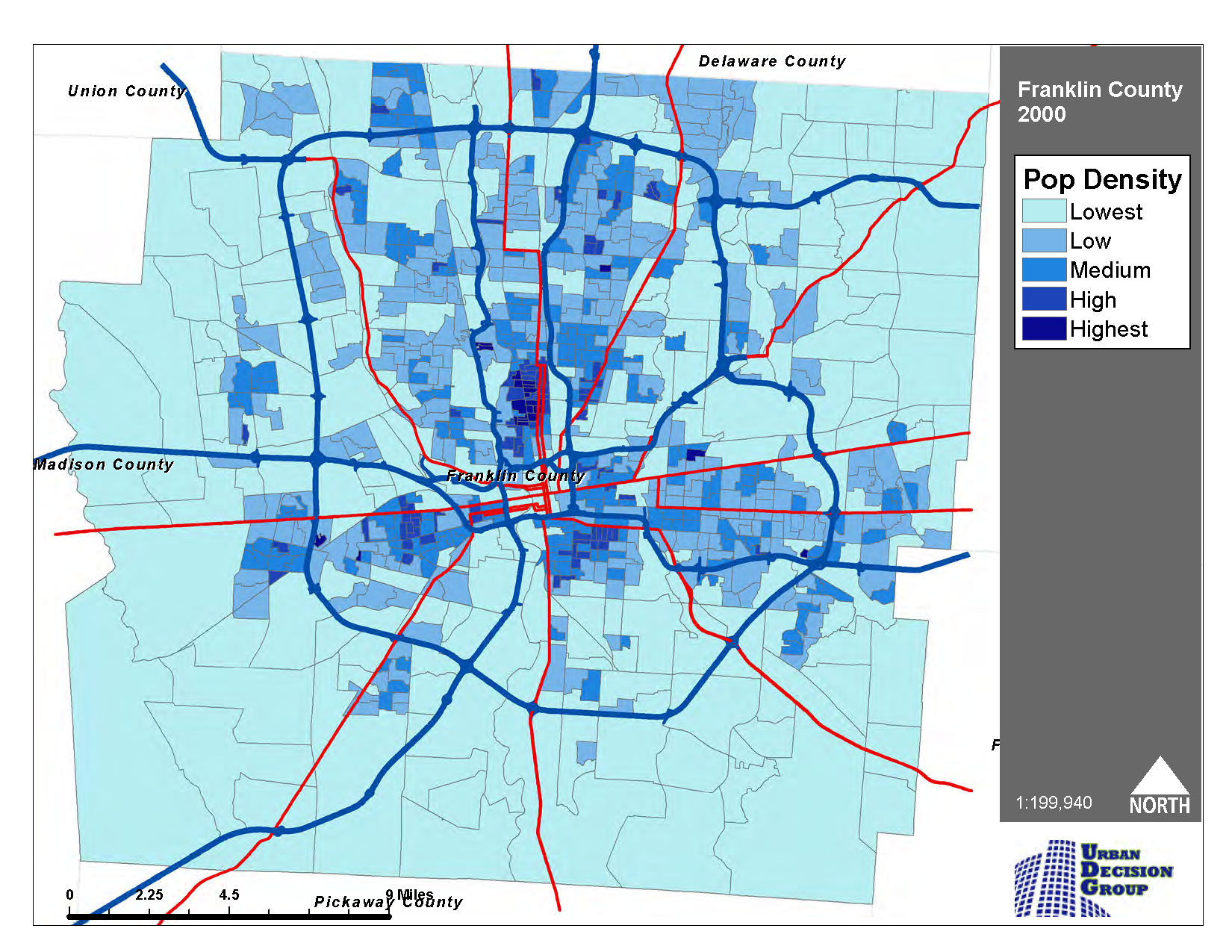
Part of the problem is the typical US sprawl of the place. The area inside the beltway is ~200 square miles - https://urbandecisiongroup.com/wp-content/uploads/2013/04/fc...
I live just outside the beltway. Driving to the OSU stadium just north of downtown would take me about 25 minutes. According to Google maps, the nearest COTA stop is a 20 minute walk away, then it's an hour and ten minutes to get to the stadium.
Agreed it would be lovely to be able to hop on a bus or train and get somewhere within a reasonable amount of time.
If something is worth doing, it's worth doing right and physically separate bus lanes is doing it right.
If you are elevating, don't use a bus.
1: you live with ADHD: "Oh my God, I need to leave five minutes ago" scheduling method. To anyone who says, "You just need to be more disciplined about time," I refer you to the part about ADHD.
2: If your quality of life depends on activities that are more wilderness/far away from cities, such as hiking, astronomy, camping, bird watching, and don't include (actively exclude?) urban experiences that require amenities.
3: Friends and family live 30 minutes to 6 hours away.
I have no problem with improving bus service for people and getting them out of cars because that means there'll be more room for me to go to where I want to go when I want to go.
You're not asked to give up going to the wilderness.
Regarding scheduling, in my eyes public transport where the mean time between busses is not under 15 minutes is not public transport. Running after a bus is a signal that the frequency is too low. "I need to leave five minutes ago to take the bus I intended" should be followed by "if I leave now I'll be a few minutes early for the next one".
Funny thing about scheduling. I have to plan to leave an hour earlier than I need to, and even then, I'm frequently late. Yet, my hyperfocus kicks in when I sit in the car and go through the rituals of "I'm driving now." The vigilance can be exhausting, but usually only bothers me when I'm leaving an observing site at 3 o'clock in the morning or I'm driving at twilight in deer country.
Your first point does not apply to, say, Switzerland. Missed your train? Just wait 5-10 minutes. 30 if you're in bumfuck nowhere.
ADHD is a big part of the reason I don't drive. I'm lucky enough to live in Berkeley which is very walkable with decent transit, and I would hesitate to move anywhere more car-oriented exactly because I have ADHD.
I think the reason I've been hypervigilant about safe driving practices is that my father owned a rigging company, and I was driving forklifts and stake trucks in the yard from about 13. I understood the impact a vehicle could have on other things, people included. Living in that world from about age nine on teaches you to be obsessive about properly securing a load (Molding machines, air handling units, lathes, etc.).
I've often thought people would be better drivers if they started their driving experience with the motorcycle safety training course curriculum and drove for a year on motorized two wheels, taking up the lane and keeping up with traffic.
Thus you get more done when using public transport. Nowadays with phones and portables you can even read your email and work rather than justb read the newspaper as commuterts did 20 years ago.
As for getting work done, back when I was an employee and using transit, two factors kept me from doing work on the transit system. First, my employer already got enough uncompensated labor from me. I wasn't going to give them any more. Second, I use speech recognition, and dictating company confidential information in a public setting is unwise at best.
2. This is why non-car-centric countries don't ban cars. If you're that kind of person (and not everybody is), you buy a car. You may not use it beyond these wilderness activities though.
3. Trains.
Trains are an interesting subject. For them to be useful, you would need to have rails covering the same destinations and paths as the highway system. One should also be aware of network effects when adding another layer of transportation services, including how they affect the distribution of services and residences. From experience, we know that roadways encourage spread because they allow you to cover a greater area with little time cost. Rail will likely encourage denser development and a higher cost of living due to a greater influence of rent-seeking entities.
One of the tensions one would need to explore is the tension between the need/desire of a chunk of the population to keep their distance, keep their living space separate from others, and be acoustically and physically isolated from them, while still needing services a 30-minute drive away.
Its funny to me that you suggest that trains need to cover what they highway system covers. When of course trains existed first and already covered many more places then highway system ever covered in most places. And with buses countries got the opportunity to cover things away from train-station and that was really not all that expensive even in rural areas.
Its just that in some countries, many of these trains were removed and the countries focused all their finances on new highway systems. And often demolished large part of productive cities to achieve it. For more so then trains ever did.
> Rail will likely encourage denser development and a higher cost of living due to a greater influence of rent-seeking entities.
No actually when you do it properly, then rail makes it so you can have a dense core around each station where you have everything you need locally while also having access to a city center in a short time.
While you subburb example misses that all subburbs are massively subsidized and make negative money. Its the poor people in the cities that are paying extra to finance these subburbs. Urban3 has done tons of analysis of this. The subburbs are the rent seekers, you just don't think of them that way because you see it as 'normal'.
There are plenty of examples, for example how in the 60s Sweden used subway trains to build massive amounts of housing alone those new lines.
> between the need/desire of a chunk of the population to keep their distance
You can have that, but you will find that once you properly account for the cost, people are much less willing to spend that money. That's why before extensive zoning codes, minimum lot sizes as requirements, parking minimum, free street parking, free highways people lived closer together. And of course the massive federal top down intensive given subburban development Post-WW2, along with the redlining of cities. All these are hidden cost on society that you simply hide and put on county, state and federal taxes.
I want good public transport in urban areas as I don't want to take the car, but I still own one for many uses.
I hate it to be mandatory to live.
Trams and trains generally offer far more reliable schedules, frequencies and journey times than busses because they either have completely dedicated alignments or have priority where there is any interface with normal traffic.
Most buses inevitably bunch (see https://setosa.io/bus/ for a nice simulation) and/or get stuck in traffic as a matter of routine. The inconvenience may be less per delay but busses are delayed far more frequently than trams and trains on most of the public transport systems I've used. So for regular users, the cumulative inconvenience is much worse on busses than on trains/trams. Which is why people flock to trains and trams when available as an alternative to busses.
Specifically with regard to the parent, the frequency at which unplanned outages happens with tram services in Zurich is extremely low in my experience - certainly planned changes to schedules or routes (for maintenance, upgrades, etc.) are far more frequent. And when "something happens" (i.e. a traffic accident), the path for trams is cleared as quickly as possible - often in 30 minutes or less - so you'd really have to be unlucky to be inconvenienced by such an occurrence.
Some animated GIFs illustrating how much space automobiles take up compared to alternatives:
* https://old.reddit.com/r/Damnthatsinteresting/comments/9ft67...
In addition to that, the US has a stigma: "only poor people ride buses".
Get on a bus in Europe to see the difference.
Busses, at least the one where I live in Europe, are very loud, noisy and smelly. I'd rather have 20 cars pass my home than one bus. I don't hear or feel those cars but once that bus passes my coffee cup visibly shakes. I also don't mind cycling behind most cars but cycling behind a bus is a terrible experience. You feel the heat blasting out of the rear-right side and the diesel smoke is terrible.
20% of London's busses are zero emission - agree that London is dense enough for this to work - long didtance busses still have to be diesel, although Tfl have some 15 mile routes that are electric
But that’s not at all what the article is about? The thesis is not that having bus stops with music and heating and free drinks will make more people take the bus, it’s that in the U.S., the slowness of buses is making them an unattractive option. And stopping too often is a major reason.
As someone living in SF I 100% agree. The bus stops all the time. The muni is also crazy slow on the west side because it has to mark every single stop at every block just like any car instead of just having priority.
My first transfer was in Sacramento. The entire bus got held up for over an hour because someone saw a man with a knife and security had to search absolutely everyone to try to find it.
Half the stations were literally crumbling, as in the ceilings were falling down and covered in water stains and flecks of black mould. The drivers often turned up hours late, which is apparently expected and normal. The stations tended to be in exciting hotspots such as Skid Row, to cater for the desperate clientele who had no choice but to run the gauntlet.
Also, after the first time I rode it and told everyone about the knife that nobody ever found, people started showing me news stories about the man who got beheaded on a Greyhound in Canada.
Overall I think they have very patchy bus and coach systems and over-index on the worst examples.
The muni (tram), stops at stop signs at every block on the west side like the N line, so it’s extreeeemly slow. A system where the tram has priority over cars and does not need to stop at every single block would be life changing.
What? I see English words, but it’s still not parseable.
The only time in recent memory that this screwed me was in SF trying to get a Muni that I thought was a surface route and was in fact underground. So I was standing at a trollybus stop directly over top of the station where I was missing my train.
The one major gap I still feel a lot as a visitor is wanting a transit-aware business search. In Google Maps the "search for X in this area" is a completely distinct workflow from "how to get to X by <mode>", and implicit in the first workflow is that you can infer how long it will take based on the crow-flies distance. And that assumption is very much not true if you are using transit. For example, I would love to be able to be like "show me three-star hotels ordered by transit convenience to X airport and Y event venue" and have it figure out both rides, and call out which ones will have what service level in the evening, overnight, etc.
I would recommend Citymapper (https://citymapper.com/) in such a situation.
My internal thought process as a tourist is that I have a starting point and end point in a city, and some number of hours in between. I want to do some touristy things in that time, and I don't want to waste it all waiting for transfers. I'm not asking Google Maps to be a tour operator for me, but it also can't even help when I have a specific thing I need of which there are many instances, and I'm like... I don't care which electronics store I go to, I just need an electronics store and would like one that's convenient to where I am by transit. Or like, there are four Apple Stores in this city, which one is fastest to get to by transit?
Another recent example was having a seven hour layover in Tokyo where I had to do the Narita -> Haneda shuffle, and wanted to eat something not-airport-food during that time. I really struggled with getting Google Maps to show me where would be a good point to aim for a stop that was convenient by train to both airports; in the end I asked ChatGPT which suggested Ueno Station and I ate monjayaki which was delicious.
I have a car, which I use when the weather is not nice, or when it would be inconvenient to take public transportation.
Otherwise, on sunny week-ends i often chose public transports. Here they are efficient , clean, secure and most importantly predictable. We have apps for payment and bus status that show us , on the phone, exactly where every bus is at any moment.
You know your bus will be there for you in exactly 2 minutes. Like a Uber, but much much cheaper.
Predictability is a game changer.
Works very well.
One reason that trains "work" is that the rails on the ground is a promise that a train is coming.
Ultimately public transport that doesn't get its own infrastructure (lanes, rails, or tunnels), is just a economic compromise to move people for cheaper than a car... It's not better for the user in any way.
And if it does need special infrastructure to make sense, it gets harder and harder to justify at all once autonomy is in the mix.
It's incredibly unlikely that there is one coherent cause for low or high ridership. All we can do is improve the utility of the service. That means improving comfort (keeping it clean), reliability (running on time with minimal detours), throughput (carrying enough people), speed (minimizing the number of stops on the route), latency (minimizing the wait until the next bus), availability (more stops that service potential destinations), and coherence (more routes that take you directly from A to B, minimizing transfers).
Personally, I feel most undeserved by latency: the routes that are convenient to me run every 30min, and the routes that run most often run every 15min. I would ride the bus way more often if routes ran every 10min. I would ride them all the time if they ran more often than that. This seems like a pretty obvious opportunity that will never happen so long as prospective budget is determined by current ridership.
n = 1 but this is precisely why I seldom rode the bus in college. Except for going clear across campus in the evening to apartment complexes that were a semi-substantial trek down the highway it was always quicker to walk. Walking 1.5 miles in 25 minutes was faster than a bus that made 14 stops before it got to where you were going.
I like light rail. It has the advantages of cutting through traffic and being more efficient to boot. I'd say we should adapt buses to a similar modality but anecdotally bus-only lanes don't work as well as they ought to because, as a surprise to nobody, people are bad drivers and interfere with their operation.
- removing stops makes the bus faster: obviously true.
- bus stops in america are closer together than bus stops in other places: backed up by data in the article.
- making the bus faster makes it better for riders. subjective, but as a bus rider i very much agree.
i don't understand how you can read this article and come to the conclusion that it's about making bus stops "nicer". that's just a little tangent it mentions. it'd be nice if bus stops were nicer.
The article points to case studies where reducing stops increased ridership: clearly this does make a difference
But I agree that truly good bus service requires commitment and budget. A city that only improves its transit in fast, cheap ways is doomed to bad transit.
With all due respect, I feel the one asserting things without argument might be you. The whole article is about how number of stops is too high and so drives low ridership.
I am incapable of even trying to provide quotes from the text, as that would mean simply restating the text in its entirety.
That said, I do agree that this being the number one issue everywhere or even where I live is far from certain.
As a driver, the number one thing I hate are bus stops near intersections without dedicated bus lanes.
Low ridership actually makes public transit feel even worse. Encourages loitering and restricts ridership to only the most desperate people. In NYC at least the buses tend to be pretty heavily utilized and I've personally never felt unsafe or put off by the condition of a bus. It's marginally more pleasant than riding the subway.
This depends very much on where you are in the world.
Full disclosure: I have visited a lot of cities/countries, approx 70k flown miles last year. I almost always try to use public transport where possible.
The last "not nice" experience in a bus was in SFO, travelling back to my hotel from the Cathedral of Saint Mary of the Assumption. Make of that what you will.
It is possible to have faster buses, even time competitive ones. Though stop spacing is only one component of such a system, the other being dedicated infrastructure and traffic priority.
Compare that to the subway which several stories below city hall, nasty, dirty, filthy, stinking air, human excrement, rats, etc... I love the bus
I don’t think public transit is ever that pleasant, but I rarely felt unsafe in Vancouver or even NYC compared to LA.
One thing that I disagree with is the timing. In a lot of cases I’d rather spend 20 minutes more on the bus than driving. It’s much easier to hop on a bus, listen to music and walk to my destination than deal with traffic or parking. Also, in cities that have properly invested in transit, there are things to do around the transit points. Grocery stores, coffee shops, general stores etc, so I’m often doing 2-3 things in a single trip. Whereas in LA, each of those things is a separate car journey away for me, so overall things are less efficient.
I went to Seattle for one weekend and experienced the sad view of only the poorest people taking the bus. It was enlightening and changed my outlook on life.
That's not what I read. The article is saying that you can get meaningful service improvements via what is essentially a free measure: cutting the number of stops. I personally regularly take a route in San Francisco that would unquestionably be better off by cutting a swathe of stops through the Mission, where it stops every two blocks on a street with painful light cycles and tons of pedestrian traffic.
The result is that by the afternoon, two or three buses on this route have piled up, one right behind the other, and passengers have to wait 45 minutes for the next one if they miss one of those.
Combine that with improvements to things like waiting areas (i.e. introducing shade), frequency of services, price (in my closest city they introduced essentially free public transport for all - it's been a boon), and you've got something that can be effectively weighed against other forms of transport.
No it doesn't fit all situations and people, but it serves the majority well.
Which results in the trams being incredibly slow compared to driving even if they are frequent, clean, and generally nice. Since the network already needs total overhaul to be wheelchair accessible, there has been a plan to combine 3 stops in to two wheelchair accessible ones. Which will also speed up the trams since they don’t have to stop as often.
This is an odd argument to make. Just as a correlation doesn't prove that there is a causal relationship, the lack of a correlation cannot prove that there isn't.
Which can be caused by having too many stops and having to choose a suboptimal route that can service them all. In the town I live in I try to avoid almost all buses except the express ones that have just a few stops but choose a reasonable route and thus are rarely late.
Americans think everything is unsafe, except for things that actually are unsafe.
It's not marginal at all. Stops rebalancing actually address your core issues. Less stops also mean more money per stop to provide nice shelters which solves your second issue.
A primary issue of buses competing with other forms of transportation is simply that they're too slow, and the main thrust of the article is that intelligently reducing the the number of stops only increases walking time a very small amount but can reduce travel time significantly.
This is certainly my main issue with taking buses sometimes - I often think taking a bus would be easier than driving (e.g. no parking, I could read or do something else while traveling, etc.), and I'd be willing to do that is the bus took, say, 1.5x driving time, but often times it's just much slower than driving.
Buses running between full on stations are faster than buses that comprise the network edges. Because the core of the network is focused on capacity. Buses that meander around to provide coverage, minimize walking, and stop every other block are really slow. Like 6 MPH end to end, no faster than riding a bicycle! Do we want a bus network to compete with walking/biking or with driving downtown?
You believe wrong. The article gives examples of cities that have already done that, and have seen average speeds go up and total ridership go up as well.
> Cities aren’t thinking about how to allocate a fixed bus budget.
Lol, dude.
Not buy itself, but as a strategy for the operator to focus on fewer high quality stops, over time that will have an effect.
> So while the number of bus stops might matter at the margins
You are ignoring that some of the things you complain about would be helped by fewer stops.
> we’re not talking about a system where marginal improvements will matter.
Its crazy to say marginal will not matter. Then nothing will ever matter. There is no revolutionary solution anywhere in sight. You need to improve on the margin with the budget you have.
> you need to make the bus an attractive option for more people.
... by marginally improving every aspect as much as you can.
The central argument of reducing stops is increasing bus speed, not reducing margins, It's in the second paragraph.
[edit]
Top comment is a straw man, attempt to correct course downvoted... I'm not sure how much value HN has left for useful discourse, who the fuck are you people, if you even are people.
...but then your "In my experience..." section repeats the article's assertions? As in, everything you list as a drawback of riding the bus is exactly what the article claims can be improved by intelligently cutting out some percentage of stops.
Also, I didn't see the claim that "too many stops is the main cause of low ridership." That would be an overreach. The central claim that I see is that optimizing the number of stops, which turns out to result in a net reduction in pretty much all major American cities, is a relatively easy way to marginally improve many aspects of bus systems.
I think your counterarguments are valid, but they're just fleshing out the article's thesis. Simply reducing bus stops and holding everything else constant would not magically improve ridership and the overall experience. And as you say, reducing bus stops and removing money supporting the system will definitely not result in improvements. (And I agree that it is the likely way it would transpire politically.)
You would need to reduce stops and direct the savings into improving the remaining stops. You would need to convert the change into more reliable schedules. To make sense, that would need to increase ridership, and adjust the demographics of riders to include people who don't have to accept "dirty, unsafe and hostile" because they have no other choice. There's little incentive to improve things when the audience is captive and powerless. Also, increased ridership leads to more resources to accomplish the rest.
Of course, the dependencies between all these changes make the improvements more speculative and harder to achieve politically, so I do agree that you can't "just" reduce the number of stops and improve everything. As you said, that would more likely just drain more blood from an already anemic system. But the article is talking about a relatively cheap and easy way to improve things; everything else transit agencies can do is harder and/or more expensive.
> So while the number of bus stops might matter at the margins, we’re not talking about a system where marginal improvements will matter. If you want to improve ridership, you need to make the bus an attractive option for more people.
That first sentence says marginal improvements won't matter. The second sentence says that marginal improvements ("an attractive option for more people") are what are needed. Maybe you're saying that marginal improvements have to reach a threshold in order to be worth doing or achieve any noticeable gains?
Autonomy could improve responsiveness to demand but you still run into other issues. DRT usually won't be able to take advantage of things proven to make buses faster and more consistent (bus lanes, reducing stop count, transit priority signals). Futher, consistency and response times gained by dynamic routing can easily be overshadowed by increased variability in trip time as the route adjusts to add new passengers or make out of the way drop-offs.
As an example, all throughout the Eastern Caribbean this system works really well (in my experience better than most centrally planned bus systems in large cities). On any given island you can go to any main road and within a few minutes a minibus will come along. Most of the time if your aren't familiar with the geography, you just tell the conductor where you are trying to get to, and they will make sure that you get off in the right spot to get where you are going or connect to another minibus. Typical cost was ~$2.
Predictability was pretty low, but because of the small size of busses, there were a lot of them roaming around, I don't think I ever waited more than 15 minutes, and that was in very out of the way places.
The GP was arguing that it NEVER works out, and I'm just pointing out that it does work in many places.
I would much rather rely on the Caribbean minibus systems than try to rely on transit in cities like Phoenix.
How do scheduled bus routes standardize a journey time vs a demand shuttle?
> out of the way journeys in my experience.
How do buses fair in this regard?
> It's really not ideal
Are buses?
How do buses fair in this regard?
Has it? When, where and with what technology?
> Predictability is really important and ridership drops as soon as users start having to plan too far ahead
Uber etc have proven this to be patently false. Existing buses are experiencing dropping ridership - Uber is not.
> won't be able to take advantage of things proven to make buses faster and more consistent
You're replacing buses with auto-shuttles. Just let the shuttles use the bus lanes.
> bus lanes, reducing stop count, transit priority signals
All of these are usable if you widen the scope to include auto-shuttles.
> consistency and response times gained by dynamic routing can easily be overshadowed by increased variability
What is the difference between Busing and Shuttles here? A bus user can keep yanking the stop cord, there can be 1 or 2 disabled passengers who take several minutes to board, there can be 50 children getting on / off. These issues are constants and all are improved with demand based shuttles.
The app would say - meet here.
> One might call such a meeting point a “bus stop” :)
Call it what you want, it could be in a strip mall parking lot, a convenient corner or just in front of the apartment building. Optimized for traveling distance between the passengers.
Are we still talking about how to optimize public transportation on city streets?
You can't just have buses stopping randomly everywhere, it doesn't scale.
This is based on the observation that people, including police, tolerate taxi drivers stopping at places where it's technically illegal.
I don't know that 'removing' these as bus-stops would actually change anything. I think a larger question is whether route changes should occur.
There was a large effort in Philly called the 'Bus Revolution' [1] that aimed to re-balance routes (I have a map from the 50s on my wall and the bus routes are the same, including numbers, as they are today). The problem there was that there was a funding crisis that massively delayed the implementation [2]. These services are massively under-funded, and that's the primary issue; implementing the article's suggestions are not free.
[1] https://wwww.septa.org/initiatives/bus/ [2] https://www.nbcphiladelphia.com/news/transportation-and-tran...
(for context: the 124/5 operate locally west through center city before getting on the highway while the 27 only makes 1-2 more stops in center city before getting on the highway)
Making these extra stops causes the bus to 'miss' the light cycle at almost every stop.
[1] https://www.septa.org/schedules/124?startStop=17842&endStop=...
[2] https://www.septa.org/schedules/125?startStop=17842&endStop=...
[3] https://www.septa.org/schedules/27?startStop=17842&endStop=3...
This would be a much bigger change, but it's also possible for the lights to give priority to buses. When a bus approaches a light, that should trigger the lights to advance to the part of the cycle that gives the bus the green light. That way, you prioritize the 20 people in the bus rather than the 10 people each in their own car.
It's slightly irritating as a pedestrian when you're waiting to cross the road to get to a tram stop, and you see that the tram is coming in less than a minute, and you know you're not going to be able to cross in time. But that's the sort of slight irritation I'm okay with for better fuel efficiency and faster trams.
Which is the issue. Philadelphia's blocks were sized in the 1600s, they weren't designed to be the optimal spacing for bus stops. Given how tiny the blocks are, there is no need to stop at every block.
A surprising number of bus routes in Dublin still follow, to a large extent, tram routes laid out in the 1870s. And use the same numbers. This stuff is _sticky_ (partly because significantly redesigning an existing route tends to annoy people; there's a fairly strong tendency to just make a new one and leave the existing one running in some capacity).
Unless you can address this fundamental problem "just walk more" isn't a viable option for transit users.
In other ways - wheelchair accessibility for example - the US is miles better than many European cities.
But I’ve been in crutches and a wheelchair many times in a life —- if the actual place is not wheelchair friendly, it is much harder to get around.
So I really interested how you are getting to this 'wheelchair accessibility' is better in the US. I would love to see some data, and not just 'we have X more ramps', but actual people in wheelchair going into their experience.
I see a lot of idolization of NW Europe from the US, but this is still a problem in Europe too. True, it's better than most of the world, but not every NW European city is as walkable or as accessible as people think it is.
So those categories of people just can't use public transit in places where public transit is more popular?
Just one thoughtless example: Austin TX downtown is actively hazardous to non-motor vehicle users. One example is worn down and effectively camouflaged pucks the same color as the roadway about 10 cm wide by 6 cm high sticking out the middle of the road randomly that once represented bike lane merge path markers. Ask me how I know. :/
To me, this exemplifies a type of thinking that is endemic to policymakers in the US. We can tinker at the edges, we can use computers to optimize what we have, but the idea of using money and political will to change anything at all in a meaningful way is anathema, beyond the pale. Giving up before even getting started. Sure, optimize away, but don't expect me to be inspired by pushing papers around.
I suspect that removing half of the bus stops in a city will piss people off and cause even less ridership.
This feels like it's optimizing for the wrong thing.
Also, the example given cites New York City buses. But New York City is always the worst example because it's the most extreme of everything. The vast majority of US cities do not suffer from crawling buses.
Maybe this should say New York City needs fewer bus stops? I'd like to see you try.
The other is the group of people who might ride the bus if it were convenient. Not just in terms of accessibility to a stop, but also accounting for the journey time. If someone tries riding the bus and finds that a 20 minute drive becomes an hour with stops every single block, they might never ride it again.
In most US cities (outside of the few big ones with decent transit), public transit is basically treated as a welfare service for those who cannot get around by any other means. Not saying that this service doesn't have value, but making all decisions in that mindset isn't going to attract more ridership from those who could choose to drive instead.
The bus might come 2x per hour. Maybe 2:18 and 2:48. But it might come at 2:15 or 2:25. So you need to arrive at 2:13 and possibly wait 12 minutes. Or if you arrive late you might be waiting 30+ minutes.
Make the buses fast and safe.
1. Dedicated bus lanes (speed, predictability).
2. Traffic light priority ( speed, predictability).
How many US cities implement even one of those?
1) stop every few hundred feet to pick up and drop off passengers
2) maintain an effective speed significantly faster than running
I don't care how long it takes to get off the bus nearly as much as I care how long it takes to get on.
Separately, the variability problem can be somewhat solved with the real-time location updates that many agencies provide. You'll still have to wait the same amount of time, but some of it can be done comfortably in your house when the bus is running late.
Safety is only one of the issues. Convenience and comfort are others. Basically a city needs to decide whether it wants people to use the bus, and then act like it.
Ridership collapsed in 2020 because of the pandemic, for obvious reasons, but it's hard to really blame that on the service itself, or the riders.
Ridership has been gradually recovering since then. Total trips are now up to something like 70% of 2019 levels, and continuing to rise. Number of unique riders is actually above the 2019 level now.
Maybe you haven't tried riding BART again within the past several years?
And in this example, how many stops would you have to cut to turn an hour-long bus ride into a 20 minute one, to compete with the car? You're effectively cutting it down to two stops - where you board, and where you disembark. That's just not a plausible way to organize a bus route, aiming it at one person with a car.
I find this very unlikely to be true for people who have spent any amount of time driving in a city.
So yeah, if your point is that if you take away all the bad parts of using a car, and leave public transit as is, then using a car comes out ahead. Splendid.
> I think the majority of city residents tend not to own cars
This depends a HUGE amount on the city. NYC/London/Paris probably true. LA? It is not uncommon for a household to have more cars than drivers
But I don’t want to drive three miles to park in a sketchy lot to hop on a train that will drop me off a mile from the venue.
Yeah, no, this simply isn't true.
People don't take transit in America because largely that transit is sparse, infrequent, unreliable, and slow. When a twenty minute drive becomes a hour and a half of buses and walking, virtually nobody rational will willingly choose that.
It was unreal.
In my city bus stops have 1km between them (sometimes it is 700m sometimes 1.3km) so about 3200 feet.
It is about 15min walk between each bus stop, so when I need to wait for bit longer I prefer to walk to the next bus stop, just to have something to do.
Huh... How is it set up where you live? I've ridden buses in Europe and I remember them having cables, or at least buttons.
To European eyes they seem old fashioned, untidy, and possibly dirty.
Also not sure what is old-fashioned about a pull cord compared to a bunch of buttons. Just a different way of activating an electrical circuit.
The Paris Metro is an absolute run-down antique compared to the trains in Seattle. It would be silly for me to declare that all European metro systems are therefore run down and tatty. If I compare the Barcelona metro to New York, it makes Europe look great. Meanwhile the London Tube is cramped, frequently dilapidated and has its own species of mosquito.
Have you seen many cords going into or out of desktops, laptops, or in cars? It is old fashioned.
SF is another good example of too many stops. It's honestly comical and I stopped riding the bus in SF at times because the stop count was painful.
I've been to Seattle once, (ex-Amazon here) where the DevCon was held in the town while my team was located in Bellevue. I took initiative to rent a bike for a day (60$ for drop-bar gravel bike) I must say although I did not beat the time between Day-1 (Office across spheres) and Bingo (Bellevue office), it was not far off. Even comparing the "Shuttles" Amazon operated, shuttle took about 1h while ride takes around 1h15m. (Plus sweat)
> P.S: I would say I am in a "fair" shape as I ride quite a lot throughout the year.
time is important to bus riders, speeding up the buses helps them. It also attracts others. Only a few are harmed more than helped - but they tend to complain the most even though they are a minority
That’s not how bus routes in NYC are organized at all.
Only if your trip is to Manhattan or along the line. Otherwise, in Brooklyn and queens, North-south subway service is almost non-existent. I live in South Queens a block from the A train. However, If I wanted to go shopping at Queenscenter Mall or along Queens Blvd, I have to take a bus up Woodhaven Blvd.
But that only works because density is low and there's only one plausible destination.
This:
> I suspect that removing half of the bus stops in a city will piss people off and cause even less ridership.
is thrown out but how do we know it's true? That commenter throws it out as their opinion but my opinion is the opposite -- the stated preference will be that people think it's bad but the revealed preference will show even more ridership as travel times improve.
This is even worse than the usual slight of hand wherein one takes a widely diffuse hard to quantify cost and rounds it to zero and then dishonestly acts as though that justifies implementing their pet policy that has some small upside because in this case the downside is known and the upside is less defined.
I'm open to the idea that we could improve the system by deleting stops, but in light of a quantifiable downside I don't see a convincing argument without having some quantification on what the upside looks like.
I'd like to see your math, as it isn't just the loading of passengers that takes time. It would seem that slowing down, completely stopping, lowering the bus, opening the doors, and then closing the doors takes up at least some of the time at each bus stop.
(Bafflingly, they went through a transition period where ~all of the buses had two doors, but the driver rarely opened the back door. It wasn't really until covid that using the back door became standard. Improved things greatly.)
> and jockey for position and for a seat before the bus can start moving again
Do urban buses where you are require people to be seated? Didn't realise that was a thing anywhere. Any (urban, non-intercity) bus I've ever been on takes off as soon as the last person gets in.
My point is that you're totally disregarding everything a bus does to stop apart from waiting for passengers to board and de-board. At the very least it has to slow down, then accelerate. Half the time it has to swing the ramp out, which takes forever. Maybe someone has to load or unload a bike. Then it has to re-merge with traffic, and maybe every 10th car will let it in, so that can take a long time too. I don't even know if waiting for passengers is _half_ the time spent, let alone all of it.
The counterpoint is any bus route that has an express option that runs in parallel. Every time I have taken the express route, the bus can be full to the gills, but is always faster than the non-express bus.
surely we can think more critically than this...
Additionally, many stops with a lot of people loading and unloading are hubs which would never be balanced away, and often are designated timing points where the bus will wait to get back on schedule, so loading/unloading time is often irrelevant because predictability is being prioritized over speed. Improving speed and consistency with techniques like removing unnecessary stops increases predictability and allows for tightening up timetables and minimizing average hold times.
[1] https://www.wmata.com/initiatives/plans/Better-Bus/frequentl...
The real killer for bus travel times is not getting up to speed, and the delay from finding a break in traffic when pulling out of a stop.
True I've seen that first hand.
As a religious belief it would be inappropriate for me to report stats from my local cities bus service. First of all they didn't get into a religious opinion logically and rationally, so spouting numbers and facts at them will not make them change their mind. Secondly my local city has multiple simultaneous impacts so its almost impossible to estimate how their experiments with stop removal has affected ridership. The article falsely claims the only variable in the system is stop spacing whereas bus service is in extreme turmoil in most communities.
Pre-covid vs Post-covid is wildly different, there has been massive inflation in operating expenses, there's a long term decline in my area WRT passenger-miles before covid which seems to be increasing post-covid, fares have increased by a factor of a little over 4x since 1990 while incomes have roughly stagnated. The article claims the opex of stops is "high" but our city invested $0 (this is a low crime suburb LOL). We got rid of 1/4 of our routes (and drivers) and increased the standard of stop spacing from never more than 950 feet to an average of about 1100 feet now. The elderly and infirm were very mad and very loud about that and they are the most reliable voters out there but halving the fare quieted them down. We lose so much money on the bus service that giving it away for free wouldn't impact the budget very much.
Currently our opex per passenger mile is about $4.50. Fare for adults is $2. We lose about $7 per ride. The loss per rider would pay for two extra people to take an uber on the same route, so there are continual demands to scrap the entire system to save money. Empty buses driving around is causing more, not less, road congestion, and more, not less, environmental damage. Our "Unlinked Passenger Trip per Vehicle Revenue Mile" is about 0.6, which boils down to on average every mile traveled by a bus driver results in 0.6 passengers stepping aboard. Our routes are about 4 miles long and run about once an hour, so on average a driver picks up about three passengers per 4 mile trip. Our drivers are usually alone in the bus. Another way of looking at it, is on average we pay our bus drivers $23/hr, so an hourly route costs $23 in labor, and they pick up less than $6 in fares during each work hour... The ratios are better during rush hour... but worse outside of rush hour.
(edited: I don't understand some of the numbers on the report, if it costs $23 to pay the driver to run a route that picks up three people the fares can't be more than $6 so even if diesel and maint were free we lose $17 per hour per route, so why does the annual report claim opex per passenger mile traveled is only $4.50? After federal subsidies or similar?)
In the long run, an unusable bus service is simply too expensive of a luxury to fund and we'll end up eliminating it. I don't think changing distance between stops matters if the stops, and the bus, are empty, other than it makes sick and old people very angry. If almost no one uses it, it doesn't cost any extra to stop quite literally on every street corner or even stop at every driveway, so increasing stop distance merely makes people suffer needlessly, which seems unusually evil.
Crawling busses are an issue all over the place. The easy way to spot it is when noticing stacked busses during peak periods.
These issues are really hard because they are fundamentally local and change is difficult and fraught with NIMBY bullshit. There is a strong inertia. My small city has a pretty good bus service that winnowed out surplus stops and added BRT. In the public hearing, one of the loud objectors to moving a bus stop 1000ft was that it would encourage inner-city youth to "rape and pillage" in the "good" neighborhood. We're literally talking two blocks away.
Oh do you now? Where do these suspicions come from? How much time do you spend on city busses? Do you have any idea how absolutely infuriating it is to be sitting on a bus while it makes stop, after stop, after stop, after stop, every single one a block or two apart, crawling down the road at a walking pace? All the while backing up traffic behind it and eroding whatever support the transit system had with the majority of the tax-paying public that never uses it.
I suspect that people find a destination on Google Maps, click the navigate button, see that the bus takes 3x as long as driving, and take their car or an Uber.
According to my cities 2022 annual report (where are 2023-2025?) they provided precisely 464344 unlinked pax trips (UPT) so someone stepped aboard a bus and threw money in the real or virtual fare box 464344 times that year. "Sources of operating funds expended directly generated" which I read as annual fare revenue was $660748.
We have a very simple two tier system $2 for adults and $1 for seniors and disabled. 2(464344-x)+1x=660748 x=267940
So we only had 196404 healthy young adult bus riders that year vs 267940 senior citizens. Your experience is not unusual but also is by far not the majority; a SUBSTANTIAL majority of the people on the bus in my city are too old or too sick or too blind to take long walks in the rain, snow, ice, heat, cold, etc.
Honestly the bus is so slow, if they could walk, they'd probably just walk. So it should not be overly surprising that most on the bus quite literally can't walk, and really need bus stops close together for disability reasons.
So all of this theoretical "well it would be so much faster if there were fewer stops" is irrelevant if the served population is primarily physically disabled, and the system can't survive. And we'd be talking about excluding one of the most powerful voting blocks in the city, that being old people. Eliminating stops would eliminate or reduce 58% of the current riders which would shut the system down, I don't think it could politically survive a hit like that.
Ironically that shutdown might be good as everyone would be better off both financially and environmentally in cars than in buses. Bus exhaust is not exactly perfume to mother nature LOL, and essentially our bus program is not a transit system, its a corrupt jobs program for drivers, mechanics, and especially for highly paid administrators.
Maybe my city is different, but in every city I've spent substantial time in, there are little tiny busses for those who are not able to walk or roll the average distance between a stop and their home or destination. They are direct, point to point shuttles. If no bus is available, they will send a cab. Those buses and cabs are exactly why you don't have to run a bus up and down every road, with a stop in front of every house, and a driver who can escort passengers to their door. They are astronomically expensive to operate, but the only way to make a transit system that serves everyone.
But in my city, we pay a small fortune to run these little busses, and then _also_, for some reason, assume that no one riding the main system has any mobility.
Also, I'd argue that the reason a "substantial majority" of your transit population is "old, sick, or blind" is because it's such an unattractive option for anyone who has a choice. When the bus is slower than riding your bike, you're not getting Olympic athletes on that thing.
I wonder if this savings includes the additional time to walk further to a stop.
Especially in light of this quote:
> In England, where 28 percent of all bus passengers are on concessionary fares for age or disability
Humans walk at roughly 2.1-3.0mph. "European cities" are listed as having bus stops 984-1476 ft apart, which would imply you'd typically walk half that to reach the nearest one (492-738 ft), which for a fit 3.0mph person is 2-3 minutes, and for a frail old 2.1mph person is 3-4 minutes.
Of course, people can be further away than that (they live orthagonally to the bus route), but you get the point. If you doubled bus stop distances to 1476ft apart, it would not add many walking minutes for the users.
Bus users can compensate for extra walking time by leaving earlier, provided the bus is on time. Good bus services can estimate arrivals in realtime, and show it to users on websites, apps, etc. as well as at the bus stop.
Bus punctuality is affected by a number of factors (e.g. traffic congestion, temporary and dedicated bus lanes), including number of stops.
The faster a bus can complete its route, the higher the route frequency can be with the same number of buses+drivers, which means buses pick up passengers more often, which means fewer passengers per stop (because less time between pickups), which means faster boarding, which in turn allows for a higher reliable route frequency. Having payment schemes like tap on/tap off, and having multiple entry doors also improves boarding times.
> Humans walk at roughly 2.1-3.0mph. "European cities" are listed as having bus stops 984-1476 ft apart, which would imply you'd typically walk half that to reach the nearest one (492-738 ft), which for a fit 3.0mph person is 2-3 minutes, and for a frail old 2.1mph person is 3-4 minutes.
> Of course, people can be further away than that (they live orthagonally to the bus route), but you get the point. If you doubled bus stop distances to 1476ft apart, it would not add many walking minutes for the users.
Given four "bus stops" spaced at the corners of a square of dimension d, and a linear relationship of distance and time such that d == t, the distance to a stop along the edges of the square is at most d/2 == 0.5d. As the crow flies (straight line) the distance from the center of the square to any of the corners is sqrt(2*(d^2)) / 2 or (approximately) 0.71d.
But people don't fly, rather geometric physical reality is something sometimes called "manhattan distance" which essentially means that they need to walk to the edge and then along the edge (or zig-zag block by block, which amounts to the same thing just repeated at smaller scale). In this case the distance walked to any of the corners from the center is exactly d. Unless you live in the middle of a park (with stops at the corners) d is the best outcome. In a physical environment other obstacles may present which require backtracking; indeed, the bus routes (and hence stops) are likely optimized to avoid backtracking, acknowledging this physical reality.
And that doesn't even consider that a faster bus route means you need fewer buses to run the same number of trips, so you can either run more trips (and save even more time for riders waiting for their bus) or cut down costs for the transit operator.
One can calculate how much area and thus passengers the stop covers and calculate walking times.
It's not completely trivial (with longer distance people chose alternatives), but can be done similar to the way the whole study was done with similar accuracy.
Somehow we combine inaccessibly rare bus stops with speed barely over walking.
The solution, I imagine, requires many changes that are politically infeasible. First, double the number of buses to reduce the wait between them. Second, add neighborhood circulator buses to get people from the neighborhoods to the express buses. Third, either add dedicated bus lanes in congested areas or, in an ideal world, make all congested inner-city roads toll roads, and use the tolls to subsidize buses.
But that does also reinforce the point. Even at max convenience, with two good options (rail, rapid bus line), it was still about 15% slower than driving. Add a single connection or your situation and you're losing an hour a day round trip.
Furthermore signal priority and own lanes are almost always beaten by good circulation planning, reducing the number of traffic lights and cars on the route of the bus.
Unfortunately, the naysayers usually get their way as changing the status quo like this is hard to do. Transit Authorities need to be given more leeway to operate how they want w/ less political involvement.
Countries that are less NIMBY/lawsuit/etc happy have vastly better public transit b/c of this.
Philadelphia City Council (which actually doesn't have any direct oversight of SEPTA) pretty much killed SEPTA's attempt at this.
If you look at a high resolution density map of the world, you'll find great public transport in places that have at least 70K people in the square km around stops. At that density, you can often support subways profitably too. Then a mesh of subways and buses will get you to places quite efficiently. But then you look in the US, and the vast majority of our large metros have very few areas reaching those densities (Manhattan excluded). So you end up in situations where a bus or a light rail can neither be efficient nor cheap, no matter what you do with the bus stops. There's just not enough things near each stop, and even when they are close, it might not be even all that safe to cross the streets to reach your destination.
So while this might be a good optimization for places where we are close to good systems, I suspect that ultimately most cities need far more expensive changes to even consider having good transit
It's MUCH faster than the train, because once it hits the highway, it doesn't stop till it gets downtown.
Dont get me wrong I love the train, but the red line suffers from the same too-many-stops problem.
Express buses thread the needle imo precisely because they hook into existing infrastructure (highways) and still move masses of people
The US has a lot of competing problems, and underinvestment in poor people and health support is one that collides with public transit.
One thing I've realized in the US is that because of our inequality, people strive hard to earn and buy their way out of misery in a way that is not necessary in large parts of Europe. So in the US we work very hard to earn money to pay for big cars to drive through the suburbs so that we don't have to see homeless people sleeping on the bus when it's cold, and once we've invested in our suburban cars & houses we have personal assets we need to defend (at the expense of communal infrastructure in some cases).
I take the bus regularly in my city, often with a child. janalsncm has legit criticisms of many US public bus systems. I take the bus with the kid so I can avoid driving/parking and go to a few spots that are convenient unencumbered by a vehicle. We tend to take a rapid line that has fewer stops -- and the speed makes it convenient. So the article isn't all wrong. The rapid transit line does earn my business. But at the same time, we don't take the bus everywhere because it is not convenient for long trips with transfers, and I likely have a higher threshold for explaining, "Honey don't stare at that guy with the foil and the lighter" than most well-off US parents. (In Europe we take transit all over.)
I think this general attitude is the source of the general poor quality of public transit in the US (even though the quote refers to the UK). Public transit is considered a mode of the designated underclass, and nobody making policy decisions considers themselves a member of that class. In the US you aren't really considered an "active participant" in white-collar society unless you have a car (though NYC is a notable exception to this maxim, it holds true in essentially all other cities)
To achieve reliability speed and frequency transport needs own lanes and semaphore priority. If there are too few lanes - make one lane dedicated to pub transport and another - single direction for cars. Voila. You can start at worst with 15-20 min wait time, but reliable, and increase nr or units where demand is higher up to using a tram
Everything else has secondary priority. Even the mentioned safety aspect - it'll matter much less if the next bus will come in 5-10 mins and you can skip the current one because of some drunk ppl.
I will give the PRT (formerly Port Authority) a shout out though:
1. Bikes are quick and convenient to bring along
2. The numbering system is intuitive enough that you can almost guess how to get to new neighborhoods
3. Accessibility is clearly a priority, and they successfully serve many disabled people
Depending on the road network and land-uses, removing stops only 200-metres apart to make them 400-metres apart (the industry standard) could decrease access to transit within a 5-minute walk by anywhere from 10-50%+, so it's limited to where you can actually apply it without penalizing (ie. putting them outside of a 7-10-minute walk) so many customers that they look for alternatives.
In Europe stop spacings are much longer even for local routes (over 400-800-metres), but this is because everyone generally lives within walking distance for their errands, so transit is used only for longer, more commute-like trips, where a longer walk for faster travel times makes sense. Accessibility is also less of a priority there so they're less sensitive to requests from seniors and those with disabilities, with many buses not being wheelchair accessible. In US/Canada, a lot of transit riders live over a 20-30-minute (often with hostile walking conditions like crossing highway ramps) walk from the nearest grocery store, school, pharmacy, etc., so they'd oppose adding 2-3-minutes of walking to shorten a 10-minute bus ride.
Moreover, closely spaced stops are really only an issue in older (pre-war) downtowns where frequent stops are the result of decades of requests from residents (especially seniors) and from schools/churches/grocery stores/retirement homes/medical clinics. Out in the suburbs, buses usually bypass most stops, and schedules take that into account. And in places with amazing land-use like Pheonix and Vegas, you have long stretches of nothing so of course there'll be higher average stop spacings.
Lastly, much of the time-savings from express routes (that skip stops) and bus stop consolidation/balancing, is from being more in sync with the lights, which are usually designed for through traffic (ie. a green wave). Transit Signal Priority can help achieve significant savings (over 10-30%+) without removing any stops, though moving stops to after the light makes it more effective (and even that can be politically difficult).
Most of the slowness comes from traffic. Where there are bus lanes, the bus can even be as fast or faster than a car. Some of our trams stop every 300 meters or so, but since they have dedicated lanes, they are pretty quick. Some of the stops are at intersections where a car would also wait. When the timing is right, and most often it is, the trams don't waste more time than would've been wasted just waiting for you turn at the intersection.
Where there is a bike lane parallel to the cars, busses and trams, an electric bike with 35-40 km/h will usually be the the fastest method of transportation, especially if you cross on reds when there's 0% chance of a car hitting you. I'm talking about a busy main street with lots of lights and traffic, not a highway, of course.
Busses with no dedicated bus lanes are slower than cars, because cars are quicker to maneuver and accelerate when needed. I think if out city made the busses (and trams, and trolleys) 2-3 times more frequent, most people would use them. It would be a difference of driving in traffic for 1 hour vs sitting in a bus reading something (or doom scrolling) for 1 hour and 10 minutes. Shorter stops means less walking, so it would incentivize people to use the public transportation more. The benefits are obvious - less traffic overall, less pollution, less energy used, less road rage, more time to chill, and so on.
They are starting to introduce "superloop" buses that interlink the more suburban "spokes" for tube & train so you can go "across" London without having to go to the centre and then back out again. I.e. basically express buses that only stop at tube & train stations and other major interchanges.
It is a great idea, but it has been done for political and ideological reasons. They have not introduced express buses for people who work in central London for example (so instead to get to central London on a bus from a suburb means stopping every hundred meters or so, so even with bus lanes progress is brutally slow). These buses going "across" are not actually that useful for most people I expect because people using transport for high-paying central London jobs will be going "in" not "across". It is the "working class" lower paying jobs that might benefit from sideways interconnects between the suburbs - this is the ideological/vote-buying reason they've introduced them.
The buses are also smaller, with many fewer bendy-bus. So if you go to fewer stops, you could overwhelm individual buses.
So if you want shorter distance between stop you need to optimize the ingress/egress with lots of doors. And you need a fast accelerating bus, like an electric or preferably trolley bus. But the US does the exact opposite, short stops with bad buses.
But yeah, the US makes so many mistakes with buses, its actually crazy. Of course, many other make many of the same mistakes but usually only a few not all of them.
Canada is also making many of the US mistakes, but at least in large cities their buses see far more use then in comparable US cities. So they are doing better while still having some feeling North American.
So I agree, some amount of stop reduction does make sense in the US. And its attractive because its basically a 'zero cost' solution. But by itself its only a drop in the bucket.
The real problem is car priority in all aspects of design and its total primacy in the way of thinking.
The reason 'Race the 8' is an event isn't because there are too many bus stops on Denny, it's because all the cars cause traffic to slow to a crawl for 6 hours of the day.
Making fewer stops helps the commute people and those that are able bodied. It doesn't help serve the people that are handicap.
I agree that low-stopping services are a good idea. Particularly in the suburbs. Use the high-stopping services to get people to the low-stopping services - and let them change buses for free/cheap. But I think that you still need regular stops, particularly if you are dealing with elderly people. And that in the middle of cities it's totally worth having a lot of stops, so that people can easily find one.
I'd assume people managing routes do this sort of analysis already. If they don't then sure give this a go in a few places and measure the results. Sounds like its worth a short if we're so off from EU.
It might better in the system throughput, and those benefits may even outweigh the misery put on that one person. But in the US, we largely sort that out by using cool-down times, hearings, and "community input."
Net result, according to my friend at least, is that bus stops feel _very_ sticky and hard to change.
Though, as you mention it's a big political ask (which is unfortunate).
Bus lanes are much more effective than the express busses to increase ridership by the way. Busses avoiding the traffic jams while the cars getting stuck in them changes the mind of even the most hardcore petrolhead.
Clearly it's possible for there to be too many bus stops. You wouldn't put a bus stop every 30 ft. So it's also possible that some existing bus routes have too many stops, and spacing them out more would help.
I ride bus and MAX (light rail) in Portland and despite not being the worst offender, too frequent stops is quite noticeable. When the bus stops every two blocks to let one person on or off each time, it really slows things down.
You can also notice when playing Cities Skylines. It is quite intuitive that making your transit stop constantly is not efficient.
On the rail system, the system has been closing redundant stations and it has made it feel much faster. Small adjustments can make a big difference.
Sure I’d like more transit investment, but that can be paired with using resources well.
Buses are mass transit. The real goal isn't serving poor people, but moving people with higher throughput than it's possible by cars individually (a single bus fits ~50 people). If you make bus lines slow and fail to attract significant numbers of passengers by forcing buses to serve every whatabout case, you're making them fail at their primary goal.
You can't make half-pregnant public transit. If you have a congested city, and just add nearly empty buses sitting in traffic and blocking lanes at every intersection, it will be strictly worse for everyone. OTOH if you can make buses an attractive option, then each bus can take 30+ cars off the road, leaving room for dedicated bus lanes, more buses, resulting in faster and more regular service.
I would agree with and extend your remarks that we also have problems where traffic patterns and geography don't match political boundaries and transit is traditionally locally run and locally budgeted.
So in the USA you end in scenarios where it takes 20 minutes to drive 20 miles but a bus would take four legs with three transfers across three separate city bus companies, figure at least three hours each way. And again, as per your "mass transit" you can't expect taxpayers in my city to provide a special bus run into my neighboring adjacent city much less the city next to that one.
This results in people being very happy indeed to pay the financial and environmental costs of car ownership to avoid sitting in a bus for six hours of daily commute.
There are also interesting social issues; if you're late its a personal failing, even if you take mass transit. I recall a friend at work getting fired because the bus was late too many times. Oh well, should have bought a car. The feeling of not being in control is further worse due to crime rates. No one will sneak up on my wife and stab her in the neck in her car, but it certainly happens on buses and no one cares if it happens depending on local race relations. None of the other passengers on the bus even cared, for racial reasons. Its pretty messed up here.
Its easy for the public in general to advise others to do inconvenient or career ending or life threatening activities, to "save the planet" or whatever, but I wouldn't do it, and I'd certainly never let my wife or kids do it, so we own cars and avoid public transit at all costs. Not taking that advice as been pretty nice so far.
The authors get mixed up equating count of marked stops with dwell time. Running leapfrogging vehicles , or numerous other strategies, reduces dwell time because one boards passengers and the other disembarks at any given stop or vice versa.
In fact, I’d argue bus fare gates, steps, 1-door loading and traffic signal/stop interactions are far more significant than stop count.
How exactly does that help? If you’re suggesting every bus go to alternate stops leapfrogging each one in the middle then that will cause a lot of confusion especially for tourist heavy cities.
So if we had a bus stop every 800 feet, on average half the stops would be empty and passed by. If that high level of use is causing too much congestion and slow down at stops, if we had two buses running out of phase, pax arrive at the same rate, so we'd pick up a pax every 3000+ feet driven. So if we had bus stops every 500 feet to keep people happy, on average the bus would drive right by about 5 out of 6 empty stops, which seems reasonable and would not result in unusual delays or congestion. Also the bus would pass by every half hour not every hour, which would probably increase ridership a lot.
So if the only labor expense were the $23/hr driver, and we pay 10 drivers on 10 routes, to drive twelve times, thats $23/hr * 10 routes * 12 hours if everything except driver labor were free that means we spend $2760 per day to transport 1556 people, or about $1.77 per trip (assuming diesel is free, buses never wear out, etc). If we doubled the number of bus that would be $5520 of driver labor to move 1556 people per day or $3.55 cost per pax trip. On one hand the actual annual total "OE per UPT" counting weekends and maint and office people and dispatchers etc, according to the annual report is $13.94, so an extra $1.77 would seem cheap, but the bus does not run for free and the total expense of doubling the runs might cost as much as an extra $14 per pax trip.
The costs don't really matter, if the taxpayers want it as a luxury bragging feature of the city. Everyone wants everyone else to use it even though no one would be caught dead actually using it. My point being that adult fare is $2 but adults don't ride its mostly elderly and disabled at the $1 fare, so a profit (loss) ratio of (28 - 1)/28 with two buses per route isn't much worse than (14 - 1)/14 with one bus per route.
Maybe another way to look at the analysis is in my city if the stops are more than 1600 feet apart there will be multiple people per stop and that would "slow things down" whereas a small fraction like 400 feet would mean the bus mostly just speeds by.
No one can seem to explain why we can't have infinite bus stops. How about every stop sign is a bus stop? The bus has to stop anyway. Artificial scarcity to drive down ridership, I suppose.
Then you end up with buses piling up at stops, which slows everything down even more.
Bringing up accessibility concerns for people who can't walk as far is well-meant, but seems contrived. There's no guarantee that accessible housing is available near the existing stops anyway, and with the cost savings from having fewer stops (and windfall from increased ridership due to the bus becoming a faster option), bus lines could even be expanded, allowing more people to live near a bus line in general. Perhaps it would balance out?
Many transit services also offer smaller shuttles that can go directly to the homes of people with disabilities, so putting that responsibility on buses alone seems ineffective. I think the author is on to something here.
Of course there most of the low hanging fruit with notorious like bus stops every 200/300feet are a lot fewer and the remaining ones to rebalance are a lot harder
I will say that a simple measure like moving bus stops to the corner after the intersection can improve transit times. My uncle used to work for the Chicago Transit Authority and worked on a project to try to implement this, although it would appear from my own travels in the city that it was far from universally implemented.
I suspect that's because rail users are more likely to have jobs which can be done remotely.
The writer might also consider that short distances between bus stops helps people who cannot easily walk longer distances.
London is trying out some services which have fewer stops, such as the Bakerloop route which follows a proposed route for a new Tube line. Perhaps this combination offer is a good choice at least for urban areas.
1. In the Dundas/College triangle, there are are 2 stops less than 100m apart. 2. At the Queen St turnaround, there are 4 stops all within 150m of each other 3. At Bloor St, there are 2 stops 100m apart
These are all within a single 2km section of the bus's 10km route.
But those 37mm in Phoenix are probably going faster than 8mph.
I'm pretty sure it's the car-centric design of American cities that are the root cause of European buses having higher ridership.
Nevertheless I agree with the basic premise of bus stops being spaced further apart where they are not.
Having lived in EUropean cities with both efficient and terrible bus performances, the presence of separate lanes, large unencumbered stops or good urban architecture/road decor makes a significant difference.
I feel sorry for Philadelphia transit future, this article is totally delulu. Go to any major European city and look how the public transport works, and you won’t have to reinvent the wheel
1. free at the point of service 2. door to door service 3. reasonable wait time 4. not a pilot project with half a dozen buses or a limited time
has been done anywhere. I would love to be proven wrong.
The situation is just so different in many cities in the US compared to Europe in ways that drastically affect public transit.
> By contrast, a bus stop in a French city like Marseille will have shelters and seating by default.
The bus stop I use regularly has seating and shelter. That's great because I currently have severe post-traumatic osteoarthritis in my ankle and it's painful to stand for several minutes while I wait for a bus.
One day, a homeless guy was sitting on the bench when I got there. A few minutes later, he stood up, walked to the bushes, pulled down his pants, squatted, and unleashed a liquified horror from his ass. He pulled his pants up, and sat back down on the bench.
I don't sit on that bench anymore.
Nearly everyone I know who rides the bus has a story of being harassed by a mentally ill person. Most women I know either refuse to take the bus, or only take it in very careful situations where the odds of being accosted are lower.
We can't have nice things as a public without figuring out a way to help the people in crisis who end up making it worse for everyone.
You already know what the conclusion is going to be, the interesting part is how the author gets there.
350, 350, 300, 250
650, 250, 300, 300, 350
It's fine. But we do have proper sidewalks between those.
I’m sure bus stop distance optimization is a good thing to do at the margins, but this article is not convincing that it’s the biggest problem with US bus service.
Bus stops at the margins are actually cheapest because it often consists of a pole which is skipped 90% of the time. At the margin you already have fewer stops further apart and there is basically nothing to trim. If nobody is at the stop 90% of the time does it mean we don't need it? No. Your riders in that area may largely not be commuters and grandma needs to get out of the house and go to the store periodically.
You are paying near zero for 10 stops over 5 miles so that each run the bus can stop at a different 2 at a cost of 30 seconds per run.
then smaller buses etc that run in a loop to serve the frequent stops
but of course - you need cities that are designed better
with electric buses - this is all achievable and economic
I feel sorry for Philadelphia transit future, this article is totally delulu. Go to any major European city and look how the proper public transport works, and you won’t have to reinvent the wheel
Some of the routes I've taken had "express" variants that skipped many stops, yet still stopped at my usual start and exit. I never bothered waiting for them - the savings were marginal, and taking the first bus was typically fastest, express or not. Time variation due to traffic etc. meant you couldn't really plan around which one you wanted to take either.
The buses already skip stops where they don't see anyone waiting for the bus, and nobody pulls the coord to request an exit, and said skipping tends to happen even during the dense rush hour. Additionally, stop time seems to be dominated by passenger load/unload. Clustering at fewer bus stops doesn't significantly change how much time that takes much, it just bunches it together in longer chunks. The routes where this happens a lot also tend to be the routes where they're going to be starting and stopping frequently for traffic lights anyways - often stopping before a light for shorter than the red, or after a light and then catching up to the next red.
What makes a significant difference in bus speed is the route.
If the bus takes a route where a highway is taken - up/down I-5 or I-405, or crossing Lake Washington, there are significant time savings. This isn't "having less/fewer bus stops", this is "having some long distance routes that bypass entire metro areas".
Alternatively, buses that manage to take low density routes - not highways per se, but places where there are still few if any traffic lights, and minimal traffic - tend to manage a lot better speed, compared to routes going through city centers. They may have plenty of bus stops, but again skip many of them due to lower density also resulting in lower passenger numbers, and when they do stop it's for less time than a typical traffic light cycle. A passenger might pull the coord, get up to exit, stand while the bus comes to a stop, hop off, and watch the bus pull off, delaying the bus by what... 10 seconds pessimistically for the stop itself, and another 10 seconds for deacceleration and then acceleration back to the speed limit?
Finally, there's also grade separated light rail, grade seperated bus lanes, and bus tunnels through downtown Seattle, that significantly help mass transit flow smoothly even in rush hour, for when you do have to go through a dense metro area. While these are far from fast or cheap to implement, axing a few bus stops isn't going to make other routes competitive when these are an option.
• Bus crawls along behind traffic during rush hour traffic, or a long line of traffic bottlenecked by a busy stop sign
• Bus stops to load/unload, blocking traffic for a bit, with a gap opening up in front of it as a result of cars not being able to get around (e.g. the stop is just directly on the typical curb/sidewalk with one lane in that direction.)
• Bus continues, and quickly catches up to the car it was behind before, since traffic was going slower than the speed limit as a result of bottlenecks
The stop was free, in these cases.
If you want to increase ridership, make the seats wider and run more often.
It only mentions in passing the success of express buses, which stop at e.g. one-tenth the stops. Like the SBS buses in New York City. On busy routes, these are already the main solution, because they stop at the main transit intersections where most people need to transfer.
Reducing the number of stops for local buses doesn't seem like it will make much difference, for the simple fact that buses don't even always stop at them. If nobody is getting off and nobody is waiting at the stop, which is frequently the case, they don't stop, at least nowhere I've ever lived.
Plus, the main problem isn't even the stop itself -- it's the red light you get stuck at afterwards. But the article doesn't even mention the solution to this -- TSP, or transit signal priority, which helps give more green lights to buses.
If you're going a long distance, hopefully there's an express bus. If you're going a short distance, bus stop spacing seems fine.
Also, what a weasel name, bus stop "balancing". It's not balancing, it's reduction. When the name itself is already dishonest, it's hard for me not to suspect that the real motive behind this is just cutting bus budgets.
And as I pointed out, there are two proven ways of making buses actually much faster. This seems exceedingly unlikely to help, since buses already often skip stops.
No, there are 3.3 feet in a meter. I know it seems like a minor quibble but it makes me not trust the rest of the article.
At least in Los Angeles, the main problem with buses (for me) is not that they're slow, but that they're disgusting. They're always dirty, and the people who ride it aren't particularly nice. I once rode the bus with a backpack, put it on the floor, and when I picked it up it was all stained with beer. I saw people drinking a soda can and then throwing it out the window. That's the main reason why I stopped riding buses.
By contrast, AVs are in production on the streets of SF despite local opposition because we decided these decisions are made at the state level.
I’m looking for a legislative mechanism that moves things from the former to the latter.
I have experience with the first three variants before and after the dedicated bus lane. 38AX only ran a couple of times in the morning, always packed and would reliably take 30mins from 25th street (it's last stop before downtown) to Market street. Before the dedicated bus lane, the 38R would take about 40 to 45 minutes from 25th street to Market street, after the bus lane it now takes 30 minutes (making the 38AX redundant). Before the bus lane, the regular 38 would take about 50 minutes from 25th to Market. Google maps now says it takes about 40 minutes.[3] So a dedicated bus lane made as much of a difference as removing every stops in between, while stopping every three stops satill yields about 1/4th of time savings even with the dedicated bus lane (and none of these lines start at 25th, used that because it was the final stop before downtown for the 38AX, riders coming from the start in 48th would see additional savings).
When looking at the ridership, the 38AX was always packed (as it came only a handful of times in the morning no one wanted to miss the last one and then have to take the 38R instead losing 10/15 minutes in their commute), the 38R is consistently more used than the 38. Right now the 38R comes every 6 minutes and the 38 every 15, so whether the ridership is impacted by travel time or frequency, I can't say. At night, only the 38 runs.
[1]: https://en.wikipedia.org/wiki/38_Geary
[2]: https://sfstandard.com/2023/08/15/despite-protests-sfs-geary...
[3]: https://www.google.com/maps/dir/37.7799217,-122.4846478/37.7...
Most stops should in fact be a pole where the bus stops frequently enough that you don't care about other amenities.
Furthermore it is deeply ironic that it suggests that we invest in fewer stops further away with more niceties for the elderly and disabled whilst suggesting they walk further because these folks often have more trouble getting up and down and walking longer distances than they do standing 3 minutes until the next bus.
May I also suggest that any study that compares prospective travel times before and after stop balancing especially if it be especially aggressive consider whether the actual decrease in time is just not having to stop because ridership actually decreased. See
> San Francisco saw a 4.4 to 14 percent increase in travel speeds (depending on the trip) by decreasing spacing from six stops per mile to two and a half.
If you had to walk half a mile on each end of your bus ride and possibly some more when you change busses you might reconsider the utility of public transit.
Whereas routes are often going to deliberately intersect to facility changing busses efficiently and this is trivial in small suburban areas in cities with a tangle of routes I've often found many practical routes suggested by google maps to involve getting off at a random midpoint of a route and crossing the street and getting on another even when traveling to fairly central locations. These fortuitous connections would certainly be decreased if stops were aggressively trimmed.
I also question that virtue of real time arrival information which is very expensive per installation and trivially delivered to the phone in everyone's pocket anywhere and everywhere for almost nothing if you are already collecting positioning info on the busses. I use one bus away for this. Put a QR code on the stop on the pole.
> Many of the solutions to these problems require money – running more buses, improving stop amenities, or upgrading signals – or the political will to take away street space for busways and transit lanes.
The solution is to do the things that are actually required. Not one weird trick to fix the bus system.
I agree with the claim that "fewer stops, faster service" on the surface.
However we'd have to see if that's truly the case, as cities have red lights and traffic, so the bus stops anyway ... I believe, taking this into account, the difference might not be that significant.
Two problems - for one, riders entering and exiting takes time, especially if the public transit scheme says you can only enter at the front and have to show/buy tickets at the driver, and the other problem is that in most areas, buses cannot request a green light, so with a loop time of 1-2 minutes (quite common in German cities on busy roads) you may easily lose 2-3 minutes in the worst case just from a mismatch of departure with the light being green.
And over the course of a few stops, that lost time can add up quickly.
In Dublin we have a bit of a mixture of newish bus routes which largely have a sensible number of stops, and ancient routes (the oldest evolved out of tram routes laid out in the 1870s), which tend to have a stupidly high number of stops, because once you put one in it's very contentious to remove it. The super-regular stop routes are _so slow_.
I'm also curious how bus stops interact with timed lights. Presumably each time the bus stops, it gets kicked back to the next cycle of green lights (which might be a low-single-digit minute delay).
Hopefully there's a traffic engineer in the audience who can give the real answers.
Of course this has limits on density of traffic lights and traffic isn't fully predictable either, but overall this works quite well, giving busses mostly a green wave.
You can maybe frame it as this story does that it is the time cost of the stops. This somewhat completely ignores the extra time people would have to walk between the stops, though?
It also completely ignores that Atlanta's metro does target about this distance for bus stops? Which would be a compelling argument against it driving adoption, to be honest.
Many of these people have no other options: If you are elderly or physically limited when you are younger, there's a good chance that wealth is limited, rideshares and taxis are not an option, and if you can't take public transit, you are stuck at home.
Don't think about it as 'today I can't take the bus'. Think about it as, 'for the most part, I can't leave my home/block anymore'.
I’d rather get to work half as quickly if it means I don’t have to listen to a druggie issue schizophrenic violent threats towards random women throughout my journey (occurred just last week on a tram in Melbourne). Other cities I’ve been to and used public transport in (NYC, Portland, San Francisco, Dallas, Sydney) have been just as awful.
All these public policy wonks really do seem to forget that most of us want to get as far away as possible from the psychos that seem to make up an increasing share of society, time and cost be damned.
This article feels like he's picking the one lever he can when it's a bad lever. He created a new kind of ethical trolley problem by making it less accessible vs more efficient
In my experience, being able to pay at any of the doors increases throughput because people are not bunched up in a single door, neither to get on or off, Parallelizing (and load balancing!) the movement of people. Not having to tap to pay (either because it is free, because monthly passes don't require it or because you can pre-pay at a machine or online) would have some additional time gains at rush hour on popular lines.
We could offer free ridership but still use orca cards and ban people who misbehave or befoul the place. Whether we keep problem children off appears to be wholly orthogonal.
Over here in my European town this isn't an issue as we have a "trust based system" where tickets are only checked infrequently by spot inspections on the running bus and most people have a monthly pass. So it's just hop on and off.
Demonstrably untrue, if you were to look at taxis, ubers, lyfts, and ... small vans that operate exactly as you describe, in many large cities. (In NYC, I know there exists such a van network in Brooklyn, and near the George Washington Bridge running across the river.)
And besides, buses have advantages that "intelligent routing"-based vans - predictability and reliability. If I need to get somewhere by bus, I know exactly which stop I need to go to, and usually when the bus is scheduled to arrive to pick me up, and also to drop me off.
(Granted, sometimes those times aren't right, but they usually are, most of the time.)
Where I live the busses are quite useful and get used by a lot of people.