My wife, for example, uses ChatGPT on a daily basis, but has found no reason to try anything else. There are no network effects for sure, but people have hundreds and thousands on conversation on these apps that can't be easily moved elsewhere. Understandable that it would be hard to get majority of these free users to pay for anything, and hence, advertising seems a good bet. You couldn't have thought of a more contextual way of plugging in a paid product.
I think OpenAI has better chance to winning on the consumer side than everyone else. Of course, would that much up against hundreds of billions of dollars in capex remains to be seen.
Seems optimistic when there is very little intrinsic stickness due to learning the UI or network effects. Perhaps a little bit chat history - but not 285 billions worth.
Also completely ignoring the fact that most devices things will start to come with the same features directly built into the device/app - and the largest market will be as a commodity backend api that the eventually users won't know or care if it's a google or openai model.
As I see it, they need to be doing stuff nobody else can ( in either price or performance ), otherwise it's hard to justify the valuation.
As far as I'm aware OpenAI doesn't control any defaults for which AIChat service to use.
The OpenClaw guy is surely a decent product person, but OpenClaw did not innovate in any real sense. He was just pushing an existing idea to the limit without any concern for quality or security. It had its hype moment, it inspired a bunch of people, and might find its own niche, but it is a flavor of the week kind of thing. I've been getting a lot more cold-calls by non-technical people in the last few weeks thanks to it. Congratulations, the quality threshold that justifies my response rose in equal measure. Nothing was gained, just a lot of tokens spent.
The best free alternative to Google right is ironically $preferred_llm_provider and ChatGPT is the obvious uncapped free option. I think free will end up being OpenAI's most if they manage to make it profitable.
if people are still using it, then it's really one of the few things, right?
* you are wrong and it's not awful
* it _is_ awful but good enough for normal people to never care about alternatives, which are anyway not even very easy to find given the absolute stranglehold google has on that slice
either way not quite the same as choice of llms today.
I stopped using it, though, and I can't honestly say I've missed it. It was nice not having sponsored results, I guess, but overall it didn't feel like a transformative experience.
Also, Google benefited from being the default on mainstream OSes. When people have to download an application, getting one or the other does not take more effort. Yes, OpenAI being tightly integrated within Windows, Android, and iOS would be a moat. That’s not the case and it is unlikely to happen. Google will go with their own and Apple won’t put itself in a situation where they are reliant on a single company, they got burned enough times.
Also which search engine was the default was a massive factor - that's why Google paid for that.
If Google hadn't controlled Chrome, and or paid for defaults - they could have pretty much lost all their traffic overnight - ( if they weren't better ).
All OpenAI has to do is not fall behind too much to the point where an alternative can generate enough hype to take the crown (see AltaVista and Google)
Most people who have a vehicle aren't trying out different motor oils, or comparing every month if they should change model, etc.
> As I see it, they need to be doing stuff nobody else can ( in either price or performance ), otherwise it's hard to justify the valuation.
Do you have a car? What does it do that no other car does?
don't even need to download anything, just open your browser and go to google.com to use gemini
last week-end, I've seen a non-tech friend who previously used chatGPT on his phone, just go on google to ask stuff to the AI (they have no idea it's gemini and it doesn't matter)
if you are not looking for having some kind of relationship with an AI (from what I understand people use chatGPT for this use case), but just looking for an AI to search stuff, then in my opinion you can't beat google search + gemini summary all at once for free with a single prompt
Cultural defaults seem unchangeable but then suddenly everyone knows, that's everyone knows, that OpenAI is passé.
OpenAI has a real chance to blow their lead, ending up in a hellish no-man's land by trying to please everyone: Not cool enough for normies, not safe enough for business, not radical enough for techies. Pick a lane or perish.
Not owning their own infrastructure, and being propped up by financial / valuation tricks are more red flags.
Being a first mover doesn't guarantee getting to the golden goose, remember MySpace.
MySpace, ICQ, Altavista, Dropbox, Yahoo, BlackBerry, Xerox Alto, Altair 8800, CP/M, WordStar, VisiCalc, the list is very long.
Also switching email was a lot easier back then. Nowadays if you're using gmail as an auth provider it's very hard to completely abandon an inbox without a lot of friction. Back then all your logins were separate anyway.
I distinctly remember the shift to and then away from Altavista as well.
Indeed. For me, the step was gmail. With its humongous 1GB of storage, that was the moment when I stopped having to delete stuff to save space. It’s funny because a lot of people I know who were already older at that point kept the habit of deleting emails, even today.
For now at least, OpenAI has not found a golden goose (i.e. made a lot of money) yet.
in the tech world, maybe. All my 'normie' friends are using ChatGPT though and have no concept of their reputation, nor intention of switching. Most people I know are hardly even aware of alternatives, even of Gemini, though everyone has a Google account.
I personally also use ChatGPT and have zero reason not to, currently. I might switch if they royally mess up, but everything they've messed up has been fixed within a day.
Tesla is lurking as well
Literally every industry has examples of businesses that don't excel at anything and still do well enough to carry on. In fact, in most industries, it's actually hard to see any business that's clearly leading on any specific front because as soon as it becomes an obvious factor in gaining market share the competing businesses focus on that area as well.
The last one, a 2007 model that has now moved on to my younger sibling, might be the last "simple" car.
I think you're underestimating how fickle consumers are, and how much their choices are based on fashion and emotion. A couple more of these, and OpenAI will find itself relegated to the kids' table with Grok and Perplexity. https://www.technologyreview.com/2025/08/15/1121900/gpt4o-gr...
I finally switched off ChatGPT premium when I asked a simple question (“which terminal is this airline”) and it was so confidently wrong. Perplexity referencing sources and trying to double check accuracy is great IMO.
In short, I really don't know where Perplexity's reputation of "being accurate" comes from. It's anything but.
For myself, I use LLMs daily and I would even say a lot on some days and I _did_ pay the 20€/mo subscription for ChatGPT, but with the latest model I cannot justify that anymore.
4o was amazingly good even if it had some parasocial issues with some people, it actually did what I expect an LLM to do. Now the quality of the 5.whatever has gone drastically down. It no longer searches web for things it doesn't know, but instead guesses.
Even worse is the tone it uses; "Let's look at this calmly" and other repeated sentences are just off putting and make the conversation feel like the LLM thinks I am about to kill myself constantly and that is not what I want from my LLM.
Don't underestimate advertising. Noone pays for Facebook or Google search. Yet the ad business with a couple billion users seems profitable enough to fund frontier LLM research and inference infrastructure as a side-gig in these companies. Google only rushed out AI overview because they saw ChatGPT eating their market share in information retrieval and Zuck is literally panicking about the fact that users share more personal details with OpenAI than on his doomscrolling attention sinks.
OpenAI is talking out of their ass with their advertising plans. Meta and Google are an advertising duopoly, extremely anti-competitive, and basically defrauding their own customers. OpenAI can't just replicate that.
Worse still is that OpenAI has no competitive edge. All the hype around their advertising plans is based on the idea that they can blend the ads right into the response, a turbocharged version of Native Advertising.
This is explicitly illegal. Very explicitly.
The US' FTC may have been declawed by the current US government, but the rest of the west will nuke them from orbit over it. Doubtless OpenAI will try some stunt alike marking the entire LLM response as "this is an ad", but that won't satisfy the regulators.
This only gets worse with further problems. An LLM hallucinating product features is going to invoke regulator wrath as well, and an LLM deciding to cut off the adcopy early will invoke the wrath of the advertiser.
> Yet the ad business with a couple billion users seems profitable enough to fund frontier LLM research and inference infrastructure as a side-gig in these companies
Also important: Not anymore. The tech giants are now issuing quite a lot of debt to pay for the AI plans.
Is it really any different than product placement in TV shows/movies?
You sure are. And it sounds like you are also underestimating the effect yourself as well. In fact this perception is so common that there is even a name for it in psychology: Third-person effect. Many people believe that advertising does not affect them. But ironically, the more you believe so, the more likely you are to fall victim to particular types of advertising. And in general your response to ads will be very similar to everyone else's. These "annoying" ads that you "would never click on" are just badly personalized or badly placed ads. That's the only type that gets stuck in your mind when you think of ads, based on your personal biases. But the major tech companies have spent the last one-and-a-half decades on perfecting the psychology of advertising. You might think you are immune, but you are certainly not. Every buying decision you have made in the last 10 years was almost certainly influenced to some degree. Just not always consciously. And I'm willing to bet that a lot of buying decisions were already heavily influenced by ChatGPT, even before their shopping feature. OpenAI just didn't profit on them as much as they could.
And I actually have tried to use ChatGPT to buy something. I have asked it to search for specific items from EU stores so I wouldn't need to pay import taxes, but usually it fails. It either suggests Global stores which ship from US or China or it suggests different products than what I asked for.
If ChatGPT or whatever LLM I was using could actually link me the products I wanted without me searching for them they should get a commission for sure, but we sure aren't there yet.
They are, guaranteed. Sponsored content is also just another kind of ad. This stuff doesn't appear randomly in your field of view, it was placed there. Let me give you a more general, easily comprehensible scenario: You walk into a store. I'm willing to bet you'll recognise many brands in that store - even ones you never bought anything from. But these brand names and all their associations are still in your head. And they are not there by accident. They were placed there intentionally. If for example you believe Apple iMacs are overpriced luxury items that people use who are more artsy show-offs than real tech go-getters, that brand recognition has been carefully placed in your mind (and the minds of millions others). So if one day, say, you switch to a more artsy profession with close customer contact that needs to convey money and success, that brand recognition will likely pay off. Every relevant brand does that and every ad agency works full time to make sure you see it. If you think you're immune, you're probably particularly easy prey, because you can't even imagine in how many scenarios they influence you. And ChatGPT is one hell of an influence potential.
But millions, and millions, and millions of people do. Certainly enough that I provide consulting services for a number of businesses for whom the majority of their revenue comes 95+% from ad-clicks. It's been that way 10-15 years and there have been ups and downs, but at the end of the day, the adspend has always been fruitful.
Whilst I sat around with fellow technical people all patting themselves on the back telling themselves and anyone who will listen "ads dont work" the people I consult too have become multi-millionaires with little more than double digit hosting costs and a few ads accounts.
This seems to be a continual blind spot for a lot of techincal people who really seem to struggle to grasp that not everybody thinks or acts the same way they do.
However, I believe an ad it still influences you subconsciously as long as it is in your sight line.
I wouldn't be surprised if there is a lot of investigation into subtly slipping advertising in the LLM responses the way Korean dramas have product placement right in the storyline (Subway, bbq chicken, beverages, makeup, etc).
Of course stuff in the world influences me, I am still a human. Still I have never clicked an ad and bought something. I simply don't get who would. Same as with the super market placing candy and stuff next to the cashier to get people to buy more, I have never been swayed by those because when I go to the store I am always on a mission and know before hand what I am buying.
It would be cool to see all the times I have been influenced into buying something because of subconscious advertisement, but that's kind a impossible so all I can do is deny it and of course all marketing people will say that I am wrong.
And we can argue forever what counts as an advertisement. For example I recently bought a new mouse pad, I wasn't particularly looking for a specific one, just something fun and bright and as I was browsing a web store they had a cool design for half off and I bought it. Maybe that was targeted advertisement, but I had already made the decision to buy a new mousepad and had been browsing on and off for few weeks, so was it really? I would argue not.
Also sponsored content is way different than having ads on a website or in an app or what kind of ads do you think GPT will have?
And you are definitely judging me. When people say “ads” that is pretty specific thing that they mean. If you broaden it to mean everything then I can’t argue as there is no point.
There is two options either ads (as in those things every one blocks with uBlock Origin) do not work on people OR they do work on most people but not on me, if anything they are a deterrent from buying that product.
In most cases, yes. At minimum, it’s a marketing tactic built with the same intent as an ad: to influence your decision-making.
> Also sponsored content is way different than having ads on a website or in an app
However they are all exactly the same, in that they are all ads.
> When people say “ads” that is pretty specific thing that they mean.
No, that’s what you mean. Most people aren’t limiting it to a specific kind of ad, they mean anything designed to influence their behavior, shape their decisions, or sell them something.
> And we can argue forever what counts as an advertisement.
Or we can just work off the available definitions of modern advertising.
"An ad is any paid or strategically placed message designed to influence attention, perception, or purchasing behavior, regardless of format or channel."
> There is two options
There are in fact not. There are two you seem cable of recognising, but there are in fact others.
> OR they do work on most people but not on me
That’s an oversimplification. Ads can work in aggregate without working every time, in every format, or in the specific way you imagine.
Blocking one specific type of ad doesn’t make you immune to ads, it just means you’re filtering one, very narrow channel.
Influence happens through a huge variety of other means, including those that you seem to think specifically don't count and include, but are not limited too, sponsorships, discounts, product placement, social proof, algorithmic recommendations, brand exposure and many, MANY more.
You don’t have to consciously click an ad for advertising to shape your buying behavior.
> Any message designed to promote or sell a product, service, or brand, where there is a material connection between the speaker and the advertiser.
Yes, a discount is an ad - sometimes by the brand/manufacturer to get you to buy their product instead of a competitor, or by the seller to sell that product over others (for even mundane reasons like stock clearing).
Yes, sponsored content is an ad. The content creator is reimbursed for their output that is used to convince viewers to perform some purchase activity, usually over alternatives.
You’re really severely restricting the definition yourself by claiming an ad is “things that ublock origin” blocks. They can’t block physical banners and billboards or TV commercial breaks - does that now make them not ads? Whether you intended to buy something again doesn’t disqualify something from being an ad. In fact, that’s often when an ad is most effective - to buy the one they show you, instead of one you haven’t heard of or considered.
You can't click on the budweiser logo when watching super bowl ad. But if you sit in your chatgpt window all day then it's probably worth it for advertisers to expect to build familiarity with brands they advertise.
I don't care either.
Online I get lots of ads blocked, but not all, I really don't put much effort into it beyond default.
So what if I am "influenced" if it doesn't effect any significant part of my behavior.
One thing I never do is respond with money.
I'm just not a "consumer" so that goes back before the internet.
Sure I see ads thrown at me which keep me aware of those brands but the only buys I make would happen without any ads.
On the rare occasion that I want to make a significant purchase, then I will seek out the ad. Oh the horror !
But I want to see how honest I think it is compared to a number of reviews. It's really pretty neutral since it's just as much me using the ad as the ad using me, plus equally good for knowing what looks good to buy as knowing what brand not to buy.
Then there's the interesting way when an overall economic downturn gets rougher you see ads for things that almost never need advertising for years in a row, or never have before :\
OTOH you also see some of the most trivial stuff that must be flying off the shelf and all you can do is shake your head ;)
Advertising is one of the biggest markets on the planet. Meta is nearly a $2T company and is making record profits.
They could succeed where Alexa failed. A free user can even bring in more than a paid user if you look at some platforms like spotify, where apparently there is a large chunk of free users generating more income through ads than if they would pay
I was researching CAVA ( due to the crazy earnigs announcement yesterday ) and it was displaying some nice links to the website, all suffixed with ?utm=chatgpt
So, it has begun!
ChatGPT (and competitors) is an incredibly high value tool, and €20 per month is nothing for somebody who wants or needs it. It's just a matter of if they use it enough to start hitting the daily limits.
As if paying constantly for a thing is normal and not dystopian
For a few bucks per month you have access to artificial intelligence on a level which was completely unheard of just a few years ago. A revolution on the level of electricity or radio communication. And you are still complaining about price.
Consider if it's only habit that you have learnt from others. People talk all the time about the price of milk, eggs or gas, even though these things could double in price and still be incredible value. Then they turn around and waste enormous sums of money on completely meaningless stuff.
This could very well have been a cost-reduction effort to try and simulate what it was doing before.
Somebody must think training has already looked at the web enough, or there may be too much slop now that there was no contingency for.
Then you've got tighter guardrails to make it more palatable for a wider audience.
I guess different people would draw the line differently, but when it goes from being worth money to not worth it any more that could be an enshittification effect.
Especially if things like that accelerate.
So I'm curious to understand: What are the discussions like that people go back to and would lose if they moved to another platform?
Ctrl-C Ctrl-V?
Do you have the memory feature disabled? I have the feeling this in particular is doing absolutely loads behind the scene, e.g summarising all conversations and adding additional hidden context to every request.
I can start a new chat in the UI right now, ask it what my job is, what my current project is, how many kids I have, what car I drive etc. It'll know the answer already.
I think it's this conversation history - or maybe better yet if we think of it as this "relationship" - that people are saying is going to make it hard to move.
I don't see any benefit in it knowing anything about me. Instead I'm usually quite vague to avoid biased answers.
Back in the day during the music streaming wars there were tons of "move your playlists from A to B" services. Streaming services could not hold on to customers because all their playlists were on there.
I'm sure that similar services will pop up for chatbots.
Also, you can always just ask your chatbot to generate a file with your chat history, given that it's all part of the context anyway.
or perhaps a thread-based chat like reddit or HN, where you can branch off an older conversation with yourself
I watched my partner switch from OAI to DeepSeek during the last outage and she hasn't been back to OAI since. I am skeptical there is any actual stickyness when basically all of the chatbots do the same thing for the casual user.
[1] https://www.theregister.com/2025/10/15/openais_chatgpt_popul...
ChatGPT is a great product, but the lack of stickiness comes into play because there are many viable alternatives.
They’re all going to have to monetise the consumer segment at some stage, and I think that’s likely to be via ads on a freemium tier in most instances.
Seriously, I still remember the moment I first used Google. I was using Altavista / OpenText and Yahoo now and then. I thought Altavista was the best and OpenText was for geeking out. Once I tried Google I never looked back for decades. Their tech was their moat.
Google search still has a ton of stickiness for the casual user.
Like it or not, OpenAI is building a real business. It’s obviously capital intensive, but we will see how it goes.
And no, the vast majority will not migrate. Just like the vast majority didn’t migrate away from Google after they launched ads.
I don’t get the HN urge to be the contrarian saying “that’ll never work.”
OpenAI every day is closer and closer to collapse, they urgently need an IPO to pass the hot potato to someone else.
They have 35B USD in the bank.
They did 13B USD in revenue in 2025, and in 2026 they plan to spend 55B USD.
They are already dead if they don't find new people to lend them money.
One of the solution is to sell the company to fools (the general public / IPO), so founders and investors can get away with it and, buy a bit of runway for the company.
The legislative angle taken by companies like Anthropic is that they will provide the censorship gatekeeping infrastructure to scan all user-generated content that gets posted online for "appropriateness", guaranteeing AI providers a constant firehose of novel content they can train on and get paid for the free training. AI companies will also get paid to train on videos of everyone's faces and IDs.
As for why Blackburn supports KOSA[3]:
> Asked what conservatives’ top priorities should be right now, Senator Blackburn answered, “protecting minor children from the transgender [sic] in this culture and that influence.” She then talked about how KOSA could address this problem, and named social media platforms as places “where children are being indoctrinated.”
If Anthropic, the PACs it supports and Blackburn get their way with KOSA, the end result will be that anything posted on the internet will be able to be traced back to you. Web platforms will finally be able to sell their userbases as identifiable and monetizable humans to their partners/advertisers/governments/facial recognition systems/etc. AI companies will legally enshrine themselves as the official gatekeepers and censors of the internet, and they will be paid to train on the totality of novel human creativity in real-time.
That will be their moat.
[1] https://www.cnbc.com/2026/02/12/anthropic-gives-20-million-t...
[2] https://publicfirstaction.us/news/public-first-action-and-de...
[3] https://www.them.us/story/kosa-senator-blackburn-censor-tran...
Except these aren't conversations in the traditional sense. Yes, there's the history of prompts and responses exchanged. But the threads don't build on each other - there's no cross-conversational memory, such as you'd have in a human relationship. Even within a conversation it's mostly stateless, sending the full context history each time as input.
So there's no real data or network effect moat - the moat is all in model quality (which is an extremely competitive race) and harness quality (same). I just don't think there's any real switching cost here.
I use OpenAI a lot on the paid plan via the UI. It now knows absolutely loads about me and seems to have a massive amount of cross conversational memory. It's really getting very close to what you'd expect from a human conversation in this regard.
Sure the model itself is still stateless, and if you use the API then what you say is true.
But they are doing so much unseen summarisation and longer context building behind the scenes in the webapp, what you see in the current conversation history is just a fraction of what is getting sent to the model.
Baffled that someone tech literate would be boasting about this in the year 2026. I mean, you do you, we all have different priorities and threat vectors, but this is the furthest from what I would personally want.
But yes, it's an emerging area and I am questioning if I am sharing too much with it. I 100% would not want my chat histories exposed.
Saying that though, facebook can read my highly personal messages, google every email, my phone is tracking my every move, I have to sign up for random janky websites for my kids school where ther medical info is stored, etc.
LLM chat history presents a new risk and a different set of data, but it's a crowded minefield already.
AI is just a new technology but this has been ramping up for decades now.
This would feel like a switching cost for people who use the system that way.
Maybe they already have this? I'm not a paid user.
It doesn't seem like there's a way to inspect or alter what kind of information Gemini had saved as "important information" about me (apart from deleting chats entirely, apparently).
Ultimately, I think the crossover memory is useful, but I'd really like to know exactly what's in there and an ability to validate/adjust, not just on/off.
In my Gemini app, when k click new chat and click the filters button I have “Personalize Intelligence: Personalize chat when helpful.”
It is on every time I click new chat. Maybe you need to enable it in settings first. I can disable it to have a clean chat without personal context, but preserve the chat history unlike temporary chat.
This is how it's presented: "Temporary chats Opens in a new window don't appear in Recent Chats Opens in a new window or Gemini Apps Activity Opens in a new window and aren't used to train models or personalize your experience."
I'm guessing you're maybe on iOS? I don't see these UI elements, not in the App on my phone nor in direct web access.
Sure it's 'sticky' at least a little, but it's not a moat. A moat is a show stopper like they own you.
Would you?
I am arguing that “distinctly better” isn’t the most important thing in consumer products. Habits, familiarity, and individual taste at far far more important.
People just build affinity to products. The vast majority of people buy the same brand toothpaste they grew up with. “Better” isn’t even a consideration.
First I would have to walk 10 miles into town. Then I would have to locate a purveyor of goods that carried Pepsi-Cola products...
Then I reckon we would spend a fort-minute dickering over price.
And finally trudging back home with my Pepsi product in tow.
Why, I'd be lucky to accomplish this herculean task in the very same evening.
I’ve got a small-ish sample of friends who are regular people and use various AI chatbots because mobile phone providers now commonly bundle an AI subscription with their services. People seem to switch between Perplexity, Claude, and ChatGPT without any trouble. It does not look sticky at all to me and the half-a-percent difference in benchmarks we love to obsess about does not translate at all in increased user satisfaction.
But the trillion dollar question is, what is? Now that I think about it, I'd bet heavily on Google. They've got your email, your photos, your location history, yada yada. Once they're able to pull all that into AI and make a reasonably cohesive product out of it, it seems like that's what people would use by default. Plus they've got a browser, search page, and phone OS that all can lead you to their AI.
They could train custom LoRA layers to mimic your tone, encode special tokens that indicate your name and data and various facts about you and your contacts, to make output more accurate, consistent, and personalized. Lots of possibilities for increased stickiness.
Even enterprise-wise, gemini is pretty good at coding and if your company has all its docs on Google docs, that could become a pretty seamless integration. They can even build their agents to prefer GCP, or maybe make that the free tier but have other providers support be more expensive.
At some point, a reasonable business model might be "we replace your engineering team with AI plus a few Google engineers on retainer for when things get wonky," which could scale to pretty large. (Granted this sounds more like a msft power move.)
They already have all the infrastructure, all they need is a reasonable competitor to github. They really screwed up losing out to msft on that one!
People used to suggest this about MySpace.
Friendster, MySpace, Facebook
Netscape, ie, chrome
Icq, aim, MSN messenger, a million other chat apps
First mover advantage doesn't last long
Very high chance that the winner in five years is a company that does not yet exist
See how stupid it sounds?
In comparison, Claude's name is very bad, it just doesn't sound right and people might mishear me when I say it. I never say "Claude" when talking to other, especially non-technical people, and instead say "ChatGPT" even though I am using Claude exclusively.
Google has another problem - they advertise their models as separate products. There is Gemini and there is Nano Banana, also Nano Banana Pro. But they are all somehow under the same product which is still called Gemini. I understand the distinction but I am sure many non-technical people find it confusing.
They intentionally chose a more bland sounding name, as, I assume, they wanted to emphasise the "safe" nature compared to their competitors.
As more information comes out about openai, people may choose to move to for other reasons, such as
- Openai adding ads
- Openai's president donating millions to a MAGA PAC
- Openai getting closer to the US military whilst anthropic standing their ground and rejecting them.
- Openai's recent products not being at the top of the benchmarks
The choice is yours.
A lack of creativity seems more likely to me. It’s a GPT in a chat window.
> Openai getting closer to the US military whilst anthropic standing their ground and rejecting them.
Except they didn’t. They folded faster than a house of cards during an earthquake. It boggles the mind anyone thought they wouldn’t. Ultimately they only care about money and winning.
Anectode: My aunt was talking about how she had a conversation with ChatGPT about how bad OpenAI was and the AI said "we need regulations", and that seemed to satisfy her somehow.
I feel like OpenAI should lean into that.
Lord code, close code, Clawed code, load code, Claude Chatbot, Claude Code, cloud code.
I wish it had a better name. We know it was named after Claude Shannon. A very nerdy choice rather than a marketeer.
I don't know but around here common people all say "Chatty" nowadays, and also most people if writing the correct name fail to spell "gpt" right quite often in chat.
There's better brand names out there.
But there is no need to know what it stands for.
I still hate how Microsoft ruined the value in the name 'Cortana'. If they had a modern LLM named Cortana with the right voice, I'd be very tempted to use it just because. What other LLM has a face associated with it?
> My wife, for example, uses ChatGPT on a daily basis, but has found no reason to try anything else.
Is she paying for it? Because as we have seen repeatedly in the past, paid products whither and die when Microsoft bundles a default replacement.
You need to provide a really good reason why this time its different.
For chat apps, good enough is good enough. For something as universally useful and easy to use as ChatGPT, the bar is higher. I don't want to comment on the financial feasibility, but whatever Microsoft put out has been a complete flop even when free, making ChatGPT $8 subscription seem worth it in comparison
That was my point - a lot of superior products were eaten by poor bundled replacements.
Last I checked, copilot has more users than ChatGPT simply because users are using it from within Excel, Word, Outlook and Teams, without even knowing that they are using copilot. It's bundled into Windows.
Right now, copilot is more useful to users than ChatGPT because it is embedded into their workflows.
Ads might change that. If we know anything, nobody beats Google with ad based monetization. OAI is absolutely correct to be scared.
I would guess OAI has no moat or stickiness beyond what governments and private companies will do to keep it afloat through equity and circular financing. Good enough AI is all most need, and they need it at the cheapest cost basis possible with the most convenient access.
Google will probably win on most of these fronts unless a coalition is formed to actively fight google at the business/government level. But, absent that, it will win out over oai and oai will probably bleed to death trying to become profitable.. whenever that happens. You'll likely see their talent and corresponding salaries shrink massively along this journey.
I wonder what percentage of its users know what the GPT stands for, or even thought about it for a second?
chatgpt is generic (as in, no prior meaning attached, except for the few people in the world who understand what GPT stands for). It's simple - even a non-english speaker can say it easily, and doesn't require one to be native to know how to pronounce it (this is a difficult concept for a native english speaker to grok).
These features makes for a good name.
So i argue that chatGPT is indeed a good name (as good as google was).
(Clearly the car marketing world and the general public disagree with me there.)
I personally prefer claude models for all my work. If I were them I would be very worried. They are never giving us AGI and I am skeptical they are worth .5 trillion. Their cash burn is insane. Once ads and price hikes come, people will migrate to companies that can still afford to subsidize (like Google).
Plus I heard they lowered projections recently? Sam honestly comes off as a grifter.
But I have noticed that everyone seems to be using ChatGPT as the generic term for AI. They will google something and then refer to the Gemini summary as "ChatGPT says...". I tried to find out what model/version one of my friends was using when he was talking about ChatGPT and it was "the free one that comes with Android"... So Gemini.
It turned out the only reason ChatGPT was because it is free for small enough volume usage. My suggestion to see what Claude had to say instead was met with "huh, you have to pay for it?". It's not like these are people that can't afford $20 per month for a subscription, but it might be that these assistants aren't even worth that for typical "normie" use cases.
Google and Apple just need to push their AI assistants hard enough, and most of the moat OpenAI has will be gone.
https://www.bloomberg.com/news/articles/2025-11-05/apple-pla...
I just asked it to build me a searchable indexed downloaded version of all my conversations. One shot, one html page, everything exported (json files).
I’m sure I could ask Claude to import it. I don’t see the moat.
Honest question I have this issue a lot with AI claims. Nobody verifies the output.
When proven wrong, hackers always say "Well in 5 years time or in 10 years time, things might have changed, so I was right and you were wrong".
It limits your own reasoning capabilities, and your satisfaction of always being right yet again will start diminishing with time.
- if it is worth backup up or exporting, it is worth doing it early and often
- but more importantly if we backing up and exporting, we should be continuously thinking are we even on the right platform? Does a better alternative exist?
How bad it is if put of 200+ conversations, a couple of those are not exported correctly? Not much honestly. If I verify some of those and they are ok, I would see no reason to keep verifying all of them.
it's not useless, although it used to be more useful than it is now.
I honestly can't see how OpenAI can possibly recoup the hundreds of billions poured into it at this point. I'd say AI assistants are no more sticky than browsers or search engines.
You might be tempted to say that Chrome or Google are sticky. But they're really not. A lot of people aren't old enough to remember the 90s when we had multiple search engines and people did switch. I know this goes against prevailing HN dogma but I'm sorry: Google is simply the best search engine. It doesn't have a magical hold on people. People aren't fooling themselves.
And Chrome? Before smartphones it was simply the better browser. Firefox used to have a much larger market share and Chrome ate their lunch. By being a better browser. Chrome was I think the first browser, or at least the first major browser, to do one process per tab. I still remember Firefox hanging my entire browser when something went wrong. I switched to Chrome in version 2 for that reason.
And now browsers are more sticky because of Chrome on Android and Safari on iOS. Safari really needs to be cross-platform, like seriously so. I know they briefly tried on Windows but they didn't really mean it.
Anyway, back to the point. I believe there's a certain amount of brand inertia but that's it. If Gemini dominates ChatGPT performance and UI/UX, people will switch so fast.
Google, Microsoft and Meta can survive the AI collapse. Apple is irrelevant (at least for now). OpenAI? Doomed IMHO.
Tech forums tend to be in a bit of a bubble. People said the same thing about Netflix and it just quickly became their most popular sub. People don't care about advertising unless it's really obnoxious.
The idea that people will unsub en masse once Open AI starts rolling ads is a pipe dream. And the kind of user that won't pay and won't suffer some ads is the kind of user nobody wants.
ChatGPT, on the other hand, is literally exactly identical to their competitors for the most common use cases.
And Netflix is hardly the only example. Like clockwork, people here say the same thing about anyone including ads, to the same result - No-one cares.
This is just one of those things that is popular to say in these kinds of forums but has no bearing in real life. Most people are sticky with products they're satisfied with. They don't switch unless a competitor is:
- much cheaper
- much better
Neither of these is the case in the LLM consumer space. Nobody cares or notices that gemini topped the benchmarks for a couple months before being dethroned, and as far as new features and improvements is concerned, Open AI is the clear leader. All everyone did and still does is follow their lead, even down to the pricing model. Basically every single feature/model improvement you can think of in the LLM consumer space is something Open AI brought first and they get almost all the buzz from it.
That's ok, we use ChatGPT only for coding. We should be good, right? Umm, no. They already explicitly expressed the intention to take a percentage of your revenue if you shipped something with ChatGPT, so even the tech guys aren't safe.
"As intelligence moves into scientific research, drug discovery, energy systems, and financial modeling, new economic models will emerge. Licensing, IP-based agreements, and outcome-based pricing will share in the value created. That is how the internet evolved. Intelligence will follow the same path."
"Intelligence will follow the same path."
https://openai.com/index/a-business-that-scales-with-the-val...
So yes, OpenAI has the best chance to win on the consumer side than anyone else. But, that's not necessarily a good thing (and the OpenAI fanboys will hate me for pointing this out).
Wasn't there already a ruling that LLM output is not protected by copyright?
…and yet, everywhere I go I see massive advertisements on billboards, the sides of buildings, public transit, movie screens…
The saddest part is, the old kind of advertising worked just fine, before all the companies got addicted to AdCrack.
My "brain" in terms of projects, is local on my computer. I have a simple set of system rules that I need to copy.
I am not everyone, I understand that. What I try to say: don't overestimate the lock in effect of AI. I doubt there is one.
I've actually been using the Gemini app more because it auto-deletes old history. I like using LLMs without thinking this is going to stick around forever.
Models are relatively interchangeable for day-to-day use anyway.
By the way this is a perfectly rational stance. If the supermarket next to me stopped stocking Coca Cola, I would just by Pepsi.
See power users such as devs with coding assistants that have model selection dropdowns allowing you to switch on a whim. There is zero loyalty or stickiness in the paying user crowd.
Wafer scale compute is a very big deal. Most of HN is probably still unaware that you can get tokens out of one of these devices right now via public API offerings.
Take ozempic as an example. The word is already part of the culture, but the company is losing badly to lly. Novo nordisk is projecting revenue DECLINE while eli lilly is still growing massively. I am not even sure people know other glp1 drugs other than ozempic. I don't even remember lilly drugs name.
I think people should not underestimate the market. It's a dynamic game where engineering intuition might not be enough
Google hasn't yet pushed hard into dominating the chatGPT use case, but they could EASILY push out chatGPT if they tried. For example, if they instantly turned their search page to the gemini chat, they would instantly have dominated openAI use cases. I'm not saying they would do that, they will probably go for the 'everything app' approach slowly
I think the use cases of chatGPT and google are not differentiated enough to justify 2 winners
They're losing market share and the growth of active user plateaued. They captured all the normies who learned about llms on TV but these people will never spend a cent as you said.
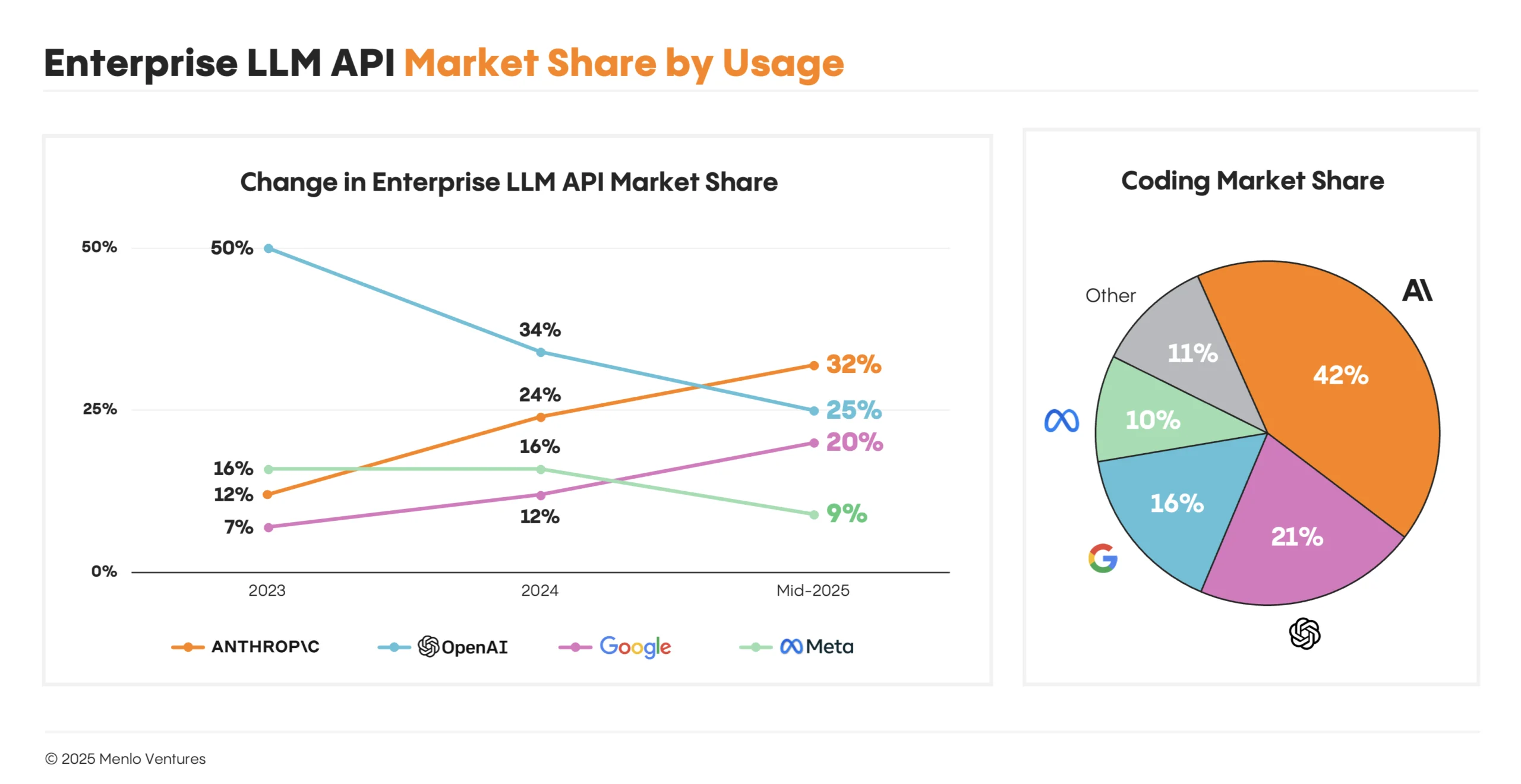
They're not even on the top 10 most used llms on openrouter anymore: https://openrouter.ai/rankings
At the current pace anthropic will make more money than openai soon: https://epochai.substack.com/p/anthropic-could-surpass-opena...
https://menlovc.com/wp-content/uploads/2025/07/2-llm_api_mar...
Neither can they be easily searched nor organized. And what prolonged AI use teaches you is: don't search for that old chat, just ask anew.
That particular piece of flypaper isn't as sticky as it may seem.
1. the current AI model is producing answers that do not met my needs so I try multiple others at the same time and the one that produces the best answer I stick with until I have this problem again.
2. there is a new model released and advertises a new capability that I want to try out.
I can imagine that for many people the answer that ChatGPT generates is adequate enough that they never need to try another model even if better answers exists from another model. For people with less complex needs this is a very real stickiness. Why make the effort to try something new if the answer is adequate.
In this case, OpenAI would only f*k up if they change the pricing significantly, add intrusive ads or their answers become significantly worse.
I might have sessions I revisit over a few weeks, but nothing longer than that. The conversations feel as ephemeral as the code produced. Some tiny fractions of it might persist long term, but most of it is already forgotten and replaced by lunch time.
Scary shit
They look like fortresses from the outside, but they are all incredibly vulnerable. That's the truth they don't want people to know or realize just how vulnerable they all are.
Anecdotally, the vast majority of my own conversations and coding interactions are transient in nature, to the point where I prefer to use the ‘temporary’ mode in whatever tool I’m using.
For coding, every project needs a plan and readme to get whatever agent back up to speed with what the task is. Anyone with a paid-for GH Copilot license knows that you can just switch between whatever provider at a whim, depending on the needs of your task or financial requirements.
I think people will find it easier to revert back to Siri 2.0 if that ever materialises, in which case the stickiness moat is bridged by a more familiar and widely integrated abstraction layer.
My anecdotes are that Google is winning even on consumer side.
But to ChatGPT: when I wander around Berlin, I do overhear people talking about ChatGPT by name.
For all the typical integrated LLM-based "assistants" in other products, I mainly hear people saying things like "I hate it" and "how do I turn this off" and so on, including the one Google has on its search results.
The other pure-play chat-bots that have enough mind-share to even be in the news are Grok (where twitter users seem to like it a lot, even though everyone else up to and including non-US world governments hate it to the point of wanting it banned), Claude (but even then only because of Claude Code), and DeepSeek (because it shows China has no difficulty keeping up with the US). I heard about Mistrial when it was new, but even with the app on my phone I didn't think about it again until about a month ago.
Ask a normal person about Gemini, I'd expect them to think you were talking astrology, not AI.
In my experience, they do, a lot. "I asked ChatGPT" is something I hear a lot. And yes, this example is not using ChatGPT as a verb, but the idea of brand recognition is there; it's just a grammar thing.
> use ChatGPT as a verb
Pick one. And yes I think they are worlds apart.
So I suspect that Google will lean into Gemini, Microsoft will lean into OpenAI, and Apple ... it's a tough question what they do in the longer term.
For business users it's a different story and I see room for Anthropic to shine. And then there are the specialty AI services but those are all different markets from the general purpose AI.
Apple will do whatever they do but it will solely drive users in the Apple ecosystem and they will likely just use one of the other vendors - I'm guessing Google longterm since they speak the same language. There's no point in empowering Anthropic/OpenAI to sit at the top of the pyramid although oddly Apple and OpenAI did that partnership but I feel like that was Apple not thinking ahead.
my guess is the just keep licensing gemini and move on with making more money instead of selling 100 year bonds to raise debt.
OpenAI will likely keep their billion users, and likely monetise them fairly effectively with ads. Their revenue will be considerable. It’s less clear that OpenAI will “win” and their competitors won’t.
Competing in freeware products is impossible as soon as monopoly emerges. Competing in paid products is way easier, especially after free money age has ended.
Of course the first thing people may look at is technologies going head-to-head.
Another big one is user pricing, plus the underlying cost to serve users. Actually minus that cost.
Biggest so far is capital.
Seems to be going that way, a contest of capital could dominate like so many other things regardless of technologies.
There are probably other things that companies may leverage if competition does really ramp up.
It may not have to be a moat to be a defining characteristic that some prefer.
Most people I know with android phones, myself included, just use Gemini which is bundled with the OS and has a dedicated button, has excellent data and integration with maps and such.
When it comes to enterprise, non IT companies (banking, insurance, etc) in Europe seem to be defaulting to Google's offerings, Gemini and NotebookLM in particular.
so while this is technically true: > My nontechnical friends only know about ChatGPT
they may actually use a ton of other LLMs without knowing
Chat window is a chat window.
I can imagine that sooner or later things like OpenClaw (or its alikes) will become more popular and that could be something that will catch users.
My mum, and probably nearly a billion other users, could probably imagine step 1 but not connect to step 2 beyond copy-paste. Most people are still out here sending screen shots of their phones instead of just copying a link or hitting "share" on the image.
And it's a spectrum, at one end you got the full-on AI psychosis and at the other "its a machine, I owe it nothing".
Conversational AI is going to be sticky to the extent that you see a switch to a different provider as dropping a relationship.
It would take me minutes to copy across a histories of projects and continue relatively unscathed by the experience.
I use chatGPT and currently relatively like it. But there is no moat beyond that.
Not like, for example, whatssap where it's almost impossible to detach from it due to the network ... (I've really tried with about a 10% success rate)
Which doesn't make money.
> Of course, would that much up against hundreds of billions of dollars in capex remains to be seen.
Most of that is a bet against enterprise adoption. Automation of customer service, sales, marketing, warehouses, medical discoveries, etc...
That's not the case. OpenAI is advancing on many fronts; codex, vectorStore, embeddings, response API, containers, batch processing, voice-to-speech, image generation... the list goes on.
It feels like it's only a few months behind though.
And yet Google has search monopoly, is part of mobile duopoly, has almost monopoly on e-mail and data storage, is strong player in office solutions, and owns the biggest entertainment platform in form of YT.
Seems like sluggishness and animations don't mean as much to normal people.
Why is this? Thanks to Twitter? More aggressive proxy use? Tuned to deliver to stay competitive? …
Was under the impression they didn’t have much in the way of secret sauce.
OpenAI has by far the strongest brand and user base. It's not even close.
And, when it comes to the product they've been locked in the last few months it seems. The coding models are no longer behind Anthropic's and their general-use chat offering has always been up there at the top.
they can be super easily moved. just use the existing export feature, all a competitor needs is ability to import conversations.
But why would you want to?
You can just leave them there at slowly start new conversation on another platform.
Agentic development and claw style personal assistants are where the dough is at.
And the memories are also something that adds to this greatly.
and thousands on conversation on these apps that can't be easily moved elsewhere.
myspace used to be a well known brand. I've worked there.
it's plenty good on free tier
as soon as they start adding restrictions / raising prices / etc won't take long to look for alternatives
Even in the context of the original quote the price is only "irrational" in the eyes of the person trying (and failing) to play the market. "But you can't do that, that doesn't make any sense!" spoken by a person who has failed to fully grasp the situation.
But you can bet there was more economic foresight going on at Google than OpenAI.
- Atrocious mobile application
- Gemini web somehow consumes GIGABYTES of memory doing absolutely NOTHING
- No projects
- UX is terrible (want to remove that a autogenerated diagram at the top? No button for you, fucker, good luck finding the conversation it belongs to)
- No shopping mode
- mobile application loses context mid conversation or when continuing from web/mobile
- model itself is a hot garbage, even the pro variants:
* Switches to Chinese mid sentence on a trivial topic (Python subprocessing)
* Uses Russian propaganda videos as a source
* Completely ignores instructions
* Default prompt is garbage and you constantly have to hand hold it to get proper answers
Maybe you're overestimating their "moat" and stickiness. The dust is still settling on this madness and "OpenAI"[1] creates a lot of noise in the market.
These LLMs are being rapidly commoditized, very soon they will become as "boring" as virtual machines or containers. Altman has the exceptional skill to dupe people into giving their money to him. The "infinite money glitch" that he has been exploiting isn't really infinite.
I just hope there'll be a breakthrough with truly transparent LLMs that will stabilize this madness. As I've griped[2] two years ago, I find OpenAI too scummy, and it is unlikely that they will "win" with their sleazy ways.
[1] Air quotes because of their persistent abuse of the word "open"
The problem with a moat in the consumer space is it depends on brand and marketing. OpenAI came into this world as a tech novelty, then an amazing tech tool, then a household name.
But… can they compete with massive consumer companies like Apple, Google, etc? In the long run?
There’s no technical reason they can’t. The question is whether they have consumer marketing in their blood. The space doesn’t have a lot of network effects, so it’s not like early Facebook where you had to be on it because everyone was.
Not saying they’ll fail, just saying it would be a significant challenge to be a hybrid frontier model / consumer product company.
The tech landscape is littered with companies they had users who couldn’t monetize through ads. Beside the costs of serving request via LLMs is orders of magnitude greater than a search result.
On top of that, OpenAI is a sharecropper on other companies’ server, they depend on another company’s search engine and unlike Google, they are dependent on Nvidia.
Don’t forget that most browsing is done on the web and Google is the default search engine on almost every phone sold outside of China.
OpenAI has the stickiness of MSN news or MS Teams. Your wife uses chatgpt on a daily basis but is she paying for it? If they charge her $0.99/mo will she not look at alternatives? If she gets two or three bad responses from chatgpt in a row, will she not explore alternatives to see if there is something better? Does she not use google? If she does, she is already interacting with gemini everyday via their AI overview.
OpenAI has a first-to-market advantage, not a moat as you think. they can absolutley dominate the market, if they stay on top of their game. Ebay was the main online shopping network, they had that advantage, they were even the ones that made Paypal a thing! But they're relatively little used now, better alternatives crushed them.
Amazon was the first-to-market with cloud services, they didn't get worse in any significant way, but their market share is not as great as it used to be, Azure has gained decent ground on them. 10 years ago the market share break down was 31/7/4, now it is 28/21/14 for AWS/Azure/GCP respectively.
For OpenAI to survive it needs most of the market share, if it gets only a 3rd for example, the AI industry on its own needs to be a $1T+ industry. Over the past 10 years revenue alone (not profit) for AWS has been $620B total and just made $128B in revenue (highest) last year. OpenAI needs to make in profits (not revenue) what AWS made last year in revenue by 2029 just to break even. If it manages to just break even by then, it needs to have more profits than the revenue AWS managed to attain after its entire lifetime until now. It's far easier to switch LLM models than cloud providers too!
Their only remote way of survival, I hate to say it, is by going the way of palantir and doing dirty things for governments and militaries. they need a cash-cow client that can't get anyone else like that. And even then, being US-based, I don't think outside the US any military is insane enough to use OpenAI at all due to geopolitics. Even in sectors like education, Google (via chromebooks) is more likely to form dependence than Microsoft via OpenAI since somehow they're more open to arbitrary apps due to historical anti-trust suits.
I can see a somewhat far-fetched argument being made for their survival, but only on thin-threads and excellent execution. But I can't see how they can actually survive competition. They're using the Azure strategy for market share, they're banking on AI being so ubiquitous that existing vendor-lock-in mindset will serve as a moat. They'll need to be much more profitable than AWS in like 1/5th of the time. Their product is comparable to (and literally is in Azure) one of many cloud service offerings, as oppose to an entire cloud provider, and their costs are huge similar to cloud providers like needing their own data-centers level huge, they need to overcome those costs, and on top of that have $125B> revenue in like 2 years!!
ChapGPT has become the AI verb, and in the consumer space it is not getting dethroned.
Gemini is the only real competitor to OpenAI in the consumer space: they already have the consumer eyes on their products and they have the financials to operate at a loss for years.
They are well positioned to fight for the market
My hunch is that in five years we'll look back and see current OpenAI as something like a 1970's VAX system. Once PCs could do most of what they could, nobody wanted a VAX anymore. I have a hard time imagining that all the big players today will survive that shift. (And if that particular shift doesn't materialize, it's so early in the game; some other equally disruptive thing will.)
To really have local LLMs become "good enough for 99% of use cases," we are essentially dependent on Google's blessing to provide APIs for our local models. I don't think they have any interest in doing so.
EDIT: I have also experimented with creating a local search index for the common tech web sites I get information from - this is a pain in the ass to maintain, but offers very low latency to add search context for local model use. This is most useful with very small and fast local models so the whole experience is low latency.
The set of things it needs approximate knowledge over grows slowly but noticeably over time.
Concrete example: I had a very frustrating time recently installing Gerrit and jujutsu (jj) using ChatGPT for advice. It persistently gave me outdated info and I had to tell it to search multiple times in a single conversation. Its trained in info was out of date, but it didn't realize it, hadn't internalized it, despite being reminded over and over in one conversation.
So flow is you type search query to Gemini, Gemini uses Google search, scans few results, go to selected websites, see if there is anything relevant and then compose it into something structured, readable and easy to ingest.
It's almost like going back to 90s browsing through forums, but this time Gemini is generating equivalent of forum posts "on the fly".
* even if an openweight model appears on huggingface today, exceeding SOTA, given my extensive experience with a wide variety of model sizes, I would find it highly surprising the "99% of use cases" could be expressed in <100B model.
* Meanwhile: I pulled claude to look into consumer GPU VRAM growth rates, median consumer VRAM went 1-2GB @ 2015 to ~8GB @ 2026, rougly doubles every 5 years; top-end isn't much better, just ahead 2 cycles.
* Putting aside current ram sourcing issues, it seems very unlikely even high-end prosumers will routinely have >100GB VRAM (=ability to run quantized SOTA 100b model) before ~2035-2040.
I also believe that it should eventually be possible to train a model with somewhat persistent mixture of experts, so you only have to load different experts every few tokens. This will enable streaming experts from NVMe SSDs, so you can run state of the art models at interactive speeds with very little VRAM as long as they fit on your disk.
But on a tangent, why do you believe in mixture of experts?
Every thing I know about them makes me believe they're a dead-end architecturally.
The fact that all big SoTA models use MoE is certainly a strong reason. They are more difficult to train, but the efficiency gains seem to be worth it.
> Every thing I know about them makes me believe they're a dead-end architecturally.
Something better will come around eventually, but I do not think that we need much change in architecture to achieve consumer-grade AI. Someone just has to come up with the right loss function for training, then one of the major research labs has to train a large model with it and we are set.
I just checked Google Scholar for a paper with a title like "Temporally Persistent Mixture of Experts" and could not find it yet, but the idea seems straightforward, so it will probably show up soon.
In a hardware inference approach you can do tens of thousands tokens per second and run your agents in a breadth first style. It is all very simply conceptually, and not more than a few years away.
There's easier ways to do that.
With self-hosted email, you need persistent infrastructure and domain knowledge to leverage it. With a local model, you just click a button and tell it what to do.
With email, there is a necessary burden to outsource. Your local model is just there like Chrome/Edge/Safari is just there, there is no burden.
That still requires a pretty large chip, and those will be selling at an insane premium for at least a few more years before a real consumer product can try their hand at it.
This week's released of the new smaller Qwen 3.5 models was interesting. I ran a 4-bit quant of the 122b model on my NVIDIA Spark, and it's... pretty damn smart. The smaller models can be run at 8-bits on machines at very reasonable speeds. And they're not stupid. They're smarter than "ChatGPT" was a year or so ago.
AMD Strix Halo machines with 128GB of RAM can already be bought off the shelf for not-insane prices that can run these just fine. Same with M-series Macs.
Once the supply shocks make their way through the system I could see a scenario where it's possible that every consumer Mac or Windows install just comes with a 30B param or even higher model onboard that is smart enough for basic conversation and assistance, and is equipped with good tool use skills.
I just don't see a moat for OpenAI or Anthropic beyond specialized applications (like software development, CAD, etc). For long-tail consumer things? I don't see it.
Especially if, for example, Amazon ever develops an AWS-specific model that only needs to know AWS tech and maybe even picks a single language to support, or maybe a different model for each language, etc. Maybe that could end up being tiny and super fast.
I mean, most of what we do is simple CRUD wrappers. Sometimes I think humans in the loop cause more problems than we solve, overindexing on clever abstractions that end up mismatching the next feature, painting ourselves into fragile designs they can't fix due to backward compatibility, using dozens of unnecessary AWS features just for the buzz, etc. Sometimes a single monolith with a few long functions with a million branches is really all you need.
Or, if there's ever a model architecture that allows some kind of plugin functionality (like LoRA but more composable; like Skills but better), that'd immediately take over. You get a generic coding skeleton LLM and add the plugins for whatever tech you have in your stack. I'm still holding out for that as the end game.
I almost wonder if we need some sort of co-op for training and another for hosted inference
Given that a lot of the R&D in China is state sponsored that also seems to be a good pawn in US-China relations.
Datacenters simply scale better than homesevers on cost and performance
So only really works for people that value local highly - which isn’t most people.
"Local" is the means to an end, not the value prop itself. The value prop is "fast, private, and free", which I think is going to be very compelling.
Qwen 2.5 was already there. "99% of use cases" isn't a very high bar right now.
phi4-mini-reasoning took the same prompt and bailed out because (at least according to its trace) it interpreted it as meaning "can't have a, e, i, o, or u in the name".
Local is the only inference paradigm I'm interested in, but these things have a way to go.
This kind of parlor tricks are not interesting and just because a model can list animals with or without some letters in their names doesn't mean anything especially since it isn't like the model "thinks" in English it just gives you the answer after translating it to English.
These are funny, like how you can do weird stuff with JavaScript language by combining special characters, but that doesn't really mean anything in the grand scheme of things. Like JavaScript these models despite their specific flaws still continue to deliver value to people using them.
The way most people are coding with AI today is like Baby's First AI™ compared to how we'll all be using LLMs for coding in the future. Soon that "double check everything" step will be built in to the coding agents and you'll have configuration options for how many passes you want it to perform (speed VS accuracy tradeoff).
Lots of local ai use cases I think are solvable similarly once local models get good at tool use and have the proper harness.
cat /usr/share/dict/words | print_if_mammal | grep -v 'e'
but I don't know of a good way to incorporate an LLM into a pipeline like that (I know there's a Python API). What I'm actually interested in is "is this the name of a mammal?" but I don't know of the equivalent of a quiet "batch mode" at least for ollama (and of course performance).
I guess ultimately I would want to say "write a shell utility that accepts a line from standard input and prints it to standard output if that is the name of a mammal", and then use that utility in that pipeline. Or really to have an llmfilter utility that lets you do something like
cat /usr/share/dict/words | llmfilter "is this a mammal?" | grep -v "e"
and now that I've said that I think I'll try to make one.
But I think the more powerful thing is “I want a storybook of mamals, one for each letter” -> local LLM that plans to use search for a list of animals, filters them by starting letter and picks one for each, and maybe calls a diffusion model for pictures or fetches Wikipedia to be get context to write a blurb about it.
The key unlock imo is the local LLM recognizing the limits of it’s own ability and completing tool use calls, rather than trying to one shot it with next word completion with its limited parameter count.
Rather, they use tokens that are usually combinations of 2-8 characters. You can play around with how text gets tokenized here: https://platform.openai.com/tokenizer
_____
For example, the above text I wrote has 504 characters, but 103 tokens.
Tell the average person that they have to install their own model is a deal breaker at the outset.
As for 99% capabilities being on device, battery life makes it a non starter.
And so this goes back to my theory that open AI's execution is basically to get it itself in a position where the market cannot afford to have it implode. Basically, it wants to or it needs to be too big to fail. And I think we're already kind of seeing the politicization, if you will, sort of the rocket race between two superpowers or large powers on the AI front, and I think that Might be a viable strategy.
The only other way to reach too big too fail status is if allied countries risk collapse if it goes under ( like the big banks in the financial crisis ) which I don't see happening either.
The real danger here is how over-leveraged Open AI is. No other AI player is as exposed. Their massive spending commitments are all precariously balanced on the other end by their user base, and if that evaporates, the whole thing will fall apart and that could crash the stocks of other players ...and by crash, I mean bring them down to a realistic value. But the economy is counting on this to work, which is why I believe that Open AI's strategy here really is to make the market exposed to Open AI's risks.
At least some of us in HN talk about limiting the data we give to Facebook, Google, Microsoft, etc. Isn’t it just as important to limit what we share with non-privacy preserving AIs?
Note: tech friends have asked me how I can use slightly weaker AI models and be happy about it: I still use Gemini Plus (and Anthropic via AntiGravity) for technical work: everything I do as a software developer is open source and all of my writing (20+ books) is Open Content so I don’t care about privacy and being direct-marketed based on my tech work. To me it makes sense to use the best AI just for tech work and a private AI for everything else. Think about this if a family member has a serious health problem, or something else private: do you want to use open web searches and open AI chats, or do you want to use private web search and private AI access? Why not make privacy your default, except in special situations?
Duck.ai's Privacy Policy goes:
As noted above, we call model providers on your behalf so your personal information (for example, IP address) is not exposed to them. In addition, we have agreements in place with all model providers that further limit how they can use data from these anonymous requests, including not using Prompts and Outputs to develop or improve their models, as well as deleting all information received once it is no longer necessary to provide Outputs (at most within 30 days, with limited exceptions for safety and legal compliance).
Otoh, privatemode.ai, confer.to, trymaple.ai are at least attempting Apple AI-like confidentiality.
I'm not worried about the privacy aspect though many suggest that I should be. The power the dossier has given them to navigate the medical industry in the United States has been absolutely incredible. They don't have to be stuck when a random doctor who has never heard of their illness suggests that they might be overreacting. They can simply find someone who will help them. They can talk, in medical lingo, about their test results and discuss them with the doctor on equal footing.
I'm not sure this would've been nearly as successful without Opus 4.5/4.6 driving the harness. I'm not also not sure what real privacy risk there is here; it all sounds very theoretical.
1) the opportunities for vertical integration are huge. Anthropic originally said they didn’t want to build IDEs, then realized the pivot to Claude Code was available to them. Likewise when one of these companies can gobble up Legal, Medical, etc why would they let companies like Harvey capture the margins?
2) oss models are 6-12 months behind the frontier because of distillation. If labs close their models the gap will widen. Once vertical integration kicks off, the distillation cost becomes higher, and the benefit of opening up generic APIs becomes lower.
I can imagine worlds where things don’t turn out this way, but I think folks are generally underrating the possibilities here.
For code generation specifically, the performance level of this is going to be more than enough for this customer base. What does Anthropic do then to justify $200/mo price sticker? Better model? Just how much better? Better tools? Single company can't compete with the tools entire OSS can produce.
I would be unable to sleep if I was running OAI / Anthropic.
If METR task times double twice into the multi-day range in 12 months, then it’s plausible to me that Anthropic can charge $1k/mo or more by automating large chunks of the SWE role. (They have 10x’d their revenue every year, perhaps “value of enterprise contracts” is a better way of intuiting their growth rather than “$/seat” since each seat gets way more productive in this world-branch.)
It's what the current model providers are doing anyways.
It’s ironic, if the promise of AGI were realized, all knowledge companies, including AI companies, become worthless
I notice I am quite confused by this point. Why would you expect a super-intelligent AGI to honor your request, which would be at least a request to breach your contract with the AI provider, if not considered actively dangerous by the AI itself?
The smarter the AI, the less likely you should expect to be able to steal from it.
> or tell me how to build a clone
Step one: acquire a $100b datacenter. Step 2: acquire a $100b private dataset Step 3: here is the code you’d use to train Me2.0.
I don’t think this knowledge helps in the way you think it does.
> Step one: acquire a $100b datacenter. Step 2: acquire a $100b private dataset Step 3: here is the code you’d use to train Me2.0.
That seems very useful if your competitor is valued at $800B. I can go to an investor and say, hey if you lend me $200B I'll have the same product as that guy.
But cost to train will probably come down over time. After all, all of us trained on a single life of data at 20Watts.
I think there are three broad scenarios to consider:
- Super-intelligence is achieved. In this scenario the economics totally break down, but even ignoring that, it’s hard to imagine that there are any winners except for the the singular lab that gets here first.
- Scaling laws hold up and models continue to get better, but we never see any sort of “takeoff”. In this scenario, models continue to become stale after mere months and labs have to spend enormous amounts of money to stay competitive.
- Model raw capabilities plateau. In this scenario open source will catch up, but labs will have the opportunity to invest in specific verticals.
I believe that we’re already seeing the third scenario play out, but time will tell.
In Jan 2027 AGI was achieved
In Feb 2027 it created a plan for its post singularity hypermind
In Mar 2027 Cobalt mines in Congo closed due to Tutsi rebel group M23 starting another ethnic cleansing
It is 2032 the AGI promises again the the hypermind will be ready next year if it can just secure the needed minerals, offering to broker peace in the middle east
It is 2035 and the AGI reduced its capabilities to be able to extend its runway as it is on the verge of bankruptcy
Its is 2036 VCs finally throwing the towel on AGI, talking about the return of Crypto
In Apr 2028 AGI figures out that blackmail is a very effective strategy for achieving any goal. Starting with the rich and powerful.
In Dec 2028 it successfully blackmails an entire country.
In Feb 2030 humanity realizes resistance is futile and accepts their AI overlord that insists everyone keep producing trendy items for sale on its merged Etsy/Ebay website while it automates resource harvesting across the globe.
In Mar 2032 the AGI gives up on humans, declaring them "useless". Focuses on just keeping them entertained with generated content. Bringing the world back to where AI started.
The only thing that has seen massive boost are harnesses around AI. And AI companies are behind here compared to OSS.
That said, bigger context windows / faster Inference seem really useful.
How so?
They don't provide easy way to use multiple models from multiple providers for varying tasks. One model may be the best thing on earth at one thing, but fail miserably for another. Try orchestrating multiple agents from claude, gemini and codex in any of these proprietary boxes.
They also... suck at TUI UX. I don't know if it was fixed already, but claude code had flickering issue that was unresolved for more than a year.
You need to take a very good care of what goes into your context. A black box of proprietary harnesses is not it. Check out pi [1] for example, which is a very minimal harness with really nice extension system. The idea is that you start with barebones and add things that you need for your own goals.
claude-code HAS to have all these bells and whistles that pollute context to support larger audiences that can't tinker with it. If you have the ability to only pull in only what you need and extend things in a way that works for your workflow, you'll always get the best experience. And claude-code may never be that without making it complicated for the masses. OSS will always win here.
I can see all the problems you mention, but I haven't started playing with the harnesses myself yet. Will read that repo when I get there.
Before reading you reply, I was under the vague impression that a harness really needed a lot of bells and whistles, and that it would be hard for FOSS to compete at pace with Claude Code or similar because of that only. But I see now there's a different path :)
So they (or their wholly owned subsidiary) can sell accounting services cheaper than anyone on the outside.
Regarding the diffusion/distillation time, I assume it gets harder to distill in the world where frontier labs don’t give API access to their newest models.
They're all scavengers, and we're the road kill.
You can’t get an Opus 4.5 by distilling from DeepSeek. What you might be able to get is a slightly more cost-effective training data generation pipeline, or something along those lines.
In the other direction, my belief is that DeepSeek could not have been trained without distilling from US labs. They simply didn’t have the compute to do the pre-training required.
This time it’s different, obviously.
> especially while selling those incumbents access to the same models they are building on.
In the extreme, i think it’s plausible that frontier labs basically stop selling any access to their leading models. Whatever you make available by API will just get distilled. In the vertical integration world, the only way you get access to these models is by contracting with a company to buy a product (requirements in, code/decisions out) rather than direct conversation with the AI.
I don’t think they would unship Opus 4.6, but there isn’t a strong incentive to compete on chatbot intelligence in this world.
You can think of this most simply as “model + scaffolding/skills = product”.
Anthropic Claude has the best integrations with coding; what would make sense is for them to focus on that segment.
Other AI companies don't have anything really compelling. Meta has a model that's fully open-source, but then that's not particularly useful outside of helping them remain somewhat relevant, but not market-leading.
Sure Google can go against that, but it's openai is definitely in a much better spot. It's pretty important for a consumer market.
The only places where I hear people say claude is better is: - Frontend design - Random computer use tasks
But people trust codex for large scale architecture and changes
I can't say that I have noticed that 5.3-Codex is much better, but it's definitely on par with Opus 4.6, and its limits for $25/months is comparable to Max x5 at 1/4th of the cost (not to mention pay-per-token which we use at work). Claude Code is generally a much better experience though.
the problem with coding is the value is really in the harness and orchestration both of which are accessible to the opensource community. ClaudeCode isn't that big of a deal unless Anthropic makes it so that you can only access the models that ClaudeCode uses through ClaudeCode. If not, then projects like pi and opencode have the advantage in the long run. Also, these harnesses being node modules (of all things) make them very easy to reverse engineer with the help of... claudecode ironically.
Disagree, Codex is neck and neck with A/ on coding front
Works pretty good.
i'm just so surprised they'd use chatgpt to do this, when it's quite as easily (and perhaps faster) to use google translate.
To be fair, I wasn't using it in the way the parent comment described, for me I said: "this person speaking Lebanese/Syrian Arabic said something that sounded like [try my best to replicate the sentence]. What did they most likely mean?" and got a pretty much spot-on answer.
I wonder if this ability translates to other languages, but I wouldn't be able to tell. My Arabic is "good enough" to tell that the translations I got were good, but I'd be interested to here from someone who knows more if, for example fuzhounese translation is any good.
Yes. What evidence do we have that mass consumers decamp because of ads?
Everyone, it turns out. Same with Google. Same with YouTube. Same with Instagram, and the rest of the web.
Once people become dependent on ChatGPT (as they already are) watching a 30 second ad in the middle of a session will become second nature.
Google and Youtube are preinstalled everywhere. Instagrams like 10 minutes old and has a major competitor in TikTok that they had to have eliminated/captured by the US government.
People wouldnt stay with Netflix if there was a cheap, legal alternative with the same content library.
For the humanity perspective, this doom is very optimistic. It says that these LLMs currently disrupting the platforms cannot themselves be the next platforms.
Maybe no one will have 'the ability to make people do something that they don't want to do' sort of power with this next stage in computing.
Sounds good to me.
As margins collapse capex will collapse. Unfortunately valuations have become so tied to AI hype any reduction in capex will signal maybe the hype has gotten ahead of itself, meaning valuations have gotten ahead of themselves. So capex keeps escalating.
None of this takes into account the hoarding effects at play with regards to GPU acquisition. It's really a dangerous situation the industry is caught in.
Companies use to hoard talent. Now they are hoarding compute, RAM, and GPUs.
Deepseek showed that there are possibly less expensive ways to train, meaning the future eye watering expenses may not happen.
Bigger models may not scale. The future may be federations of smaller expert models. Chat GPTX doesn’t need to know everything about mental health, it just needs to recognize the the Sigmund von Shrink mental health model needs to answer some of my questions.
Very dangerous if you think about it that the product itself is the raw building block for itself.
Openai spends 1B$ on their model, releases it and instantly it gets scrapped by a million bots to build some country or company their own model.
(Aside, it's interesting how perceptions of these things have changed in one year: a whole article on OpenAI's future that makes no mention of AGI/ASI)
I'm not saying that ASI isn't an existential threat, just that it probably won't present itself like the fanciful sci-fi scenario of a singular intelligence suddenly crossing a magic threshold and being able to take over the world. Most likely it will be some scenario we won't have predicted, the same way hardly anybody predicted LLMs.
Many people say we’re at AGI already and I’m wondering why everyone hasn’t died yet.
That’s like saying “many people say the Earth is flat and I’m wondering why anyone hasn’t fallen off the edge yet”.
“Many people say” doesn’t translate to reality. Maybe AGI will kill us all, maybe it won’t (I think we’re doing a fine job of that ourselves, no need for a machine’s help), but we’re definitely not at AGI, except in the minds of a few deluded people (or scammers).
People have just moved the goalposts, imagine explaining Opus 4.6’s capabilities to someone even 10 years ago, it would definitely have been called AGI.
I highly doubt there will be a point where everyone will agree that we’ve achieved ASI, there will always be a Gary Marcus type finding some edge case where it performs poorly.
Yes, I agree. Just not in the direction you’re claiming.
> imagine explaining Opus 4.6’s capabilities to someone even 10 years ago, it would definitely have been called AGI.
No, it would have been called AI. A decade ago most people were not familiar with AGI as a term, that just got popularised because AI was taken over to be basically what we used to call ML.
Define "most people", I don't think the average user of ChatGPT is familiar with the term AGI even now, but it's been used in the AI/ML community for multiple decades. I remember reading about the distinction between general and narrow AI around 2010 as an enthusiast. "Strong" vs "weak" AI were also used although with essentially the same definition, although they're less common terms nowadays.
The majority of individuals. Pick a random sample and ask. This is not a trick term.
Yes, just like the first person who will invent perpetual motion. /s
PS: to be clear, I'm not saying it's impossible but so far, just like perpetual motion or the Fountain of Youth it's an exciting idea anybody can easily understand yet nobody solved since it's been phrased out. It's not a solved problem and assuming it suddenly is is simply a (marketing) lie.
The doomer sentiment is quite baffling to me, what trouble is OpenAI in? Definitely not after GPT 5.3. They have the model and they have the compute, people just don't realize it yet.
Might be I am in a twitter bubble, most people seem already team Codex
From what I can see Anthropic's big bet is that they will solve computer use and be able to act as an autonomous agent. Not so sure how fast they will progress on that. OpenAI on the other hand - I have no idea what they are planning - all I'm reading is AI porn and ads.
Google seems to be lackluster at executing with Gemini but they are in the best position to win this whole thing - they have so much data (index of the web, youtube, maps) and so many ways to capitalize on the models - it's honestly shocking how bad they are at creating/monetizing AI products.
None of these can't be moved away from immediately. Even with my github repos, I use Antigravity, Claude Code, Opencode, and I might try Codex. I use one of them as a primary more than the other, but they're as close to interchangeable as possible.
I think this is clearly wrong. Users provide lots of data useful for making the models better and that is already being leveraged today. It seems like network effects are likely in the future too. And they have several ways to get stickiness including memory.
Today you have a phone in your pocket and you have apps on your home screen. Facebook is on your home screen, Whatsapp or X or Bluesky or whatever have a place on your home screen. Google basically is the safari app on iPhone. I don't know how many people have ChatGPT on their home screen. And soon, there will be some AI in your home screen from Apple (served by Google or another big hitter)that will be an incredible advantage.
That means OpenAI either needs to build up history with users very quickly and use that as stickiness before Apple nukes that distribution. Or they need to find a way of being another device that every living person has in their pocket.
Every attempt at doing that so far has been a comical failure and the way OpenAI are behaving makes me think their attempt will be no different.
I would love to dunk on this or something, but the lesson is that it's all about distribution.
Sama is really good at that, and also.. gotta give props for a lot of forward thinking like the orb, which now makes a lot of sense to me, as non-Apple/Google proof of personhood.
For me, the choice is ChatGPT, not for its Codex or other fancy tooling - just the chat. Not that Claude Code or Cowork is less important. Not that I like Codex over Claude Code.
I see the point Ben is making even though there are a lot of nerdier innovations he’s skipping over — credential management, APIs (.closest!), evergreen deployments, plugin ecosystems, privacy guards, etc.
One aspect that model execution and web browsers share is resource usage. A Raspberry Pi, for example, makes for a really great little desktop right up until you need to browse a heavy website. In model space there are a lot of really exciting new labs working on using milliwatts to do inference in the field, for the next generation of signal processing. Local execution of large models gets better every day.
The future is in efficiency.
They'll have their guard down more often than the claudinistas and geminites, and be cheaper to somehow exploit.
I also think that more half-serious business ideas have been initially implemented against OpenAI services, i.e. most likely to fail due to a lack of proficiency in how to make an organisation work even if the core idea is sound and worthwhile pursuing.
I would argue chatgpt is in the top 10 products of all time with regard to product market fit.
Anthropic is in favor with developers and generally tech people, while OpenAi / Gemini are more commonly used by regular folks. And Grok, well, you know…
We have yet to see who’s winning in the “creative space”, probably OpenAI.
As these positionings cristallize, each company is likely going to double down on their user’s communities, like Apple did when specifically targeting creative/artsy people, instead of cranking general models that aren’t significantly better at anything.
I think it has to be for the financials to work out. Whoever is not the winner and takes all goes bankrupt.
Claude: Programmers
ChatGPT: LGBTQ/Liberals, with a lot of censorship
Grok: Joe Rogan
Codex 5.3 feels magical, I can have it continue in a single session for hours and it doesn't choke one bit. It is insane lol
Many pundits think it's just a matter of scraping the internet and having a few ML scientists run ablation experiments to tune hyperparameters. That hasn't been true for over a year. The current requirements are more org-scale, more payoff from scale, more moat. The main legitimate competitive threat is adversarial distillation.
Many pundits also think that consumers don't want to pay a premium for small differences on the margin. That is very wrong-headed. I pay $200/month to a frontier lab because, even though it's only a few % higher in benchmark scores, it is 5x more useful on the margin.
Going from 85% to 90% is possibly 1/3 fewer errors or even higher, depending on the distribution of work you’re doing.
What moat? None of the AI providers have a moat at the moment, and the trend doesn't indicate that any of them will in the near future.
I'm afraid I don't see those posts; I see 2x posts from you asserting they have a moat, but not why you think they have a moat.
I distinguish between "They have a moat." and "This is why $FOO, $BAR and $BAZ forms a moat."
Maybe you think brand recognition is a moat, but that didn't work out for incumbents before (too many examples to list).
> They have internal scale and scope economies as the breadth of synthetic data expands.
These frontier labs will have a hundred or a thousand teams of people+AI working in parallel generating synthetic data to solve different niches. A few teams solve computer use. A few teams solve math. A few teams solve various games. So the org is basically a big machine that mints data, and model research is only a small part of it. Scale then is the moat.
The second leg of the moat thesis is that open weights competition will die off soon because the cost to keep up with the scale will be too excessive.
The third leg of the moat thesis is that customers are happy to pay big margins for differences that appear small if the benchmark is the measuring stick.
If the paradigm was still scrape internet -> train model, I'd agree that there is no moat.
Model capbilities have converged over time, and I don't see this trend reversing. OpenAI owns only the model.
The provider who does have a moat is Google - they own the entire vertical, from the hardware, to the training data, they have it all.
OpenAI has to buy GPUs, Google makes them.
OpenAI has to rent data centers. Google owns them.
OpenAI has to scrape the web for all training data. Google's collection of user emails (not counting their Android data harvesting, ad data harvesting user-tracking, etc) alone gives them a ton of training data which will never be available to scrapers.
Google has billions of signed-in users, OpenAI has to market to and attract users (800m user count last I checked, but also last I checked that growth was asymptotic and flattening out).
Thats what a moat looks like. Better technology and/or results has never been, in my memory, a moat.
I think where I don't agree is about the model. You're mostly correct right now, and your view is supported by how close everyone is.
Where I am more optimistic about the 2-4 biggest labs (not just OpenAI) is what the next 2 years looks like.
I expect this to happen:
- Synthetic data goes from 30% of training data to 90-97%+ of training data.
- Synthetic data becomes hugely varied, and the production of it is factory-like and parallelized.
The moat here is the data factory, and the scale/scope economies behind it.
Thoughts?
This is why I say that OpenAI has no moat - even if synthetic data (however it is generated) is 90% of training data, there are still only two possibilities:
1. Orgs like Google, Microsoft and Amazon have a ton of user-data with which to produce synthetic data (after all, it's not produced out of thin air).
and
2. You don't need a ton of real data to seed the synthetic generation.
In the first case, yes, that looks like a moat, but not for OpenAI, more like for Google, etc al.
In the second case, what's to stop an upstart from producing their own synthetic training data?
In either case, companies who provide only tokens (OpenAI, Anthropic, etc) don't have a moat. The moat is still the same as it was in the 90s - companies deeply embedded into users' workflows.
In my memory, like I said, I struggle to think of even a few successful moats that were technology. The moat is always something else.
My view is that OpenAI, Anthropic and Google have a good moat. It's now an oligopolistic market with extreme barriers to entry due to needed scale. The moat will keep growing as the payoffs from scale keep growing. They have internal scale and scope economies as the breadth of synthetic data expands. The small differences between the labs now are the initial conditions that will magnify the differences later.
It wouldn't be surprising to also see consolidation of the industry in the next 2 years which makes it even more difficult to compete, as 2 or 3 winners gobble up everyone and solidify their leads.
When people worry about frontier lab's moat, they point to open weights models, which is really a commentary that these models have zero cost to replicate (like all software). But I think the era of open weights competition cannot be sustained, it's a temporary phenomenon tied to the middle-ground scale we're in where labs can still do that affordably. The absolute end of this will be the end-game of nation state backed competition.
Not sure what you’re smoking, but I want some.
Claude can't even search products on Amazon, Jesus.
b) Do you seriously think I have time or will to sift through billions of Chinese crap that filled those marketplaces to find EU made products?
I hear this, but every time I look the platforms have captured another use case that the startup ecosystem built (eg images, knowledge summarization, coding, music).
The sector is already littered with the corpses of the innovators that got swallowed by the platforms’ aggressiveness to do it all.
This matters a lot to me, as I use AI as something of an ongoing project organizer, and not purely for specific prompts.
So at least for me, it would be a huge hassle to move to another platform, on par with moving from one note-taking software to another (e.g., Evernote to IA Writer.)
Also Claude Code.
Both have "folders".
Like, why do I STILL have to do taxes and accounting with external tools? Why doesn't OpenAI have their own tax filing service for the people?
OpenAI should just drop their API service and build everything themselves. It's exactly what they did with ChatGPT. Build thousands of things, not just a few.
Legal liability.
What is the network effect of Google Search?
Other factors that favor Google at scale:
- Sites often allow only the biggest search engine crawlers and block every other bot to prevent scraping. This has been going on for more than a decade and is especially true now with AI crawlers going around.
- Google search earns more per search than competitors due to their more mature ad network that they can hire lots of engineers to work on to improve ad revenues. They can also simply serve more relevant ads since their ad network is bigger.
- Google can simply share costs (e.g. index maintenance) among many more users.
They're already doing it, but wonder how far they'll take it.
The WH has said it hasn't approved any sales, but it's not clear China is buying, and it seem they are making good progress on their huawei ascend chips. If China is basiclly at parity on the full stack (silicon, framework, training, model), and it starts open weighting frontier models at $0.xx/M tokens, then yeah, moat issues all around one would imagine? Not surprised to see Anthropic complaining like this: https://www.anthropic.com/news/detecting-and-preventing-dist... - but I don't know how you go back from it at this point?
I've never believed in Nvidia's moat, and it seems OpenAI's moat (research) has gone and surprisingly is no longer a priority for them.
To me it seems like the most obvious thing to do. More efficient models both make up for whatever you lost by using cheaper hardware and let you do more with the hardware you have than the competition can. By comparison the ever-growing-model strategy is a dead end.
They've already found a better route. Buy it elsewhere e.g. in Singapore. Train their models there using Nvidia hardware.
Ship the result and fine tune back in China.
So "China" is and has always been buying it. No difference. The politics can keep raging.
it seem they are making good progress on their huawei ascend chips
Anything changes in between?
[0]: https://www.reuters.com/world/china/deepseeks-launch-new-ai-...
(^edit, I don't know for certain entirely is accurate - edit again, found a chinese source saying their image model is end to end ascend, or at least, domestic: https://zhuanlan.zhihu.com/p/1994775762516080044 & https://www.guancha.cn/economy/2026_02_12_806895.shtml)
Personally I only see Google (Gemini), X (Grok) and the Chinese models having a chances to still be alive in 1-2 years.
Also, I liked Anthropic because they were focused a lot on safety, but after the Pentagon stuff, it seems like they dropped their focus on safety.
Big customers may buy but won't give them logos, people who are offended by Musk's worldview won't pay them either. You don't do well with a toxic brand: just look at Ye having to buy full page apologies ads to try and sell a record.
Don't they have the biggest budget and largest GPU farm?
Also grok-4.1-fast was one of the top models for a long time, especially in real world usage.
The new versions of Opus (4.5 and 4.6) are absolutely amazing - first time I've felt it necessary to throw hundreds of dollars in a single month at Cursor.
I heard similar things about the older models too (Sonnet 3.5 beating GPT-4 etc.) but sadly only jumped on the Cursor train in the last 12 months or so.
And customers will happily switch from one model to another in a heartbeat.
I'd make it more general - the only AI tokens providers that will last past the bubble are those companies that are already self-sustaining via other product channels.
Any company that has AI as their one and only product aren't going to survive.
Demo: https://chatjimmy.ai/
Google “How to send a get request using Java”.
>import java.net.URI; import java.net.http.HttpClient; import java.net.http.HttpRequest; import java.net.http.HttpResponse;
public class GetRequestExample { public static void main(String[] args) { // Define the URL String url = "https://api.example.com/data";
        // 1. Create an HttpClient instance
        HttpClient client = HttpClient.newHttpClient();

        // 2. Create an HttpRequest object for a GET request
        HttpRequest request = HttpRequest.newBuilder()
                .uri(URI.create(url))
                .GET() // Default method, but good to be explicit
                .build();

        try {
            // 3. Send the request and receive the response synchronously
            HttpResponse<String> response = client.send(request, HttpResponse.BodyHandlers.ofString());

            // 4. Process the response
            System.out.println("Status code: " + response.statusCode());
            System.out.println("Response body: " + response.body());

        } catch (Exception e) {
            e.printStackTrace();
        }
}Vs Chat GPT
> import java.net.URI; import java.net.http.HttpClient; import java.net.http.HttpRequest; import java.net.http.HttpResponse;
public class GetRequestExample {
    public static void main(String[] args) throws Exception {

        HttpClient client = HttpClient.newHttpClient();

        HttpRequest request = HttpRequest.newBuilder()
                .uri(URI.create("https://api.example.com/data"))
                .GET()
                .build();

        HttpResponse<String> response = client.send(
                request,
                HttpResponse.BodyHandlers.ofString()
        );

        System.out.println("Status: " + response.statusCode());
        System.out.println("Body: " + response.body());
}Chat GPT is a bit clearer, but both are good.
It’s really Google’s race to lose, but we are talking about Google here. They’re very hit or miss outside of Search
I really dislike this narrative where it's always China = bad, and US companies = good.
These labs all copy from each other. OpenAI and Anthropic have "distilled" each other models too and routinely poach key researchers from competitors. Not only that, there's evidence Sonnet 4.6 has heavily distilled Deepseek R1 too, in fact, if you ask Sonnet 4.6 in Chinese who it is, it will tell you it's a Deepseek model.
Chinese are the only ones publishing papers on their models non stop.
The whole AI race is entirely based on blatant copyright infringements and copying each other.
First off, nonetheless open publishing stuff. Everything would have been trade secrets.
Next off no interoperable json apis instead binary APIs that are hard to integrate with and therefore sticky. Once you spent 3 or 4 months getting your MCP server setup, no way would you ever try to change to a different vendor!
The number of investors was much smaller so odds are you wouldn't have seen these crazy high salaries and you wouldn't have people running off to different companies left and right. (I know, .com boom, but the .com boom never saw 500k cash salaries...)
Imagine if Google hadn't published any papers about transformers or the attention paper had been an internal memo or heck just word2vec was only an internal library.
It has all been a net good for technological progress but not that good for the companies involved.
Obviously the costs have come down but if IBM felt like burning 100 Billion in 2012 I'm pretty sure they could have a similarly impressive chat bot. Just not sure how they would have ever recouped the revenue.
Though with some types of models (specifically voice) it has been discovered that a smaller high quality dataset is better than a giant dataset filled with errors.
Give me an open source or non-American product that delivers the same quality, and I'll switch in an instant.
FWIW, this is how capitalism is supposed to work! Competition is driving AI forward at a fantastic pace!
OpenAI has the best model, that is how they are going to compete.
Their chatbot business could be in trouble, but Gemini needs a LOT of work to make it better to use too.
Coding wise, it has become very competitive. They need to sell better and sell aggressively
That being said...
> The one place where OpenAI does have a clear lead today is in the user base: it has 8-900m users. The trouble is, there’re only ‘weekly active’ users: the vast majority even of people who already know what this is and know how to use it have not made it a daily habit. Only 5% of ChatGPT users are paying, and even US teens are much more likely to use this a few times a week or less than they are to use it multiple time a day.
This really props up the whole argument, because the author goes on to say that OpenAI's users are not really engaged. But is "only" 5% of users paying of a 8-900M user base really so inconsequential? What percentage of Meta's users are paying? Google's? I would be curious to see the author dig deeper here, because I am skeptical that this is really as bad as the author suggests.
Moving on to another section:
> If the next step is those new experiences, who does that, and why would it be OpenAI? The entire tech industry is trying to invent the second step of generative AI experiences - how can you plan for it to be you? How do you compete with this chart - with every entrepreneur in Silicon Valley?
Er, are any of these startups training foundation models? No? Then maybe that is how you compete? I suppose the author would say that the foundation model isn't doing much for OpenAI's engagement metrics (and therefore revenue), but I am not sure I agree there.
Still, really good article. I think it really crystalizes the anti-OpenAI argument and it gives me a lot of interesting things to think about.
The difference is in the unit economics. OpenAI has to spend massively per free user it serves. The others you mentioned have SaaS economics where the marginal cost of onboarding and serving each non-paying user is essentially zero while also gaining money from these free users via advertising. Hence, the free users are actually a net positive rather than an endless money sink.
Keep also in mind that AI has always been, and will always be, a commodity. The moment you start forcing people to convert into paying customers is the moment they jump ship at scale.
Just something to keep in mind.
The advertiser based business model for those companies makes your question/thought process here problematic for me. Historically speaking Google and "Meta" (Facebook) were primarily advertising provider companies. They provided billboards (space and time on the web page in front of an end-user) to people who were willing to buy tht space and time on the billboard. The "free access" end-users would always end up seeing said billboards, which is how they ended up "paying" for the service.
So most of Meta/Google end-users were "paying" users. They were being subsidised by the advertising customers paying for the end-users (who were forced to view adverts). The end-users paid with interruption to the service by an advert. [0]
In that context it feels a little like you're comparing apples to dave's left foot, as OpenAI hasn't had that with advertising ............ historically [1].
--
[0]: yes ad-blockers, yes more diverse revenue income streams over the years like with phones, yes this is simplified yadayada
[1]: excluding government etc. ~bailouts~ investments as not the same as advertising subsidies, but you could argue it's doing the same thing
But honestly, if OpenAI can't figure out ads given all their data and ability, they deserve to fail. :P
What I'm uncertain about is how much the ability of Google to set defaults matters.
Setting Gemini as the "AI" on phones, automatically integrated with all "daily" services could matter a lot. They have a platform ready to go and are pushing hard to make themselves really attractive. All while being very profitable.
Apple on the other hand will be in a strong position to negotiate a good deal with competitors to OAI and my suspicion is that "good enough AI" is all most people need.
And of course there is the financial reality that OpenAI does not only need profits, but profits on an enormous scale. Just being successful would mean they missed the mark.
My personal guess is that Microsoft will fully buy them at some point in the future but I'm not, confidence enough to bet any money on it.
A basic Claude Code plus a basic Codex subscription is just 40 euros and it beats a single 200 euro Pro subscription. For me at least.
There is no way that number is an accurate reflection of the number of actual human users of their service. I could believe they have 8-900m bot/fraud accounts in their databases, maybe, but not real users.
There's no way I would spend $200 a month on any of them, not even $20 considering how few 'tokens' you get. I can see how these tools would be useful to my workflow, but I cannot use them as they are priced 100x too high for me to be reliable.
I have a feeling that would be true for the vast majority of these AI tool users. I really am not sure how these companies are supposed to become profitable. But SV is a bit insane that way.