BuildKit: Docker's Hidden Gem That Can Build Almost Anything
64 points
4 hours ago
| 4 comments
| tuananh.net
| HN
bmitch3020
2 hours ago
[-]
I don't use buildkit for artifacts, but I do like to output images to an OCI Layout so that I can finish some local checks and updates before pushing the image to a registry.

But the real hidden power of buildkit is the ability to swap out the Dockerfile parser. If you want to see that in action, look at this Dockerfile (yes, that's yaml) used for one of their hardened images: https://github.com/docker-hardened-images/catalog/blob/main/...

reply
tuananh
2 hours ago
[-]
i did include a repo example on how to create custom frontend as well https://github.com/tuananh/apkbuild
reply
moochmooch
2 hours ago
[-]
unfortunately, make is more well written software. I think ultimately Dockerfile was a failed iteration of Makefile. YAML & Dockerfile are poor interfaces for these types of applications.

The code first options are quite good these days, but you can get so far with make & other legacy tooling. Docker feels like a company looking to sell enterprise software first and foremost, not move the industry standard forward

great article tho!

reply
kccqzy
2 hours ago
[-]
Make is timestamp based. That is a thoroughly out-of-date approach only suitable for a single computer. You want distributed hash-based caching in the modern world.
reply
craftkiller
2 hours ago
[-]
Along similar lines, when I was reading the article I was thinking "this just sounds like a slightly worse version of nix". Nix has the whole content addressed build DAG with caching, the intermediate language, and the ability to produce arbitrary outputs, but it is functional (100% of the inputs must be accounted for in the hashes/lockfile, as opposed to Docker where you can run commands like `apk add firefox` which is pulling data from outside sources that can change from day to day, so two docker builds can end up with the same hash but different output, making it _not_ reproducible like the article falsely claims).

Edit: The claim about the hash being the same is incorrect, but an identical Dockerfile can produce different outputs on different machines/days whereas nix will always produce the same output for a given input.

reply
ricardobeat
1 hour ago
[-]
> so two docker builds can end up with the same hash but different output

The cache key includes the state of the filesystem so I don’t think that would ever be true.

Regardless, the purpose of the tool is to generate [layer] images to be reused, exactly to avoid the pitfalls of reproducible builds, isn’t it? In the context of the article, what makes builds reproducible is the shared cache.

reply
craftkiller
40 minutes ago
[-]
Ah you're right, the hash wouldn't be the same but a Dockerfile could produce different outputs on different machines whereas nix will produce identical output on different machines.
reply
xyzzy_plugh
1 hour ago
[-]
It's not reproducible then, it's simply cached. It's a valid approach but there's tradeoffs of course.
reply
jasonpeacock
2 hours ago
[-]
You can network-jail your builds to prevent pulling from external repos and force the build environment to define/capture its inputs.
reply
stackskipton
37 minutes ago
[-]
SRE here, I feel like both are just instructions how to get source code -> executable with docker/containers providing "deployable package" even if language does not compile into self-contained binary (Python, Ruby, JS, Java, .Net)

Also, there is nothing stopping you from creating a container that has make + tools required to compile your source code, writing a dockerfile that uses those tools to produce the output and leave it on the file system. Why that approach? Less friction for compiling since I find most make users have more pet build servers then cattle or making modifications can have a lot of friction due to conflicts.

reply
verdverm
1 hour ago
[-]
BuildKit also comes with a lot of pain. Dagger (a set of great interfaces to BuildKit in many languages) is working to remove it. Even their BuildKit maintainers think it's a good idea.

BuildKit is very cool tech, but painful to run at volume

Fun gotchya in BuildKit direct versus Dockerfiles, is the map iteration you loaded those ENV vars into consistent? No, that's why your cache keeps getting busted. You can't do this in the linear Dockerfile

reply
whalesalad
2 hours ago
[-]
Folks, please fix your AI generated ascii artwork that is way out of alignment. This is becoming so prevalent - instant AI tell.
reply
scuff3d
58 minutes ago
[-]
The "This is the key insight -" or "x is where it gets practical -", are dead give aways too. If I wanted an LLMs explanation of how it works, I can ask an LLM. When I see articles like this I'm expecting an actual human expert
reply
slekker
28 minutes ago
[-]
This one too: "It’s a proven pattern."
reply
unshavedyak
2 hours ago
[-]
I imagine it's not the AI then, but the site font/css/something. Seeing as it looks fine for me (Brave, Linux).
reply
craftkiller
2 hours ago
[-]
Are you on a phone? I loaded the article with both my phone and laptop. The ascii diagram was thoroughly distorted on my phone but it looked fine on my laptop.
reply
whalesalad
2 hours ago
[-]
Firefox on a 27" display. Could be the font being used to render.
reply
antonvs
1 hour ago
[-]
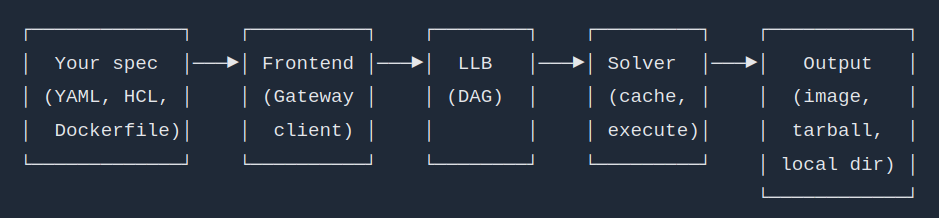
The only ASCII image I see on that page is actually a PNG:

https://tuananh.net/img/buildkit-llb.png

Maybe the page was changed? If you're just talking about the gaps between lines, that's just the line height in whatever source was used to render the image, which doesn't say much about AI either way.
reply
tuananh
1 hour ago
[-]
looks fine to me but since it messed up for some so i replace it with png
reply
seneca
1 hour ago
[-]
I found it more jarring that they chose to use both Excalidraw and ascii art. What a strange choice.
reply
tuananh
1 hour ago
[-]
the hugo theme requires an image thumbnail. i just find one and use it :D
reply