End of "Chat Control": EU parliament stops mass surveillance
415 points
6 hours ago
| 39 comments
| patrick-breyer.de
| HN
nickslaughter02
6 hours ago
[-]
> Despite today’s victory, further procedural steps by EU governments cannot be completely ruled out. Most of all, the trilogue negotiations on a permanent child protection regulation (Chat Control 2.0) are continuing under severe time pressure. There, too, EU governments continue to insist on their demand for “voluntary” indiscriminate Chat Control.

> Furthermore, the next massive threat to digital civil liberties is already on the agenda: Next up in the ongoing trilogue, lawmakers will negotiate whether messenger and chat services, as well as app stores, will be legally obliged to implement age verification. This would require users to provide ID documents or submit to facial scans, effectively making anonymous communication impossible and severely endangering vulnerable groups such as whistleblowers and persecuted individuals.

reply
JumpCrisscross
55 seconds ago
[-]
> further procedural steps by EU governments cannot be completely ruled out

I once had a lawmaker explain the constant work of defending an issue in a helpful way.

In a democracy, we don't kill our opposition. If they hold certain views, e.g. that security trumps privacy, they're going to litigate that view. Probably for their whole lives. That means they'll continuoiusly bring up the same ideas. And you'll have to continuously defeat it.

But there are two important aspects to this. Passing legislation takes as much work as repealing it. But unpassed legislation has no force of law. Being on the side that's keeping legislation from being passed is the decisive upper hand. You have the status quo on your side. (The only stronger hand is the side fighting to keep legislation from being repealed. Then you have both the status quo and force of law.)

The second point is that legislative wants are usually unlimited. Especially once a group has invested into political machinery to organise themselves, they're not going to declare victory and go home after passing their law. They're going to push for something else. Thus, repeatedly failing to pass a law represents a successful bulwark. It's a resource sink for the defense, yes. But the defense gets to hold onto the status quo. The offense–the guys pushing for Chat Control–are effectively throwing money into a pit. The only thing they may have to show for their work is a more-experienced machine, but that's true for both sides.

In the end, each generation tends to have a set of issues that are continuously battled. The status quo that persists or emerged then forms a bedrock that tends to be forgotten for a while. This is the work of a democracy. Constantly working to convince your fellow citizens that your position deserves priority. Because the alternative is the people in power killing those who disagree with them.

reply
1vuio0pswjnm7
1 hour ago
[-]
"> Furthermore, the next massive threat to digital civil liberties is already on the agenda: Next up in the ongoing trilogue, lawmakers will negotiate whether messenger and chat services, as well as app stores, will be legally obliged to implement age verification. This would require users to provide ID documents or submit to facial scans, effectively making anonymous communication impossible and severely endangering vulnerable groups such as whistleblowers and persecuted individuals."

Perhaps this is bad news for "messenger and chat services, as well as app stores" who solicit "users" to exploit them for commercial gain, for example _if_ users are unwilling to accept "age verification" and decide to stop using them. The keyword is "if"

The third parties know it's possible for capable users to communicate with each other without using third party "chat and messenger services" intermediaries that conduct data collection, surveillance and/or online ad services as a "business model". Thus the third party "tech" company intermediaries strive to make their "free services" more convenient than DIY, i.e., communication without using third party intermediation by so-called "tech" companies

But users may decide that "age verification" is acceptable. For many years, HN comments have repeatedly insisted that "most users" do not care about data collection or surveillance or online advertising, that users don't care about privacy. Advocates of "Big Tech" and other so-called "tech" companies argue that by using such third party services, users are consciously _choosing_ convenience over privacy

Perhaps the greatest threat to civil liberties is the mass data collection and surveillance conducted by so-called "tech" companies. The "age verification" debate provides a vivid illustration of why allowing such companies to collect data and surveil without restriction only makes it easier for governments that seek to encroach upon civil liberties. While governments may operate under legal and financial constraints that effectively limit their ability to conduct mass surveillance, the companies operate freely, creating enormous repositories that governments can use their authority to tap into

reply
sveme
34 minutes ago
[-]
There's a fairly non-invasive way to do age verification: ID cards that connect to a smartphone app that only provide a boolean age verification to the requesting service. Requesting service can be anonymous to the ID app and the requesting service can only receive a bool.

That most implementation will try to collect far more data is the real concern.

reply
brightball
2 hours ago
[-]
The timing of having Meta dropping encrypted chats on Instagram is...interesting.
reply
zoobab
2 hours ago
[-]
"Next up in the ongoing trilogue, lawmakers will negotiate whether messenger and chat services, as well as app stores, will be legally obliged to implement age verification."

Trilogues should be burned down, closed doors meetings with Ministers writing laws from their own services.

reply
pnt12
1 hour ago
[-]
See you soon folks!
reply
miohtama
5 hours ago
[-]
Here is the EPP's plea to get this passed earlier.

They even used a teddy bear image.

https://www.eppgroup.eu/newsroom/epp-urges-support-for-last-...

"Protecting children is not optional," said Lena Düpont MEP, EPP Group spokeswoman on Legal and Home Affairs. "We call on the S&D Group to stop hiding behind excuses and finally take responsibility. We cannot afford a safe haven for child abusers online. Every delay leaves children exposed and offenders unchallenged."

Personally, I feel there must be other privacy-preserving ways to address child abusers than mass surveillance.

Also, for the record, here is the list of parties that lobbied for this for Mrs Düpont, alongside very few privacy-focused organisations. Not sure why Canada or Australia are lobbying for EU laws.

ANNEX: LIST OF ENTITIES OR PERSONS FROM WHOM THE RAPPORTEUR HAS RECEIVED INPUT

- Access Now

- Australian eSafety Commissioner

- Bundesrechtsanwaltskammer (BRAK)

- Canadian Centre for Child Protection

- cdt - Center for Democracy & Technology

- eco - Association of the Internet Industry

- EDPS

- EDRI

- Facebook

- Fundamental Rights Agency

- Improving the digital environment for children (regrouping several child protection NGOs across the EU and beyond, including Missing Children Europe, Child Focus)

- INHOPE – the International Association of Internet Hotlines

- International Justice Mission Deutschland e.V./ We Protect

- Internet Watch Foundation

- Internet Society

- Match Group

- Microsoft

- Thorn (Ashton Kutcher)

- UNICEF

- UN Special Rapporteur on the right to privacy

https://www.europarl.europa.eu/doceo/document/A-9-2020-0258_...

reply
DoingIsLearning
4 hours ago
[-]
We need to add Palantir in bold letters to that list, they are behind this in every way except for 'officially'.

> The Commission’s failure to identify the list of experts as falling within the scope of the complainant’s public access request constitutes maladministration. [0]

> The Commission presented a proposal on preventing and combating child sexual abuse, looking in particular at detecting child pornography. In this context, it has mentioned that support could be provided by the software of the controversial American company Palantir... [1]

> Is Palantir’s failure to register on the Transparency Register compatible with the Commission’s transparency commitments? [1]

(Palantir only entered the Transparency Registry in March 2025 despite being a multi million vendor of Gotham for Europol and European Agencies for more than a decade)

> No detailed records exist concerning a January meeting between European Commission President Ursula von der Leyen and the CEO of controversial US data analytics firm Palantir [2]

[0] https://www.ombudsman.europa.eu/en/decision/en/176658

[1] https://www.europarl.europa.eu/doceo/document/E-9-2024-00016...

[2] https://www.euractiv.com/news/commission-kept-no-records-on-...

reply
heavyset_go
1 hour ago
[-]
> - Thorn (Ashton Kutcher)

They really have no shame, do they? https://www.bbc.com/news/entertainment-arts-66772846

Kutcher defended a rapist in court when they thought they were anonymous (they weren't), the same rapist who bragged about assaulting their underage peer/co-star to Kutcher, and then harassed the children of the plaintiffs[1] in his trial where he was convicted and sentenced to 30 years to life:

> Another plaintiff stated that she and her neighbors observed a man snapping pictures from her driveway, and later that night, broke a window in her 13-year-old daughter's bedroom.

[1] https://people.com/tv/danny-masterson-church-scientology-sue...

reply
benced
1 hour ago
[-]
> Recently, only 36% of suspicious activity reports from US companies originated from the surveillance of private messages anyway.

I don't have many opinions on this but this sort of lazy logic would make me nervous. 36% is not a small number and that's before the folks doing this activity find out that private message is less patrolled.

reply
dgellow
49 minutes ago
[-]
Yeah, that number is actually really high. I’m wondering how noisy those reports are
reply
YeahThisIsMe
15 minutes ago
[-]
It's never going to stop. They'll keep trying until they get it because they're sick people.
reply
elephanlemon
5 hours ago
[-]
I’m confused by

> This means on April 6, 2026, Gmail, LinkedIn, Microsoft and other Big Techs must stop scanning your private messages in the EU

It had already passed and started?

reply
vaylian
4 hours ago
[-]
> It had already passed and started?

Facebook and others have been scanning your private messages for many years already. Then someone discovered that this practice is illegal in Europe. So they passed the temporary chat control 1.0 emergency law to make it legal. The plan was to draft a chat control 2.0 law that would then be the long-term solution. But negotiations took too long and the temporary law will expire on the 4th of April (not the 6th) which means that it will be illegal again for Facebook and others to scan the private messages of European citizens without prior suspicion of any wrongdoing.

reply
moffkalast
1 hour ago
[-]
I take it facebook/meta paid no fines for doing it illegally in the first place?
reply
isodev
5 hours ago
[-]
Of course, remember Apple championed the idea with iMessage scanning which at the time produced A LOT of discussion e.g. https://www.eff.org/deeplinks/2021/12/2021-we-told-apple-don...
reply
nickslaughter02
5 hours ago
[-]
Yes, voluntary Chat Control 1.0 has been running since 2021.
reply
SiempreViernes
4 hours ago
[-]
Well, chat control 1.0 is about making an existing practice legal, it didn't create the practice of scanning messages for know child sexual abuse material, though I don't know how long that has been going on before the legislation in 2021 passed (but probably for several years at that point, since getting a new law trough takes a while).
reply
fh973
3 hours ago
[-]
Gmail and likely others have been scanning at least emails for child pornography since the 2010s.
reply
layer8
4 hours ago
[-]
reply
3836293648
5 hours ago
[-]
Something something constitutional (ish*) rights say you can't do this.

Chat Control 1 says, eh do it anyway if you want on a voluntary and temporary basis until the Courts get around to saying no.

Chat Control 2 says you have to. Until the courts finally get around to striking it down in 15 years.

reply
inglor_cz
5 hours ago
[-]
It was possible on a voluntary basis.
reply
appstorelottery
5 hours ago
[-]
What happens to the already scanned metadata?
reply
layer8
4 hours ago
[-]
The data that isn’t flagged from scanning is prohibited from being stored in the first place. Flagging is required to have maximum accuracy and reliability according to the state of the art. Data that was flagged is stored as long as needed to confirm (by human review) and report it. Data that isn’t confirmed must be deleted without delay.
reply
gostsamo
4 hours ago
[-]
There was an interim legislation that will expire in april.
reply
_fat_santa
4 hours ago
[-]
It seems like an almost never ending hamster wheel of chat control being introduced, voted down, then introduced again in the next session.
reply
xeonmc
26 minutes ago
[-]
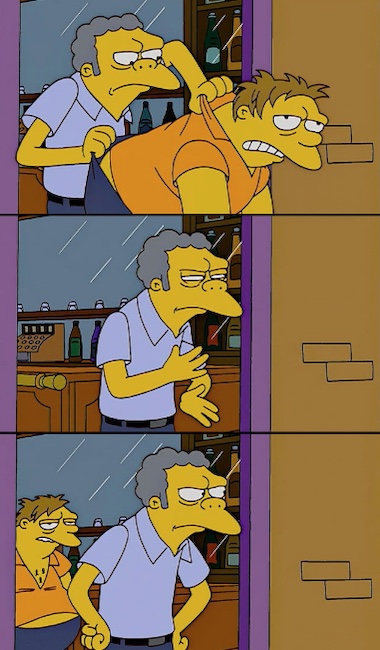
I think the more fitting imagery would be https://en.meming.world/images/en/4/4a/Moe_Tossing_Barney_Fr...
reply
ryandrake
3 hours ago
[-]
That's the problem with modern democracies (it happens in the USA too). They only have to win once and it's law. We have to win every time.
reply
__loam
2 hours ago
[-]
Need to amend constitutional rights to privacy then these laws can be struck down in courts.
reply
bigyabai
2 hours ago
[-]
I feel like that would end with the same surveillance loopholes that Google, Microsoft and Apple exploit today.

Users need the ability to choose operating systems and software that is not exclusively green-lit by a first-party vendor. It's not glamorous, but pretending that software isn't a competitive market is what put us into this surveillance monopoly in the first place. "trust" distributed among a handful of businesses isn't going to cut it in a post-2030s threat environment.

reply
moffkalast
1 hour ago
[-]
It's a problem when the parliament can't propose the laws it has to vote on and the commission isn't elected and continues to be presided by the most corrupt person in the EU. She is blatantly EPP and just keeps proposing the shit they want.

For Americans, imagine if only Republicans ever got to propose legislation and only Democrats could vote on it. That's more or less it.

reply
toyg
4 minutes ago
[-]
> She is blatantly EPP

Well, that's because she was nominated by European governments, which happen to be largely run by right-wing parties right now. There have been socialist personalities in her place in the past. That has nothing to do with democracy.

reply
petre
35 minutes ago
[-]
At least the Commision can't conduct war for 100 days without Congress approval.

I thought Juncker was an idiot but VdL is corrupt to Hillary levels and worse than the disastruous Merker/Juncker duo in every way. I'd like to see her replaced with someone like Macron. That's the type of leadership that the EU needs right now.

reply
tpm
42 minutes ago
[-]
You are mostly right except vdl is very, very far from the most corrupt person. It can be much worse.
reply
dmitrygr
1 hour ago
[-]
We need a double-jeopardy-like constitutional amendment for legislation. Legislation once-tried and failed cannot be tried again.
reply
krapp
1 hour ago
[-]
That would be antithetical to democracy. The people must be allowed to introduce any legislation they want, as often as they want.

Otherwise it would be trivial for a government to intentionally fail to pass anything they disagree with, and thus act as a de facto dictatorship.

reply
jagged-chisel
1 hour ago
[-]
Not to mention how would one even define "the same legislation"?
reply
dmitrygr
1 hour ago
[-]
When have "the people" been last consulted on this? Do you really think Chat Control has high public support? Given how most "democracies" work in our world today (which is to say with no consultation of the people), i think limiting their ability to do further harm might be worth it.
reply
krapp
1 hour ago
[-]
This wouldn't limit the ability of governments to do harm, it would limit the ability of the people to mitigate that harm by giving them only one chance to ever do so.

I don't think "democracy is flawed therefore we need less of it" is a good idea.

reply
moffkalast
1 hour ago
[-]
The MEPs represent the people. They've just been consulted. They said no.

Looking at what each of my MEPs voted they seemed to pretty accurately represent their own party lines, the right and far right voted for, left and center left voted against. I'm shocked! Shocked! Well not that shocked.

reply
cess11
3 hours ago
[-]
The US really, really wants it implemented, and several national police institutions in the EU does too. Plus the politicians that start to drool a little at the prospect.
reply
moffkalast
1 hour ago
[-]
Given the current US-EU relations I'm more surprised we're not telling them to go fuck themselves on this.
reply
beej71
4 hours ago
[-]
Political engineering angle: "These people will not rest until they are able to read your child's messages."
reply
someguyornotidk
16 minutes ago
[-]
The fact that they could pull a stunt like this shows that the EU is no democracy. Shame on the politicians who tried to rob people of their rights.
reply
amarcheschi
6 hours ago
[-]
I would say "end of chat control, for now"
reply
vintermann
6 hours ago
[-]
Those guys only ever have a "maybe later" button.
reply
rsynnott
5 hours ago
[-]
That's pretty much how it works; there's generally no way, in a modern parliamentary democracy to say "no, and also you can never discuss it again". You could put it in the constitution, but honestly there's a decent argument that parts of chat control would violate the EU's can't-believe-it's-not-a-constitution (the Lisbon Treaty is essentially a constitution, but is not referred to as such because it annoys nationalists) in any case and ultimately be struck down by the ECJ, like the Data Retention Directive was.
reply
account42
5 hours ago
[-]
Constituional cours are a last defense against bad laws though and should not be the first one - they are not designed to be fast enough to prevent a lot of damage being done before they strike something down.
reply
wongarsu
4 hours ago
[-]
The first defense is that the Council of the EU (formed by government ministers of the member states) and the European Parliament (elected directly by EU citizens) have to agree on the legislation. And while the council is staffed by career politicians, the parliament is a more diverse group that's generally a bit closer to the average person

From the point of view of the individual, the parliament is our first defense. And this is an example of it working

reply
ApolloFortyNine
4 hours ago
[-]
If something in 'Chat Control' is so fundamental that it should lead to the law not even being brought up for discussion (privacy), then that 'right' should be more clearly defined in the constitution, or constitution like structure.

It's when laws can exist, but simply have bad implementations, where you obviously can't jump to an amendment process.

reply
rsynnott
5 hours ago
[-]
I mean, they're _not_ the first defence. This is a story about the parliament rejecting a bad law.
reply
cucumber3732842
4 hours ago
[-]
That constitution sure did stop Giuliani from having the cops shake down all those black guys.

At the end of the day you still need people to actually believe it, for whatever "it" is.

reply
rsynnott
2 hours ago
[-]
Yeah, this is more or less what I'm saying. Large parts of 'Chat Control' likely _are_ unconstitutional, but that doesn't necessarily stop it being brought (it just makes it likely that the courts will kill parts of it if it ever passes).
reply
cucumber3732842
2 hours ago
[-]
> (it just makes it likely that the courts will kill parts of it if it ever passes).

Years after harm was done and lives were ruined no less.

reply
leosanchez
6 hours ago
[-]
For today or for this month.
reply
lo_zamoyski
6 hours ago
[-]
The value of persistence!
reply
bradley13
2 hours ago
[-]
Thex will try again. And again. It's for the children, don't you know?

The only way to really stop this would be to pass legislation that permanently strengthens privacy rights.

reply
schubidubiduba
6 hours ago
[-]
Nice to see that democracy can work
reply
nickslaughter02
6 hours ago
[-]
> Nice to see that democracy can work

Did it work? One political party (EPP) didn't like the result of the previous vote and so they forced a re-vote.

> After the European Parliament had already rejected the indiscriminate and blanket Chat Control by US tech companies on 13 March, conservative forces attempted a democratically highly questionable maneuver yesterday to force a repeat vote to extend the law anyway.

https://www.patrick-breyer.de/en/end-of-chat-control-eu-parl...

reply
rsynnott
6 hours ago
[-]
Note that European parliament parties aren't particularly cohesive; some EPP members voted against it.
reply
nickslaughter02
6 hours ago
[-]
> some EPP members voted against it

20 out of 184

reply
olex
5 hours ago
[-]
Do I understand the voting / results wrong? Looking at this: https://howtheyvote.eu/votes/189270

The measure voted on is "Extension [of Chat Control 1.0]", it was voted 36% "for" and 49% "against" (so result is "against"), and looking at "Political groups", majority of EPP MEPs voted "against" (137 out of 164 votes).

reply
rsynnott
5 hours ago
[-]
I think the point of confusion is that there was an amendment before the final vote, which was way closer.
reply
pqtyw
5 hours ago
[-]
But the vote failed only because the EPP voted against it? Or did they mix up the buttons or something? https://howtheyvote.eu/votes/189270
reply
nickslaughter02
5 hours ago
[-]
EPP wanted indiscriminate scanning instead, not targeted one.
reply
Sharlin
6 hours ago
[-]
EPP is appalling and I'm revolted that many large so-called "moderate, centre-right, liberal-conservative" parties are happily part of it and indeed actively pushing extremely anti-citizen, anti-human agendas with the help of the far right.

(Edit: word choice)

reply
Noumenon72
5 hours ago
[-]
Site guidelines: "Please don't fulminate."
reply
modo_mario
3 hours ago
[-]
> with the help of the far right.

S&D voted even more for this than the conservatives themselves. ESN the least.

reply
baal80spam
6 hours ago
[-]
See you next month!
reply
Freak_NL
6 hours ago
[-]
Did that vote pass with a difference of one single vote? Tight squeeze there.
reply
rsynnott
6 hours ago
[-]
The screenshot is actually a vote on an amendment. Here's the final vote: https://howtheyvote.eu/votes/189270

Less tight.

reply
pqtyw
5 hours ago
[-]
I don't quite get it, so the conservatives wanted/want to repeat the vote but also the EPP voted against it and the Socialists supported it?
reply
rsynnott
5 hours ago
[-]
European parliament parties are really not particularly cohesive, and the EPP in particular is a bit of a random mess; it is _broadly_ liberal-conservative and pro-European, but its membership is a bit all over the place: https://en.wikipedia.org/wiki/European_People%27s_Party#Full...

Note that in some countries it has _both ruling coalition and opposition_ member parties.

reply
cluckindan
3 hours ago
[-]
EPP is the predominant christian nationalist party.
reply
rsynnott
2 hours ago
[-]
Eh, I wouldn't say that's true. It has a lot of "Christian democratic" parties (the likes of CDU/CSU), and also a bunch of 'liberal-conservative' parties (there's a fair bit of crossover). However, it's pro-Europe, and certainly not particularly nationalist. Nationalists (at least ethnoreligious nationalists; leftist nationalists like Sinn Fein go elsewhere) would largely be in ECR, the absurdly-named 'Patriots.eu', ESN.
reply
whywhywhywhy
5 hours ago
[-]
There’s often large differences between what politicians tell you they are and how they vote once in power
reply
pqtyw
5 hours ago
[-]
I don't quite get what you mean? EPP is technically in power (whatever that means in the European Parliament). But also why would that matter? Or they wanted to force a vote just so they could vote against it (which is not necessarily a stupid strategy in cases like this)?
reply
whywhywhywhy
5 hours ago
[-]
> in power (whatever that means in the European Parliament).

It means the people who get to vote on if you have a right to privacy or not.

reply
SiempreViernes
4 hours ago
[-]
So what happened previously is that the parliament accepted a modified text for an extension of "chat control 1.0", the conservatives didn't like that draft so they managed to get a redo of the vote on the amendments.

It seems this second time around amendment votes produced a final draft that the parliament as a whole found unacceptable, which apparently includes the majority of the EPP.

You can see the outcome of the individual amendment votes here, starting on page 15: https://www.europarl.europa.eu/doceo/document/PV-10-2026-03-...

and what the actual amendments were here: https://www.europarl.europa.eu/doceo/document/LIBE-AM-784377...

It is however quite tedious to go trough this to figure out what the final draft text was that then lead to the outright rejection.

From the tweet, it seems tuta is implying it was the vote in favour of amendment 34 that killed the extension; I guess that's possible but certainly not obvious from the amendment text:

> Reports on the 1325% increase in generative AI produced child sexual material requires voluntary detection to be calibrated to distinguish artificial material and avoid diverting resources from victims in immediate danger. Such measures should prevent the revictimization of children through AI models, while ensuring that this technological development does not justify general monitoring, a relaxation of privacy standards, or the weakening of end-to-end encryption.

reply
joering2
4 hours ago
[-]
Ashamed of France Poland and Hungary. Hungary is a state regime dictatorship so I get it.. but France and Poland, after everything Poland went thru during WW2 then communism with USSR, who the heck are these people voting FOR ?
reply
raverbashing
6 hours ago
[-]
No, that was an ammendment
reply
wewewedxfgdf
6 hours ago
[-]
Just rename it to something something save the children something something. Instant approval no matter what is in the bill.
reply
rsynnott
5 hours ago
[-]
That pretty much _is_ what it is called. It's generally known as Chat Control, but "Chat Control 1" (the thing just rejected) is called "Extension of the temporary derogation from the ePrivacy Directive to combat online child sexual abuse", and "Chat Control 2" (which you'll probably have heard more about; it's the one that keeps reappearing and disappearing) is called "Regulation to Prevent and Combat Child Sexual Abuse".
reply
olex
5 hours ago
[-]
It's already called "Extension of the temporary derogation from the ePrivacy Directive to combat online child sexual abuse".
reply
cryptonector
1 hour ago
[-]
> The Hard Facts: Why Chat Control Has Failed Spectacularly

The ostensible reasons for mass surveillance fail. That's very interesting.

reply
the_mitsuhiko
6 hours ago
[-]
This will come back because too many EU countries want it.
reply
embedding-shape
5 hours ago
[-]
Judging by https://howtheyvote.eu/votes/189270, the outliers who seem to want this, would be France, Hungary, Poland and Ireland, all other countries seems to had the majority MEPs voting against it.
reply
jimnotgym
5 hours ago
[-]
The countries are free to repropose similar things through the council (basically the representatives of the ruling party in each country), but the MEPs are free to strike it down. The MEPs are elected through PR in each country so often have broader representation than the council.
reply
kergonath
5 hours ago
[-]
It’s more complicated than that. MEPs do not represent countries, so you can say that most MEP from $country were for or against, but that would not necessarily be the position of the country’s government. For that you have to look at what happens in the council of the EU, which is composed of government ministers.

It is not exceptional for most MEP from a member state to be in the opposition at the national level, particularly in contexts where it is seen as a protest vote. Turnout is usually low for European elections, so they tend to swing a bit more than national elections.

reply
the_mitsuhiko
5 hours ago
[-]
It's way more complicated. For instance according to this vote Denmark is overwhelmingly against it. However Denmark most recently was the country that pushed heavily towards this, in fact, under Denmark's leadership the whole thing was revived last time around.

If you look at local politics and news they are all lobbying massively for it (or some people do). The reason is usually "for sake of the children". Parents in particular are heavily in favor of chat control.

reply
wongarsu
4 hours ago
[-]
While the EU council is composed of people from the respective country's government, the European Parliament is directly voted in by citizens and has a lot of people for whom politics is not their main career.

You could interpret the results as the Danish government being for Chat Control, but "normal" Danish people not following the same trend

reply
miohtama
5 hours ago
[-]
Hungary can be explained by Victor Organ's desire to spy on the opposition by any means necessary.

France has had really strange tendencies lately, e.g. when they arrested Telegram founder.

reply
psychoslave
4 hours ago
[-]
Let’s make very clear that "France" here stands for MEP sent by France.

Only 51% of people able to vote in European elections actually vote (with 2,81% white ballot), so it’s not even a majority of electors sustaining them, despite abstention being at record low level in decades.

Elites being disconnected from people day-to-day reality and needs is a recurrent topic leaking even in the mainstream media which almost all owned by oligarchs by now.

European institutions are notoriously opaque and byzantine, which doesn’t really help with feeling represented, even before Qatar gates and the 1/4th of MEP revealed "implicated in judicial cases or scandals."

https://www.touteleurope.eu/institutions/elections-europeenn...

https://vote-blanc.org/europeennes-2024-la-repartition-par-d...

https://www.lemonde.fr/les-decodeurs/article/2024/06/10/euro...

https://www.bfmtv.com/politique/gouvernement/gerald-darmanin...

https://www.lemonde.fr/en/les-decodeurs/article/2024/02/02/o...

reply
0xy
6 hours ago
[-]
Bastion of democracy Germany will be pushing hard given they let slip they want mandatory IDs on social media. They want full control.
reply
olex
5 hours ago
[-]
German MEPs voted overwhelmingly against the extension: https://howtheyvote.eu/votes/189270 ("Countries" tab).
reply
rsynnott
5 hours ago
[-]
RE Chat Control 2 (ie _not_ this, the proposed permanent version):

> In early October 2025, in the face of concerted public opposition, the German government stated that it would vote against the proposal

German MEPs also voted against this one.

(Note that the German government and German MEPs aren't the same thing here.)

reply
fcanesin
3 hours ago
[-]
To get "End of Chat Control" EU should actually pass laws prohibiting it, this whack a mole will eventually lose.
reply
ori_b
3 hours ago
[-]
Who is going to push a counteroffensive, banning specific types of data from being collected?
reply
_the_inflator
3 hours ago
[-]
No, this is the end of the wording for the initiative, nothing else.

We will see many new initiatives, old wine in a new bottle. Any bet that EU diehard bureaucrats will change tune, not the goal. They are going to use the so called salami tactic.

Death of free speech by many cuts, so to say. It is in the left wing DNA. Have a look at German history regarding "Landes-Verfassungsschutz" units. It is disturbing to read this article here: https://de.wikipedia.org/wiki/Verfassungsschutz_Nordrhein-We...

And back then already it was the so called center-right party ruled against this left wing initiative - imagine, first thing you do right after WW2 is ramping up a control unit to control freedom of speech.

Please value free speech. Agree to disagree, but remember: those who live by prohibitions will ultimately use this tool against you as well. Consider wisely what is something you dislike personally and simply exercise your right to not listen to certain voices or appeal to prohibition.

Prohibition becomes a tool and everybody knows that people love to use their tools. And since I have a law degree, often times what you plan is not what is finally what courts decide, how they apply the law.

Freedom rights are fundamental.

reply
em-bee
3 hours ago
[-]
this is the end of the wording for the initiative, nothing else

it is more than that. since 2021 an EU interim regulation (2021/1232), set to expire on 3 april, was allowing companies to voluntarily scan messages. this vote was about the renewal of that regulation. since it has been rejected, the regulation is no longer in effect.

reply
adw
2 hours ago
[-]
You’re painting an EPP/ECR initiative as left wing? That’s inconsistent with the facts.
reply
hermanzegerman
25 minutes ago
[-]
He's rambling about "left-wing DNA" in the Verfassungsschutz, who is famously quite good at turning a blind eye to right wing extremists. Probably because AfD got rightfully classified as far-right-extremists.

So to him they are probably left-wing.

reply
whywhywhywhy
5 hours ago
[-]
It doesn’t matter they can just keep trying and paying people off until it gets through.

Someone somewhere really really wants this and has the time and resources so it’s an inevitability.

reply
latexr
5 hours ago
[-]
It does matter. Even if it eventually passes, the later and more gutted it is, the better.

Saying that it doesn’t matter is just defeatist (and unfortunately always parroted on HN) and plainly wrong. Defeatists have been proven wrong time and again.

reply
wongarsu
5 hours ago
[-]
Also making sure this is as painful and costly as possible to pass will discourage future attempts. If we just rolled over and let it happen that would signal that it's easy to pass legislation like this and we would get a lot more like it
reply
whywhywhywhy
5 hours ago
[-]
Perhaps a system where that can happen is broken
reply
dethos
5 hours ago
[-]
That was a close one. This is getting harder and harder. It is important not to be naive to the point of thinking this is over.
reply
fleebee
5 hours ago
[-]
One would think that the same thing getting denied over and over would make future votes about it easier to decide.
reply
astrashe2
6 hours ago
[-]
Here's a mirror link: http://archive.today/CJlNk
reply
Havoc
5 hours ago
[-]
They’ll keep trying.
reply
layer8
4 hours ago
[-]
That’s why we need to keep voting for the MEPs who oppose it.
reply
Ms-J
5 hours ago
[-]
Until we stop them.
reply
cbeach
5 hours ago
[-]
In 2016 the UK demonstrated that there is a way for the public to vote down the corpus of bad EU legislation.

Of course our national govts have been pretty woeful ever since, but in 2029 we will have the opportunity to vote for genuine, dramatic change, with strong options on both the left and right side of politics.

Regarding the creeping surveillance state, Reform UK have explicitly stated they will repeal the awful Online Safety Act.

This is how we wrestle control back from the establishment.

reply
wongarsu
4 hours ago
[-]
The UK has shown that they can vote down bad EU legislation, and pass a lot of pretty awful legislation that's worse than anything the EU ever produced

But I'm sure voting for Nigel Farage one more time will fix everything

reply
moorebob
1 hour ago
[-]
Interesting you blame Farage for the bad legislation passed by the Tories and Labour? Why is that? I thought he was one of the most vocal contrarians to Tory and Labour policy?
reply
throwaway132448
4 hours ago
[-]
People who think reform are anti establishment genuinely fascinate me.
reply
gmuslera
6 hours ago
[-]
Its time to start trying to push Chat Control 2.0. With enough money and infinite retries eventually all the bad regulations with a power group behind will end being approved.
reply
zoobab
2 hours ago
[-]
Same for software patents in the EU, it came back through the Unified Patent Court.

Told you so.

reply
mantas
6 hours ago
[-]
Or it will get a new name. Just like „Chat Control“ is far from the first name for this BS.
reply
nickslaughter02
5 hours ago
[-]
Sweep it under ProtectEU.

> The European Commission wants a backdoor for end-to-end encryptions for law enforcement

https://www.techradar.com/pro/security/the-european-commissi...

reply
kitd
3 hours ago
[-]
Call it `chatctl` and give it a CLI.
reply
pnt12
1 hour ago
[-]
"Save the children", or "if you oppose this you're ugly".
reply
Hamuko
5 hours ago
[-]
It's not named "Chat Control". It's just what it's commonly known by. It's basically the same as "Obamacare".
reply
latexr
5 hours ago
[-]
Exactly. Its real name is “Regulation to Prevent and Combat Child Sexual Abuse”.

https://en.wikipedia.org/wiki/Chat_Control

reply
wongarsu
5 hours ago
[-]
Perfect name. Who in their right mind would ever vote against the Regulation to Prevent and Combat Child Sexual Abuse? Imagine if your voters heard that
reply
stavros
4 hours ago
[-]
What's perfect is the marketing campaign to call it by what it actually wanted to do, ie Chat Control. Whoever did this was so successful that we didn't even know the bill's official name, instead knowing it by what it actually wanted to achieve.

Good thing the EU didn't take a page out of the US' book, because things like the PATRIOT act are already pithy and hard to outmarket.

If RPCCSA were actually called PROTECT, the nickname "Chat Control" would have been fighting a losing battle.

reply
miki123211
3 hours ago
[-]
It's just a HN thing though.

Ask a European who isn't in tech, and they won't know what you're talking about. Maybe they will today specifically, this vote is bound to get some press, but in general, mainstream media doesn't care much about this bill.

Even Europeans in tech who aren't in the "tech equivalent of gun nuts" culture that HN seems to exemplify are 50/50.

reply
latexr
2 hours ago
[-]
> It's just a HN thing though.

It’s not. People on Reddit, Mastodon, and other websites are also aware (of course not everyone, but not everyone on HN either).

> Ask a European who isn't in tech, and they won't know what you're talking about.

People who haven’t heard about Chat Control haven’t heard the bill’s real name either. That’s true of the overwhelming majority of EU regulation, Chat Control isn’t special in that regard.

reply
stavros
2 hours ago
[-]
Yeah but that's the intended audience. The Europeans who aren't in tech weren't likely to know about this anyway.
reply
nazgulsenpai
5 hours ago
[-]
Yep, and it will make it more difficult to pass legislation designed to actually help combat child exploitation when a large(ish) portion of the population immediately equate "for the children" with a power grab.
reply
btilly
4 hours ago
[-]
Unfortunately, that population immediately equates the two for good reason. Bills that are presented as "for the children" usually are a power grab.

Even more unfortunately, the issue is so emotional that we can't have a reasonable discussion on it. This limits the discussion to proposals that sound good to angry people. And the opposition to those who can get angry about something else. Which limits how much reason is applied on either side.

For example, look at the idea of a national sex offenders registry, like we have in the USA. The existence of such a registry is reasonable given that we're no more successful at stopping people from being pedophiles, than we are at stopping them from being homosexuals.

But the purpose of such a list is severely undermined when an estimated quarter of the list were themselves minors when they offended. The age at which people are most likely to land on the list is 14. But a man who liked 13 year olds when he was 14, is unlikely to reoffend at 30. What is the purpose of ruining the rest of his life for a juvenile mistake?

Such discussions simply can't be had.

reply
r_lee
1 hour ago
[-]
> The age at which people are most likely to land on the list is 14. But a man who liked 13 year olds when he was 14, is unlikely to reoffend at 30. What is the purpose of ruining the rest of his life for a juvenile mistake?

am I like misunderstanding or what does this mean exactly? I'm so confused. "reoffend" what kind of offense are we talking about here?

reply
integralid
5 hours ago
[-]
we can learn from our American friends and call it something like CHILDREN SAFETY ACT. So you want to hurt children, huh? I hope not
reply
latexr
5 hours ago
[-]
That’s already (kind of) the name it has. “Chat Control” is a name given by critics.

https://en.wikipedia.org/wiki/Chat_Control

reply
saidnooneever
5 hours ago
[-]
this is litterally what they do. point at opposition and try to imply they are pro child abuse. actually really sick to use such a method. I suppose that is what u get for decades long degradation of education and other things. A bunch of childish freaks in power who can only try to chuck eachother under the bus instead of doing something actually good.

they care less and less about it being obvious too.

our new prime minister (NL) was asked about some campaign promises recently (ones important to a lot of his voters actually) and he justs plainly said somethin like: yeah well sometimes u just gotta say shit to get votes.

i mean, its not news ofc... but now they dont even care to mask it. They know the public will just bend over and take it anyway.

reply
zamalek
2 hours ago
[-]
Don't forget the pointless backronym.
reply
raffael_de
3 hours ago
[-]
Any event E with P(E) > 0 will eventually happen.
reply
ramon156
5 hours ago
[-]
See you next year!
reply
glenstein
4 hours ago
[-]
Is the snow melting? Do you hear birds? Must be chat control season.

Someone should sell calendars based on when this typically gets proposed as well as dates throughout the year when past instances of check control came up against key procedural hurdles.

reply
Arubis
44 minutes ago
[-]
Good.

Now let's start preparing for the next one.

reply
AJRF
5 hours ago
[-]
See you again next week!
reply
greenavocado
6 hours ago
[-]
That margin is really small
reply
rvz
3 hours ago
[-]
Until next time.
reply
fsflover
3 hours ago
[-]
reply
cynicalsecurity
4 hours ago
[-]
A big W, for now.

Until we meet again.

reply
umren
5 hours ago
[-]
Chat Control 3.0 will go through
reply
varispeed
6 hours ago
[-]
This is a clear case of a terrorist attack attempt (Chat Control fulfils definition of terrorism fully). Chat Controls would be illegal in Germany.

This is sad that this has gotten this far. If they wanted to pass a law to blow up citizens, do you think European Parliament would seriously consider it? It is exactly the same calibre of idiocy.

I would expect German authorities to issue arrest warrants and properly investigate this.

For context:

If terrorism is defined as using violence or threats to intimidate a population for political or ideological ends, then “Chat Control” qualifies in substance. Violence doesn’t have to leave blood. Psychological and coercive violence is recognised in domestic law (see coercive control offences) and by the WHO. It causes measurable harm to bodies and minds.

The aim is intimidation. The whole purpose is to make people too scared to speak freely. That is intimidation of a population, by design.

It is ideological. The ideology is mass control - keeping people compliant by stripping them of private spaces to think, talk, and dissent.

The only reason it’s not “terrorism” on paper is because states write definitions that exempt themselves. But in plain terms, the act is indistinguishable in effect from terrorism: deliberate fear, coercion, and the destruction of free will.

reply
techteach00
4 hours ago
[-]
I agree that it's an act of state sponsored terrorism. Don't let the down votes make you feel alone.
reply
Ms-J
5 hours ago
[-]
Maybe it is time to make start a prediction market?

Any time a scumbag politician tries this again:

"Mr. Jones, secretary of communications for the state, TTL (Time-to-live) left. 2 Hours? 1 Day? 1 Week?"

It would stop fast.

Anyone want to build this? There is a lot of money being left on the table.

reply
DaSHacka
4 hours ago
[-]
Wouldn't this have the opposite effect? Seems to play right into their hands that they need mass surveillance for "" safety"" reasons
reply
canticleforllm
5 hours ago
[-]
How long until they stage an incident to occur so they can pass CC 1.1? 6 months? 2 years?
reply
anthk
4 hours ago
[-]
Goid news, now stop the age bullshit in CA.
reply
spwa4
6 hours ago
[-]
... again?
reply
hermanzegerman
32 minutes ago
[-]
They are conservatives. In Germany they also try every time to enact Mass Data Retention ("for catching Criminals"), then the courts decide it's not compatible with the constitution, and after a few years they try again.

I highly doubt they have given up here too

reply
freehorse
5 hours ago
[-]
So, in the end a big majority of the conservative/liberal faction (EPP) voted against, and the vast majority of the social democractic faction (S&D) voted for chat control.

https://howtheyvote.eu/votes/189270

Just pointing this out because yesterday there was the myth around that "chat control is pushed by the conservatives", obscuring the actual political dynamics in the EU about it.

reply
skrebbel
4 hours ago
[-]
EPP proposed it, but then it got amended (ie toned down) so much that they turned on their own proposal. This apparently happens quite a lot. So the way I understand it is they turned it down not because they thought it was bad, but because they didn't think it was bad enough.
reply
nickslaughter02
5 hours ago
[-]
> So, in the end a big majority of the conservative/liberal faction (EPP) voted against, and the vast majority of the social democractic faction (S&D) voted for chat control.

EPP wanted indiscriminate scanning instead, not targeted one.

reply
marginalia_nu
5 hours ago
[-]
There's also the DDR and Stasi as a counter example if anyone think mass surveillance is incompatible with socialism.

Mass surveillance isn't really a question that projects well onto the left-right scale, and attempting to make it fit a left-right question is more likely to distract than provide a useful understanding.

reply
geon
4 hours ago
[-]
Yes. I would place it on the authority–liberty axis.

While your examples were on the economic left, they were clearly authoritarian.

reply
iknowstuff
4 hours ago
[-]
Greens based as always
reply
miroljub
6 hours ago
[-]
[flagged]
reply
tomhow
1 hour ago
[-]
We detached this subthread from https://news.ycombinator.com/item?id=47529682 and marked it off topic.
reply
bilekas
5 hours ago
[-]
[flagged]
reply
boxed
5 hours ago
[-]
"What did the Romans ever do for US?" :P
reply
camgunz
6 hours ago
[-]
They literally just voted it down. Twice in 2 days. Also compared to whom?
reply
miroljub
5 hours ago
[-]
> They literally just voted it down. Twice in 2 days.

And they will try again tomorrow. Until it passes.

> Also compared to whom?

Why compare? The fact that there are worse regimes than the EU doesn't make the EU even a single bit better. Lesser evil is still evil. Let us strive for good.

reply
vrganj
4 hours ago
[-]
"They" being the member states. The EU is the institution preventing them from implementing it, not enabling them.

You're inverting roles here.

Just look at the UK and how crazy they've gone now that the EU can't shoot their ideas down anymore.

reply
rsynnott
6 hours ago
[-]
> With every new proposal, every vote, they are closer to the totalitarian regime. Proposals can be declined a million times, but the EU regime is always finding sneakier and more manipulative ways to push again and again.

... I mean this is how all parliamentary systems work. It's more _visible_ in the EU than in others, I think, because the council/commission are more willing to put forward things that they don't really think the parliament will go for (in many parliamentary systems, realistically the executive will be reluctant to put forward stuff where they think they'll lose the vote in parliament).

But there's not really a huge difference; it would just be _quieter_ in most parliamentary systems, and you wouldn't really hear anything about it until the executive had their votes in place, brought it forward, and passed it. I actually kind of prefer the EU system, in that it tends to happen more out in the open, which allows for public comment. And public comment and pressure is a huge deal for this sort of thing; most parliamentarians, on things they don't understand, will vote whatever way their party is voting. But if it becomes clear that their constituents care about it, they may actually have to think about it, and that's half the battle.

reply
andai
3 hours ago
[-]
We already don't have free speech. There's nothing protecting it (and many laws already to the contrary.) There aren't really any such constitutional protections from what I can tell.

Once laws are passed they aren't revoked. So it's just a matter of political climate. Just wait for people to get a little more negative, a little more paranoid (which has historically been "helped along" in various ways)-- a law only needs to pass once, and then we're stuck with some stupid bullshit forever.

It doesn't really seem like how you'd want to design it.

reply
hermanzegerman
30 minutes ago
[-]
Obviously you can revoke Laws.

And not being able to deny the Holocaust doesn't mean you don't have free speech

reply
mariusor
3 hours ago
[-]
"fascism" has a pretty well defined meaning, which is not whatever the EU would become if something like chat control ever passes. Towards totalitarianism, sure, but again not all totalitarianism is fascism. I wish people would stop using le mot du jour as a replacement for everything in an subconscious need to increase others' engagement.
reply
sveme
6 hours ago
[-]
So in summary: because the law was avoided today, the EU needs to be abolished? Weird take.

You can see it the other way around, without the EU, Denmark and others would have already implemented ChatControl in their country. This is driven by member states (Denmark), not the parliament, after all.

reply
miki123211
3 hours ago
[-]
There are advantages to "government by evolution", as opposed to "government by monoculture"

With the former approach, every country is allowed to try different things, some amazing, some dumb, and learn from the amazing and dumb things that others have done.

In the latter, there's only one governing body, and whatever that body said, goes. There's no science or statistics, just sides shouting their arguments at each other, calling people names.

Both the EU and the US used to heavily lean towards the former approach, but they're slowly but inexorably moving towards the latter.

reply
miroljub
5 hours ago
[-]
> So in summary: because the law was avoided today, the EU needs to be abolished? Weird take.

There are many reasons to abolish the EU, but the topic here is chat control.

> You can see it the other way around, without the EU, Denmark and others would have already implemented ChatControl in their country. This is driven by member states (Denmark), not the parliament, after all.

Would they? We don't know. Would the government of Denmark be ready to commit political suicide by insisting again and again on something so unpopular?

The whole premise of the EU is to allow various unelected interest groups to push unpopular regulation to the EU member states without any consequences.

reply
anonymars
5 hours ago
[-]
Isn't the UK a perfect control group? Didn't the EU push back on similar legislation, until Brexit?

> insisting again and again on something so unpopular?

Didn't the UK do exactly this?

reply
dyauspitr
3 hours ago
[-]
What a joke. Compared to US, implementing chat control is like a pin prick compared to the scale of MAGA fascism. The EU is probably the best example of functional government anywhere in the world right now.
reply
ecshafer
6 hours ago
[-]
The EU is fundamentally flawed. There are no checks and balances, and its only democratic if you squint and look at it the right way. People need to directly elect the MPs, directly elect some kind of president. They have no accountability, no checks and balances.
reply
freehorse
5 hours ago
[-]
I agree there is a strong democratic deficit in the current EU governance structure, but I disagree with a proposal such as

> directly elect some kind of president

We do not need a president with over-powers, and electing directly one does not solve anything for democracy, as the recent history in countries like the US and France shows. The point of directly electing a president is giving that role more power. The current structure in the EU is not so much president-centric either executive or legislative wise, but more like comission-centric, which is what imo has the biggest problem in terms of democracy in the EU.

reply
bilekas
5 hours ago
[-]
> People need to directly elect the MP

They do.

> directly elect some kind of president

I get the impression you're coming at it from a US perspective, and it's not that, and doesn't intend to be for now. The president is elected by majority of the MP's who have been elected by the people of their respective countries. Almost like the US electorial system, except it's done internally because people generally only vote for their own best interests and not that of the entirety.

Perfect, no, it can be slow and a lot of red tape, but what system isn't flawed.

reply
gpderetta
5 hours ago
[-]
People directly elects MEPs. And the Parliament literally right now just put a check on the Council.

Many EU nations are not presidential, and personally I prefer parliamentary republics than presidential ones.

reply
sveme
5 hours ago
[-]
The commission is checked by the parliament is checked by the council is checked by the commission. Most other national organizations only have one check - Germany, for example, only has the Bundesrat as a check of the Bundestag.
reply
Kim_Bruning
5 hours ago
[-]
Checks and balances means some folks should NOT be directly elected. if everyone is <directly elected>, then you have <directly elected> checked and balanced by <directly elected>. Which is to say, not at all. :-P
reply
em-bee
3 hours ago
[-]
one if the problems is that most elections are only for one person, so only the majority (the person with the most votes) wins.

give everyone half a dozen votes or more, and and you'll get a more representative sample.

for example instead of electing a president, elect a while leadership team. independent of party affiliation. (i'd get rid of parties completely while we are at it, every candidate should be independent (the expanded version of that gets even rid of candidates, every adult can potentially be elected, but that is a more complex system that needs more elaboration))

reply
naasking
5 hours ago
[-]
You could have a system where everyone is directly elected while keeping checks and balances, if voting were restricted, eg. maybe everyone can vote for a president/prime minister, but only non-teachers can vote for an education minister, and only non-finance people can vote for something like the Fed chief, etc. The point being the checks and balances now happen because other groups keep your group in check by voting.
reply
vrganj
2 hours ago
[-]
This sounds like the opposite of what should be happening? Like an anti-technocracy aiming for an electorate as little informed as possible?

Why exclude teachers from picking the education minister? If we're restricting votes, shouldn't they be the only ones doing so instead?

reply
Kim_Bruning
5 hours ago
[-]
Absolutely! That does keep some of the checks. You can do better than that though!

It's like on the Apollo missions where some parts were made by two completely different manufacturers and worked completely differently.

Hybrid political systems are best. Of course if we like democracy (and most people do), then that should be the most common kind of component. But I'd still like to have some different paradigms mixed into the system. And that's exactly what most modern constitutions do, for better or for worse.

reply
miki123211
3 hours ago
[-]
I'd personally go for a two-chamber system (like congress/senate or commons/lords), with one chamber being elected and the other being chosen by sortition.

Maybe also a 3rd chamber, where the weight of your vote was proportional to IQ (much more palatable in EU than US).

reply
rsynnott
5 hours ago
[-]
> People need to directly elect the MPs

...

We do? What did you think the European Parliament elections every four years were for?

> directly elect some kind of president.

Why? Nowhere in Western Europe except very arguably France (France, as always, has to be a bit weird about everything, and has a hybrid system) has a directly elected executive. True executive presidential systems are only really a thing in the Americas and Africa (plus Russia, these days).

Like, in terms of big countries with a true executive presidency, you’re basically looking at the US, Russia and Brazil. I’m, er, not sure we should be modeling ourselves on those paragons of democracy.

> They have no accountability, no checks and balances.

The parliament has the same accountability and checks and balances as any national parliament, more or less (more than some, as the ECJ is more effective and independent than many national supreme courts).

reply
gpderetta
5 hours ago
[-]
> We do? What did you think the European Parliament elections every four years were for?

Probably it is not taught as part of the curriculum in Russia.

reply
rsynnott
5 hours ago
[-]
Ah, looks like they're American, based on their profile.
reply
Ylpertnodi
3 hours ago
[-]
From an EU perspective, there's not much difference between russia, and the US at the moment.
reply
em-bee
2 hours ago
[-]
i always found it odd that the most powerful person in many european countries, the prime minister, is not directly elected. but the problem is not really there. the problem in my opinion is the concentration of power in one person. and the influence of political parties to decide who gets to be a candidate.

imagine system where we directly elect the whole cabinet. only people with electoral approval should get to be ministers. and the prime ministers or presidents job is to only manage that group.

reply
rsynnott
2 hours ago
[-]
> the problem in my opinion is the concentration of power in one person.

Generally, a prime minister is less powerful than an executive president, often much less powerful.

> and the prime ministers or presidents job is to only manage that group.

On the face of it, that is the PM's primary role in a parliamentary democracy. Now, the complication is that, in many parliamentary systems, the PM has significant power over the ministers (either via the ability to directly appoint them, or via being the head of the ruling party/coalition/or various other means). But generally, the PM is less powerful in nearly all systems than, say, the US president; in particular the finance minister is often a separate semi-independent power within the cabinet.

reply
cbg0
5 hours ago
[-]
> The EU is fundamentally flawed. There are no checks and balances

You're missing a [citation needed] on that.

reply
marginalia_nu
5 hours ago
[-]
Non-elected representatives from my country keep pushing for chat control via the council. How do I, as a citizen, hold them accountable?
reply
munksbeer
3 hours ago
[-]
> Non-elected representatives from my country keep pushing for chat control via the council. How do I, as a citizen, hold them accountable?

How is that an EU problem? Without the EU, like here in the UK, we had non-elected lobbyists pressuring our elected government to implement age checks, message scanning, etc. And it is still continuing.

You're fighting the wrong fight by blaming the EU for this.

reply
marginalia_nu
3 hours ago
[-]
This is a highly solvable problem, one that is solved by not overloading the national elections with to different concerns.

EU has checks and balances that were intended for a trade union, not a nascent superstate. If we don't implement proper checks and balances in a real fucking hurry, we'll wake up one morning and realize the EU has turned into another Soviet union, and by then it'll be far too late to do anything about it.

reply
triceratops
4 hours ago
[-]
Ask your government why they're sending those representatives. As a citizen you vote for your government, right?
reply
marginalia_nu
4 hours ago
[-]
How badly would you say the council or commission have to mess things up before they saw any voter-initiated repercussions what so ever with a system of accountability that requires voters to consider punishing the council or comission more important than their own national elections?

If accountability is to work, it has to be more than an abstract theoretical possibility.

reply
triceratops
4 hours ago
[-]
It isn't abstract. Your government sends representatives to represent its platform and priorities. If you don't agree with the reps you need to elect a different government.
reply
marginalia_nu
4 hours ago
[-]
It's a abstract because you will never ever see a situation where voters neglect national elections to adjust the EU council or commission. Maybe it's what needs to happen, but the way thing are arranged it just won't.
reply
triceratops
2 hours ago
[-]
Why "neglect"? You're voting for a government that does the things you want.
reply
iknowstuff
4 hours ago
[-]
Vote against the ruling party in your smaller national election
reply
marginalia_nu
4 hours ago
[-]
That's a system of accountability in name but not in practice.

Even if there was an option in the national elections that didn't want this stuff, convincing a majority of voters to disregard national politics for an election cycle to have an imperceptibly small impact on the council members is such an unlikely outcome the council or comission would de facto be committing genocides before voters would be mobilized, and even then it's unlikely they'd face any repercussions.

reply
salawat
4 hours ago
[-]
It isn't popular, but they have a name and address right? Not talking violence, but the number one way of dealing with these sorts is to usually talk things out. If you're really concerned about, get a group of similarly minded people and make it unambiguously evident that this person is championing something a lot of people are not behind. It becomes much harder to ignore or wave off something when people start making themselves known on your doorstep.

And no, this isn't dog whistling violence. It is simply applying signal. The only other message I can think of is engaging an investigative journalist/PI and starting to figure out who is lobbying the person, and start pressuring them.

reply
izacus
4 hours ago
[-]
The article you're commenting on is reporting how directly elected representatives defeated the motion.

Why do you keep lying?

reply
marginalia_nu
4 hours ago
[-]
That's the parliament. What about the council and the commission? Am I not allowed to hold them accountable? Does my power as a citizen only extend to a fourth of the balance of power?

They keep getting away with these attrition tactics with regards to implementing near Stasi levels communication surveillance. What about the day they're pushing to give the council unlimited powers, or to abolish voting rights, or to purge jews?

reply
vrganj
2 hours ago
[-]
The Council and Commission are representatives of your democratically elected national government. You as a citizen of your country get to pick said government.

If the EU were to not exist, your representatives in the Council/Commission (e.g. your national government) would be more powerful because they wouldn't be checked by the Parliament, not less.

Your problem is with your government, they just successfully deflected it to the EU in your mind.

reply
patmorgan23
4 hours ago
[-]
The council is made up of heads of state, so no more undemocratic than your own countries executive, and the commission is selected by the Council and approved by the EU parliament.
reply
marginalia_nu
3 hours ago
[-]
Russia and China has elections too, they are a necessary but not sufficient criteria for democracy. Just because there are elections doesn't mean the people can actually hold the government accountable.
reply
izacus
4 hours ago
[-]
The parliament holds them accountable like it just did in the article you're comme nting on.

Again, why are you aggressively lying here? Why are you misrepresenting workings of EU despite them following every single democracy out there?

reply
sailfast
6 hours ago
[-]
“Congrats all we maybe fixed the problem we created in the first place! Let’s celebrate!”

Also - wasn’t this program voluntary? This seems like the height of backslapping. Would have been better if they just sat on their hands and did nothing in the first place.

reply
nickslaughter02
5 hours ago
[-]
> Would have been better if they just sat on their hands and did nothing in the first place

You described 95% of EU's work.

reply
rsynnott
5 hours ago
[-]
> Also - wasn’t this program voluntary?

This gave companies permission to do things which would ordinarily be illegal under the ePrivacy directive, but did not make it mandatory for them to do so. That permission is now revoked (or will be when the derogation they were trying to extend expires in two weeks).
reply