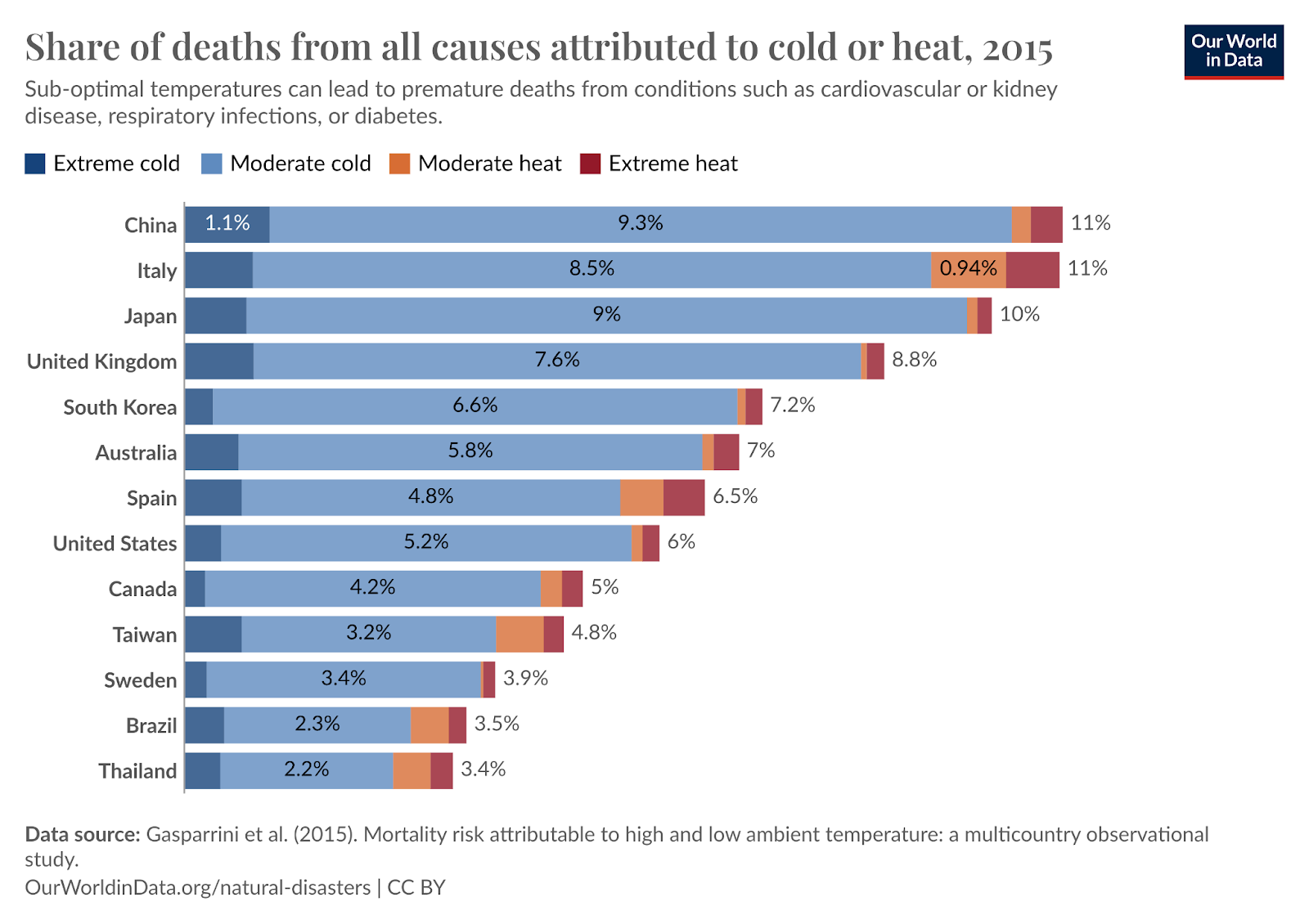
I made a slightly-snarky comment along these lines once, and a fellow commenter on HN pointed out how efficient air conditioning is. For one, it's always accomplished via heat pump; eg, moving heat, so the only byproducts are electricity consumption and waste heat. We know how to produce clean electricity. On the flip side, heating indoor spaces also produces waste heat, but a lot more of it. Much worse, the vast majority of home heating (at least in the US) is done by burning fossil fuels. If you compare the heating demands of the northeast to the cooling demands of the south, in terms of BTUs, the heat demands are way more intensive.
The most important factor in this equation is the temperature change required. The temperature differential between a winter temp of 20 or 30F to an indoor temp of 70F requires SO much more energy than cooling from a summer temp of 90F to indoor temp of 70F.
So I can remain smug about living in a mild climate in the Bay Area; my total energy consumption is much lower than the average home. But I probably shouldn't feel smug about not needing A/C when the real problem is the gas furnace I run every morning and part of the day, for months on end, from November to March.
(My house is actually currently missing several walls; the gas furnace has been thrown in the trash and it's being replaced with 3 heat pumps, which will give me both A/C _and_ more efficient heat. No thanks to PG&E, which will reward my GHG reductions by charging me out the ass for the electricity required to heat my home).
Yeah but at least in the winter you have alternatives.
I spent the first month of the year in a 100 year old home in the Midwest during a record breaking snow storm.
I was fine. It was cold, but I had clothes, sock, blankets, etc. Space heaters are cheap and they work. Hell I could blast the oven out in the open if I needed to.
OTOH I’ve been in central Florida in peak summer with a dead AC for weeks. There is no refuge from <90f indoors. Evaporative coolers don’t work in humidity, fans don’t work, nothing but AC will work. When I didn’t have AC in Florida I had two options:
- soak the sheets in water so they’re cool enough for me to at least lay down and fall asleep comfortably
- pay money to go somewhere else.
I don't think I have ever met or heard anyone think or say that...
All the apartments I see have mini-splits or in-wall units. I put a floor standing dual-hose unit in my bedroom where my desktop PC and server also are.
Powered air conditioning didn't really take off until the mid 20th century. Prior to that most simply used fans.
Then I traveled to Spain in August and was hosted at someones house for a week. They had no AC. And their method is simple: split the day in two resulting in the siesta. During the day in the intense heat you're tired by 3 PM and nearly dead by 5. The Spaniards? They go home and go to sleep for an hour or two then wake up when the sun has gone down and it cools down. Most things close at 5PM and reopen around 8PM. People stay out late too - I saw parents chatting on benches at a playground after midnight while their children played.
We have ways around this heat problem. Though I know people so spoiled that they INSIST their home and workspace must be at 60F even in 100F heat. They'll burn forests just so they wont be inconvenienced by a bead of sweat.
https://www.reuters.com/sustainability/climate-energy/heatwa...
I don't consider that being uncomfortable is a solution.
There are actual solutions used by hot countries to deal with the heat: ventilation, vegetation, construction techniques, etc... But adjusting work schedules so that you have a hour or two of poor quality sleep when you can't do anything else is the kind of thing you do when you have no other choice, not a solution.
I have nothing against the Spanish schedule, but I would rather not do my siesta in an unbearably hot place. And yes, AC is a solution.
AC doesn't have to be that bad. Set a reasonable temperature, combine it with good insulation, etc... Same idea as for heating in the winter.
https://pubs.acs.org/doi/10.1021/acs.est.2c09588
"In Phoenix, where the lowest daily high temperature over the 5 day heat wave is 43 °C and daily minimum temperatures average 32 °C, the rate of heat-related mortality increases by about 700% relative to the Power On scenario, reflecting the extremity of heat exposures in a desert city in the absence of mechanical AC. As reported in Figure 3, the estimated rate of heat-related mortality for the Power Off scenario in Phoenix is 917 (approximate total =13,250 deaths), which approaches 1% of the synthetic population."
https://resilient.az.gov/resiliency-programs/energy-programs...
"The Office of Resiliency received a termination notice from the U.S. Environmental Protection Agency regarding the Solar for All grant on August 7, 2025. The program is unavailable until further notice."
Or they can wait for the worst case scenario to actually happen, and THEN do something, as is tradition.
How many forests will you burn to not just wear two sweaters and blanket?
Nice try. I wear a sweater.
Shops and stuff that require outdoor labor yeah for sure. This doesn't work for workers mandated in the 9-5 jobs like office work.
And personally, I'd rather my workday is finished at 5 PM instead of 8 PM with a long break towards the mid-end of the workday.
And I'm sure my current country of Austria won't adopt Spanish way of work and life anytime soon just because summers are hot an people don't have AC at home/work. Societies, especially the Austrian one, are incredibly stubborn to change for a variety of reasons even when the evidence and solution is right in front of you. How do I know this? Well, Covid proved we can do a lot of work from home. Did that stick? Of course not, we still have to go to the office for most white collar jobs, even IT ones, just because management said so. We don't live in a world run by proof and rationale, we live in a world run by the status quo, vibes and feelings of the boomer and asset owning class.
I think the solar generation from say 10am-4pm is where you'd find a surplus, if there is one.
At least at my home, there's only ~20% difference between peak and off-peak rates, but, if you have A/C, it still makes sense to pre-cool on hot days, back it off at 4pm and then turn it back up at 9pm if you still need the cooler temps to sleep.
1. https://www.caiso.com/content/summer-loads-resources-assessm...
(Of course, the ideal scenario is not that rising carbon emissions from increased cooling get offset by lower emissions from decreased heating, but rather that we transition to abundant carbon-free energy from solar, wind, nuclear, etc. and are able to keep our houses as cool as we want in the summer and as warm as we want in the winter without any environmental consequences.)
Building regulations killed it's use in America! Requiring the adding in of rebar actually makes it weaker... as well as more expensive than wood (go ahead and guess which groups lobbied for that set of regulations).