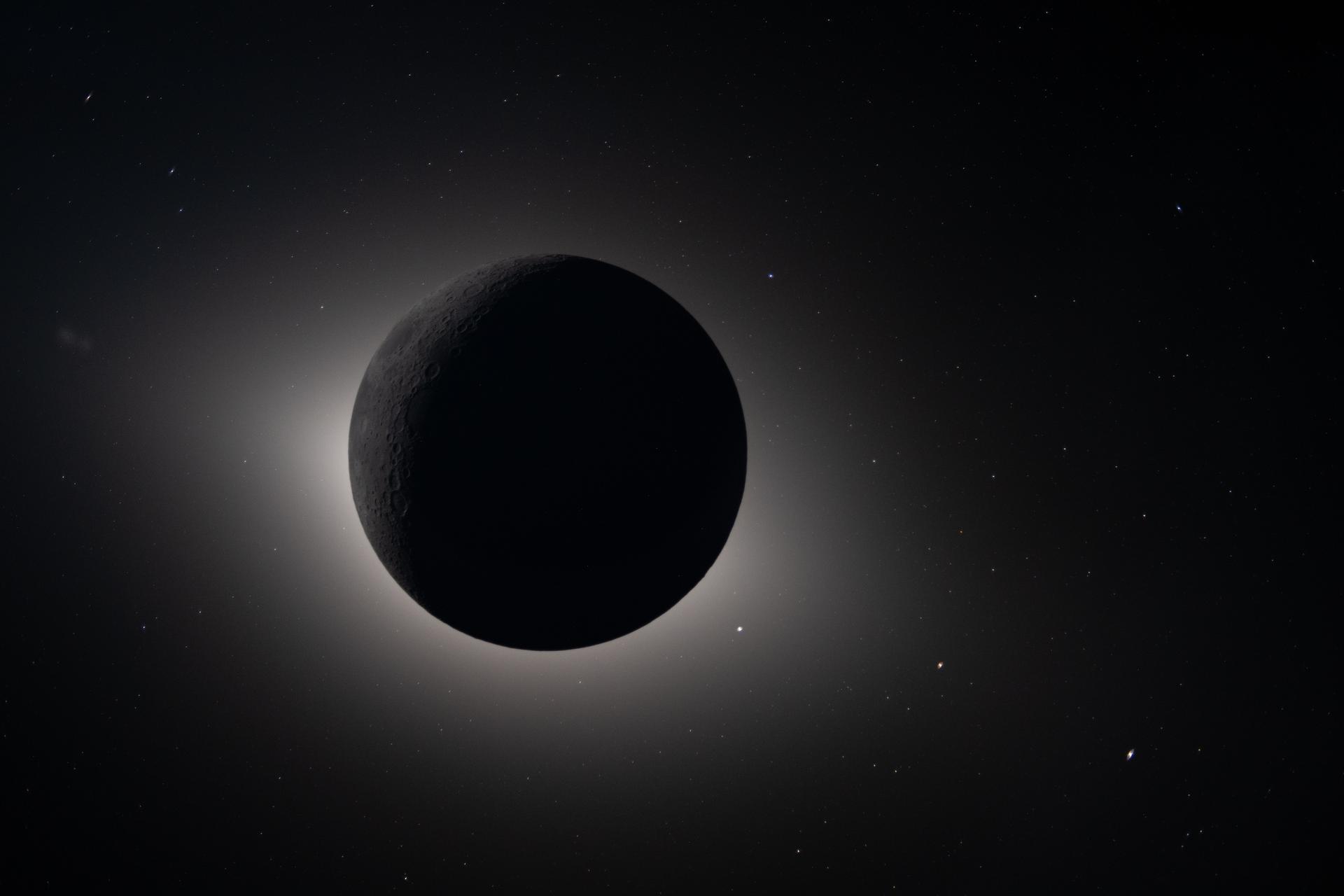
Edit: Found 'em: https://images.nasa.gov/search?page=1&media=image&yearStart=...
I don’t see TIFFs, so I assume the originals were JPEG.
Could be, we see TIFFs, after they get back.
edit: exif data shows some are from a Nikon. I just want to see them all!!! My greedy line still plays
Even the smallest resolution images I see in the link that the parent edited into their comment have better quality than what news outlets posted.
I want TIFFs that takes ages to download and I need to scroll around in/zoom out on!
Maybe it's not operating as described yet?
The laser is on one side of Orion, and when that side is not oriented towards Earth for various reasons, the optical communications cannot be used.
For continuous communications, at least when there is no interposed body, like the Moon, multiple lasers located around Orion would be needed to ensure coverage. When by the far side of the Moon, a relay orbiting around the Moon would be needed.
Still, the pics are mind blowing. Out of this world, tbh
There are some very bright noise pixels on the dark area, which is different from the noise in similar photos taken with D5 (much darker and uniform).
The trick is to zoom to the same percentage zoom and compare side-by-side.
I did spot a few "hot" pixels visible on the Moon, but those are easily fixed in post.
I've subsisted on photos from the Apollo missions and artistic renditions for so long that seeing the modern, high resolution real thing to be quite stirring in a way I didn't expect. It actually does make me believe that the future could be quite cool.
* The exif data has Adobe Lightroom Classic (Windows) metadata in it.
Back in 2019, Robert Zubrin suggested using rovers "to do detailed photography of the [Moon] base area and its surroundings" to "ultimately form the basis of a virtual reality experience that will allow millions of members of the public to participate vicariously in the missions" [1].
[1] https://spacenews.com/op-ed-lunar-gateway-or-moon-direct/
I think perhaps you mean the far side of the moon. The "backside" of the moon implies a large graben stretching almost from pole to pole, and I have seen no evidence of such a geological formation in any photos.
It really is surprising being able to see the Moon isn't spherical. (Are those abberations?) It makes sene, given the moon isn't in hydrostatic equilibrium.
The US spends almost that much on net debt interest each day (~$3 billion/day[0]). Not that adding to the debt helps at all, but the old proverb about being penny wise and pound foolish seems relevant
Acceptance of over costing and under delivering is exactly why the US is stuck with SpaceX as its prime space launch provider. It's only through the miracle of the vanity of billionaires that there's even a realistic second choice (Blue Origin) that might develop.
It's also this type of attitude that let's us be in a situation where we honestly don't know how well the heat shield will work on reentry (SLS launches are so expensive, and so slow to build and prep to launch, that we cannot fit in a uncrewed mission between 1 and 2 to test or validate fixes or models).
If Artemis as a program succeeds, it will be despite the incredible graft, pork, and ass covering, not because of it. I want Artemis to succeed because the achievement will be beautiful and amazing, and I want everyone to be safe and sound. I want Artemis to fail, to force a reckoning. I still believe that America has great things to offer to the world, but it's not going to be able to do that by muddling it's way through and cobbling together random pork filled programs into a vaguely inspiring shape.
New NASA administrator Isaacman has redone the Artemis program. The changes were announced at the Ignition event a few weeks ago:
https://www.nasa.gov/ignition/
If you read one thing, read the sides on building the moon base:
https://www.nasa.gov/wp-content/uploads/2026/03/2-building-t...
The goals it to fly often - adding a SLS launch to 2027 and a second launch to 2028. This drops the cost-per-launch, which is mostly fixed. It redoes SLS to make it less expensive and more capable. It moves the lunar space station down to the surface of the moon.
And it's budgeted at $10B/3 years, which fits into NASA's budget.
Isaacman took the Artemis program and fixed it. The reckoning came, and it's looking good.
And don't be fooled about the SLS launch cadence. As recently as summer 2025, Artemis III was still a nominally a 2027 manned lunar landing (https://www.nasa.gov/blogs/missions/2025/08/18/nasa-begins-p...). It got moved to a 2028 manned lunar landing in early 2026, before being converted back to a 2027 manned test flight.
The plan for SLS also does nothing to make it more capable (though hopefully less expensive). The cancelled exploration upper stage is being replaced by Centaur V, which is a less powerful stage. Isaacman refuses (I think rightfully) to really pin down on if there a future for SLS past Artemis V. If Isaacman chooses to cancel SLS after Artemis V (which I think is a defensible course of action), then SLS would represent a ~17 year long program that cost at least 41 billion dollars that netted 5 mission launches.
And characterizing it as "moving the lunar space station down to the surface of the moon" is... kinda falling into the trap. Lunar Gateway was supposed to launch ~2028 (along with Artemis IV - from the era where Artemis III was the first lunar landing). Gateway was a gongshow, and was delayed, and now cancelled. And now the new plan says the habs (the part that people think as an actual base...) happens in Phase 3 starting in 2033. The sort term elements they are trying to reuse from gateway into near term (think ~4 years) base projects are very "ancillary".
It remains unclear if NASA will infact be able to up the launch cadence of SLS to meet the double 2028 launch requirement. While it was clear that Gateway made... very limited sense for great expense, and the new plan is certainly ambitious with what I think is a stronger value proposition, it's also basically exactly as pie in the sky as gateway back in 2019.
The fact that I am doubting NASA's ability to execute now, is the very cost of SLS (and friends).
SLS will never be worth it. But I'd discount from that price tag the continuity benefits of keeping the Shuttle folks around, and aerospace engineers employed, across the chasm years of the 2010s.
Kind of similar to farm subsidies and the strategic implications there.
If they’d wanted to they could have launched an empty Orion crew module into LEO on another, cheaper, rocket and tested re-entry. The crew module by itself is less than ten tonnes.
Now thinking about Mars, sending astronauts there is actually a net negative for science because it risks contaminating Mars.
We send astronauts there because it's cool, period. Science has nothing to do with it.
>Why do we need astronauts to view the Moon when we have robotic observers? Human eyes and brains are highly sensitive to subtle changes in color, texture, and other surface characteristics. Having astronaut eyes observe the lunar surface directly, in combination with the context of all the advances that scientists have made about the Moon over the last several decades, may uncover new discoveries and a more nuanced appreciation for the features on the surface of the Moon.
https://www.nasa.gov/missions/nasa-answers-your-most-pressin...
For the last 20 years NASA has intentionally run their Commercial Crew Program, which has the stated goal of developing/fostering/funding the development of commercial providers for launch vehicles.
They, by plan they explicitly laid out and implemented, decided to rely on American commercial providers. And that's what they got. And in doing so, the program ended up producing the most prolific/successful launch vehicle in history.
>> It's only through the miracle of the vanity of billionaires that there's even a realistic second choice (Blue Origin) that might develop
Yes, this is another company which the NASA commercial program explicitly funded in order to get them to develop another launch vehicle.
The question is why does SpaceX stand alone? Why did ULA stagnate? Why can't NG make SRBs that don't have nozzles that fall off? Why can't Betchel build a launch tower on time? What is it about government contracts in these other areas that led to all of this under performance?
The US benefits by having SpaceX around. It would benefit even better by having many SpaceXs around.
Oh, and also I believe it's generally understood that NASA provided very little funding for New Glenn. They gave BO a lot of money for HLS, but that's relatively recent (2023). New Glenn has been in the works since 2013 and was mostly bankrolled by Bezos, with some USAF/DoD money kicked in.
100%, and something that is underappreciated and often taken for granted nowadays, especially on our little forum here.
>>> It would benefit even better by having many SpaceXs around.
That made me chuckle, sounded to me a bit like "our house would benefit from having a few cats around". Perhaps the reason why there aren't too many SpaceX-like companies around is that it's truly among the hardest companies to ever create.
If we don't have it, either we're subject to monopoly, or just a State owned company, at which point, why not just cut out the middlemen and go full Nationalized?
ULA is the old guard made from Lockheed and Boeing. SpaceX is the snappy upstart moving fast and breaking things. Having the freedom to fail with experiments is a totally different methodology from any failure seen as very bad. SpaceX has never been involved in loss of life. If they ever have that happen, I'd imagine they'd be forced to stop moving as fast and quit breaking things.
And now it's over 50 years since we last landed on the Moon.
To be fair, we just saw two of them work fine, with no nozzle fall-off-ages
Spends, or accrues?
If you want to make the US financially solvent, cut defense. Defense LAPS every other budget category. Whether you want to take the conservative position on why that is (our allies freeload on our defense spending) or the Progressive one (the U.S. is an empire in decline and every major empire through history has spent vast sums to maintain itself why would the U.S. be different) doesn't change the fact that our military budgets exceed over a dozen other nations' combined, the vast majority of whom are allies.
I suppose it matters how you lump things, but for federal spending:
  - $678 B, Social Security
  - $478 B, Medicare
  - $425 B, Net Interest
  - $419 B, Health
  - $412 B, National Defense
  - $320 B, Income Security
  - $184 B, Veterans Benefits and Services
  - $75 B, Education, Training, Employment, and Social Services
  - $53 B, Transportation
  - $43 B, Administration of Justice
  - $15 B, Other
Also note that most people consider social security to be an entirely different kind of government spending than anything else in that list.
Also, without a military the US would not be even 1/3rd as wealthy as it is today, given its military created the global order that secured the last 80 years of the global economic system, shipping lanes and USD dominance. You can argue over specific wars/missions being dumb, but to pretend the overall ROI on that dominance enabling 80 years of relatively peaceful global trade hasn’t been positive is to be intellectually dishonest.
The world is currently teetering on a global economic crisis over just ONE shipping lane not being fully open for a few weeks. Read more history and you’ll see this used to be the norm.
Veterans get SS too, so no, costs associated with veterans wouldn't shift to SS. It is fair to suggest that the health care costs of uninjured, untraumatized veterans would just show up under Medicaid/Medicare. I don't know what percentage of veterans health care costs (not health care visits) fit in that category, versus "stuff that wouldn't be an issue if they hadn't been in the military".
The Biden administration's FY2025 defense budget request was $850 billion for the DoD, with the total national security budget reaching over $895 billion. The FY2026 proposal submitted by the Trump admin is 1.5 trillion for DoD.
Except for social security, health, medicare, debt interest
This is not a lot of money on a nation-state scale. It's equal to giving every person in the US about US$12.
$1.3 billion for the mission hardware.
$2.2 billion for the single use SLS.
$0.5 billion for the launch pad.
> watching people go back around the Moon
Two of the missions were actually meant to land. One of them still may.
If Trump gets his $1.5T military budget, that would be about the military spend per day I think?
This is way bigger than just putting people on the moon or hubris. It's the prerequisite for everything we've also said about Mars. Elon just muddied the waters so much that people are so negative about anything else.
Absolutely! What do you have in mind?
I was also very curious of their descriptions during the eclipse where the Earth shine was lighting up the dark side of the moon to such a surreal look they couldn't really describe it. They were even commenting that they didn't feel the photos being taken were doing it justice either.
I also was wondering if they will make any modifications to the capsule since covering a window to block the Earth shine caused concern on the ground from some of the readings they were getting. Assuming it was overheating as they redirected air flow to the window. Then again, the following missions won't be so concerned with a single fly by so probably not something they'll address.
If I had any doubt about crewed missions, this Artemis moon flyby is extinguishing them.
Hearing the crew discussing observations with Mission Control, moving cameras around, describing what they see, reacting to events and to curiosity and changing what they’re doing accordingly. And obviously just SO EXCITED to be doing it all. It was just amazing.
They’re still live streaming. It’s not as exciting anymore - ‘just’ on the way home now - but you can just put it on in the background and experience a tiny bit of what it’s like to be in the capsule. They’re exercising right now.
My favorite episode of the series and I was thinking of it during Integrity's flyby.
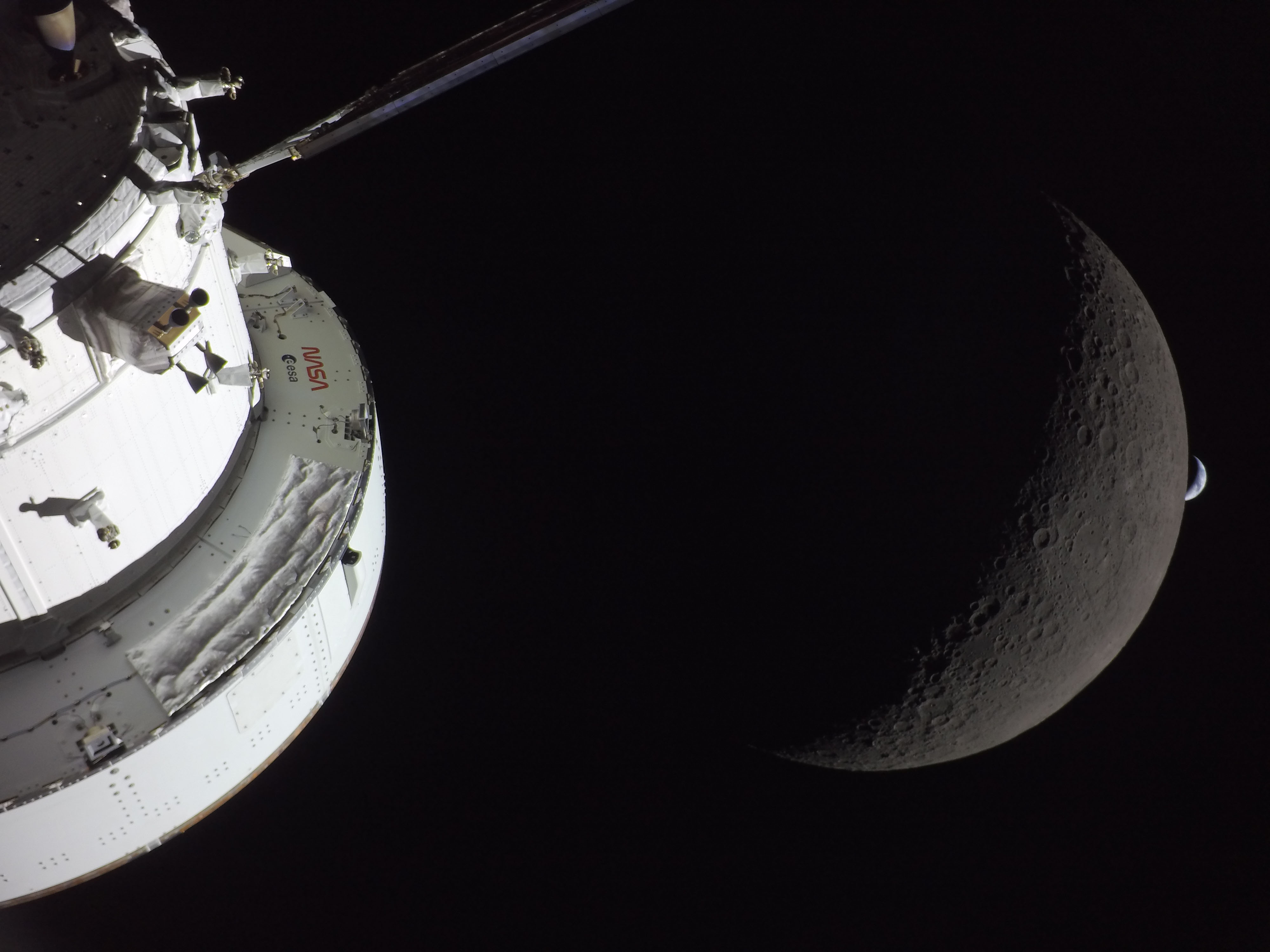
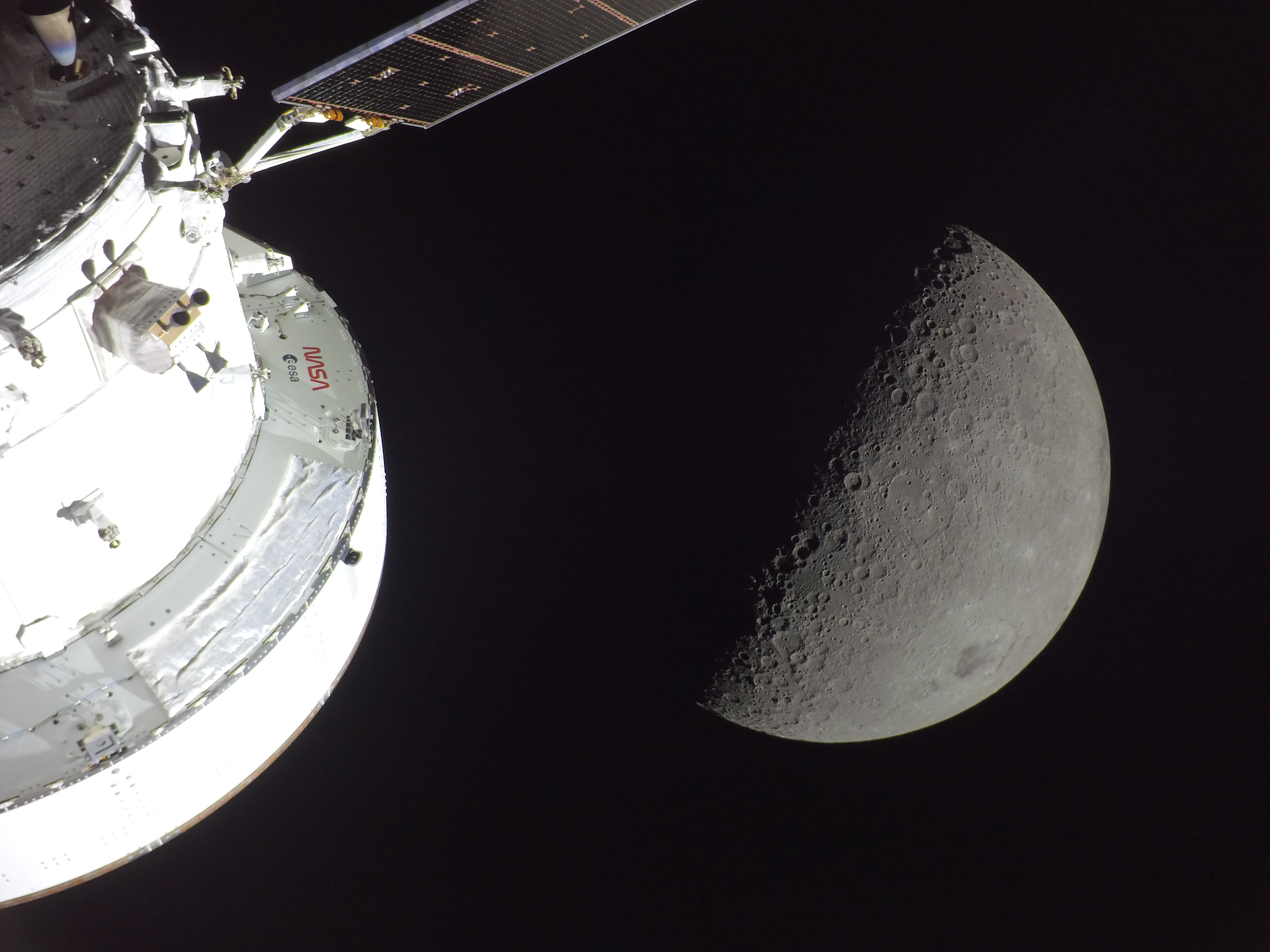
1. The moon eclipsed, with the Orion capsule (outside POV, from GoPro) - https://images-assets.nasa.gov/image/art002e009567/art002e00...
2. The moon eclipsed, with the Orion capsule, and Earth crescent (outside POV, from GoPro) - https://images-assets.nasa.gov/image/art002e009567/art002e00...
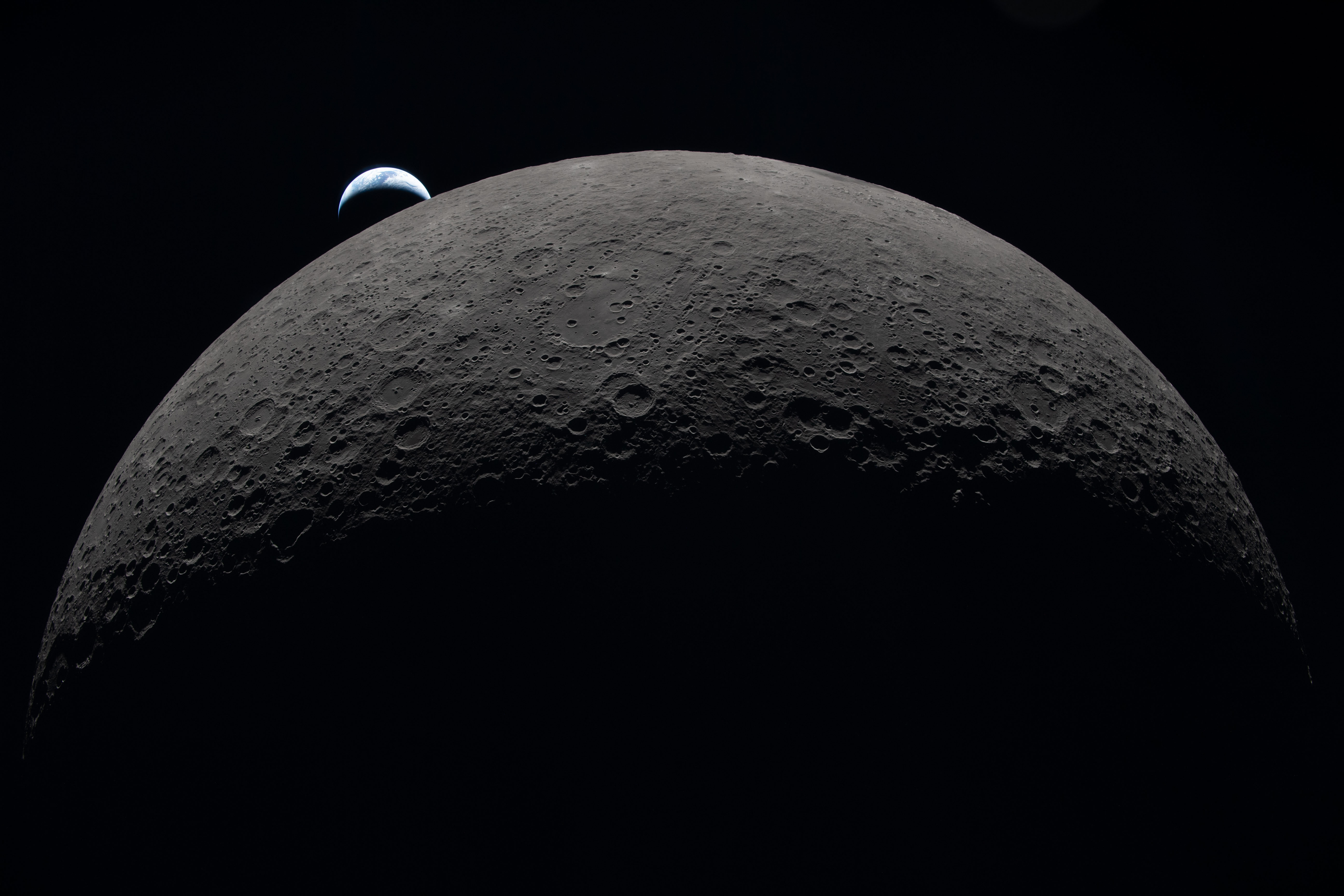
3. Crescent Moon, Crescent Earth (my fav!!) "A New View of the Moon" - https://images-assets.nasa.gov/image/art002e009287/art002e00...
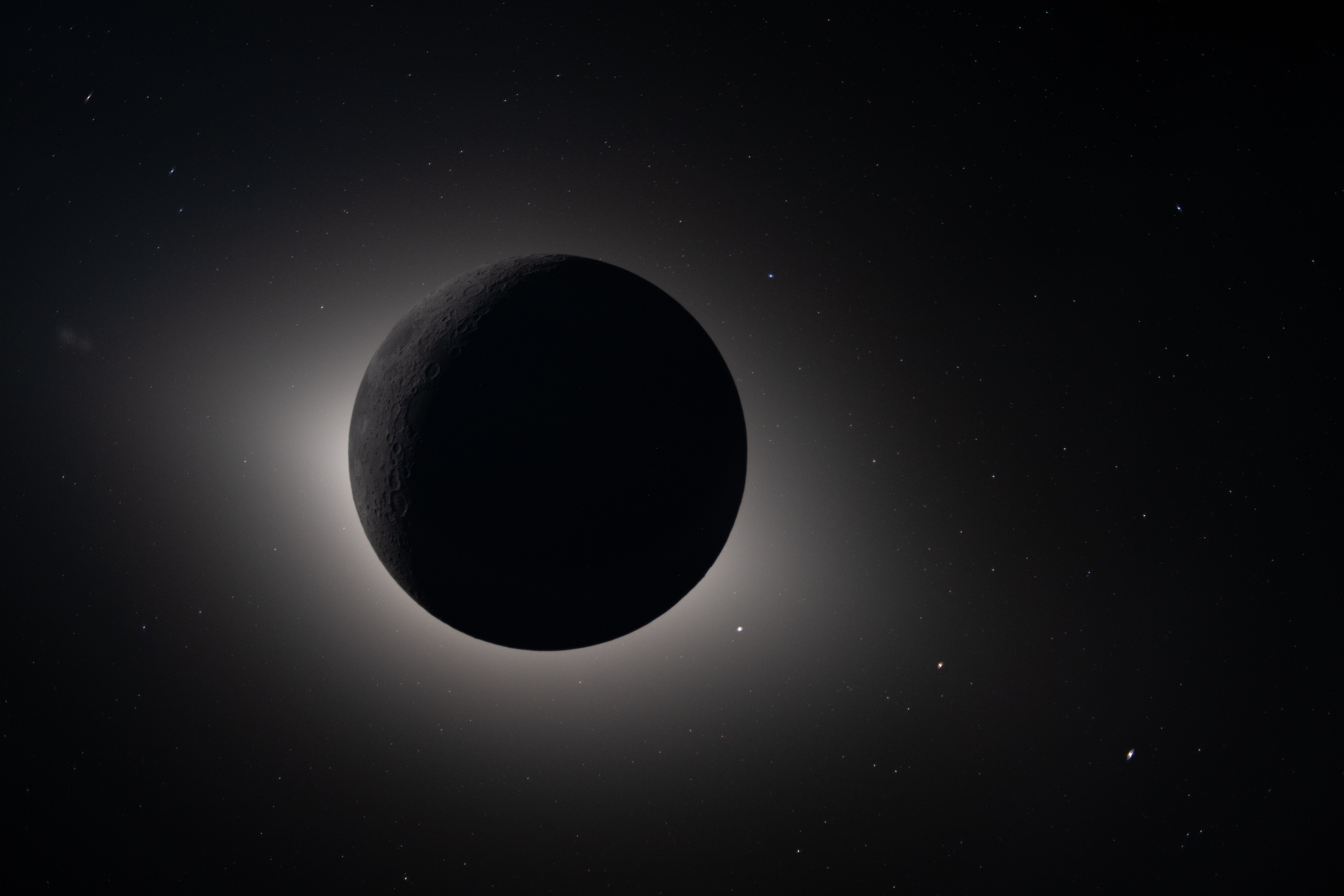
4. Artemis II in Eclipse (new fav!) - https://images-assets.nasa.gov/image/art002e009301/art002e00...
https://www.nesdis.noaa.gov/news/noaas-space-weather-mission...
https://zoomhub.net/showcase/photography/nasa
Try different layouts with L (grid, masonry, spiral, etc.), filter by gallery or camera, WASD/Q/E/Tab to navigate.
In theory, LRO is currently flying at lower orbit than Artemis I mission [2]. Shouldn't the LRO images be better? Maybe NASA has not disclosed all images?
Honest question: why the hype with these pictures?
[1] https://svs.gsfc.nasa.gov/4109
[2] Lunar Reconnaissance Orbiter (LRO) -> ~50 km vs. Artemis I -> ~129 km
https://data.lroc.im-ldi.com/lroc/view_lroc/LRO-L-LROC-2-EDR...
https://data.lroc.im-ldi.com/lroc/view_lroc/LRO-L-LROC-2-EDR...
Feel free to assemble these into nice composites or 3D renders.
Uninformed, but not ignorant and perhaps even interested. I hope your response started with "No, actually, even cooler: ..." and you made a space fan that day.
I've been waiting for a new Earth Rise/Set shot (which is thankfully at least 5568x3712px from a NIKON D5).
Edit: https://www.nasa.gov/nasa-brand-center/images-and-media/
> You may use this material for educational or informational purposes, including photo collections, textbooks, public exhibits, computer graphical simulations and Internet Web pages.
[0]https://images-assets.nasa.gov/image/art002e009301/art002e00...
Edit: After further looking and some zooming into it, I'd say the bright dot closest to the moon is Venus, the next one has a red tint making it Mars, and then the last one would be Saturn with the rings. There might be a couple of galaxies in the upper left corner. I was quick to dismiss and blame on compression. The benefits of not having to shoot through atmosphere. I wouldn't have expected that detail in what I'm assuming to be a fairly fast exposure
It's taken with an AF Nikkor 35mm f/2D on a NIKON Z 9.
https://en.wikipedia.org/wiki/Ecliptic
Also, if you look at the famous family portrait, you'll see they're in a pretty straight line as well
https://science.nasa.gov/resource/first-ever-solar-system-fa...
https://www.flickr.com/photos/nasa2explore/55194334756/
This is an amazing image.
Looks to me as if a meteorite came in at a shallow angle and basically skipped across the surface. Leaving dimpled craters as it bounced. Looks very similar to rocks skipping on a pond. Am I correct or is there another explanation for these?
Loved the Project Hail Mary quote from one of the mission controllers. :)
This bright spot in world news has been good for my mental health and general motivation. Thank you NASA!
I see that they travelled 1.6% more distance compared to a tech that was used 56 years ago. If NASA is really excited about this, I think they are having a low news day. I'm sure they must be other goals.
feedback welcome
The planets have much more complicated gravitational interactions because in addition to the Sun's gravity, they influence each other. So you end up with things like orbital resonances instead.
A planet that's close to its star and far from other strong gravitational influences will tidally lock to the star.
Planets can become tidally locked to the sun- mercury is. Probably the timescale required for the other planets is just much longer
EDIT: Apparently mercury isn't actually tidally locked to the sun, TIL
It has to do with the tides. Except in this case it isn't ocean tides - it's lunar tides. Just as the Moon's gravity creates a bulge in Earth's oceans, Earth's gravity creates a bulge in the material that makes up the moon.
If Earth and the Moon didn't rotate, the bulges would "point" directly at the other body. But with rotation, the tidal bulge is a little bit offset in the direction of rotation. And the Moon used to rotate.
That offset creates a torque. Earth's gravity tries to pull the bulge into perfect alignment. Over time this slows the rotation of the moon until it stopped rotating at all.
(Technically the Moon does rotate, but it does so at the same rate that it orbits Earth. So it doesn't rotate from our perspective.)
Ignoring the orbital period implications, I think it'd be bigger news if either US or Europe, or Asia couldn't ever actually see the moon.
But only Luna is tidally locked at the moment. Terra is not, and its rotation still has a long way to slow down before it becomes so.
[1] The Earth does move in the moon's sky a bit. If you are on the near side but getting close to the far side, the Earth will be below the horizon sometimes.
and one cancels the other, yes
I imagine most bodies rotating around a second object will eventually lose their angular velocity.
I think it would’ve been a super cool throwback to the history of lunar exploration; maybe it’s just me but I think it would’ve been really exciting. It would basically be the like visiting a UNESCO (moon?) heritage site.
Since all the Apollo landings were on the near-side of the Moon, they were in fact less accessible to this crew.
My disappointment lay chiefly in their L.O.S. periods, because in 2026 why does Earth lack operational satellites that could relay comms from the other side? Or a space optical/radio telescope that would benefit massively from the darkness and shielding of a Moon-sized body? No humans necessary for that. Of course, you couldn't power such a craft with solar power...
The moon is not an easy body to orbit. Keeping something in orbit around the moon requires a lot of station keeping which requires a lot of fuel. Once that fuel runs out, the orbit will not be stable. People have talked about trying an Earth-Moon L2 point, but that's not as stable as Sun-Earth L2 where things like JWST are located.
China has a lunar comm relay IIRC, to support some surface operations on the far side.
it's full moon
Tangentially, did the NASA website move to WordPress? I thought it was Drupal, the Drupal official website even had a case study about nasa.gov. I see wp-content links on the site and there is no Drupal behaviors in JavaScript and I didn't notice any of the usual drupal classes in the source
Then I read about the NASA administrator being some sort of “charisma” bravado guy and the government pressures to get to the moon during Trump presidency.
How NASA safety standards are somehow 1/10 of the ones they impose on external private companies who would never be allowed to do crew launch with that kind of level of risk.
I think I am just going to forget about it for now until I hear about hopefully safe return in mainstream news so I don’t end up with heart attack. They really should take mainly single people without families on these missions imo.
[0]https://www.hasselblad.com/about/history/hasselblad-in-space...
But the real question is: Who of those 4 clogged up the toilet? That's what the public demands to know.
I hope they will come back as ambassadors of peace.
every significant achievement point became a publicity stunt of lowest quality, with forced line reads and little practicality
I'm eagerly awaiting future engineering challenges and science results - but I'd want NASA to concentrate on that first, and farce show-making second
I though they were going _to the moon_, not "flyby".
NASA is a pale reminiscent of its former self. Sad.
> No, the Artemis II mission will not land on the moon. It is a 10-day crewed, deep-space flyby test flight designed to verify spacecraft systems before future landing missions. The crew will circle the moon before returning to Earth, serving as a critical step toward landing later in the decade.
Don't get mad at me. My question is, why did we have to send this mission? This is not the first time we are going to land on the moon, so why this prerequisite?