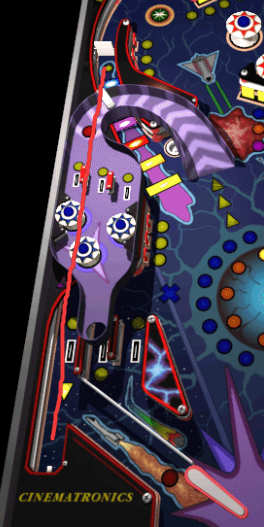
The author was able to do this just decompiling the exe files, without looking at the original source code. Basically, completely blind.
So it goes without saying: The deaf, dumb and blind kid sure makes a mean pinball.
edit: It does! I installed the AUR version of it that was linked in the repo README and tested it out, and typing "hidden test" during the game startup sequence lets me drag the ball
I didn't know about this. Not sure if the developers settled or take two gave up. I would guess the latter as the decompilation / port scene seems to be going strong. Though I don't follow it that closely.
Damn amazing how they are making these pinballs today.
More tables here too:
https://vpforums.org/index.php?app=downloads&showcat=50
https://vpuniverse.com/files/category/82-vpx-pinball-tables
https://virtualpinballspreadsheet.github.io/
https://github.com/k4zmu2a/SpaceCadetPinball
It's been ported to a whole bunch of consoles. There's also a browser version!
Also, turns out Space Cadet Pinball is part of a bigger Maxis game I never heard of: Full Tilt! Pinball.
Also turns out we almost got DOOM bundled with Window 95! (GLUEM) but it was rejected: "Can't we just get a game of pinball or something like that?" And here we are :)
https://en.wikipedia.org/wiki/Full_Tilt!_Pinball#Development
Every year we ship a live visualization of our merchant's sales on Black Friday. For a long time it was just a globe with arcs where each arc shows a real sale going from seller to buyer, but in the last few years we have been transforming the website into something more fun and interactive.
I found programming a pinball machine to be quite challenging. We were a team of 2 engineers and 1 artist and we worked on that project for about a month and a half. We wrote some notes on the process and put them in the desktop computer next to the pinball machine if anyone is curious about how things work.
I wouldn't mind at all if it was all just purely kept in a metaphorical locked vault, only to be opened after some special conditions regarding the support and lifespan of the software were met. Even if those terms were like, "only after the original copyright has expired", aka 70+ years, it would still be so much better for the state of preservation of source code over the current norms. We have games that have had their original source code lost in under a decade from their publication. (Kingdom Hearts 1) Any alternative is better than the current state of things.
I don't know, the incentives for creators are already low enough. Any book one writes lands immediately in Anna's Archive and is digested into LLM slop for the profit of Altman & Co. Any piece of investigative journalism, when shared here or on Reddit, sees a link to some paywall-bypass site as one of the most upvoted comments. So we are already in a Bastiat's window situation where people are disincentivized to produce creative work. I'd rather not put the work of software creators even more at risk of being cheaply copied and copyright laundered: any state vault would be an easy target for trillion-dollar corporations.
Aside, as someone doing retro reverse engineering I greatly appreciate the author's words about the tension between software preservation and the need to reward creators for their work.
That is generally because they're on random sites that want you to subscribe for a year to read the one piece that was mentioned on the sites you read... not going to happen, sorry.
It's prolly hard to achieve legally, but the idea that a software is close source until it's no longer sold then automatically becomes open source would attract me as a potential user/buyer of the software: less lock-in in the worst-case scenario (being fully dependent on it wile company goes bust or decides to cancel the project).
Reminds me a bit of the https://kde.org/community/whatiskde/kdefreeqtfoundation/
<<The "social contract" ensuring Qt remains open-source is primarily maintained through the KDE Free Qt Foundation, established in 1998. This agreement guarantees that if The Qt Company ever fails to release an open-source version, or if the Qt project is neglected, the foundation has the right to release Qt under a BSD-style license.>>
If you enjoy playing Space Cadet I would really recommend giving Visual Pinball a try. There are so many more pinball games better than Space Cadet, with amazing tables people have made for them all available for free. I think it's Windows only though (very, tables are all scripted in VBScript and PinMAME is loaded as a COM object).
As an aside I tried to hack around with this and found out the programming for Space Cadet is pretty awful (not to disparage them or anything, it works). The state of the lights directly reflects the game state. (This is the cause of the bug where if you drain or start a mission while the rank-up light show is playing, you can skip a rank.)
Fortunately for us, you're wrong :-)
VPX now runs on Linux, Mac, iOS, and Android. And it runs great on those platforms thanks to some pioneering work by the dev jsm174. The VBScript bits are handled using just enough Wine to make it happen but the rest of it is all native. Surround sound feedback (SSF), the Direct Output Framework (DOF), Pinup Popper packs (PUP Packs) etc are all supported as well. The GUI that used to be Windows only is now built into Windows / Mac / Linux versions via ImGUI and can be brought up live during play.
If you want to try it out, log into Github and download the latest action for your platform [0]. Most non-Windows users will want to use the latest version in master as this brings the most amount of parity to the Windows version compared to the 10.8.0 release last year. Use the BGFX version as that has the new multithreaded rendering backend that supports Metal and Vulkan. If you want to learn more, best to check out the Virtual Pinball Chat Discord [1] or poke around the wiki [2].
The devs have been putting in a lot of work to generally make VPX cross platform and it shows. I have built my own Pincab [3] based on it and its amazing.
*Edit*: Should have mentioned that VPX is now supported by Batocera as well, though the VPX version in there is getting a bit long in the tooth.
[0] https://github.com/vpinball/vpinball/actions/workflows/vpinb...
[1] https://discord.gg/BhR9h5aWm
[2] https://github.com/dekay/vpinball-wiki/wiki/About-Visual-Pin...
I wish I could find another pinball game I enjoyed as much. The closest experiences I could find are Xenotitle and Demon's Tilt but I found them harder to get into and get good at.
The next best thing imo is Yoku's Island Express.
While we’re at it, I’d love to see a physical version of the seseame street pinbal table [2], though that one might be a bit more ambitious. :)
You might be able to make the kickback lane work with a subway or maybe make the machine a widebody and go around the mess?
One could have the ball go quite low below the table surface and then use some kind of mechanical kicker to get it up to table level again near the bottom. It's possibly a unique problem, but seems to be much less work than building the rest of the table.
A bit like Star Trek teleportation.. is it you, or a copy of you?
The kickback puts the ball into the left orbit, which is at ground level, the ball will hit the spinner and then IIRC cause it's outside the crop, it goes into the lanes at the top of the playfield, and into the pop bumper area there.
We wouldn't want to leave any money on the table in the pursuit of a better product, would we?
(I can't imagine any other reason why, except maybe bug reports)
If the ball is coming straight down the middle, there's no choice but to tilt. A really good player will be able to tilt the tightest machine enough to get that ball to a flipper. Also, a really good player is better at judging "straight down the middle" and choosing not to tilt at all. Anybody who is reasonable at pinball can play for an infinite amount of time on a very loose machine.
It's not actually a factor that can be removed from pinball. You can't have machines tilting when people just lean against them, or when a player pushes a flipper button energetically. The owner has to pick some threshold. They're irredeemably physical games.
Perhaps it was just chance that I grew up playing what seemed like a much better pinball game ( Hyper-3D Pinball, aka Tilt!* ), but I was always underwhelmed by Space Cadet Pinball on windows.
In reality they're both pretty similar, I just happened to play a lot of one before the other, but the full screen DOS experience was much richer than what felt like a much more flat and less 3D windows experience.
You can see some Hyper-3D Pinball / Tilt! gameplay here: https://www.youtube.com/watch?v=q9ufwSkB0XQ
* Not to be confused with "Full Tilt!", from which space cadet pinball comes from.
I still applaud the Linux version for its hack value :)
Other pinball games are bland and boring to me.
It was also included with Windows NT 4.0, Windows 2000, Windows Me, and Windows XP (both the original and x64 versions). Finally removed in Vista to never return.
It's a fun bit of Windows history trivia.
- https://devblogs.microsoft.com/oldnewthing/20121218-00/?p=58... - https://devblogs.microsoft.com/oldnewthing/20220106-00/?p=10...