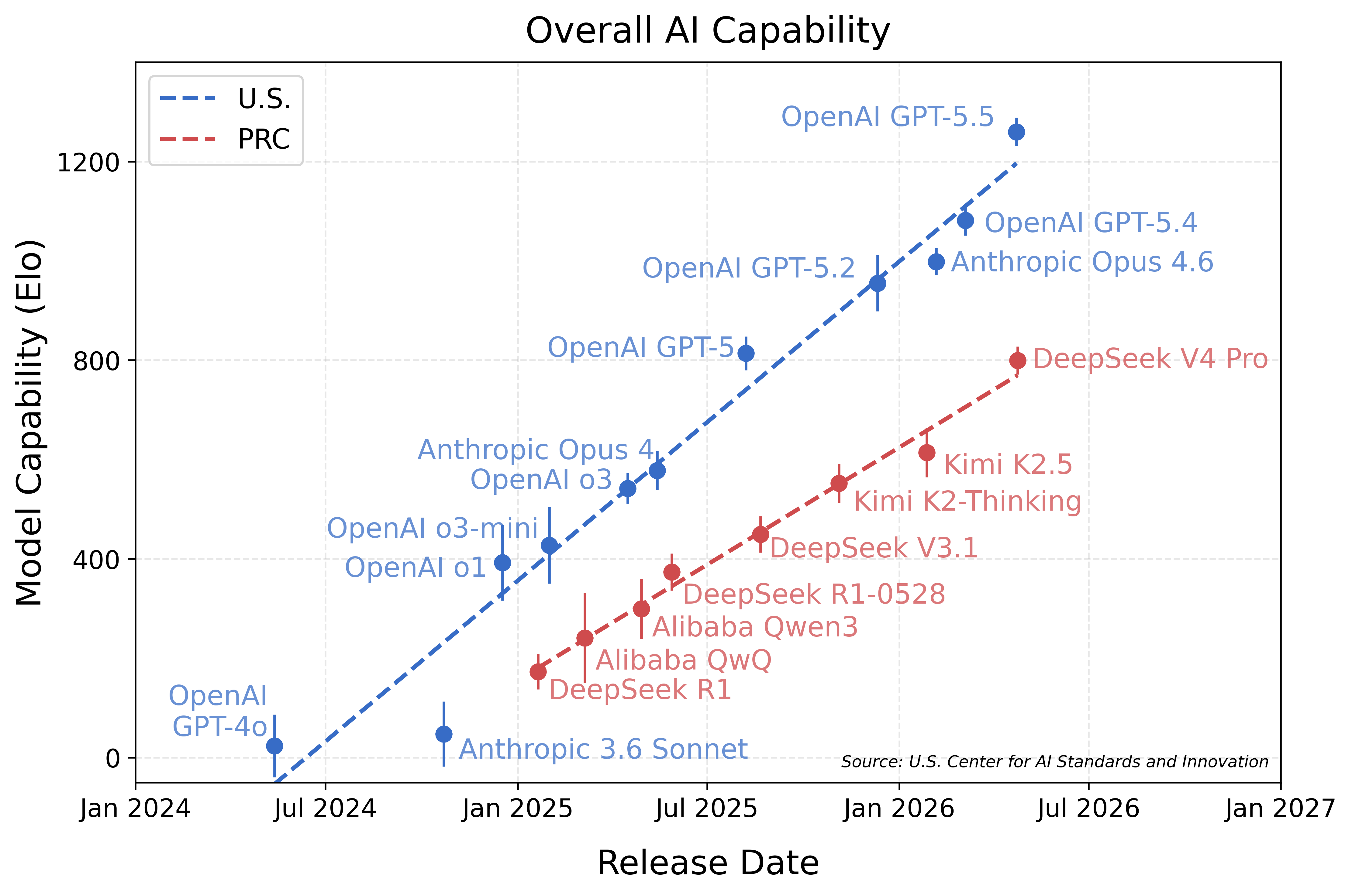
There is no secret sauce the US labs have that the Chinese ones don't, or won't have soon enough. Deepseek 4 and Kimi 2.5 are not quite Claude 4.5/GPT5.5 but there's no fundamental principle missing - they are strong evidence that there's no real advantage the "frontier" labs possess that isn't related to scale, which they will gain in time (if they even need to). The RL post-training techniques that work are widely known and easily copied. All Deepseek is really lacking is data, which they're getting - and the harder Anthropic/the USG makes it to access claude in china, the more of that precious data they'll get!
I used to sort of entertain the "fast take-off breakaway" scenario as being plausible but not really anymore. The only genuine moat the frontier labs have is their product take-up, which isn't nothing, far from it, but it's not some unbreakable technological wall. Too late guys - it might have been too late for quite some time.
However, they just don't perform that well in practice. That's the real issue. You can actually see it when you move away from open benchmarks. Deep seek 3.2 is 4% on Arc-AGI 2 [1], while GPT 5.2 high is 52% and GPT 5.5 pro high is 84.6%. That's the real reason why nobody is using these models for serious work. It's incredibly frustrating.
In addition, I already feel the pain myself on the model restriction. I'll asking my codex 5.5 agent to crawl a website - BOOM, cybersecurity warning on my account. I'll ask it to fix SSH on my local network - another warning. I'm worried about the day my account would be randomly banned and I cannot create a new one. OpenAI already asks you to perform full identification in order to eliminate these warnings - probably exactly for that - so that if they ban you, it's permanent.
The Chinese models right now are in a weird spot. Compared to the frontiers, both their pre and post training is woeful - tiny, resource constrained in every dimension including human, slow. I'd compare it to OpenAI 5 years ago except I think even then OpenAI had way more!
But they "cheat" quite a lot in distillation and very benchmark-focussed RL and that's where you get this superficial quality in the leaderboards that doesn't match up when you go off-script. Arc is a great example in that it really belies an "inferior soul" at the heart of it all.
What gives me great hope though is that those same scaling laws that Altman and others have been hyping forever will absolutely kick in for the Chinese labs just as they did for the US ones, and I don't think anything can stop that process now. So they will catch up. It won't be tomorrow, but it's not going to be 10 years either. 3-5 would be my reasonably educated guess.
And the final risk, that China itself might try to restrict availability of the tsunami of GPU or other AI hardware it will inevitably produce - well, I just can't really imagine a country that has been configuring itself for the last 40 years as a single purpose export machine deciding that actually, no, it doesn't want to export something.
About the model restrictions - absolutely. I've been trying to do security research on my own software and the frontier models immediately get suspicious. I've been playing with the local ones much more this year basically because of this. They have deficiencies, for sure - they feel very "hollow" compared to the major labs. But I've talked to a lot of people, and the consensus is pretty clear - just a matter of time.
Why are you bringing up an outdated Chinese model from 6 months ago to compare to a US model from 6 months ago? The outdated Chinese model will have performance from ~12 months ago, obviously. But today's Chinese model DeepSeek 4 has performance not far from the US model 6 months ago; 46% compared to 52% from 5.2.
Kimi K2.5 has also been superseded by a finer tuned Kimi K2.6 three weeks ago. Moonshot's Kimi models appear to be the favored Chinese model, at least for coding, and not Deepseek V4. z.AI's GLM 5.1 is also worth mentioning as rather competent for coding, also released in April.
Those models too will not be beating US AI labs by your metrics (although for coding, Kimi K2.6 might beat the very uneven Gemini depending on the situation), but in your critism at least consider the state of the art in your comparisons.
It definitely 'feels like' it is as good as Claude for many regular web app coding tasks (though I don't have real benchmarks). And it is comically cheap.
I'm not suggesting it is better than the latest Claude or codex models, but it seems 'good enough' for a lot of use cases in my limited real world testing.
I don't think every dev will be comfortable just releasing claude on their project.
This shows that AI cloud consumption is just a conspicuous consumption status symbol, nobody knows why they need cloud AI or what problem they are even solving.
Data governance and enterprise sales is a moat. The harnesses aren’t.
I mean, if that’s the case, then Anthropic themselves are currently actively filling in that moat with nice, solid, walkable dirt. Claude Code may have been a moat 6 months ago but these days you’ll want to replace the “m” with a “bl”.
But 1) people use other models with that same harness. 2) I moved on from Claude Code and all the features I cared for up and running in less than a couple days. Without even looking for available plugins or extensions.
And even then, their is no stickiness. For most use cases there isn’t much value in one frontier model over the other.
Just have to look at the people flocking from one to the other for whatever reason.
The point isn’t that gpt is better, it’s that it is so much better for my work it isn’t even sticky, it’s reinforced concrete. I use opus 1% of the time because it writes better and it’s sticky there.
Yes I’ll switch approximately immediately if opus or Gemini (which I use more than opus!) is better for what I do, but at this point frontier model tokens are not fungible.
Likewise Qwen 3.6 absolutely blows me away and that’s on a 35b 6-bit model on a local 5090. Same thing, busy trying to find stuff to do to keep it busy 24/7.
I can still find some niches for Opus 4.7 but being able to attack problems and not worry about consumption is a game changer.
I will say, as pointed out by others, DeepSeek and other Chinese providers still lack a bit in the tooling that Claude has, but they'll get there.
This is not just about mainland China though. The current US government is extremely selfish and self-centered. Other countries really need to consider for their own long-term situation here.
Also, he concedes Mythos-level capabilities will be cheap next year, then handwaves it with "you need the best AI, not good-enough AI." For most use cases, frontier minus six months is fine.
At the end of the day, as a consumer, you still pay per token (or per something) to your provider, except you can chose from multiple providers with your own criteria. If you want to use DeepSeek v4 hosted in Europe, it's possible.
Open models that are competitive with frontier will be used on shared hosts.
You can always run these models cheaper locally if you're willing to compromise on total throughput and speed of inference. For most end-user or small-scale business needs, you don't really need a lot of either.
And with the extreme chip shortages for the next two years, there's little appetite for even bigger models anyway.
Barring a breakthrough in scaling, the only direction the models can really go is smaller. Which will inevitably mean better performing local models for same chip budget.
Before you challenge with benchmarks, consider the labs which release open weight models have internal testing and unpublished results.
1. Your European startup will be competing with others using a much better frontier model. In a scenario where you already have other major disadvantages (access to capital, labor), you might be outcompeted
2. Open models have been keeping pace very nicely, but they rely on distillation of frontier models. If the race gets really tight, this could be affected so that the time gap grows larger (ie, it's very unlikely anyone but Anthropic is distilling from Mythos at the moment)
If the small (and I'd even say, sometimes imperceptible) difference between Opus & DeepSeek v4 Pro is such a disadvantage for your startup, it's that your startup have an issue, not the LLM.
At the end of the day, your startup is there to solve real problems and even before the LLMs, being fast at coding things have never been such a huge competitive advantage compared to marketing, sales, customer support, product vision ...
Update: GPT-5.5 found it.
Article: https://www.nist.gov/news-events/news/2026/05/caisi-evaluati...
Graph: https://www.nist.gov/sites/default/files/images/2026/05/01/1...
edit: I'm specifically referring to the "5.5 Pro" model, not regular 5.5 with Pro tier subscription. Claude has no model available that's comparable to 5.5 Pro either.
The thing is, vast majority of code tasks aren’t a venture into the unknown. We as an industry for the most part build CRUD interfaces and dashboards. That can be achieved, with supervision, with frontier open-weights models quite well.
Well, yes, someone probably will do that. But I’m pretty sure there will be consequences for the engineer errors in this vibe-calculations.
But, I think, with every revolution, hierarchies have only historically fallen only for the former serfs to rise.
The industrial revolution, the renaissance -> all were marked by an massive shift in the socioeconomic status and the rise of the middle class.
I think AGI, when it happens, will only raise equality. I may be wrong.
There's also an additional economic concern that rarely gets mentioned: because no one has cracked continual learning, keeping models up-to-date and filling in gaps in performance requires retraining on an ever growing dataset. Granted, you aren't starting from scratch each time, but the scaling required just to stay relevant looks daunting.
I don't know where any this goes on a societal level, but I've believed since the release of deepseek r1 that access to frontier models would eventually be locked up behind contracts, since the only moats protecting the models themselves are purely artificial. It remains to be seen how effective China is at pushing the envelope, and whether they are interested in providing unfettered access. And on top of that, it remains to be seen how well these models actually turn out to scale in the long run.
In other words, if AI does have continued significant economic impact, only the US and China would be able to leverage it completely. The rest of the world is implicitly betting that AI won't be good enough, or that eventually the compute curve flattens out so using a model that is 10x larger only leads to marginal benefits.
Is it even though? Quantization and speculative decoding are improving the local AI story by leaps and bounds every month.
But if progress keeps going I'm sure it will get to the point where my brain doesn't feel sick after watching it. I hope so, because I'm sure there's a lot of AI videos in my future, whether I want them or not.
There’s no narrative, there’s now sense of reality, it’s just a sense of here’s a million pixels of colours that have proven to go well with each other, it’s _slop_.
It’s been years and the only place AI has conquered in visual entertainment is as a subpar Photoshop replacement to fill in the B-roll gaps for those that don’t have the patience or money to do it the proper way.
Physics.
I would imagine not single everyone on HN have enough disposable income that allow us to subscribe Claude Max or other similar max plan of other models without thinking.
Some people mentioned open weight model, but there are two hurdles. One the current economic mean securing the best hardware is already stupidly expensive compare to a year or two ago. And the open weight model lack the magic that Claude/Gemini/OpenAI put in the proprietary one, meaning one will have to create their own agent that is clever enough to search the internet when it knows its training data is stale.
> “The two AI superpowers are going to start talking. We’re going to set up a protocol in terms of how do we go forward with best practices for AI to make sure nonstate actors don’t get a hold of these models,” Bessent told Joe Kernen on Thursday, on the sidelines of President Donald Trump’s two-day meeting in Beijing with Chinese President Xi Jinping.
https://www.cnbc.com/2026/05/14/us-china-ai-rules-bessent-us...
OpenAI is already talking openly about gated access to their models (see this OpenAI podcast episode for example: https://openai.com/podcast/#oai-podcast-episode-16)
Separately there's also a very active effort to stop open weight releases.
It's dangerous to those who think access to frontier intelligence is important.
The Chinese labs have reached "escape velocity" long ago - they will continue development regardless of API access to US models or the willingness of US labs to share their research.
Would that make those countries more attractive to young people perhaps? As a place to grow and learn skills where the opportunities are non-existent in the AI Sovereign countries.
The Trump Administration telling the very neo-fascist oligarchs who bought him an election and bought him a ballroom to play nice with their toys? At the expense of rampant capitalism? Lol.
He already showed us the limit of his comprehension of the topic when he made EO 14179 limiting states from regulating AI.
Trump doesn't swing for perfect pitches. He is a madman, a lunatic, and a true moron. Do not give this man any credit. I would be shocked if he could tell you the time on an analog clock.
Gotta low how it is ok to question the results of the latest presidential election but not the earlier one which is supposed to be sacrosanct, but again ok to question the one in 2016.
Somehow Trump is owned by capitalists but also starts trade/actual wars that thwart their agenda. I never understood how people come up with simplistic reductionistic views full of inconsistencies. Won't the evil capitalists and Neo fascists be served better with a predictable/controllable president?
That's a weird way to characterize months of incessant "we have incontrovertible hard evidence but you can't see it yet" claims, which--when finally forced into the light--were laughed out of every court in the nation.
If it was just pure and innocent "questioning", things would be very different. We probably wouldn't have had the January 6th mob attack on Congress, for example.
Glad to see others catching on.
I suspect this was just a throwaway word usage, but its usage here ends up being pretty anti-Semitic, so probably worth reconsidering its use if that wasn’t the intention of your post.