> I then tried using one of the AI tools to analyze my code in a project and a few other small tasks before it all came to an awkward halt. The system informed me that I had just run out of credits and I would need to provide a credit card to purchase more tokens I wanted to keep going.
> So you must believe me that the idea of paying a service in perpetuity so I could think just seemed so laughably absurd and horrific that I didn’t even bother giving them my card. I closed the laptop. I uninstalled the IDE and went back to using Emacs even.
I wholly support their personal choice. I am tired of articles from people who haven't used LLMs preaching about how it's all vibecoding, though.
Acting like LLM use is (EDIT: I meant is not) a spectrum between doing everything manually or handing control over to the LLM and vibecoding everything is a tired strawman argument.
This is still missing the point that LLM use isn't a binary choice between YOLO vibecoding or complete abstinence from LLM use.
I just don't know how many people have an overly negative opinion on AI assisted coding because they've just used the poor versions of these products given out for cheap/free. A similar critique is basing one's opinion on AI based on summary that Google provides for free in their search.
Like you said, the models available on free trials are usually toys compared to what developers use. Even Opus and GPT-5.5 are available on $20/month plans and you can buy a single month to try it out. The way they write about paying for a tool seeming "absurd and horrific" says it all about the level of actual research that went into their understanding. It's entirely based on news headlines.
When I run out of tokens, I pay for extra. It doesn't feel good, but I do it because I didn't write the codebase - the drug dealer did. Just one more "fix" and the code should be good to ship. Oh no, out of tokens again? Just one more "fix", and another.
And the code that the AI writes is sprawling and almost incomprehensibly complicated. Overly complicated. It's like a tweaker wrote it, on methamphetamine.
I can make this comparison because many years ago I once had an ex that put methamphetamine (I didn't realize they had an addiction) in one of my vitamin capsules "as a joke", and I was up for 36 hours straight writing convoluted code, and then writing voluminous notes about the code I had yet to write. I had never done that drug before, or since (why they are an ex). I don't even drink. After that episode I re-read what I had written and it was quite scattershot.
And now I get the same exact feeling when using AI to write code, or have it write tickets, or plan out something, etc.
I use these tools daily, and it's like putting a drug dealer between me and the code. Sure it writes a lot more code than I could write without it, but at what cost? I really don't like where this is headed. And I don't think most software developers using AI realize what is happening.
But isn't the strawman here was that it wasn't a spectrum. That they couldn't just use it some, but all or nothing.
* https://repo.autonoma.ca/repo/treetrek/tree/HEAD/render/rule... - syntax highlighting for 40 languages and file formats in ~10 minutes
* https://shufflenblues.com/expenses/ - real-time expenses progress updates with payment vendor API in ~30 minutes
* https://repo.autonoma.ca/repo/treetrek/tree/HEAD/git - real-time, cache-free raw Git reader implementation with cloning in ~5 days
* https://repo.autonoma.ca/repo/notanexus - PDFjs integration in ~3 days
However, these are likely not the "hard" problems you've mentioned. I feel like I can architect solutions at a higher-level now, without having to be completely caught up in many technical nuances. I'd rather not learn the extensive PDFjs API, for example, because it would take weeks of effort to understand.
Your syntax highlighting is very basic as well. Just ask LLMs to provide tests where it would fail to render correctly.
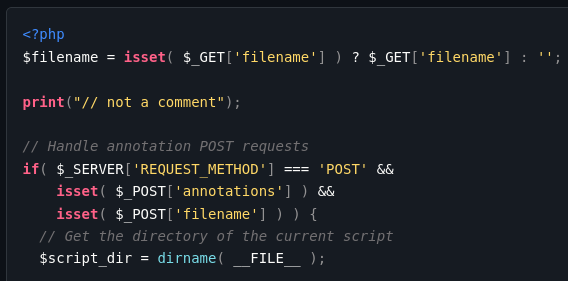
The first thing that comes to mind after looking at it: print("# not a comment")
Dependency-free, performance, FORTRAN, and it would take me more than ten minutes to find and integrate a highlighter that works across all of my code bases than having the LLM write one from scratch.
I searched for PHP-based Git libraries. All of them either invoked "git" using a system call or offered write abilities to the repo. I wanted a pure PHP solution that did not write to any files or invoke executable files (for security purposes). Maybe I didn't search long enough; at some point it becomes faster to tell the LLM what's wanted than to find a solution that fits.
> print("# not a comment")
Works correctly?
And regarding the gym, sure, you might enjoy lifting dumbbells and solving puzzles to sharpen your brain. But that is not what engineers are hired for; they are hired to deliver a system using the best tools available. You can choose to farm by hand while the industry moves to using tractors, but sooner or later, you will be left behind.
And lastly, moving higher in abstraction allows us to tackle even more complex problems—I'd argue much more complex than the narrow puzzles we were facing before. Part of the resistance is simply an avoidance of facing higher-level complexity once the lower tier is automated.
I've been in the field for 20 years, and I do think the situation is analogous. We might not like it or we might deny it, but the fact is, LLMs do automate the mechanical part of thinking. Some people might not accept that, but that is the reality given my subjective experience and the experience of many others who are using the tool.
We as a collective must learn the skill to put these new abilities to good use instead of just aiming to accelerate as much as possible.
There are hard problems at every level of abstraction. TAGE predictor optimization up to handling data-center failover.
I don't really have a challenge for people like the OP, I get it. I too dragged my feet, even mourned the death of a type of work I had grown fond of. Then I got over it and realized I might prefer the romance of riding a horse into town, but I also like that there's semi-trucks delivering fresh produce to my grocery store year round. The leverage available right now is frankly insane. The one thing an "old dev" [as he self-labeled] can be sure of is that the younger generations will not share these hang-ups to the same degree and it's those people who will inherit the burden of maintaining and furthering the digital world.
After 20 years of coding, I do understand the grief and the sense of loss—I felt it deeply myself. But as an engineer, I was also captivated by the capabilities of the new systems. Watching these systems mechanize the thinking I had been doing for years, struggle in areas I used to struggle with, and even outperform me in some areas is nothing short of a magical experience, leaving all the anxiety about the job aside. Personally, I chose to focus on that magic, to see how far we can push these tools and discover what their limits are.
- They're too expensive
- My buddy's 1995 Accord breaks down a lot
- Walking is healthier, plus you can stop and smell the roses
- I enjoy caring for my horse
- Sometimes you can get stuck in traffic
Fine if that's the way you want and can afford to live your life. But it is an exotic luxury belief. For those of us who are participating in the economy for real, the preference to not drive cars is not realistic.
If you can walk to your office and the temperature is always between 50 and 70 degrees F you would probably think cars are crazy, too.
Which, funnily enough, proves the point even further. Some people get so comfortable in their bubble that they become unable to even comprehend why other people make other choices in other situations.
I almost always walk to the office. The temperature range is a lot bigger (freezing in winter to uncomfortably hot in summer), and it's like 3 km, which many people wouldn't dream of walking. When my work was farther I used to cycle.
Most people can easily get to work without a car. Just depends on goals and motivations. Car is definitely the laziest way.
This is statistically very false.
It does a good job of proving my point that people within this bubble have a hard time understanding what the rest of the world is like.
For those of us lucky enough to have the choice, the best bet is to sit it out for a year or so until it all comes crashing down, then re-engage with what's left of the software industry.
EDIT: Oh, you are talking just about the US. Then your comparison doesn't make any sense because LLMs are available worldwide.
- They dangerous both to me as a driver, my passengers, and other road users, including pedestrians and bicyclists.
- They ruin cities which constantly have to accommodate ever increasing number of cars by destroying previously walkable neighborhoods to make room for roads and parking.
- They destroy our climate
- They are loud.
- Busses are nicer and I can read a book while riding the bus.
EDIT: To clarify on the public transit usage. The data is by-modal. Lower income levels are by far more likely to use road based public transit (such as busses), but high earners are more likely to live near a rail station and use rail based transit: https://cepr.org/voxeu/columns/public-transit-access-and-inc...
virtually everyone building a startup uses these tools to automate a huge chunk of the work. you have no real chance otherwise.
my advice is to get on the cheap claude code sub and to check out the superpowers plugin.
the idea of the plugin is to help you create a “design” plan which promotoes to an “implementation” plan.
the former is a high level architecture decisions which YOU TAKE and use the agent to browse different approaches that might work.
the latter is the concrete steps the agent will take after you click execute. every file change documented, every migration required, etc. very easy to oversee it
just my 2 cents (as someone working on startups)
I mean, I get it, there's different kinds of people out there with different motivations, goals, spare time, etc.
But there's also a process of product design that I think the author is overlooking.
Lately I've been working and iterating on a number of DSLs, projects that might be a total waste of my time because they end up being poorly conceived or not very useful compared to a general purpose language!
I'm also working on a video game that is basically Magic: The Gathering meets StarCraft with Civilization style hex-grid conflict. It could be a total bust and entirely no fun to play (it's hard to tell if it's fun by itself because I enjoy working on the game while testing out the play patterns). It would suck to spend a couple of years on this if it's no good.
I very much enjoy the process of trying to figure out the best syntax and semantics for a new DSL or the process of iterating on gameplay elements when working on a game. The destination is also less important. I don't really expect anyone to use my DSLs or play my video games. I'm ultimately doing it for my own enjoyment.
Saying this, I am interested in the overall architecture and I've definitely learned from my mistakes, especially with creating DSLs. Like, having a TypeScript language server with a Rust runtime has some issues. It's kind of better to build the language server into the runtime so you're not maintaining multiple parsers, and depending on the language features, an additional pseudo-runtime in the language server.
That's because AI wrote it to deter other AI from taking it's job
I know its not rational, but it would be pretty darn terrible in my brain to pay for an IDE. Even more unimaginable to me to pay $100 a month for something...
All to say, "cheapskate"-ness from TFA really resonated with me, I don't see the sentiment around a lot.
Context engineering is allowing me to do things I've always wanted to do but don't have the time/energy. I'm writing in C++, assembly, Rust, Go. I'm fucking with boot loaders and all kinds of things.
It's brought me a far greater understanding of how cryptography, GPUs, CUDA, Apple Metal - all topics I have a vague interest in but have no time to work on.
The current raft of LLM models are genius children. It's like that 15 year old at college. But I have 30 years of experience and a genius child is pure power in my hands.
And it's a genius child that never gets tired. For a few hundred bucks a month I can have 3 geniuses working on my ideas through the night. Last night they wrote 20 different research theses on a topic and benchmarked them all. Then combined them into a best of breed algorithm better than anything that has been done before. It's an amazing world we live in.
I don't write this to throw mud at OP - they are entitled to their opinion. Merely to point out the contrast.
I get the conversational aspect and value of it I just dont get people saying “I dont code anymore I manage agents” - besides obviously people selling AI
I can pick and choose which parts of the problem deserve my attention and which can be done by the LLM with me just keeping an eye on it while I mostly work on something else. I don't have metrics but I feel like I am doing higher leverage work with less friction.
Setting up the systems around the LLM itself is fun too. Hacking on harnesses and trying to improve the UX or the metrics is fun. Playing with different workflow topologies across agents is fun. Diving deep into context strategies, memory systems, prompting is fun. Trying to marry ideas from the past with what LLMs enable now is fun.
I don't see how this is soulless or unbearable but granted I'm not at a place that is demanding I maximize throughput. That would suck.
most of the other things you mention feel tedious to me. i like diving into the code, understanding how to solve a problem, figuring out how to make the code structure look elegant and readable. find and comment on a clever short-cut, even if it means that i may not be clever enough to debug it later.
i don't get any of that with LLM generated code. i'd spend more time to clean up and fix the LLM code than i would writing it from scratch. to use LLM code efficiently, i'd have to give up all that. but i don't want to do that.
using LLM to code feels like gambling. every time i put in a prompt, its like rolling the dice. am i going to get a useful solution this time? and then reroll until i get a useful result rather than building up the application one step at a time.
Since this blogsite has a .is domain I must assume they mean Egilsstaðir a lovely city with a population of around 2500 people.
"woodwork is just procrastination that gets in the way of implementing your ideas."
We can find plenty of others, but my main point is that industrializing a process doesn't make it "procrastinating". There are plenty of jobs that are done by machines but are still practiced by humans for multiple reasons. If we think of coding as a means to create, then we have plenty of examples of good reasons to have both the industrialized process and the 'handmade' one.
"Thinking is just procrastination that gets in the way of your opinions"? ;-)
probably that nothing really matters, so I guess do whatever makes you happy. If programming makes you happy then you should do it.
I find programming Advent of Code fun so I do it, but I don't find writing yet another web interface fun, so I have Claude do it.