The four-day workweek in Australia: insights from early adopters of 100:80:100
231 points
6 hours ago
| 26 comments
| scienceaim.com
| HN
thegrim33
1 hour ago
[-]
An AI-generated article which summaries a pre-print release which surveyed 15 people at 15 companies about their thoughts on whether the arrangement was working for them. Of those 15, a grand total of 6 (unidentified) people at 6 (unidentified) companies (all in the same country), said they "thought" productivity had increased. Not a single data point was taken about whether it actually increased. The questions that these 15 people were asked was not disclosed.

An informal survey, of unknown content, of 15 unidentified people, with 6 of those people being in the "boosts productivity" camp. Cool beans. I guess that settles the matter once and for all.

reply
jkldotio
4 minutes ago
[-]
It's 15 companies that adopted a technique and it's part of a broader constellation of experiments in this area which have been confounding the traditional logic that productivity would decrease. https://www.4dayweek.com/research

The people representing the businesses in preprint hold titles like co-founder, CEO/founder, COO, General Manager, and CEO. The size of the business and sector are also noted. I think your framing of them as "unidentified people" is therefore off, it is certainly not the same as a journalist conveniently using "unnamed sources", this is standard academic practice.

Different companies measure different things, but they do measure and that is addressed in the paper. "revenue (DM10), profit (DM4), other financial targets (DM2, DM6), customer/client satisfaction ( DM8, DM6), story points (DM14), sprint goals (DM7), billable hours (DM12), capacity ( DM4), response rates (DM10), standard operating procedure metrics (DM9), sick leave (DM1, D M 4. DM9, DM15), lodgements (DM12), employee happiness (DM6, DM15), projects delivered on time (DM15), and net promoter score ( DM4)". There were also other benefits like hiring and retention.

So this is not what "unidentified people" "thought" about productivity, this was founders and the c-suite using their existing favoured metrics. On those metrics a large number of them reported an increase in productivity, and a larger group reported no deleterious effects on productivity. This is broadly consistent with the trends in the wider research into this area globally, which continually go against the predictions that productivity will drop. Is is universally applicable? I don't think anyone is claiming that.

I've followed this area for a while and, sorry to be impolite, it is your summary that is less accurate than the the one you accuse of being AI-generated.

reply
46493168
2 minutes ago
[-]
I haven’t had a solid schedule since Covid, work just happens whenever and I weave my personal life into it. Sometimes it’s late nights and a weekend, sometimes I take off a random Wednesday and do errands.
reply
declan_roberts
1 hour ago
[-]
I was contacted this week for a position that was openly 6 days a week. We need to end H1B in this country as soon as possible and keep the 996 schedule firmly out of the United States.

They call you lazy for not wanting to compete against the entire world in your own country.

reply
rented_mule
2 minutes ago
[-]
Chinese tech companies' 996 policies, and large Chinese tech companies in general, are newer than that ethic in the US. What I hear about 995.5 (every other Saturday off) from my friend at Xiaohongshu in Beijing sounds remarkably consistent with what I heard from my Google friends 20-25 years ago, from working hours to on-site amenities that kept you at work. You're spotting a correlation, but I think causality probably goes in the US -> China direction on this.

In the early to mid 90s, I worked at a Silicon Valley based software startup. We had something called "The Century Club". You made the club if you'd done 3 consecutive months in the last year without working less than 100 hours in any week of those months (averaging 100 hours was not good enough). More engineers were in the club than not. We were told that making the club was not mandatory, but nobody in the club was ever fired and most not in the club were eventually fired.

The next startup I was at had a similar culture without the cute name. I remember my most exhausting stretch there was coming in on a Saturday morning, for a database migration that had to happen outside business hours, and working straight through without sleep (other than nodding off at the keyboard) until Monday afternoon. Our CEO was kind enough to bring us food. Even in regular times there, I would go exercise from 10-11 PM, and more often than not I'd go back to the office after.

A decade later I was at Amazon. Our entire group of ~100 engineers was required by our VP to work weekends, in the office, for months at a time when approaching ship dates. The VP would send an email every Friday during this period to remind us to be there. Of course he wasn't there.

Those were all pretty counterproductive, but didn't seem that unusual. The difference in the US back then was that even asking about such things during an interview would often result in no offer because the candidate didn't have a "good" work ethic. Things have gotten a lot better in the US in the last 10-15 years, but a lot of that came from competition for talent. The more that competition eases, the more likely it is that we'll go backwards on this.

Relating back to the article... For the last 3 years of my career (I retired a few years ago), I worked 4-day weeks, and it was all remote. This is just as anecdotal as the article, but I felt I got far more done, with higher quality, than at any point in my career. It was such a revelation.

reply
randycupertino
11 minutes ago
[-]
My company currently has roles open for "5-6 days per week in the office" - we used to be 100% remote! It's awful.
reply
archagon
1 hour ago
[-]
Quite a leap to attribute corporate greed to H1B.

Think again: this is entirely homegrown.

reply
genxy
56 minutes ago
[-]
You give away your bias when it is the other way around.

The H1B is a byproduct and a tool of corporate greed.

reply
shermantanktop
1 hour ago
[-]
Is there not a connection between the two?

You'll have to spell out what you're suggesting here. "Think again" only works on LLMs, and then only sometimes.

reply
Tadpole9181
25 minutes ago
[-]
The top comment seems to insinuate the 996 (or any overwork scheme) is being brought over because of H1B visa workers.

The responder is saying that domestic American capitalists do not need foreign influence to abuse or exploit labor. The H1B visa program has absolutely nothing to do, for example, with Walmart telling their full time employees how to apply for government assistance programs because they refuse to pay a livable wage.

reply
aeternum
4 hours ago
[-]
Papers like this should be called opinion surveys.

Calling it a study is a disservice to science. As Feynman said, anything where they have to put science as a suffix is usually not science.

reply
Mordisquitos
4 hours ago
[-]
What a hollow dismissal of based on acrobatic leaps of semantics.

The word 'study' is no sacred possession exclusive to the natural sciences, and there is nothing wrong with properly conducted surveys as a method in sociology, economics or psychology.

If surveys targeting the very people responsible for optimising their businesses' productivity, with no incentive to falsify their conclusions, is good evidence. Without any other way to systematically measure the change in productivity across a plethora of different businesses implementing a four-day workweek, it is as good as it gets — much better than purely theoretical assumptions that productivity must have dropped.

You can find the study here if you wish to critique its methods: https://www.nature.com/articles/s41599-026-07536-x

reply
aeternum
2 hours ago
[-]
I did read it, thus my comment. Did you actually read the methods? This is what you're defending:

"Methods This study took a qualitative approach, using semi-structured interviews with n=15 industry leaders" .. "Participants were identified via media reports " .. "A total of n=15 key informants participated in this study" .. "Recent research into appropriate sample sizes for qualitative research found saturation typically occurs between 9 and 17 interviews and the researchers agreed that no fresh insights or themes arose after the twelfth interview in this study (Hennink & Kaiser, 2022)"

The interviews contain invaluable insights such as: “adopting the 4DWW takes work” “Productivity up, waste removed” “Management -led/employee -driven,” “Train for leisure,”

I stand by my statement.

reply
kibibu
21 minutes ago
[-]
> As Feynman said, anything where they have to put science as a suffix is usually not science.

This is such an absurd thought-terminating cliche. Science suffixation seems more an indicator of the age of the field, not its scientific rigour. Are "climate science" and "computer science" not science?

On the flip side, just because it says "ology" at the end of a word does not mean it's a science.

reply
latexr
4 hours ago
[-]
Edit: It’s becoming ever more increasingly common on HN to get downvotes for innocuous respectful posts. If you’re downvoting, I’d genuinely appreciate if you explained what is it that you find offensive about this post. You’re not going to hurt my feelings, I sincerely want to understand what it is that you see as transgressive so I can learn from it. Thank you. Another example which baffled me: https://news.ycombinator.com/item?id=48222383#48227701

> As Feynman said, anything where they have to put science as a suffix is usually not science.

I appreciate Feynman’s contributions—and in fact have been recently revisiting the Messenger lectures—but that seems like an unnecessary jab. The use of “usually” is also a convenient cop-out which makes the remark meaningless because the speaker can pick and choose in any conversation so they always win.¹

I thought about it and picked the first thing which came to mind: Natural science. From Wikipedia²:

> Natural science or empirical science is a branch of science concerned with the description, understanding, and prediction of natural phenomena, based on empirical evidence from observation and experimentation. Mechanisms such as peer review and reproducibility of findings are used to try to ensure the validity of scientific advances.

Seems pretty scientific to me. But alright, let’s check the article to give it a fair shot in context. The only time the word “science” comes up is “Social Sciences”. Again from Wikipedia³:

> Social science (or the social sciences) is one of the branches of science, devoted to the study of societies and the relationships among members within those societies. The term was formerly used to refer to the field of sociology, the original "science of society", established in the 18th century. It now encompasses a wide array of additional academic disciplines, including anthropology, archaeology, economics, geography, history, linguistics, management, communication studies, psychology, sociology, culturology, and political science.

That’s a wide range. Are all of those “not science”?

¹ Assuming your rephrasing is accurate and not missing important context.

² https://en.wikipedia.org/wiki/Natural_science

³ https://en.wikipedia.org/wiki/Social_science

reply
aeternum
2 hours ago
[-]
I'm the one that said usually, Feynman didn't have that cop-out and he was specifically talking about social science:

https://www.youtube.com/watch?v=tWr39Q9vBgo

Worth watching the clip so you can hear the argument directly. IMO his point is that peer review is not what makes something science. Nor are studies, publishing papers nor p-values, even gathering and reproducing data is not what makes science science.

reply
ENGNR
4 hours ago
[-]
Australia also has a 60 year productivity low and a government that is boosting taxes on capital gains on shares/business to basically a worldwide high. So take our experiments with a grain of salt!
reply
BLKNSLVR
3 hours ago
[-]
Tax changes that have been overdue for twenty-odd years to address house prices and attempt to level the playing field between labour and capital.

Pity they didn't also change the gas tax.

reply
ENGNR
3 hours ago
[-]
House tax changes... strong yes

Share tax changes... ugh

My hope was cashed up bogans would start betting on shares instead of housing/crypto. At least it could be funnelled into something productive

reply
BLKNSLVR
2 hours ago
[-]
My limited-research understanding is that there shouldn't be a difference between capital gains from housing versus shares, otherwise it's 'picking winners' or encouraging investment in specific directions. Having said that, the 'winner' they've picked is new house builds, which retain some tax benefits. I'm OK with that, without having skin in that game now or likely into the future.

In regards to other comments further down regarding Australia's tax rates being high, internationally Australia is on the lower end.

I believe the (seemingly very loud) naysayers about these tax changes are those who receive much more of their income via 'capital' than via 'effort', and so my sympathies are minimal to non-existent. Sure, I have capital investments that will yield lower returns, but I believe the changes make "the way it works" overall more fair to those who don't have the means to earn means passively.

Cashed up bogans may funnel more of their money into new house builds, which is productive...?

Semi-unrelated addition: To some extent I think that 'owning ones own house' is a motivator to work harder, so as home ownership has grown increasingly out of reach, so has some amount of motivation to actually work dried up. There's an inherent 'participation in society' to owning a home that has an intangible but high value. Whether this has anything to do with Australia's decreasing productivity, I don't know.

reply
sysworld
3 hours ago
[-]
Yeah, housing tax changes were needed, but seems weird to also do Shares. NZ, like always is lagging behind AU, and also needs house tax changes. The housing situation in NZ dire.
reply
erentz
2 hours ago
[-]
NZ is even worse than Australia on the housing tax vs shares tax front. No housing taxes. Yet they have what is effectively an annual wealth tax on shares (FIF) even on their pitiful retirement savings schemes. This discourages saving in shares and encourages putting money in real estate.
reply
HDBaseT
1 hour ago
[-]
You shouldn't have to rely on shares investments to make a living or retire though.

Just because someone doesn't invest in shares, doesn't mean they are a bogan. I'm sick of this term being thrown around at people you look down upon...

reply
shell0x
2 hours ago
[-]
The tax is already bad here, even without it. I paid $89,000 taxes just for the last financial year because stock gains are added up on top of the income and my partner doesn’t work and there’s no family support allowance here.

I can apply Australian citizenship next year but I will leave ASAP after becoming a citizen for Singapore, Dubai or Hong Kong where the tax is < 20%

reply
BLKNSLVR
1 hour ago
[-]
You're breaking my heart.

To pay $89,000 in taxes you'd have to be earning in the range of $350k. Do you think you're hard done by? I'd be rather annoyed if you were eligible for family support allowance in that earning range? (partially because I'd be missing out on a decent chunk of government support myself)

What am I missing about your situation that makes it remotely sympathetic?

reply
shell0x
1 hour ago
[-]
If you live in inner Sydney, the rent alone is $1350 pw and tax is ridiculous. I basically sold my stocks to have a down payment but then that got added on top of income. If i’d have stayed in HK, i’d have paid 0% for that.

I just treat it as paying for Australian citizenship to make me feel better and it still comes out cheaper than buying a Saint Kitts and Nevis passport. Australian passport also opens up the E3 visa to go to the USA

reply
HDBaseT
1 hour ago
[-]
You don't "have" to live in Sydney though. This is something immigrants like yourself fail to understand.

It's a privilege to come into this country, its a privilege to live in Sydney. If you don't like it, you can leave.

I make less (even before tax) than you PAID in tax, yet you still want handouts.

reply
HerbManic
51 minutes ago
[-]
Alas for some people, their lifestyle will expand to fill their income. They could earn 10x as much, and it probably still wouldn't be enough.
reply
N_Lens
54 minutes ago
[-]
He doesn't like and he does say he will leave, after getting the Australian passport first for opening doors.
reply
mgh95
54 minutes ago
[-]
> It's a privilege to come into this country, its a privilege to live in Sydney. If you don't like it, you can leave.

I hate to put it like this, but that's exactly what the poster is doing.

reply
tedk-42
1 hour ago
[-]
they are greedy and don't want to pay their fair share.

people that count their tax dollars are usually very selfish to begin with.

i generally think the gov can do better with how money is spent though.

reply
gsinclair
1 hour ago
[-]
If you made income, and enough gain in stocks to pay that much in tax, you should be happy.

I want to know why you are keen to become an Australian citizen if you’re not enthusiastic about contributing your share.

Constructive discussion about appropriate levels of taxation is important, but let’s at least agree that the things we rely on (roads, hospitals, schools, defence, …) cost something.

reply
HerbManic
43 minutes ago
[-]
I don't think they realize that they are in the top 1% of earners on the planet with numbers like that.

It is always funny to see how many think they are hard done even though by the numbers they are the winners by a wide margin.

reply
shitloadofbooks
1 hour ago
[-]
As an Australian with a family and 2 high-paying salaries paying a LOT of tax, none of those countries are remotely comparable to Australia.

If you hate taxes and fees, Singapore has a 60% Additional Buyer's Stamp Duty on residential property applied to foreign buyers, on top of an already insane property market. There's huge fines and government intervention into _everything_ and a massive high-stress culture.

Hong Kong is equally absurd for property and has a sword hanging over its head, that falls if China ever makes a move on Taiwan; the inevitable US and global sanctions would decimate HK.

Dubai is just a comical option.

reply
shell0x
1 hour ago
[-]
I can get PR in Singapore through my partner, so no 60%. Company paid medical and everything so expat life and no responsibilities. And if I were ever have to have kids, you can’t hire a maid here sleeping at your apartment and you have to clean yourself which is ridiculous. In Hk, SG, Dubai you can get domestic helpers cheaply and they take care of everything
reply
BLKNSLVR
1 hour ago
[-]
> And if I were ever have to have kids, you can’t hire a maid here sleeping at your apartment and you have to clean yourself which is ridiculous.

Not sure if serious.

If serious: This is a really weird and almost sociopathic thing to say. I really don't get where you're coming from. It's certainly not the cultural direction I'd like to see Australia moving in.

reply
shell0x
1 hour ago
[-]
You realize this is the standard in Asia right? They only cost like 2.5k a month which is pretty good value

https://www.life.gov.sg/guides/domestic-helper

https://www.immd.gov.hk/eng/services/visas/foreign_domestic_...

reply
BLKNSLVR
39 minutes ago
[-]
OK, just seems weird from my cultural experience, and the way I was reading your comment it sounded 'entitled' (likely due to the cultural difference).

Describing it as "pretty good value" bothers me in a number of contexts.

I'm also fine with this never becoming a thing in Australia. Not sure how out-of-touch or in-touch that makes me, but that's how I feel nonetheless.

@Loocid, thanks for saying what I was dancing around.

reply
Loocid
28 minutes ago
[-]
Its too close to slavery for my liking. Yes, they are paid but 2.5k per month is very low for Singapore, they rely on you for shelter, and are very likely from much poorer neighbouring countries that are trying to support family back home.

The money is better than they get back home, but the whole power dynamic is extremely exploitable which results in a lot of abuse cases.

reply
dools
1 hour ago
[-]
Don’t let the door hit you on the way out!
reply
sumedh
2 hours ago
[-]
Why are you not leaving right now?
reply
shell0x
1 hour ago
[-]
I could as a German but my partner has a weaker passport so I’m just waiting till she got her australian passport
reply
sumedh
26 minutes ago
[-]
Australian govt needs to tighten the rules to discourage people who want to take advantage of Australia but don't want to contribute in return.
reply
tedk-42
1 hour ago
[-]
so you take but you don't want to give?

perhaps try a different perspective of, "it's good i live in a place where we contribute for a common good"

reply
shell0x
59 minutes ago
[-]
Taxes are a financial loss.

I preferred living in Hong Kong and Singapore and do not enjoy living here honestly, but if you treat it as payment for my+partner’s backup citizenship, it seems more justifiable.

reply
mianos
1 hour ago
[-]
I'd assume, as an Australian, who works for a HK company and has travelled for work all their life, the long term lifestyle in Australia is probably better than those countries. I love HK and Singo but I am not sure I'd want to live there. But for working, most people here would not work in an iron lung and the socialist government pretty much supports the idea that, if you don't like to work, you shouldn't have to as long as there are a few who will work. And, that number is fewer and fewer.
reply
HerbManic
53 minutes ago
[-]
I'm sorry but you pay more in tax than I make in income! This sounds like your lifestyle creep has chewed up your money stream. Despite my significantly lower income, I manage to own my house in Melbourne. With your income I could have it paid down in a few years at most.
reply
BLKNSLVR
24 minutes ago
[-]
Well done, good planning, good self-discipline!

I'm in a similar boat, and can relate to the on-going management and suppression of lifestyle creep in order to reach worthwhile goals. It feels like a never-ending battle, even after 20 years.

reply
Mordisquitos
4 hours ago
[-]
So you're saying that four-day-workweek companies saw no decline in their productivity, in contrast to the Australian average productivity which went down overall‽

That means the four-day-workweek is even better than we thought it was!

reply
_kulang
4 hours ago
[-]
As an Australian, I am not sure that most work done in this country adds to productivity
reply
HerbManic
40 minutes ago
[-]
The ghost of David Graeber would agree.
reply
bjt12345
1 hour ago
[-]
How is the recently announced 2026 Australian Government budget relevant to this study done in 2023-2024? There is a whole bunch of other factors to Australia's productivity, not at least the drop in GDP per capita and fall in Total Factor Productivity.
reply
runtime_terror
2 hours ago
[-]
What's your point about increased capital gains? Taxing income based on ownership should be higher than income via actual labor. It's insane that's not the case in most places.
reply
mianos
1 hour ago
[-]
If you start a business and grow it from hard work, you will now be taxed more. It's not just passive gains, it's all gain.
reply
meander_water
2 hours ago
[-]
reply
jpollock
2 hours ago
[-]
Glancing through the study, I'm curious about both sample bias, and the lack of formal measurement. I'm not an expert in this type of thing, not even an amateur. I'm poking holes to see what's left.

"Participants were identified via media reports featuring Australian firms trialling the 100:80:100 model, in addition to companies listed on recruitment sites that specialise in 4DWW jobs. In other instances, eligible organisations were recommended by the participants themselves."

I'd expect organisations with positive results will be the ones recommended by other participants - "talk to these people, it worked for them too!"

I'm also interested in whether or not organisations converted all staff to 100:80:100, or if it was optional. Is the performance driven by peer pressure?

Finally, the participants' measures of productivity will have significant lag time in them, so it depends on trial's length, e.g. "revenue", "profit", "csat", "projects delivered on time", "net promoter score".

Table 1 has "Duration", but the units are unlabelled, if it's weeks, it's less than a year, months is probably better for seeing performance changes.

It's an interesting qualitative study, I'd certainly like a four day work week with no change in comp.

reply
sensanaty
2 hours ago
[-]
Here in NL lots of people do 32 hour weeks (legally your employer cannot deny you this if you ask for it), and I've literally never seen it be an issue productivity/team-wise, and people's QoL raises dramatically having an entire extra day free to themselves.
reply
passive
3 hours ago
[-]
Four-day work weeks are for cowards.

Take all that AI productivity and found a one-day work week company. One day of focused collaboration each week, let bots and brains chew on stuff in the interim.

reply
pinkmuffinere
2 hours ago
[-]
Oh no, I can't tell if this is sarcasm or not, lol
reply
passive
2 hours ago
[-]
It's a little bit snark, but I do think it would be an interesting experiment. Wish I had lots of money to try it out.
reply
gsinclair
1 hour ago
[-]
If I had the “lots of money” required, I’d try out a zero-day work week instead!
reply
tedk-42
1 hour ago
[-]
a lot of AI is just wasteful like this.

there are a lot of parallels with crypto 'mining' a transaction and AI slopping a functional output.

reply
farhanhubble
1 hour ago
[-]
If you look at Australian IT companies they're management and consultant heavy. Roles like architects, review boards, program managers etc., exceed actual engineering roles. In such a set up it takes forever to get any real work done.

Then Australian real wages have also declined. So there is already low motivation to work beyond the minimum expectation.

Australia also has strong social security, at least until now, and there are plenty of odd jobs due to the real estate and tourism industries, so there is little pressure to survive unless you owe too much credit.

Automation and technology adoption also lags behind. For example, people still wait thirty minutes on a call to get an appointment with a doctor instead of making an online booking.

For all of these reasons productivity has been low and declining. An extra day off work is a strong stimulus for squeezing what gets done into the rest of the days.

In my opinion this is an extreme, just as the work yourself to death culture in India and China is. On a scale of a few decades economies where people worked agressively harder have grown tremendously but at the expense of the long-term wellbeing of the people. Places like Australia that were well off and felt little pressure to compete have sustained good quality of life but at the expense of having no competetitve edge anymore.

reply
stego-tech
2 hours ago
[-]
Given the gargantuan amount of data showing productivity relative to wage gains, or productivity relative to time worked, or productivity relative to physical office proximity, and the absolute staunch refusal of business to listen to any of it, I can only assume one thing:

The point was never productivity, it was about humiliation and control.

If it were about productivity, workers would be paid substantially more to reflect the immense productivity gains we’ve created through automation; we are not.

If it were about effective time management or efficiency, we would be on four-day, 32 hour work weeks to reflect the real productive output of labor; we are not.

Just like how RTO excuses of “mentoring Juniors” and “improving team cohesion” went out the door for mass layoffs, despite data showing that a flexible schedule adapting to the needs of the team rather than whims of leadership have better outcomes and higher productivity; we now pay higher commute costs, fuel costs, energy costs, and opportunity costs so real estate investments don’t invert.

It’s all bullshit and lies, and this is one more study to add to the Alexandria-esque library of research proving that there is no single good way of working, and the insistence of refusing to change how we work is ultimately costing us more than if we just learned to adapt.

reply
rr808
3 hours ago
[-]
As someone working on a Sunday on a rainy memorial day weekend. Bring back the 5 day week!
reply
pizzly
3 hours ago
[-]
Working based on time i.e. 5 days a week is already problematic. We all see the pay by the hour workers like pool cleaners, vendor machine stocking people etc spending lots of time dragging out their work as they get paid by the hour. It makes perfect sense from their perspective and yes not everyone drags the work.

Fixing the work week to just 5 days have similar issues. Some weeks will be less work and other weeks more work but you spend the same five days there. So the what you learn that matters is to spend 5 days physically there and perform a minimum workload so you don't get fired. You drag the weeks with less work and pick up inefficient habits as a result. That is what a 5 day working week teaches. Again there will be exceptions.

Now assuming this study is correct I am not surprised with the results. You just incentivized workers to get the same amount of output done with the condition that you gain 1 day off. Off course workers will find better and quicker ways of working to get that day off.

Even if we did a 4 working day week the problem of working based on time either fixed or paid by the hour remains. The incentivisation is the problem.

reply
goda90
3 hours ago
[-]
What's the actual problem? Most people don't live for work.
reply
pizzly
2 hours ago
[-]
Agree. The problem is the incentivization. If a painter paints a roof in 5 hours but could do it in 1 hour just to get paid for the 5 hours its not the worker at fault but the system. If the painter got paid for the 5 hours but only did 1 hour of work then everyone wins. The painter can have more time off work or work more for more money, their choice.

Likewise the office worker working 40 hours per week, five days a week. If on some days the worker can come home early because they completed what actually needs to be done then that is better for the worker. But instead companies have a fixed 40 hours + overtime expectation. On the weeks with less work, people do busy work but instead could be using that time doing what they want.

Again the problem is the incentivization.

reply
recursive-call
2 hours ago
[-]
The actual problem is that workers want to make the most money possible with the least effort possible. Until we have a system where people do work that they want to do, perverse incentives will always be an issue.
reply
cluckindan
4 hours ago
[-]
But how will a consulting company bill for the 20%?
reply
umpalumpaaa
4 hours ago
[-]
You increase prices by 20%
reply
rhplus
4 hours ago
[-]
Billable hour rates would need to increase by 25%.
reply
dwattttt
2 hours ago
[-]
You really missed the opportunity here. You were meant to bill for the review, assessment, report production, and risks judged when coming up with that 25%.
reply
micromacrofoot
3 hours ago
[-]
what consulting company on earth pays 100% of their revenue to employee salary — I've worked at a number of them and it's not unusual for my pay to be half of the hourly rate charged
reply
B1FF_PSUVM
4 hours ago
[-]
I remember one business class anecdote, where the conclusion of changing workplace conditions (light, music, etc. both ways) was that productivity studies increase productivity ...
reply
miohtama
4 hours ago
[-]
It's Hawthorne effect

https://en.wikipedia.org/wiki/Hawthorne_effect

Related to it we have novelty effect and bunch of other psychological effects that are hard to isolate in human science. In this sector, a lot of studies cannot be repeated.

reply
gchamonlive
4 hours ago
[-]
Only if you do bad science experiments without a control group, otherwise you'd see the control group productivity boost as they'd also be under the same scrutiny. I didn't read the study methodology, so I'm not comparing to that, only responding to your comment in isolation.
reply
brokenmachine
2 hours ago
[-]
What a huge surprise. Every one of these studies shows the same thing.

Same as every study of open-plan offices shows that they suck.

The psychopaths in charge do not care.

reply
ktallett
4 hours ago
[-]
Basically every study shows a four day week works best. The issue is why we never go with what the study shows.
reply
t-writescode
4 hours ago
[-]
Because if we did we’d have universal healthcare, 4 day work weeks, WFH where possible, walkable cities, and a lot more housing, and every single one of those things makes it harder for abusive jobs to control their employees.
reply
toomuchtodo
4 hours ago
[-]
Progress is a functioning of effort, time, and luck. It’s a marathon. Keep grinding. Success is proven possible.
reply
amelius
2 hours ago
[-]
We're all in competition with each other. One person works 4 days, another person still working 5 days puts them out of business. Reality is more complicated but in the end there is no way around this basic fact.
reply
toomuchtodo
2 hours ago
[-]
Labor law changes reduce the work week, as was done previously. How many people work six days a week for no additional pay beyond five days today?

With population declines locked in almost globally (About 71% of the world’s population now lives in countries with birth rates below the replacement level needed to maintain population size), working age population decline, reducing labor supply, is also locked in. Reduced go forward labor supply reduction means labor power.

https://www.visualcapitalist.com/fertility-rate-of-world-pop...

https://www.suerf.org/wp-content/uploads/2023/12/f_fa99ccdbe...

The demographic future of humanity: facts and consequences [pdf] - https://news.ycombinator.com/item?id=44866621 - August 2025 (400 comments)

https://news.ycombinator.com/item?id=47680794 (US specific citations)

reply
latexr
4 hours ago
[-]
> universal healthcare, 4 day work weeks, WFH where possible, walkable cities, and a lot more housing

My my, seems like we gots ourselves a socialist o’er here. We don’t take kindly to your kind ’round these parts. What’s yer idea? Improve folks lives? Treat others with respect and dignity and give e’ryone meaning? Are ya cuckoo in tha head? Git him, boys.

reply
zurfer
4 hours ago
[-]
Naive question but if it works best wouldn't companies that have a four day work week outperform theirs peers and because of that grow faster, and become more common?

I see the opposite in most startups that have a 6 day work week to get ahead of the "slowly moving" 5 day work week competition.

reply
lmm
2 hours ago
[-]
> Naive question but if it works best wouldn't companies that have a four day work week outperform theirs peers and because of that grow faster, and become more common?

Eventually, but what's the typical lifecycle of a company? And if e.g. Treehouse succeeds or fails, was that because of their 4 day work week or because of any of the hundreds of other reasons a company might succeed or fail?

reply
dbetteridge
2 hours ago
[-]
In a perfect free market, like a spherical chicken in a vacuum. Maybe.

Problem is there's no such thing, monopoly powers, government subsidies, inter-company issues, contracts.

All these things can mean that a less functional, more wasteful and less productive organisation performs (in the sense of the metric that companies care about , line go up) better than a 4 day week startup.

reply
ktallett
4 hours ago
[-]
In what metric do they get ahead? I think this is the key. What many visualise as getting ahead primarily seems to be fund raising or having a higher monetary value. Especially in startups where the largest mouth, the biggest blagger, or the quickest to mention a buzz word gets you more funding. Being closer to your end goal, with an adoptable product that improves society, is really the only metric that matters.
reply
latexr
3 hours ago
[-]
Think of it like a sprint versus a marathon. If you run at full speed you can get farther than someone keeping a steady pace in the same amount of time, but you’re going to tire yourself out and become slower. You’ll lose in the long run despite looking very “productive” at the start.

Similarly, have you ever been “in the zone” and worked non-stop on a fun project, being super-productive for a full week or even multiple weeks, but then “crashed” (or even burned out) and your output got worse?

New companies are on a race against the clock. At the beginning everything is a cost, you’re constantly losing money. So you plough through to survive until you become stable. Then you need to scale back and take it slower to allow yourself to recuperate and keep going.

Also, keep in mind that small companies can often be very productive simply by having fewer employees and “red tape”. You can have an idea, send a message to someone else, get an immediate OK and get going. When a company gets too big and has lots of processes to keep things running, a lot of effort is wasted on even getting started.

reply
danielmarkbruce
4 hours ago
[-]
"study"... The replication crises in science has shown that most studies are total bs. So we probably don't want to go with them.
reply
ktallett
4 hours ago
[-]
How does that differentiate from a boss or a company philosophy stating a 5 or 6 day week is better? With no reliable metric on better, other than ancedotal evidence. It's not as if it's repeatable experimentation.
reply
danielmarkbruce
50 minutes ago
[-]
It doesn't, but in the case where a boss or company say it, at least we know it's bs. Do you believe something because your company or boss says so?
reply
cluckindan
4 hours ago
[-]
By inductive logic, a zero day week works best.
reply
oompydoompy74
4 hours ago
[-]
Speaking as an American, I don’t give a shit if it increases productivity or not. Productivity has gone up exponentially with technological advancement since the advent of the 5 day work week. We, as a species, should be minimizing work to 3 or 4 days a week with equal overall pay. Corporations should be fined heavily for contacting an employee after working hours. On call should require corporations to pay hefty overtime. This is a compromise because really and truly corporations should be illegal. Employee owned co-ops are more humane.
reply
schappim
2 hours ago
[-]
Speaking as an Australian, our productivity has been lagging[1] compared to the US, largely due to the availability of cheap labour (attributed by economists to foreign students)[2].

I heard one economist on the ABC give the example of carwashes[2]. From the 1990s to the early 2000s, car washes in Australia were largely automated and hand-wash car washes were relatively uncommon. However, the abundance of cheap labour has since led to a proliferation of hand-wash car washes.

1. https://files.littlebird.com.au/SCR-20260525-ietj.png

2. https://www.abc.net.au/listen/programs/abc-news-daily/the-pr...

reply
anakaine
1 hour ago
[-]
As a fellow Australian, this is likely an early window on what the next 5 to 10 years will yield with our recent mass immigration. Economically speaking we could well see a race to the bottom in wages whilst we continue to experience exceptional housing pressure.
reply
gsinclair
1 hour ago
[-]
The car wash example is interesting, as something I’ve seen and experienced but never thought about in that way.

I wonder how it truly factors into productivity, though. How is productivity measured, and does that measurement capture what is true?

You mention automated car washes as a baseline. I never used those in the past because I figured they’d be rubbish or would scratch the car or whatever. So I’d occasionally wash the car myself, and that’s it. Now that we have manual car washes available, I use them from time to time. They clearly (I assert) do a better job than anything automated. And they do it inside and out.

So I find the comparison interesting, but in need of elaboration.

reply
card_zero
1 hour ago
[-]
It's a tautology, if productivity is measured as GDP per worker. Productivity, so defined, is down because each worker is moving money around less, although there may be more workers. Which is the same thing as them being paid less. Question is, if they accept that, and cars still get washed, does it matter?
reply
testing22321
1 hour ago
[-]
> Speaking as an Australian, our productivity has been lagging[1] compared to the US

Good.

Developed countries should not aim to emulate the US. To get the same productivity you’d have to lower the standard of living of all the employees to the same level as those in the US.

No. Don’t do it.

Quality of life matters much more than profits.

reply
stanac
3 hours ago
[-]
> Employee owned co-ops are more humane

Speaking as someone born in Yugoslavia.

That's almost how it was in Yugoslavia. Companies where "owned by society", but workers had voting rights. Whenever there was a vote to decide whether extra profit should be used for capital investments and/or operational improvements or assigned to salaries budget, everyone voted to increase their salaries.

Not every employ should be a co-owner, or at least not everyone should have voting rights.

reply
mohamedkoubaa
2 hours ago
[-]
Did you know that public market shareholders almost always vote for stock buybacks
reply
coredog64
1 hour ago
[-]
An employee-owned co-op results in extremely high risk concentration. If your co-op experiences a downturn, you are likely to lose your job and see the value of your share of the co-op decrease.

There are no solutions. There are only trade-offs. - Thomas Sowell

reply
teaearlgraycold
2 hours ago
[-]
You still need free market economics. If consumers have enough choices then the company with comfortable employees that refuse to invest profits into their operation will lose to the better organized competitor prioritizing a balance between the two.
reply
christophilus
4 hours ago
[-]
That would be ok in a non-globalized world. In our world, any country that implements those laws will see a lot more offshoring.
reply
xg15
2 hours ago
[-]
So then all the productivity improvements are nothing more than boosting the hashrate of your crypto miner? You have to do it to not fall behind, but once everyone has done it, we all end up back in the same spot where we started?
reply
amazingamazing
2 hours ago
[-]
Unironically, yes. One saving grace is in some ways, such as medicine and technology, more will be available to you, but not for less effort.
reply
xg15
2 hours ago
[-]
It's kind of understandable then that parts of the younger generations aren't motivated to continue that system? (Not just in the West, also in China, see "lying flat")
reply
archagon
1 hour ago
[-]
Normal people, yes. The oligarchic class gets more and more bloated as you can plainly see.
reply
danaris
3 hours ago
[-]
Not if that country also legislates heavy penalties for companies that produce their goods in countries with worse labor laws.
reply
nickff
3 hours ago
[-]
The economic motive for offshoring would remain (though slightly mitigated), unless that country’s demand (in each regulated sector) was much more than rest of the world’s. I personally doubt that most places are even willing to implement such legislation, given that they’re not even willing to protest PRoC’s use of slave labor and prison camps.
reply
anomaly_
2 hours ago
[-]
You're just going to Galapagos your economy. Consumers won't put up with high prices and inferior goods. Unless you want to restrict internet/information access so your consumers don't know what they are missing out on.
reply
amanaplanacanal
2 hours ago
[-]
I dunno. Consumers put up with a lot. Why can't I buy a cheap Chinese EV again?
reply
Avicebron
2 hours ago
[-]
Well the short version is that Robert Rubin and company sold our industries for parts years and years ago. And now we have to rebuild the industrial base from scratch
reply
jfengel
1 hour ago
[-]
That should make it possible to buy a cheap Chinese EV.

You can't because they didn't sell out completely. In fact they still have some power to protect the companies from foreign products.

The result is a mishmash of protectionism and globalization.

reply
youngNed
2 hours ago
[-]
Nah, I live in the UK, prices are higher than eu, public service is much worse, but public are voting for the party with members that brought this about.

Humans are weird.

reply
jfengel
1 hour ago
[-]
Voting for someone else would mean admitting you were wrong.

Paying high prices and losing your job are bad, but not as bad as changing your mind.

reply
xg15
2 hours ago
[-]
Almost like we needed some international worker's organization to put pressure on all relevant countries at the same time...
reply
AndrewKemendo
1 hour ago
[-]
Hey don’t go talking crazy about some kind of global labor solidarity and collective bargaining
reply
idle_zealot
4 hours ago
[-]
Hey, if fuel gets expensive enough this will be much less of a problem! Let's all thank Trump and Iran for their great work on bringing the four day work week closer to fruition. This isn't how I would've imagined bringing industry back to the States, but it's a promise made, promise kept.
reply
paulryanrogers
1 hour ago
[-]
Has the promise been kept? Is industry on-shoring in any significant sense? Or just making photo ops for Trump and fam, then slow walking the implementation until it's quietly canceled or scaled back to a token effort?
reply
jmyeet
2 hours ago
[-]
This has the same energy as "if we tax the billionaires, they'll leave". That statement and yours are wrong. Why? Because if it was profitable, they would've done it already. Pretty much any employer would use you as fertilizer if there was an uptick in the stock price.

But let's say it's true. Great. Punish them with tariffs. They also have diminished political power because they're no longer a local employer.

We are colletively at a breaking point as a society where people legitimately can't afford to exist in a society that will soon mint its first trillionaire. This is beyond even French revolution levels of wealth inequality.

reply
FridgeSeal
1 hour ago
[-]
Fully agreed.

“Oh but businesses will leave”

Yeah so what, if they do, we either didn’t want them, or they _actually won’t_ despite the squealing, or they will go, and if their segment of the market is useful, will get snapped up by new/local versions which do respect local constraints from the get-go.

All of these are better outcomes than not doing anything because “what if”.

reply
eudamoniac
1 hour ago
[-]
That only works with tariffs, which are widely considered evil apparently.
reply
azan_
1 hour ago
[-]
> We are colletively at a breaking point as a society where people legitimately can't afford to exist in a society

Aren't poverty rates being reduced basically everywhere and people getting richer across all deciles? The truth is that even if 90% tax rate was enforceable it would not change much - many problems plaguing societies right now are due to bad legislation and NIMBYs, with housing being the prime example. Somehow people want at same time: more houses, cheaper housing and as little new housing development as possible.

reply
tomhow
52 minutes ago
[-]
Grandiose, ideological declarations like this are antithetical to HN’s ethos of curiosity. Please read the guidelines and make an effort to observe them if you want to participate here.

https://news.ycombinator.com/newsguidelines.html

reply
amazingamazing
3 hours ago
[-]
This will never happen for the simple reason that there are some countries whose members are poor and so they are rightfully ready to work harder and longer for opportunities.

A more important point is why is it that Americans objectively are richer yet feel poorer?

reply
HDBaseT
2 hours ago
[-]
Trillions of dollars spend on wars which don't need to exist doesn't help.
reply
pixelatedindex
3 hours ago
[-]
> A more important point is why is it that Americans objectively are richer yet feel poorer?

I thought about this a lot. Some of it is expectation wrapped up in the American Dream. You work hard, and get those rewards. But that isn’t true because life isn’t fair and capitalism isn’t particularly humane or ethical.

Some of it is perceived. The people who strike gold without hard work expect to keep striking more gold, and when the yield shrinks you’re appalled because that’s not how things should be.

US is a deeply individualistic society, now more so than ever. We don’t always sacrifice for the common good, because they’re supposed to work hard just like me.

Anyway if you read all that, thank you.

reply
FpUser
1 hour ago
[-]
>"You work hard, and get those rewards."

For a relatively short period it was true. Now majority works hard, lives from paycheck to paycheck and can not even own a house. Most results of what they produce goes to feed ever growing appetites of Musks

reply
xg15
2 hours ago
[-]
Depends what your comparison is. Are you comparing with the EU, China or Ethiopia?

Seems to me, the question is more why all that supposed prosperity doesn't translate to the living quality improvements one would expect.

reply
micromacrofoot
3 hours ago
[-]
on the whole, most americans are not being compensated for the amount of value their work produces
reply
stavros
2 hours ago
[-]
But, if there exist poorer countries, why is there a five-day work week instead of a seven-day one? Why aren't we all just working 24/7?
reply
phyzix5761
2 hours ago
[-]
In most poor countries workers are doing 10 hours per day 6 days a week. With a significant number of them doing 7 days a week.
reply
stavros
2 hours ago
[-]
The argument (maybe in a sibling comment) was that, if the US switched to a 4-day workweek, companies would simply offshore their work to poorer countries who work 5 days, so my question is, then why isn't the current workweek 7 days?
reply
amazingamazing
2 hours ago
[-]
There are Americans working 24/7, though. Surely you have heard of people working multiple menial full time jobs? Jobs are being offshored and cheaper immigrants are being imported who can be paid less. What more evidence do you need?
reply
losvedir
2 hours ago
[-]
Lot of shoulds, oughts, etc. How about this: do whatever you want. Nothing is stopping you from setting up a 3 day workweek co-op. More power to any group that wants to. There are a number out there already. But it's worth considering why it hasn't totally taken over "naturally".
reply
tsimionescu
2 hours ago
[-]
This is absurdly ahistorical. Corporations take as much as they can. If there were no law limiting work to 40 hours / week, they would demand far more - as they had before massive workers' protests forced the current limits.
reply
losvedir
2 hours ago
[-]
All the more reason people would prefer to work for a co-op, no? I really don't know why there aren't more co-ops, and am inferring they just don't work all that well. But if there are any regulations or something preventing them from succeeding, I'd love to know about it.

Also, I guess it's worth noting I've been "exempt" all my life (not subject to 40 hours a week), so that particular labor win I guess didn't really cross my mind.

reply
squibonpig
1 hour ago
[-]
If everyone has 40 hours a week + overtime and you have a coop that pays competitively for 24 hours a week and no overtime you won't get as much market share, can be outcompeted. It has to be done on a large scale, historically as a matter of policy. This was true for tons of different reductions in the workday and other labor rights improvements in the past.
reply
card_zero
1 hour ago
[-]
They can't strategize and adapt very quickly, because of all the cooperating.
reply
anonymars
2 hours ago
[-]
How did the 40-hour workweek come about?

(Certainly not "naturally")

reply
farnell
2 hours ago
[-]
Labor unions and henry ford
reply
bigiain
2 hours ago
[-]
Unions.
reply
baylisscg
2 hours ago
[-]
More completely the 8 hour work day movement. Loosely, 8hrs each for work, sleep, and everything else with everything else often being called recreation. Add in a 5 day work week and 40hrs. There's monument in Melbourne commemorating stonemasons winning an 8 hour work day in 1856 but they were working 6 days a week.
reply
antisthenes
1 hour ago
[-]
More specifically than Unions, it was the threat of violence (in extreme cases) and work stoppage by workers against the ownership class.

E.g. the Russian Revolution (one of the main workers' requests in the events leading up to the Revolution was the 40 hour work week and fair treatment).

The unions were just a symptom to mediate the threat of violence in exchange for a larger share of the added value generated by the worker.

reply
xg15
1 hour ago
[-]
You can ask that question in the opposite way too: Why does the weekend still exist? Why aren't people working 24/7?
reply
throwaway-11-1
2 hours ago
[-]
Labor has been completely defeated in the US. Capital sets the terms and has captured the political class. You know this but are using deflection to put blame on individuals who don’t actually hold power. Management can offshore anytime workers present a challenge.
reply
azan_
1 hour ago
[-]
What are you talking about? Minimum wage has nowadays a lot wider coverage and many unions have absurd privileges and compensations (e.g. docking unions) for which entire society has to pay. Even recently NYC hotel keepers have managed to negotiate 6 figure salary. There's lots of doomerism that doesn't really hold up when confronted with actual evidence lately.
reply
xnx
15 minutes ago
[-]
We need mutual disarmament
reply
han1
4 hours ago
[-]
Do workers really care about productivity? As long as I get paid that's what matters.
reply
idle_zealot
3 hours ago
[-]
I like to feel that I'm spending my time productively, yeah. Not all of my time, mind you. People generally like to feel their work impacting their environment. Many consider it the most fulfilling part of their lives. Working purely for compensation is a great way to kill most positive energy for a solid half of your waking hours most days. People react differently, of course. For some the knowledge that they're making money alone provides the psychological reward, others find enjoyment in the moment-to-moment of things, even if they're not part of a meaningful goal, and yet others offset the meaninglessness of their work with a fulfilling home life or hobbies.

On the whole though, I'd say yes, people do care about productivity so long as they feel it's connected to their world and oriented in the right-ish direction.

reply
han1
3 hours ago
[-]
I work remotely at companies until they fire me for doing the minimum. I still get paid for the two to three weeks, so I couldn't care less because the money goes towards my hobbies.
reply
idle_zealot
3 hours ago
[-]
Do you feel like maybe we could do a better job of constructing a world where people don't feel they need to do this objectively worthless activity?
reply
losvedir
2 hours ago
[-]
This is why we can't have nice things.
reply
FpUser
1 hour ago
[-]
As long as they feel growth of productivity results to increase in their standard of living then why not?
reply
micromacrofoot
3 hours ago
[-]
a good number do, I've been surprised by how many low level fast food managers actually care about how well the store's performing due to owner pressure despite seeing little to no wage improvement regardless
reply
azan_
3 hours ago
[-]
People should realise that they will be the ones paying for it. Prices will increase a lot. People need to be aware of that. Personally I'm okay with that trade-off. Also corporations - when checks and balances work properly, which is frequently not the case unfortunately - are great and net benefit for humanity.
reply
runtime_terror
2 hours ago
[-]
I wonder what would happen to costs if we had a 90%+ tax rate on the ultra wealthy... maybe if all these record profits were instead funneled back into society everyone would be better off AND prices would drop... a system like this would be good for society it seems... we should come up with a good name for that system, tho...
reply
quantummagic
1 hour ago
[-]
You would get some version of the Soviet Union. Where all the rich people would be connected to government rather than industry. And industry would become enfeebled and unable to produce efficiently, and the average person would be much poorer than people currently are in the USA.
reply
azan_
2 hours ago
[-]
I think its pretty naive to thing that it'd work this way. It's really bad idea. If someone has company that debuts on stock market, and stock price increases let's say 100x times, who is he funneling the funds from? I'd say it's not funneling but creation of wealth, economy is not zero-sum game.
reply
paulryanrogers
42 minutes ago
[-]
US had tax brackets in the 90%s for decades. It was part of a golden era for workers, for that and a variety of other reasons like strong unions.

Of course the rich tried to work around it. But culturally they also understood that paying a lot of taxes was considered their duty to society, especially in times of crisis.

reply
thfuran
1 hour ago
[-]
If someone has a company doing an IPO, it’s extremely unlikely that the company was so small that one person did all the work. Why is it a given that one person should retain nearly all of the proceeds of the sale? To answer your question, that person is funneling funds from investors who are expecting returns derived from the labor provided by the undercompensated employees.
reply
azan_
1 hour ago
[-]
Ok, let's follow that logic. If IPO makes CEO much, much richer but generally also makes company and workers better off (but to smaller degree), does IPO make workers more undercompensated? Nobody lost anything for the CEO to gain. Also is "funneling" (that's an interesting choice of word) investors money into company stock a bad thing? Why would it be? I'd say it's a very, very good thing and it's in almost always 100% voluntary to buy stocks.
reply
thfuran
24 minutes ago
[-]
>If IPO makes CEO much, much richer but generally also makes company and workers better off (but to smaller degree), does IPO make workers more undercompensated?

Yes, obviously. The bulk of work of the company is done by the workers. That is to say, most of the value is generated by the labor of the workers. If a commensurate share of the profit is not returned to the employees, they’ve clearly been undercompensated.

reply
Marsymars
59 minutes ago
[-]
Presumably there's some level of progressive taxation where the top rate is between 0% and 100% that most helps the median person.

The problem is that people with power are largely incentivized to push this rate lower than the optimal-for-the-median-person rate in order to benefit the wealthy at the expense of everyone else.

reply
FridgeSeal
1 hour ago
[-]
Prices are already obscene, and we’re all being ripped off.

I’d much rather pay the prices corrected-for-supporting-livelihoods, than the artificially inflated prices used to line the pockets of the rich.

reply
azan_
1 hour ago
[-]
> I’d much rather pay the prices corrected-for-supporting-livelihoods, than the artificially inflated prices used to line the pockets of the rich.

But unless you do central planning (which doesn't work) you can't really separate these two, can you?

reply
nonfamous
3 hours ago
[-]
>> Prices will increase a lot.

Citation needed. Very little of what we buy today as a consumer are commodities whose price is determined primarily by the cost of production — and even then labor costs are rarely the most significant cost.

Most things we buy are priced according to what the consumer is willing to pay for it, and the balance sheet of the companies that sell most of the things we buy show there’s a lot of wiggle room there.

reply
azan_
2 hours ago
[-]
> Citation needed. Very little of what we buy today as a consumer are commodities whose price is determined primarily by the cost of production — and even then labor costs are rarely the most significant cost.

Services and goods where lots of human labor is required get much more expensive with larger cost of labor. E.g. fast-food, food delivery. And there's nothing wrong with that of course - I'd rather pay 2x more for delivery than have people working on wages that are not enough to even feed them.

reply
paulryanrogers
38 minutes ago
[-]
If labor costs are so high and such a large portion of production then how can companies afford to funnel so much money to executives? Hundreds and even thousands of times more than their cheapest workers? Often to the tune of millions and now billions?

Surely there is more slack in the system than the Epstein class wants to openly admit.

reply
senectus1
59 minutes ago
[-]
Speaking as an exhausted Australian...

I would love a three day weekend every weekend. in fact I'd even "pay" for that (My father used his LSL one day a week every week.. a genius idea imho).

But I dont see it happening any time soon.

reply
abcde666777
3 hours ago
[-]
This all sounds great until you've actually had your own small business and experienced things from the other side.

Employees are expensive, good employees are hard to find, and sometimes things need to be fixed outside 9-5 to avoid having an angry client on your hands.

reply
sensanaty
2 hours ago
[-]
You should hire people to cover those hours outside of the 9-5 then. Or do you expect your employees to slave away for your benefit without getting anything but the bare minimum from you?
reply
MattDamonSpace
1 hour ago
[-]
Someone doesn’t understand why we have nice things. “Increased productivity”, the thing you don’t give a shit about, is the only reason you’re not living in the dirt and dying of a tooth infection before 35.

If you wanted to live with a QoL of the 1940s you could do so today working 2 days a week. Of course you’d have no air conditioning, shitty food, no running water, etc etc.

You don’t have to LIKE corps but you should at least understand your world before calling for the guys with guns to get involved.

reply
Marsymars
57 minutes ago
[-]
I'd pretty happily work e.g. a 4-day work week for the QoL of 20 years ago - but I can't actually do so, it's not a option with most employers.
reply
yshamrei
4 hours ago
[-]
Won’t we face an economic decline if we continue reducing the work week even further?
reply
Pacers31Colts18
2 hours ago
[-]
Corporations really dont care about productivity. Wfh has shown we are more productive
reply
claudiug
3 hours ago
[-]
USA: So what I hear, is we need to work 6 days per week + AI? Correct?
reply
paulryanrogers
33 minutes ago
[-]
With all these comparisons to the industrial revolution, I do wonder if employers are salivating at the thought of getting 12x6, per human. Perhaps more if one sees the AI as a productivity boast.
reply
userbinator
3 hours ago
[-]
Now do 3, 2, 1, and perhaps 0 days... but seriously, this probably just resulted in employees squeezing out some of the slack time they would otherwise have with an extra day.
reply
goda90
3 hours ago
[-]
3 days off is infinitely better than moments of stress induced slacking spread throughout the week, so I don't see the downside.
reply
mmooss
2 hours ago
[-]
Here's the paper, with no paywall.

https://www.nature.com/articles/s41599-026-07536-x

Hopkins, J., Bardoel, E.A. & Djurkovic, N. The four-day workweek in Australia: insights from early adopters of the 100:80:100 model. Humanit Soc Sci Commun (2026). https://doi.org/10.1057/s41599-026-07536-x

reply
sublinear
3 hours ago
[-]
> What success looks like differs by industry, and a rigid, one-size-fits-all measurement would have made the findings less applicable to the real world [...] Burnout emerged as a major theme in the findings.

This is the actual problem to discuss, not the days per week.

Stressors vary a lot by industry and experience level. A senior manager in IT may do more than 40 hours a week plus be on-call with almost no stress as long as their projects are doing well. Meanwhile, there may be no sane amount of overtime pay that will convince a young guy doing roofing in his first year, and he's highly stressed out either way.

Anyone spinning this as a political issue is plain ignorant.

reply
panny
4 hours ago
[-]
>scienceaim

>!!

Junk science slop blog. Nice.

87.3%

AI GPT

zerogpt.com

https://i.imgur.com/9lT1VSp.jpeg

reply
optiWorker
2 hours ago
[-]
I believe these results, as my experience of Australian workplaces has been ubiquity of people whose presence is net negative to the workplace, even after discounting their salary.

Most Australian companies would be better off simply paying (10~90% of) its employees to stay at home.

I do wonder to what extent this is due to the Great Feminization - it is now routine to find workplaces that have "upgraded" their wokeness from reminders that sexual and physical violence is not OK, to policies like "disparaging remarks are not tolerated" or "you must respect your colleagues at all times".
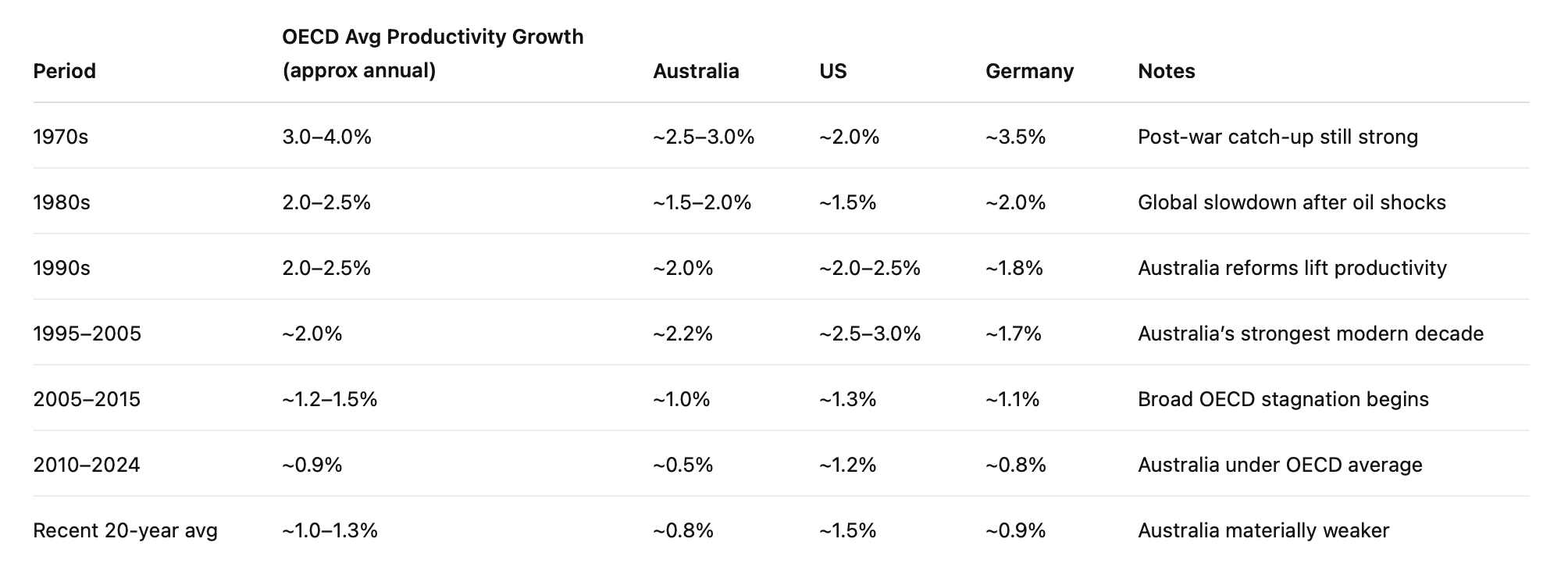
reply
dools
1 hour ago
[-]
Sounds like your employer would definitely be better off paying you to stay home …
reply