Or really buy any laptop rated highly by Dave2D or other reviewers that's 4 to 5 years old.
Different category to a 15” 2kg cheap 5 year old dell.
There's nothing in the market like them, which is a shame - I think a slightly better quality Minibook (Chuwis are plain crap) would be a very solid laptop.
Sure, I can blame Chrome and JS, but ultimately, the core 2 duo and 8GB RAM did not keep up very long.
I bought a tablet from this brand few years back. Screen edges were non responsive to touch within months.
the brand is trash.
It is being thrown away in the first place for a reason.
I also just acquired a 2014 MacBook Air for two packs of coffee to use as a distraction free tty writerdeck and toy around with, as it's my first piece of Apple hardware.
What's wrong with them? The M1 was popular and now people selling them are competing against a lot of other people selling them which suppresses the price. Like it or not, Macs are mainstream and therefore aren't going hold a "magic" high price.
13th Gen Intel, 14” screen, 16GB/512GB at about $350.
Lenovo and Dell both make similar business laptop models at around the same age and price point.
Businesses sell off perfectly functional laptops in bulk because they are on regular refresh cycles for employees, not because there’s anything wrong with them.
On the Mac side, MacBook Air M1.
I will note that I also had the screen rotation issue described in the post, but it was easy to solve at the desktop environment level in COSMIC. I didn’t bother dealing with it elsewhere because I honestly don’t mind if the grub menu is sideways.
They're sometimes an odd size, but when I hit the wrong key due to a sizing constraint, I don't even have to think: Backspace, hit the right key with mildly adjusted positioning.
I've tried a few machines with different layouts, and that's never the case - and having to stop and look at the keyboard to find a key interrupts flow in the worst kind of way.
https://www.zdnet.com/a/img/2014/10/03/9f923860-4b47-11e4-b6...
My T14 has even a dedicated slot for a SIM card.
At least with Lenovo laptops, that is very common. You con't need to order the laptop with a radio; it can be easily upgraded.
(Note: My estimate on this is purely based on Apple implementing/expanding the use of their own cell modems, which also includes their wifi chip. It seems logical that they would quickly adopt the same chip for wifi in their laptops, thusly getting LTE/5g 'for free'. Definitely no insider knowledge on this)
https://www.macrumors.com/2011/08/14/photos-of-a-prototype-m...
I think it was a year or two latter I got a Chuwi Lapbook 12.3, which was a great machine. Lovely 3:2 screen off the Surface Pro, again a pretty good Intel small-core set-up, decent ram, ok SSD, all so cheap. Great metal case. Lovely machine, at such a great price. https://www.notebookcheck.net/Chuwi-LapBook-12-3-Celeron-2K-...
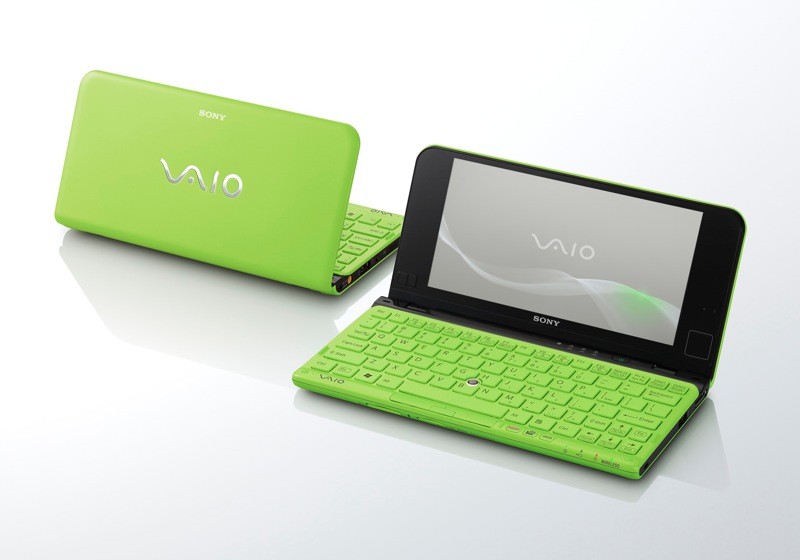
I’d love to see someone retrofit a modern soc into the vaio p motherboard form factor. There were a few partial efforts on GitHub but seems like Sony’s miniaturisation skills remain undefeated.
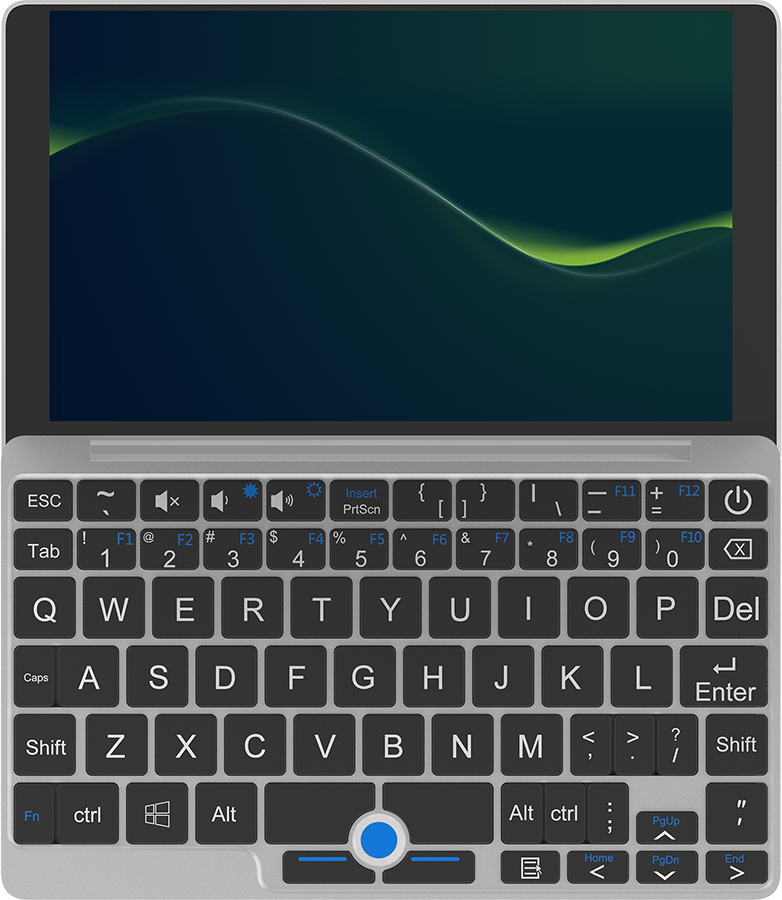
I can't say I agree with the author's assessment of the keyboard in this submission. I find it more pleasant to use than the other laptops I have access to.
At least it can charge off a powerbank, but that's pretty standard now.
As others have noted the company has done some pretty shady things with some of their other products, and I would not really expect a warranty, so this isn't really a recommendation. But my personal experience after ~six months of use has been good.
I'd rather not have to underclock the RAM and be careful in which order I plug my USB hubs in order for the system to be stable even if I still end up with great performance.
I used to play with omarchy. It is good enough for a lot of use cases. For powerful work I just connect to remote session.
Perfect for planes in economy
It's actually the keyboard that surprises me the most: I think it's really good (and I consider myself a bit of a keyboard snob). I've never had any issue like the author describes, of having to strike keys just-so.
I think my desire for this kind of product is something lighter, but this set of notes on the Chuwi feels like the compromises GPD gives you but with less power.
I had no idea other vendors like Chuwi were providing netbook like devices. I will be doing more research tonight. Great post by OP!
Lots of 15.6" Windows laptops come with 1080p screen which is painful to look at.
Nowadays it’s probably a performance / battery saving “feature” attempt.
When film is converted to 50 Hz TV, the film is sped up 24->25 fps and every frame shown twice. When converted to 60 Hz TV, there is "2:3 pulldown": every even frame is shown twice, every odd thrice. (Actually, both PAL and NTSC have interlaced video modes, with only every other line updated each frame, so as to conserve bandwidth.)
BTW, when 60 Hz computer monitors were introduced in Europe and used in office spaces with fluorescent lights with passive ballasts that flickered at 50 Hz, some sensitive users suffered headaches from using the computer screen for too long. These days, both fluorescent lights and LCD backlights tend to flicker at much higher frequencies that it isn't much of a problem.
[1] generally 24fps because that is culturally what film looks like and people get very weird whenever anyone tries to fuck with it
But actually interlaced content exists too. Each field is independent, there's no frames to speak of.
Early video game systems based on NTSC/PAL ran at 60 fps or 50 fps, but ran off-spec signals to always hit the same half of the display lines (odd or even). 4th gen systems (genesis/mega drive and snes/sfc) had a few games that used interlaced output; later systems had many, running PAL@60Hz became a common option too.
It was Japanese, naturally.
At linux.conf.au 2007 we chose a smaller conference bag, designed to carry your electrical accessories and nick-knacks... it turned out to be the perfect size for the new EeePC (and later the MacBook Air 11").
You (we) are old :)
16GB ram is cool though.
PostmarketOS has a small handful of Snapdragon 870, 865 tablets (~5 year old, Cortex-A77). But it feels like it's by hook & by crook. Meanwhile it feels like bootloaders are just getting more and more locked down, making it less interesting whether mainline Linux support developers or not.
I'm a big believer in cheap, small, low-power laptops. For simple tasks, you don't need that much compute.†
But you can't skimp on the keyboard! Especially because, one of the big advantages of a low-power laptop should be for writing!
------
† Okay, Electron exists... you shouldn't need all that compute.
I don't share the complaints of the OP about the keyboard or the screen, though. The keyboard is fine, I can hit about 110WPM on it, slower than my regular pace, but enough that there's no dramas. The layout is great: Occasionally there's keys that are too small (looking at you, apostrophe) but everything is at least in the right spot, which is way more important.
The 2K display at 10" is high enough DPI that everything is totally crisp, and you can unlock ~95Hz (bad for video, good for everything else) with a bit of a tweak. You can also smash a byte into the EC at the correct offset and access the full unrestricted BIOS -- mostly to crank the RAM up to 4800MT/s.
I'm running vanilla Arch with Niri and Noctalia, and it's a dream. It's my primary dev machine, used in combination with a remote server with a tonne more grunt. If it broke tomorrow, I'd buy another - and I wouldn't do that with my macbook.
To the OP:
* Accelerometer support, EC-byte-bashing to get BIOS unlock: https://github.com/greymouser/minibook-x-tools
* 95Hz EDID fix: https://github.com/sonnyp/linux-minibook-x/issues/7#issuecom...
Getting from zero to a fully working OS was a mild journey, but I'd do it again.
Client side (device) sets the current draw. Weird take to not use the supplied psu.
So, unusable for blind typing.
920g for a 10" is also crazy much. LG make 14" laptops under a kg.
I want something like the Sony Z4 tablet. About 600g with keyboard dock. Thin, waterproof (not the keyboard), days of standby, 4G supported, the keyboard was excellent.
If it would be possible to run a current version of Android on it, it would be perfect.
I do have my ASUS EEEPC 701 4G Surf still working. I think it is 18 years old at this point? It is rocking Antix, in its 3.6 GB hard drive. It broke the S key in the keyboard last night and I ordered a replacement.
I use it as writer deck and to ssh to my server and raspberry pi from the sofa.
It is built in a very resistant way? Survived my kid so far.
They're Android tablets with non-removable keyboards.
The idea of a netbook was very small, cheap, portable, full-featured computer that you could use like a normal computer.
All the ports, your desktop OS, and so on.
Chromebooks ain't it, even if they compete in the market segment that made netbooks a success.
I've done that with mine. Worked great, and now I get around 30 hours of battery life with a lean linux distro, as long as I'm only like reading websites or writing on it.
How's the Windows support with this flow?
For a list of devices: https://docs.chrultrabook.com/docs/devices.html
All of them, specifically.
I don't want to think about which windows program can or can't run with Wine.
This includes:
* Microsoft software, from MSTeams to Windows itself
* Audio production software (DAWs and VST plug-ins)
* Games
* Device-specific software (like drivers/software for portable thermal printers)
* CAD (nTop, only supports Windows, for example, and don't tell me I don't need it; same for many Autodesk products. NX and Rhino don't have Linux support)
The last one is the most fun, as I'm a CAD developer who worked on nTop in particular.
Also drivers are often better on Linux.
How's nTop Linux support coming along?
The hardware feels great to hold (though the touchpad is still meh). I covered the Google logos with a glossy black vinyl Obsidian sticker.
As a data point: I'm 100% converted personally. A Chromebook is what goes into my backpack and the device I use for all my general day-to-day UI clickery, and it's a better fit for my needs than Windows (not nearly as bad as it used to be but still sort of a PITA to make work as a Linux-focused dev environment) or Linux (not nearly as much of a PITA for a connected consumer network device but still has the occasional wart trying to get something weird to run).
Run Windows and Windows programs that I use.
> it's a better fit for my needs than Windows
Happy for you. The key here is your needs.
Well... yeah. Likewise your post is clearly about your needs, which are different. But that's not what you said, you said it "wasn't a computer" and you couldn't use it "like a normal computer". Which is obviously wrong. But I guess "normal computer" means "windows" to you, which (especially given the forum you posted on!) is a little surprising.
So what you wrote (but apparently not meant) seemed mistaken to me, thus the correction. But if you want windows then just buy windows. Your market is well served.
Normal computer means a choice of OS to run on it without having to hack it to do that job.
Chromebooks aren't sold as general-purpose computing devices. They aren't "normal computers" in the same sense that cell phones aren't.
>which (especially given the forum you posted on!) is a little surprising.
I'm a CAD developer and user. I need Windows for my work.
I would hope that this forum includes people who are in touch with the real world.
That's too high a standard. When we consider MacOS along with Windows and Linux, there are basically no computers that let you freely choose between all three without hacks.
And even just considering Windows and Linux, a big chunk of the laptop market only supports Windows properly.
A laptop that runs any normal desktop OS is a normal computer.
If you must use windows, then you must use windows and you don't have a choice. None of that has anything to do with the nonsense about Chromebooks not being "real computers" or whatever, that's just the rationalization you've decided on. Obviously they are real computers.
Psh, Fuck that. Install actual Linux on it (I have Debian on mine) and don't deal with ChromeOS (if you don't want to).
A Chromebook is a first class consumer device backed by a Big Threatening Tech Giant that works on all sites everywhere because no one wants to piss off Google. And it's still Linux and runs great. I'll take it.
I was too, and then AI came out, and now Codex just makes my Linux work how I want it, no needing to fiddle with .config/gconf whatever crap. I just tell it to fix my two finger scrolling on my trackpad, and it does it.
– Linus Torvalds
If you are an adult, able-bodied human male, and you even notice a laptop being "heavy" becauase it's over 1000 grams, I am sorry but your health is fucked. I am not a strong man. But if you are so weak 200grams extra or whatever bothers you, sort your life out. Seriously. You will feel so much better.