If I had to highlight the one thing all those conversations had in common it would be precisely this:
I thought that having this knowledge would set me apart
Forever? That seems over-optimistic for all occupations in all eras.
For the rest of my working career? This really hasn't been true in a long time either, especially in software, where technology changes on the order of years.
For the duration of my mortgage? The fondest hope, but pretty much like the above.
For the next 10 years? Here is the big change. Even for fields like medicine, where knowledge really did set you apart. The AI can adapt faster. AI is inside the human OODA loop.
People who _can_ see the wood for the trees, and are able to understand multiple (sometimes conflicting) requirements and work out a way through that solves the problems that arise, for all involved parties.
An understanding of domain, the ability to communicate effectively and a mind that can think laterally, will all be vital.
In the future, those who succeed will be the owners of capital.
Something happened in the 80s, and it wasn't "the dawn of a new technology". It happened specifically in the US, and was done by their government.
Yeah, but we were talking about only success, not winning.
In the past and the present, you could succeed purely on a combination of skill, talent and labour. This approach looks like it will not work much longer.
You can also inherit talent, but "the descendants of those worthy are worthy" is a belief humanity spilled a lot of blood to get away from.
The results will hopefully be a lot more tangible.
I suppose, my best guess is that a team will be reduced to one or two people; the those that are left will be judged solely on outcomes.
Two (human) brains are always useful; the benefit of a human in these scenarios is that we can be accountable, and that we have a very real incentive to do well and not be fired. The LLM obviously doesn't care in that regard!
But there are other dimensions as well that differentiate people and determine their value to business, like the ability to be handed problems no one else can solve and stick with them through sheer stubbornness until solutions begin to emerge.
I think perhaps the problem is instead "I thought that having this knowledge would set me apart, forever, without me having to learn anything else"
If your argument is that the customer themselves could use an AI or whatever to learn plumbing, that was always an option (libraries, google, youtube). They pay you so they don't have to worry about flooding their house (or at least have someone else to blame).
They might be able to "one shot" simple fixes that you might previously have assigned to an apprentice, but believe me, AIs are not about to start doing complex things for the layman that actually required seniors previously in either programming or plumbing, because very few of those things were just "type better into a computer". (build trust, speak confidently, know what doesn't work, take responsibility, test without breaking systems, communicate and work together with other professionals, have opinions)
it's oft debated, but I do fall on the side of "you should still know maths even in the age of the calculator/matlab/llms". I have found productive employment, and indeed tickets to speak to the big boys in their gilded palaces many times because graphs and charts are their favorite toys and knowing maths got me there. They have always been able to make things with excel, with matlab etc. Often they actually can make charts themselves, but they don't care to become experts in what data is important and what isn't.
The LLM isn't yet good enough to tell you what data matters. People act like LLMs are magical gods that do everything, but it is but another tool. It has limitations, just as it has strengths. It is not ultimately convincing, it is not infallible, and experts will keep finding edge cases all the damn time. Anyone working with them every day knows this, and you need to know it too.
I could theoretically learn everything about plumbing but would still rather call a professional for the peace of mind that it was done "correctly" and it the process goes wrong, I would have an instant fix instead of trying to go back and educating myself on plumbing more.
Could you consider that as part of knowledge? Yeah and also no. Because the knowledge can be copied and put into a LLM but legally a LLM cannot sign off on things like NDAs or take accountability like a human has to in these roles.
We can argue about imagined future progress, but I don't see that getting much better, given that the literature doesn't often do that, and how often experts in one scenario end up being poorly suited given another set of facts.
Not producing holy code in the academic best language.
"Oh, we'll just ship production to China, and do the design and marketing in US, this is where the real value is anyway, China will never be able to do design and marketing as well as we do".
Literally same thing:
"Oh, we'll just let LLMs code, and we'll just do Taste. LLMs will never be able to do Taste"
It seems to me that knowledge doesn't always imply competence, but the lack of knowledge often very well explains incompetence. And, since the LLM is replacing the competence part without imprinting any knowledge on the one that wields it, it generates a lot of competent imbeciles that pass interviews and appear as though they not only do things, but know things as well. And once you reach that critical mass, sheeeeesh
The whole leetcode movement was designed to sell this idea that knowing a solution that can be looked up in a matter of minutes on the internet some how puts you astronomically ahead of those who don't. Strangely enough go look at that site itself and thousands submit working solutions to those problems.
Knowing a solution discovered by somebody the first time, is no test of capacity or ability to get work done. It would probably matter if you discovered solution to a novel problem by yourself. How does knowing the end result of a long process by other people decide your ability to do anything at all?
During interviews I have seen companies go to absurd lengths to justify these tests. Including asking candidates to imagine they might not have internet and might need to know these solutions.
The only skill that really matters in our line of work is today most popularly known as high agency lifestyle. And delivery skills largely depend on ownership. In my decades of experience with software work, not knowing a thing isn't even a correlating factor in getting things done.
they don’t want to be forced to reinvent themselves every five years because the world is changing faster than it ever has
While I understand where people are coming from to an extent that’s just never been my lifestyle and so when I see people looking for some kind of long-term stability I just kind of baffled at what makes them think that that was ever possible.
It’s like the propaganda from the American 1950s nuclear family idealism really got locked in in a way that people believe that there was a real thing
And while it was certainly true that American baby boomers got to ride the economic pax Americana that happened from 1949 to today, that period is over
While it is still possible for you to have a career your career is most likely going to change every 5 to 10 years now and that’s just a fact of the society that we have built
we did not build society intentionally
It was built via attrition and the current leaders are the ones who are fully committed to monetary based global domination
* The curve of AI improvement will continue at the current pace
* AI companies will have the capital continue to expand infrastructure
* there will be some kind of functioning economy if all knowledge workers are replaced
There are strong headwinds to all three of these.
Hey it may come to pass but it’s very speculative at this point. I see a lot of tech people simply overlaying the progress curve of previous tech booms which is reductive.
Frontier AI is already good enough to be very useful for engineering. It's too costly for many places where it could be useful today.
The cost for the same quality of output is going to drop at least 10x over the next 18-24 months.
And likely again in the following 18-24 months.
At the same time, the cost per watt is going to down ~25%, and at the same time speed will increase (also valuable since time is money).
How do you know that?
In 2026 the prices have been spiking. It now costs orders of magnitude more than it did in November.
April of last year you'd get 1431 ELO[0] from o3-2025-04-16 for $8.00 per million output tokens. April of this year you can get 1436 ELO from deepseek-v4-flash for $0.2 per million output tokens.
[0]: https://huggingface.co/spaces/lmarena-ai/arena-leaderboard
I can't use last year's SOTA model when my competitors can use the current SOTA model.
This is also baked in the eye watering valuations of model companies.
Lots of people can. Tools don't need to be top of the line to be useful. Snap-on may exist, but they don't put Harbor Freight out of business.
Advanced IDEs exist but complex projects were still built in vim.
The more capable the budget models get, the lower the marginal gains from using the frontier models, even if the frontier models always stay 6 months ahead.
You can use open source models of equivalent or better capabilities for ~90% less cost...
If you kick and scream hard enough, you can always find a data point to make sure you're correct.
No one is saying that the Opus model last year costs 90% less now than it does this year.
That's not how it works.
There are better, more efficient models with equivalent capabilities that are 90% cheaper (see DeepSeek v4 Pro).
Historic trends, every 18 months, performance for the same level of quality has gone down 90%.
See: https://www.reddit.com/r/LocalLLaMA/comments/1gpr2p4/llms_co...
And Chart 13 here: https://www.rdworldonline.com/ais-great-compression-20-chart...
And here: https://epoch.ai/data-insights/llm-inference-price-trends
The technology already exists now on the algorithmic front for the next 10x drop between everyone adopting DeepSeek's MLA, MoE (mostly already done), Medusa (a better version of Google's speculative decoding), Kimi's Attn Residuals, and Mimo's Sliding Window Attn, and (possibly) Microsoft's 1.58b (this may be a nothing burger).
Historically, algorithmic gains are only ~30% of the pie, but there's enough out there to get to 10x, with just what's available already. The other ~70% of the pie is better training data (often synthetic) and distilling frontier knowledge. There's no sign we are tapped out on that front.
> In 2026 the prices have been spiking.
That's not for the SAME level of output...
Regarding AI companies having capital to expand infrastructure; this is largely irrelevant. The cat is out of the bag, and you can already make serious gains by finetuning to local problems on a desktop machine. There is enough hardware out there to run these things en masse; it's more a question of power. Regardless, this stuff will always keep progressing, regardless of who is doing it.
Regarding the economy, it may be largely irrelevant if we, the people, don't do something very soon. The wheel keeps spinning as long as there are productive workers; it's just that those workers are being replaced by machines. The last year has increasingly demonstrated that you don't need normal people to buy your stuff to remain afloat. You can just keep selling amongst your rich friends while the masses starve, as long as _something_ is still producing what the wealthy want, and enough systems are in place to protect them.
I guess this is trivially true if you say "maximalism" (hell, the maximalists think it will speed up as the AI becomes a super-AI-researcher), but as long as the rate of change is positive and not miniscule, it's hard to predict what 2035 looks like in software development.
These things are very hard to quantify, but making the progress that happened from Jan 2025-December 2025 repeat twice in 10 years would be enough for me to say I couldn't predict the day-to-day of a software engineer in 2035.
> Work that introduces new methods, highly creative ideas, or solutions that have not been used or experienced before. More generally, an approach that introduces an innovative strategy to solve a complex problem.
Something that I've been thinking about for the past year or so is coming to grips with the fact that the vast majority (anecdote) of software engineering work is not novel (and maybe that's okay). Few opportunities lend themselves to doing truly novel work. Other than infrastructure work and highly specialized software, pause and ask yourself when you last encountered software were you said "how the hell did they do that?" or "damn, that's nice" (for me, the most recent was Ghostty). I think much of the angst that people have when they fear for their job is coming to the realization that LLMs can do most of the "standard" work that a lot of highly compensated individuals currently do. We've built livelihoods around this and the threat of that coming to an end is genuinely frightening.
Amd do it better in most cases imo. Which is also hard to come to terms with, because there is a good bit of elitism/entitlement going around. The idea that a SWE is working at a higher level, which is beyond the reach of mere mortals, so therefore the high compensation is justified. Meanwhile everyone is, for the most part, doing some slight variation of the same thing as you suggested.
After starting out working minimum wage jobs I've always thought that the work gets easier and easier from there. Compensation and hard work are negativity correlated.
Correction, essentially 0% of software is novel. Git wasn't novel. Chromium wasn't novel. Linux wasn't novel. Even C when it came out wasn't novel. Likewise Unix. They're all permutations of either prior knowledge, or evolutions of already existing concepts. They only might _appear_ novel to people who lack the depth to see what technology really is. Effectively applied physics (which has been solved for... over a few centuries at this point?) which itself is applied mathematics. There is novely to be found in physics and math themselves, but it's far out of scope of practical engineering.
Like every month for the past 5 years? The progress in machine learning is dizzying. It is astonishing what can be done now with text, images, audio, video, code, etc...
If you don't study it, however, you have no idea how it works or how to do it yourself.
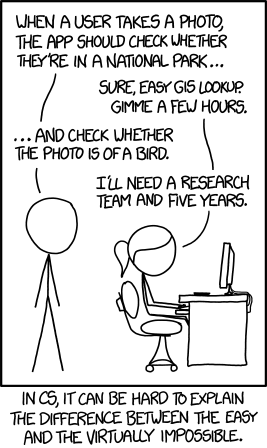
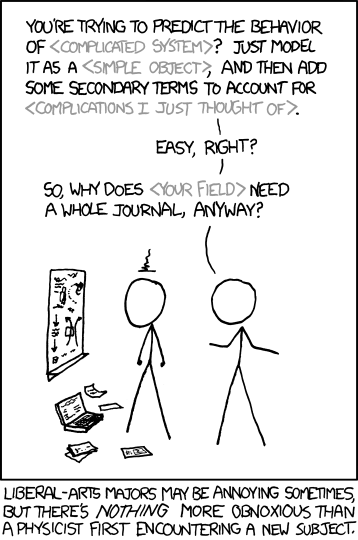
oblig. xkcd https://xkcd.com/1425/
AI is really good at making things that look like they work.
This is a steelman of your argument.
it's look like clean and polished but its full of mess, and duplicate code, no conventions..
we're generating code faster but at what price. but the real and deep project intelligence still a bottleneck.
They did. Now it's all JSX or htmx or some other favored template or DSL monstrosity. Most people do not write HTML or CSS, and haven't in decades. You're spot on.
This says nothing about quality, however. Quality of HTML/CSS is purely subjective. A website's presentation layer cannot meet any technical standard metric for quality in engineering or manufacturing such as durability, reliability, efficiency, or safety.
But where are Frontpage and Dreamweaver now ?
Parallels to the industrial revolution are apparent. And this is disturbing.
Until they go wrong because they are not good inside.
We’re in some weird stage of capitalism where everything is a grift and nobody really cares anymore.
I've felt this way for a long time now. There's no substance to anything anymore. The US economy feels like a more advanced Nigerian scam, where very few things that the US makes provides anything of actual value and substance. Americans just can't afford quality anymore. We decided we'd like to have significant amounts of garbage rather than fewer quality things. This change was likely due to revving the economy toward quarterly profit goals and GDP growth over everything else. Theoretically, prioritizing investments should have "trickled down" where companies could have more capital to invest in workers, R&Dand quality...but instead it all just got soaked up into executive pay and the stock market.
Once you start noticing private companies (like some restaurant chains) manage to both treat their employees better and serve their customers better than the publicly traded ones, it seems like a very consistent trend.
Having pursuit of endless growth to appease otherwise uninvolved shareholders might not be the best way to do "capitalism".
For the most part, people don’t need a thousand new features; the investment class does. Nobody gets mad at Craigslist.
The problem is... what can we practically do? When the village fish monger 200 years ago sold shoddy fish, you could go to him, give him a few whacks with his fish, and even if the fish monger didn't improve the quality of the fish he sold in response, you at least got some kind of feeling you got justice.
Nowadays? For most of the world, those responsible for the bad software aren't in the same village any more, for 95% of the world's population the USA is on an entirely different continent. Can't do anything to hold anyone accountable, with the exception of cancelling a 5$/month subscription LOL and yelling at some poor Filipino or Indian callcenter grunt. If you're among the lucky 5% that lives in the US, sure, you can file lawsuits if the problem is egregious enough, but that's expensive and consumer protection has been gutted. And doing a copy of a plumber's brother event? Might give you people treating you like jesus-come-to-earth but in the end you'll still face capital punishment for it, if you don't get taken out by the private security of the uber rich before you can even raise your gun.
Whatever the eventual solution to the problem you raise will end up being, it is certain it will not be pretty... bottled up rage is not good for any society.
I looked at some examples and couldn't tell the difference.
There is a visceral hate in the artistic community toward AI that doesn't really make sense to me tbh.
But pretty soon after that it's "Why am I paying a transcriptionist $3/minute when I can just have the machine auto-transcribe it and then my admin assistant can just scan it for mistakes."
Even if there still IS a quality difference between great writers and AI product, "good enough" is good enough for most customers, especially if you have to pay professional rates to get better.
Really? Have you seen how the CEOs marketed it and talked about people in that community? Artists hate it, because they listened to what AI community and leadership were openly saying.
The weirdest thing on this all is how people find the hate puzzling considering initial rhetoric coming from the industry itself. And current rhetoric for that matter.
"Why do you guys hate AI so much? All I did was tell you it's so great that it makes your skills worthless and how glad I am that I won't need people like you around in the future to make art and designs. What's wrong with that?"
It is just ... we insulted those people, told them they are worthless, when they want to talk about things they like doing we tell them they should use AI and then we act all puzzled they hate us. How could that happen.
And you can see it again and again.
There's a large amount of voices, both online and off, that are sneering. Between crabs in a bucket happy that software devs are being clawed down, and people happy thinking they no longer need us
I'm worn down by a cacophony of voices telling me I'm no longer wanted or needed. I'm very tired.
I'm thinking of this awful slop "art" I saw on Wayfair yesterday. As a surfer, it's hilarious. That's not how you stand on a board. It's not even a board. And the wave is terrible-- nobody wants to surf shorebreak like that! https://www.wayfair.com/decor-pillows/pdp/design-art-4-hawai...
I guess it could be a useful signal-- if you meet someone and they have it up in their home, you know they don't surf.
More generally, I think anything AI produces that's dense with factual details is inherently trash.
Mass unemployment equals riots equals an end to the status quo.
I take it you haven't been listening to what the guys at the AI labs have been saying?
Plus that's what the whole article is about. I'm not sure how you could've missed that?
Even if code typing goes away, a new breed of engineering will take it's place.
> Take copywriting. It was a profession that took years to master and paid well. This changed slowly as more professionals joined the market, even after the demand spike driven by ecommerce and adtech. Now, LLMs have destroyed the job for the vast majority of professionals.
No, it does not. There is no ceiling for complexity.
There are perhaps limits to useful complexity.
There are certainly limits to complexity people are willing to pay for. So if you are looking to make a living in development the fact that anyone will soon be able to do the basics and customise it for themselves is going to be a problem for you. Not directly, but because you'll be competing for fewer and fewer more interesting jobs that pay less and less over time (as development increasingly becomes a commodity task like waiting tables and stacking shelves), with the rest of us (maybe not me, I've already been unhappy in tech for years as remote work isn't good for my mental health, so I might bail early and beat the rush for those cushy table waiting jobs!).
> No, it does not. There is no ceiling for complexity.
There's an upper limit on everything. Maybe there's no ceiling on incidental complexity for s/ware development, but there sure as shit a ceiling on the essential complexity.
No ceiling.
with abstractions and complexity there's essentially infinite demand for software
It's quite hard to predict what will happen, but in a few years, I bet the unemployment rate of tech workers will be really high, we can just look at how many jobs are currently already replaceable but the owner of it is just lagging in the implementation of automation, it's probably already the large majority of tech jobs.
It's never been declared saturated, with one exception in the six months following the dot-com crash.
I've been in the industry since the mid-90s. I have not seen automation with the potential to automate away everything for the average office worker.
LLM will have an extremely large context window and extremely high communication bandwidth in the future. Therefore, even more complex large-scale software will emerge.
In my position, our team is clearly displaying "increased demand due to increased efficiency". I admit our position may be situational -- but my anecdote seems more substantive and speculative than "I disagree" from my vantage at least.
Tools/improvements have rarely been negative in such a massive way except rare instances, and even then society moved on and past those tools to bigger & better things.
How many people today seriously consider agriculture as a career prospect but almost all humans who lived in the last 2000 years worked as peasant labor on a farm. We are thriving in comparison to that period of time.
You: you're saying "it's different this time."
I don't know. It looks like AI really rots people's brains. As if that they just shut down their minds when they see an anything AI-related. Imagine if this article were about anything else, like:
Article: the stock bubble is going to burst because...
Comment: your argument boils down to "the stock bubble is going to burst."
It'd be so stupid. But somehow when it comes to AI this kind of weird comment is tolerated even celebrated.
The argument boils down to: this is exactly the same as other times. And provides multiple examples.
I feel that OP has reach that point because he went out of the basic tooling like Claude Code (at least in its default state) and embrace multi-model, automatic reviewing, fuse, loops and so-on, when it's done right, well, failure rate to solve issues is <1%, this is exactly why you arrive to that kind of depressing thoughts afterward and it's spot-on.
Many people will disagree because they are still at the vibe coding stage, not "as much as I can prompt will be automatically done stage". Claude Code imo is deliberately not implementing the best ways for users to work, they have recently implemented Workflows but that's almost a year late, many companies are doing this since always and that's just part of basic tooling nowadays.
People talk about models and benchmarks score while genuinely I'm baffled because they seem to ignore that that same benchmark can reach 99% by levering tooling intelligently, we don't really need better models (at least for coding), we just need adoption of proper methods. The day developers will discover that they are already able to solve 300 issues in a single day with ZERO supervision in complex Rust codebases, I'm sure they'll change their mind.
Our bottleneck in our team is currently just having the mental bandwidth to type as much as possible, it's kinda sad, it is becoming all absurd.
If you are still watching the output of the model for coding tasks, I bet you haven't challenged your own methodologies, yet.
The practice of writing code, or programming, in recent years has really fallen into two buckets:
The vast majority of folks are given a task, they write code to complete that task, and the task completion then counts towards some objective (eg; a new feature, product or fixing a bug). Perjoratively, they've been known as "ticket takers".
A much smaller group have instead worked in the other direction-- identifying where improvements can be made to a product, piece of infrastructure, or pain point and transformed that into tasks that can then be solved via code.
How much of a role you play in that strategy and formulation has been the real differentiator. Not so much what you know. While these are correlated, they're very different.
At a high level, it's been the difference between "developer" and "engineer" but the reality is the titles have become somewhat meaningless in recent years where many "engineers" are just doing the same CRUD tasks over and over.
The reason this matters is that at some point, you can only abstract so far... the requirements for what to build have to come from somewhere. At the most extreme case, there's only the CEO and a company that's nothing but AI agents. In the least extreme case (today) each line worker could manage 1 or more LLMs/agents.
It's not entirely clear to me or frankly a large portion of those in the industry that we're suddenly on pace for one outcome vs another. But I do think that software isn't particularly unique here other than it was an initial starting point for LLMs to deliver value. All white collar work is at risk including CEOs.
And if that happens it would be outlandish to think a utopia emerges... the opposite is far more likely.
Extremely formal syntax, limited ambiguity, simple verifiable testing procedures, and colossal well-documented training sets.
I don't yet buy that the successes of coding agents will apply nearly as well to other professions. "Correct more often than not when asked a random accounting question" really isn't any indication to me that they'll get there.
We became for AI what our clients were for us. Some hate it, some love it.
To feel safe in life our clients needed to have an actual business. Now when we are the clients of our AI we are scared, because now we need to have an actual viable business. Economic machine that works. Because the old model of just selling our time and effort to a client no longer works, when we are the clients.
TLDR: there will be less programmers and they will be better on average.
This entire section is backwards to me.
The current state of a lot of different domains I've been in is that they tend to center around 2-3 major, generic products that all get retrofitted to fit those smaller/medium-sized businesses. Now that the economics have shifted, it makes sense for those businesses to bring on software devs to build software tailored to their problem specifically.
And you can't compare copyrighting. It's a totally different field, with different goals and different time tables.
"Usually" is the keyword. Until it becomes "always" (counterintuitive for heuristic systems) or "almost always" some human experts will (/may?) be needed to babysit.
P.S. "_are_ usually right" since they are "LLMs". Methinks running the response through an LLM could've made it more "right".
"These AIs are usually right about things I don't know anything about" sounds like the textbook example of risky thinking though.
Wouldn't that be true for humans as well? If you have documentation explaining a rule and you read it, you may not need to reach out to coworkers.
Otherwise I think the author's concerns are 100% valid.
> > So blog with single post hyping LLMs. Oh and the domain name "human-in-the-loop". Call me suspicious.
> If after reading what I just said in the reply above you still think I'm an "AI shill" or "lab shill", there's nothing I can do for you.
Yes there isn’t. Because they look indistinguishable.
Replacement Inevitability with a human face, along with all the human concern; “I am part of it and it scares me.”
> Yeah, that's what I'm doing right now. I'm one of the engineers who's constantly committing to improve our agentic tooling, I use different models to do adversarial code reviews, I keep a toolbelt of skills and prompts, etc. I have effectively become the so-called "AI-native engineer" (gosh, I hate that term).
Some CEO gloating about replacing all-knowledge-work gets skepticism, eye-rolls and resentment. Someone in the trenches having human feelings about it generates both sympathetic and ecocentric fear.
---
And maybe autor intent does not matter? The original submission was massively “popular”. It served its purpose.
Literally today I got like 4 AI ads literally mocking "old people still using excel", trying shame and insecure people into some AI whatever product.
This is literally the first technology that is trying to scare and mock me into using it. All it actually does is that I am growing to hate it, honestly along with tech industry itself. Which I used to like.
The problem looks something like (not a real example): Type Z hours maximum A per day, B per week, C per month, D per year. E more hours than A is allowed every F weeks but no more than G per month and H per year. More than B is allowed... etc Minimum rest hours I per day, J per week, K per two weeks, L per month. More is allowed every 7.5 days unless it is full moon and maximum hours per day were exceeded at least 3 times in the last 82 days except from solar eclipses or if the Kings is married 12.5 years or if the employee gave birth in the last 472 hours.
My employer has software to make the schedules. It cant tell where shifting around shifts is possible but you can try do it and it will tell you why it isn't possible.
I was hoping to calculate if multiple shifts can be shifted around to facilitate someones day off. Sometimes it just cant be made to work but if people are willing and there is a hole you end up doing it anyway. (I've done a triple shift once because the coworker wanted to bring his wife to the hospital.) Employees earn undocumented days off... and then you end up with multiple schedules, the real one and the official one. Possibly extra copies depending on who knows what is really going on. This cant be the way...
Better just have modern laws that make sense in code.
In the 1990s when crypto went to court. It was determined that really anything coming from AI is protected speech. Very few exceptions, AI cant export a few things.
So you're never seeing AI go away, which means you need to transition/adapt.
This is just silly. It's fairly clear that the current design (by which I mean the entire concept of the deep neural network) has its limits and that they just aren't that good. We're seeing lots of other AI and software engineering brought to bear, but there's nothing 'inevitable' that means this is close.
"at some point" is so vague as to be irrelevant. Fusion might be the dominant source of electricity "at some point". Equally, AI knowing good principles could be 30 years away.
Don't assume that hard intellectual challenges are solvable on faith. Look at what's currently possible.
AI has always been a field where https://imgs.xkcd.com/comics/tasks.png applies heavily.
Maybe, but people have been saying deep learning is about to hit a wall since 2012, and many reasonable-sounding "machines fundamentally can't do X" have since fallen.
Feels like we're standing on a roof with floodwater up to our ankles - maybe it stops rising now, but we didn't foresee it getting anywhere near this high in the first place.
I do agree that progress will probably be more slow/gradual than others seem to predict, no "hard takeoff", but even being decades away is still relevant to someone starting a career in software development.
This is a particularly ignorant thing to say.
(Also, both might be out of reach of the current AI architectures)
It tastes bad, and poisons you slowly.
Some (less) food is produced on farms and kitchens.
It tastes good, and keeps you healthy.
I don't really care who/what wrote the code. I don't even really care about the code at all. What I care about is the end product.
The problem is not "code quality" the problem is that billionaire sociopaths have removed human judgement (and human morality) from the dev loop. This started long before AI.
Coders are hyperfocused on style and missing the substance. We are entering a world where rich bastards can produce evil software without any checks whatsoever.
At least when humans were required to write the code, they had to find and retain unscrupulous humans. Now they're completely unfettered, and we're soon going to learn the precise shape of the digital prisons they're constructing.
> They will come for finance, biology, law, marketing, all knowledge work. That's their stated goal and they're already teasing it with "ChatGPT for Health" and similar launches. They're working on "harnesses" for other fields, it's just a matter of time before we have "Claude Finance Analyst" or something.
…
> Beg to disagree. The models will learn good engineering principles at some point.
…
> Stop and think, don't try to predict the future using (bad) past examples.
Don't try to prediction the future based on the past.
Also, here is my doomsday prediction.
Thats kind of ironic.
Heres a more thoughtful take: everything is an s curve.
Things start out fast, then they slow down.
It happens in learning, in tech, in literally everything.
The question (unanswered) is where we are in that curve.
Will they get better? Yes.
A lot better? A bit better? /shrug