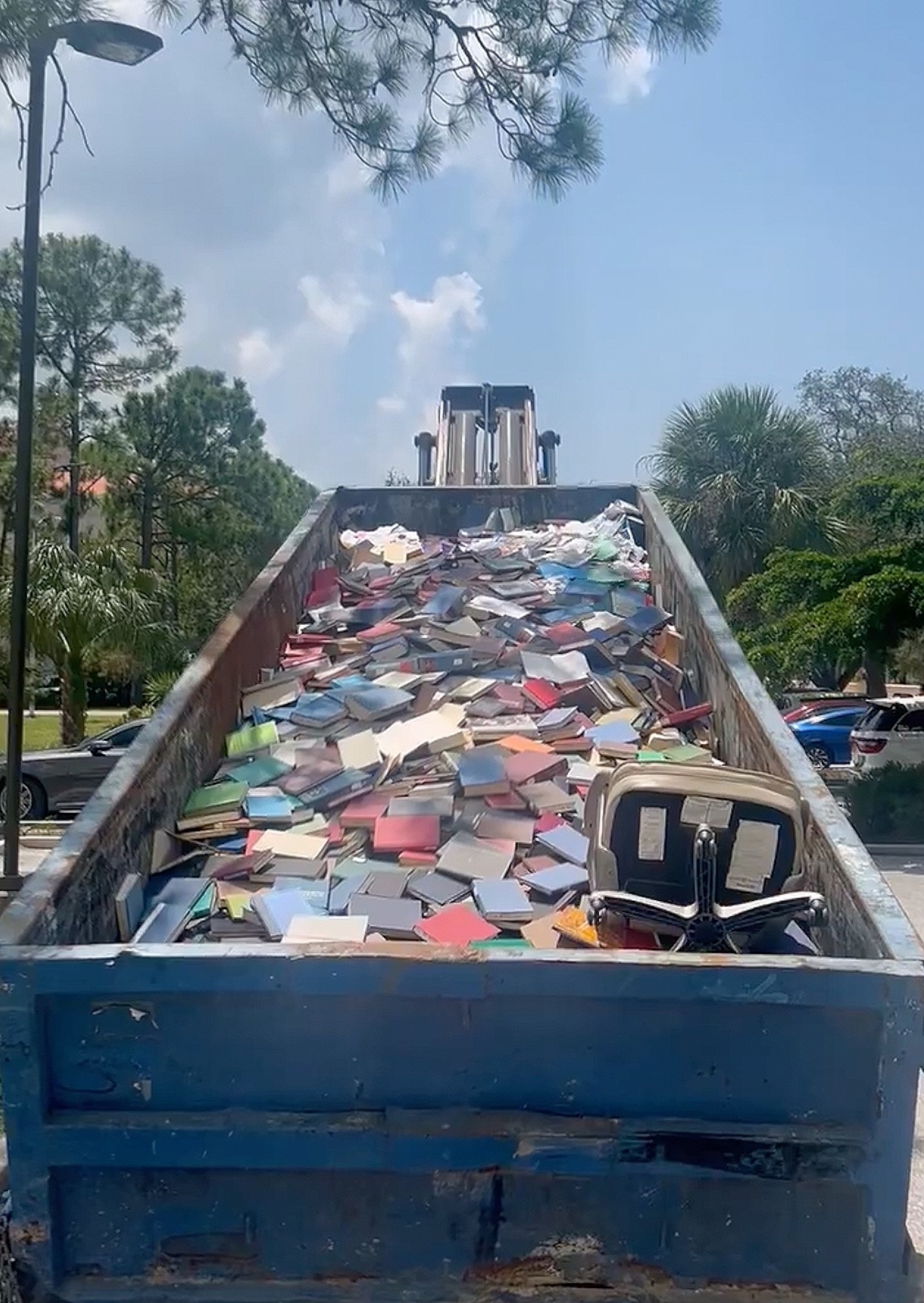
I used to work in a library, and this was often the case. Our basement was stuffed to the gills with romance novels that nobody was reading anymore, mysteries published decades ago, and kids books that probably related to kids from a previous generation more. A yearly sale would see the collection trimmed. Almost across the board, you could still get those books through interlibrary loan. If not from the county network, from another library in the state. In my time, I never heard of anyone missing a book that had been disposed of.
I rarely go to a library to loan a specific work - I go there to find a work. This means going through dozens of potentially-relevant titles, taking them off the shelf, quickly browsing through them, and taking the one or two best ones home. This entire workflow becomes impossible if the book isn't readily available.
A book hidden in a box in the basement, or which arrives after only a few days, might as well not exist at all. I'm simply not going to scroll through a list, order several dozen books solely by their title alone, and come back a few days later (if this is even allowed at all): it's just not worth my time.
The whole "we keep a copy in a central archive" approach only works for historical purposes, not for actually making it available for reading. If you do that you have to also make digital scans trivially available for browsing - and in practice that rarely happens!
If you are a software dev, go volunteer at a library and offer up your time to do this. Do something for your community, do something for yourself.
I ended up with a nice selection of books on nuclear energy and radioactivity including a nice non-fiction Asimov book on the neutrino and particle physics.
Libraries are always filled to the rafters. The only way to fit new books in is to take old books out. If they didn't, they would only ever have books from the 1940s when they first built that library.
(Taylor, Lunar Science: A post-Apollo view)
A last copy policy will ensure that when one wants to compare a first edition of _The Fellowship of the Ring_ against a second, one can get the full weight of Aragorn's snark:
>What did you fear that I should say? That I have here a rascal of a rebel dwarf that I would gladly exchange for a serviceable orc?'
If there is enough space to have a room full of books, it would be better used as a publicly accessible set of stacks. The only real reason to have a librarian-only room is for books that are rare and valuable.
Someone needs to take up Carnegie's mantle and finish the job which he began.
What's the limiting principle you propose? It has to be something real libraries and library funding sources can take action on, because they have to take real-world actions on them. So this is not a time for aspirational speeches or vague exhortations to "do more", which is the exact opposite of a limiting principle anyhow. What is "enough"?
As I noted, it's a pain for me to have to drive down to DC to get access to a book which _used_ to be in the local library system, but isn't anymore, or to purchase my own copy (which wasn't previously necessary).
https://www.abebooks.com/servlet/SearchResults?ref_=search_f...
In the first edition, he was depicted as a large creature, and Tolkien was upset about it, and in the second edition, changed the description to small.
This information was gathered by a rare book seller who's videos I find immensely interesting.
Given the number of books I've been unable to find when I wanted them save in the Library of Congress (which won't loan, necessitating a trip to DC, or finding and purchasing my own copy), and the number of times my ILL requests have been turned down, a last copy per system mechanism seems the best for preserving access.
Yale, Columbia, Harvard, Princeton, and NYPL coordinate on exactly this https://recap.princeton.edu/
This is hardly comparable to difficult philosophy books as mentioned in the article, though. To my mind, the poin of libraries is to house and make accessible difficult or challenging books that might not necessarily be popular. I was shocked when I first visited an American library and found large numbers of mass-market paperbacks and magazines. When I say 'large numbers' I mean 10 or 20 copies of books by Oprah or other celebrity authors. Librarians would have it that they're serving the community by making these books available in the library around the same time they're available in bookstores, ignoring the fact that once the publisher's marketing drive is over all those extra copies are going to be surplus. I do not understand why you would buy 20 copies of one book when you could have it and 19 other books.
My local Half-Price Books (a second-hand bookstore chain) has a vastly better selection than my local library.
University libraries of course might be a good exception to this rule. But your local public library should be a way to make reading accessible to the average middle to lower class family. And that means providing the materials they want to read - not what you think they should.
It's always going to be a balance for librarians. They don't get to operate in ivory towers disconnected from those local taxpayers whom fund them.
These libraries do not coordinate the deaccessioning. If it ever gets down to 2 copies, there's a non-zero chance that they will deaccession their copies simultaneously, and then there are none.
You worked for a library. Did they ever check first to make sure some other library had a copy? Did they warn that other library "we're getting rid of ours, please don't get rid of yours"?
Resources:
https://archive.org/want/?mode=donation_book
https://help.archive.org/help/does-the-internet-archive-have...
https://help.archive.org/help/donate-books-app-for-ios-and-a...
https://help.archive.org/help/how-do-i-make-a-physical-donat...
When I got it, I read through it, solid for three days. Wow. Stunning look at a technology in its infancy.
The name of the Bookseller was Luma Kunda. Thank you Mr Kunda. I later learned from someone at the nearby bus stop, that Mr Kunda possessed an eidetic memory.
I would have loved to hear him tell stories about what he saw in the tarot cards.
Despite the frenzy of building at most American universities, the library is forced to serve dual purpose as space for study and collaboration as well as repository of printed material. The collection is not managed on merely its own merits, but subordinated to the other, competing demands even on its 'home' turf.
Decades ago there were rows and rows of bookshelves, with these bound magazines, going back to the 1880's. It was so interesting to look through them.
But now there was nothing, zippo, left of that. Just huge areas with completely empty shelves. Apparently it happened fairly recently, and the bookshelves hadn't been removed yet.
I asked the reference librarian where you could look through these, online. But she came up empty, unless you're actually a student and have access to their special subscriptions that may have these old magazines.
Many of my fondest memories growing up was browsing the bookshelves in my childhood home, discovering books that I remember to this day. Now I read almost exclusively on my kindle and the browsing experience is just so terrible. I feel I have failed my children in a real way by not giving them access to this.
I could not count the number of books I picked up and enjoyed, even if only for a short while, whilst I was studying at uni.
Here's another article about the same library, the Chester Fritz Library, acquiring one of the 11 remaining copies of a 444-year-old book: https://blogs.und.edu/und-today/2026/02/chester-fritz-librar...
Also, disposing of books when there are not actually space limitations, in order to create the supposed library of the future that has few books, is so new a phenomenon that it shouldn’t yet be called routine. Objecting to this trend is still very much appropriate.
20 years ago when I was in university, this trend was already picking up steam.
First they removed the historical newspaper microfilms (replaced with an online archive which could be searched)
Then the academic journals went online, allowing desk-bound academics to access them online.
Then the paper journals they had on the shelves got older and older, and the library became less and less a place of research, more and more a collection of textbooks for undergraduates and a place for quiet study.
And once the library decided to focus on being a study space, whiteboards and areas for study groups and laptop users became the order of the day. Smart whiteboards and projectors too, this being 20 years ago.
People see some value in the physical books themselves. They are sacred, discarding them becomes a crime against knowledge. Sure I get it, the nazis burned books; but these libraries are in no way comparable to that
But I do love physical books. Even unimposing books, I like reading them but also touching them, their smell, their covers. And for art books, I think it goes without saying that the experience of the digital version is markedly different to the physical version.
I love going to a used books store and simply perusing their shelves, occasionally buying something, and a digital library simply cannot replicate this.
Books are, I think, in some small way, sacred. And I don't want to associate with people who think otherwise. I don't think you get it at all.
I’ve fantasized (like other datahoarders) of personal archives - and I do have a few hundreds of gigabytes of textual content archived for myself and to LORA my machines into. Copyright law does make it hard to have a co-op of book scanners but I can scan all of mine for myself.
Perhaps the future will be universal access but in the event it is not, perhaps my children will benefit from the family archive - though a future Primer must necessarily sort out the vast quantities of it that are inexplicably fan fiction erotica.
My particular experience with book dumpster diving was when they were cleaning out the office of a former professor at my college, who had been a student of Dijkstra, and had nine binders with photocopies of the EWD archive [1]. I and two other students split up the books, and to this day I have three volumes of faded yellow copies of these papers. Despite the fact that these are all digitized now in some form it's still a chunk of history that I feel privileged to own.
You are indeed privileged. What you have gained by reading them, is more than an education: It would be a journey, to read them, and your commentary.
I picked up a science fiction book, in a recycle bin, that for the most part belonged there, except for one chapter... one short chapter-and after I read it, the world started to swirl... "Human language had by this time, become mostly telepathic." Thank you, Joe Haldeman.
And Thank you Edsger W. Dijkstra.
OTOH - I personally don't have enough room for real books, so everything I have is digital on a NAS. It's there, but "not the same".
Digitization reminds me of part of the plot of "Rainbow's End" (Vinge), where physical books get digitized, through a destructive process...
https://www.washingtonpost.com/technology/2026/01/27/anthrop...
Really, we need a gigantic bibliography project of some sort. These 2648 titles are the core computer science bibliography would be a big help. Or these 17,852 titles are the core 1970s harlequin romance novels.
>Digitization reminds me of part of the plot of "Rainbow's End" (Vinge), where physical books get digitized, t
He wasn't able to predict that they'd just shred the books without bothering to digitize them though.
Maybe publishers could have the right to purchase the books back at current list price or something if they want to block the shredding.
- It's fun to collect, to look at what you have.
- You can remember the books, by looking at your shelves.
- You /actually/ own something, instead of some random variable in Jeff Bezos' database saying you are /allowed to/ read it.
If everything is locked up in ebooks with DRM (Amazon recently nuked old Kindles to close a DRM loophole), culture is locked behind corporate paywalls.
>DRM
You're downloading them wrong.
Yes, that's what funds the creation of culture. If intellectual property is unprotected, then creators of that property are not supported.
Gotta love how as hundreds of billions of tax dollars are being misappropriated through corruption, state university books about to be trashed can't be taken home supposedly to prevent corruption. Nothing wrong with throwing away books, but let common sense prevail and people take them home.
Down with the oligarchy.
As an academic, the vast majority of my reading is on my Kobo, and I don’t think this particular medium encourages this. Sure, an e-reader is inferior to print books in terms of random access and keeping multiple pages open at once, but I don’t find myself skimming the way I might on a laptop screen or smartphone.
If it's some online article, though, I definitely skim. And I'd skim if it were printed, too.
* https://i.abcnewsfe.com/a/d4018abd-6789-46ea-83bc-092fddc313...
* https://abcnews.com/US/books-dumped-en-masse-floridas-new-co...
>Libraries will get you through times of no money better than money will get you through times of no libraries. --- Anne Herbert
When I was very young, my father retired to a rural county in Virginia where the county library was a carrel of used paperbacks in the basement library --- for each Scholastic book order, the teacher would remove a couple of books (as well as the promotional poster which my purchases made eligible), then hand me the box and the balance of its contents.
Like the furrow's length which I grew to feel in my bones by helping a neighbor plow his garden w/ a horse, I feel that quote in my soul.
>A home without books is a body without soul. (or words to that effect) --- Marcus Tullius Cicero/G.K. Chesterton
c.f.,
>No ornament of a house can compare with books; they are constant company in a room, even when you are not reading them. --- Harriet Beecher Stowe