* 51 degree field of view. Stated as being like you're working at a 24" monitor.
* 4 hours of mixed-use battery life with the case holding another 20 hours
* 132/136 grams depending on size
* Supports prescription lenses, easily interchangeable/swappable
Priced at $2195 w/ $200 deposit, arrival expected in Fall.
At a $2195 price point, it just won't be possible to have an ecosystem. All the other platforms mentioned were orders of magnitude cheaper. That being said, I do think AR has real utility, but the price discovery will take a while
It's been considered by all measures a flop. (I have one and love it).
Snapchat has a 2nd rate social media platform after a new audience, they already failed with hardware once, they lost all momentrum relative to their geo spatial ad filters and Lens make app (blew up during COVID).
I dont know convinces anyone that they are due for an Apple like moment in AR at $2k+ per glasses.
This is why VCs/PEs tend to not like founders.
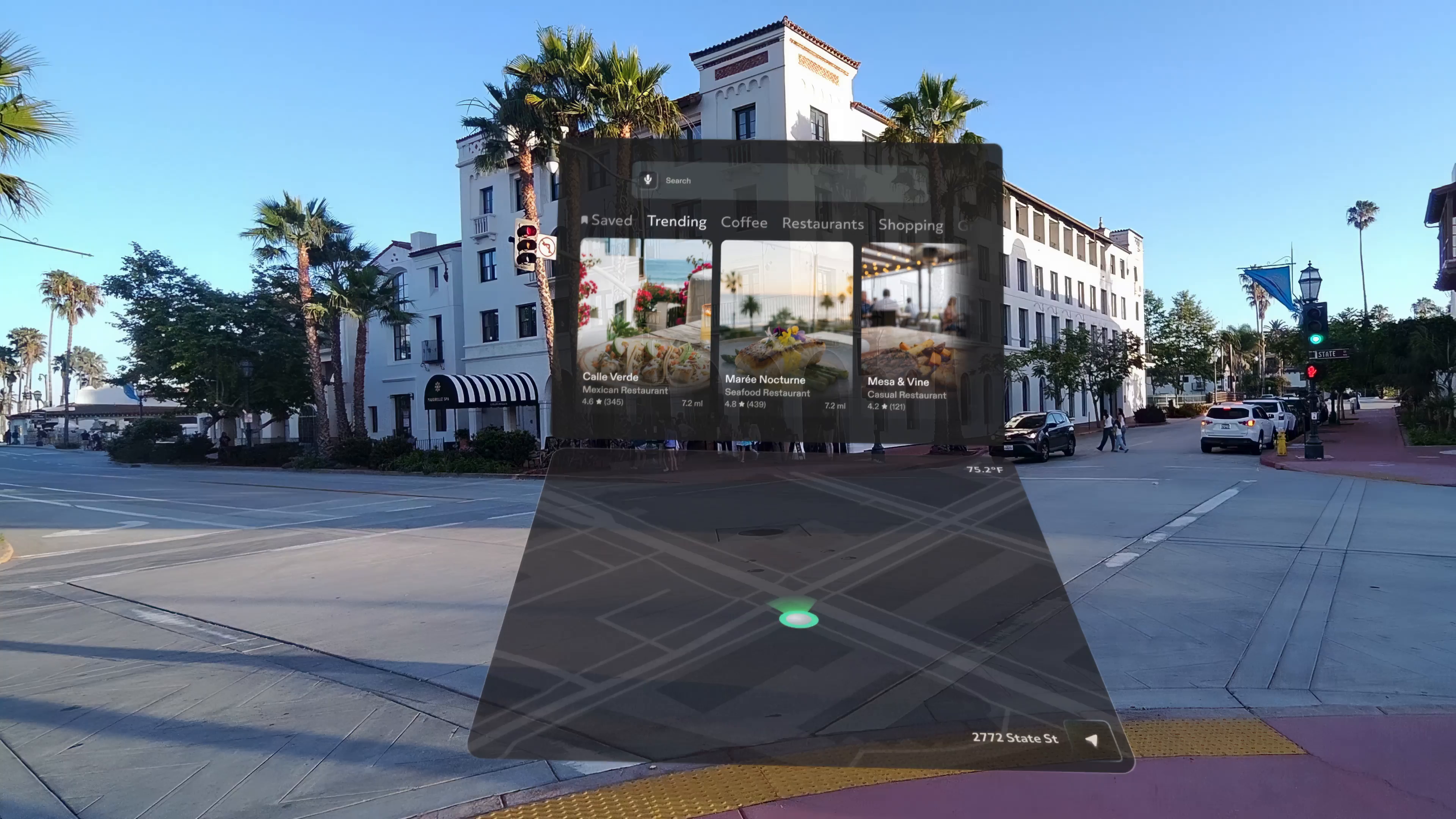
Not only that but the augmented reality images have their "location" on the wrong corner.
I can understand not wanting to use a real restaurant (i guess?) but if you are faking literally everything then what is even the point of the demo? I sort of assumed it would be an overlay of video taken from the glasses along with the re-created output... but this just seems like they created the visuals after the fact to match the recorded glasses footage.
Here is a link to their screenshot from the video: https://images.ctfassets.net/o1znirz7lzo4/4CwEXSX8icqDQAtDrD...
(Note: I would like to thank my years of delivering pizzas in Santa Barbara during college for the knowledge to debunk this video.)
Did I mention much cheaper?
Now, the ecosystem and the engine so far were designed for lower stake experiences but to make the purchase of this device worthwhile for average users, they will need Vision Pro app depth of thinking and attention to detail while fitting into the far tighter software and hardware constraints.
So the key for them is to lower the skill ceiling so creatives can tap into more of the juice, which is why they've announced an Unity to Lens Studio bridge and closed loop agentic coding, while making it more attractive for seasoned developers to use their engine and push its capabilities(native c++ sdk).
It takes quite a lot, but from what I've seen over a year developing on their kit and watching their platform evolve, their strategy has sound fundamentals. But they urgently need to tap into a broader and more diverse talent pool, like say Blender and Houdini artists, harware & robotics engineers, ML engineers, even music producers and sort of corral their attention into their platform long enough for truly novel and useful applications to emerge.
Dayum.
I do buy into the AR glasses future. They’re insanely cool tech. Meta makes a great one.
- The price is actually competitive. They want to compete with Meta's Orion. However the product is ... lacking. None of the demos actually show-cased the dual wavelength display. The current usecases are available today at Meta Rayban Display for more cheaper and more polish.
- Dual snapdragon, and i assume one is dedicated to CV alg / scene-understanding/slam, without an external puck, i wonder how the thermal performance would look like.
- Looks very ugly, C'mon. This is the same team that desigend the original spectacle? where is Evan?
- I liked the Los Angeles text on the side. well-done.
This sounds slightly like Texas Instruments DLP (digital light processing) in that there's something actually physically moving. Does anyone have any more info about what this actually is?
See? It's possible to support older tech
Off course, this would mean less lock-in for everybody and we can't have that.
Gotta love that no matter how much the hardware advances, the optimistic, advertised abilities of AR have significantly reduced over time.
4 hours of use. To what, do turn by turn navigation? Play that stupid game that's just an escape room but poorly implemented?
Is that really all you offer?
It took me a year of confusion and throwing darts in the void before I finally began to see what this form of computing might represent. And that gain of clarity happened _thanks_ to deeply synergetic advancements in AI model capabilities and more recently with agentic coding which freed up the bandwidth to operate on higher level interaction and geometric primitives.
AR in isolation is nearly useless, but in conjunction with other domains and the environment it begins to make sense.
In my opinion, the ideal environment to nurture AR development looks a lot like Bret Victor's Seeing spaces. A lab, tools, devices, surfaces, combined with spontaneous, open-ended, and somewhat continual interaction and learning. https://worrydream.com/SeeingSpaces/
They've also announced a C++ native dev kit, as until now you could only use JS and TS withno node libraries. I think this specific update might have an outsized downstream impact on the ecosystem.