But why are there no near-term products? If you can cut through granite and such this way, it ought to be useful for other cutting jobs. There should be useful tools, such as small units for drilling pipe holes through concrete and rock. Going for a 10km hole as the initial product raises the suspicion that the real product is the stock.
No need for an expensive containment dome, or expensive plumbing. If anything goes wrong, the nuclear fuel is already a mile underground. When the fuel is used up, they can leave it where it is since it’s below the water table. No need for expensive and hard to source highly enriched uranium.
The hard part is digging the wells, but that seems trivial compared to Quaise, who’s trying to dig 3-20km wells. The Deep Fission wells can just go anywhere (perhaps next to a disused former coal turbine?).
And even if you are stupid enough to actually do this, the fuel efficiency will be terrible. Your only negative feedback for fission is the Doppler effect and thermal expansion. So you will only be able to utilize a tiny percentage of the fissionable materials.
perfectly safe /s
What could possibly go wrong!?!?
seems it usually happened at lesser depths, and for ones deep enough to contain debris, the main effects were geological, from the actual explosion? not what i expected tbh
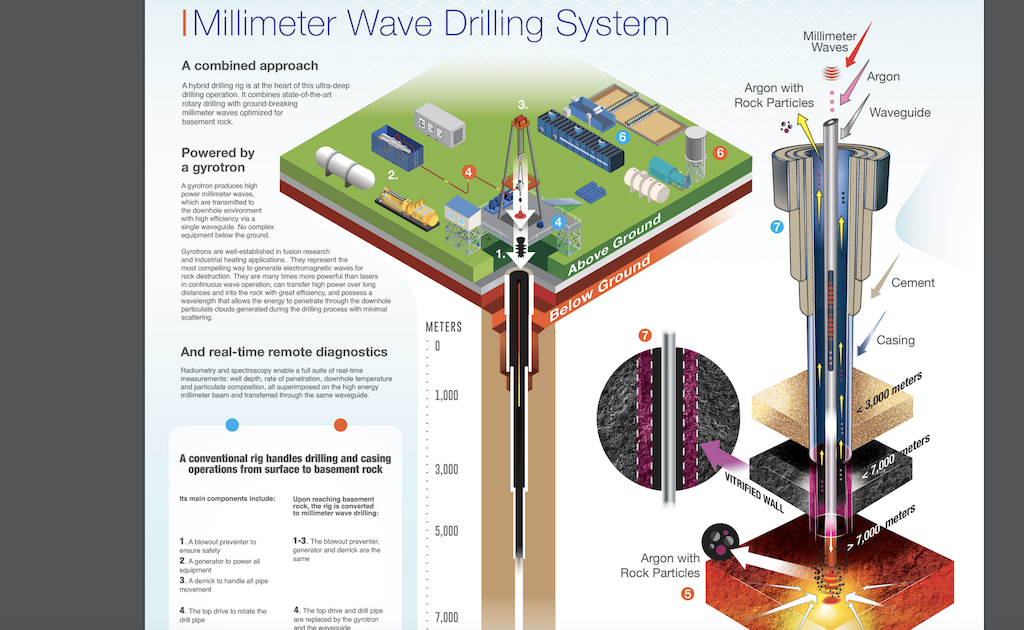
"For the application in EGS drilling, this device uses a metallic waveguide to carry the millimeter wave (MMW) beam to a standoff distance from the crystalline rock. Argon gas is used as the waveguide fill medium due to its ability to stay transparent to MMW’s at such deep depths and thus higher pressures [12]. Purge gas is also used to pump out the excess material that has been transformed into smaller particles (Figure 2.4). "
As a former geologist involved in drilling, thats going to get real expensive, real fast, in terms relative to regular mechanical drilling thanks to the requirement for argon. Perhaps theres an economically efficient changeover point at depth as mechanical drilling becomes less capable due to increasingly plastic deformation.
It's possible there exists a material that is transparent to mm waves, airtight, and can survive the conditions at the bottom of the hole. In such a case they could cap the waveguide and prevent any gas leakage.
I'm quite sure Quaise is well aware that Argon isn't cheap and are already exploring multiple avenues for reducing its usage.
It is interesting that they have to use Argon instead of the more typical Nitrogen or SF6. A waveguide with such a significant pressure differential is decidedly unusual and a unique challenger for what they are doing.
I doubt argon is the purge gas.
I'd be curious if anyone (perhaps the parent) knows why – my assumption is that it's more expensive and/or not as reliable to drill higher up with mmWave, not least because the ground might be uneven materials, etc., and then it becomes something predictable and harder to rotary drill lower down, incl. as you would spend more time doing things like replacing bits low down and sending things up and down?
To be clear though, I'd love to have one of these rigs on my old project and compare rate of progression and hole quality. Particularly when establishing the hole in sedimentary gravels and clays. I imagine casing will still be required.
One thing that I'd be concerned about is the ability to collect samples if most of the material is being vaporised or melted. Similarly, the cooking of the side of the hole on the way down could make geophysical responses much more difficult to interpret. Sonic velocity would probably increase, televised would probably be harder to interpret, harder to spot hydrothermal infill in sedimentary cover, would it affect gamma tools (probably not)
Edit: also wondering how the hole holds up around aquifers. Does the super heating cause wall instability immediately above the non geothermal aquifers as superheated steam is created? How does this affect the hole stability if we are not casing?
Edit 2: if we are not casing, how does the hole hold up around aquifer sands, loose fill, fractured or brecciated mass?
Edit 3: Also! Do we ream open the top of the hole to down past the last aquifers before the geothermal horizon? If not, how are we stopping stopping aquifers interplay and interaquifer contamination?
Some shale formations in Michigan, for example, sometimes requires drilling to a 4" thick target. You don't know the exact depth because the depth of that 4" thick layer can vary by many feet from an another spot 100m north/south.
I'm aware that if you search "thickness of Antrim shale" or "thickness of Collingswood shale", Google will happily tell you that it's 20-40 feet thick, but for modern drilling techniques, the economics of the well depend on hitting a much more narrow target than that, which can be delicately guided in by analyzing fossils that come up.
Nice article on an earlier demo: https://newatlas.com/energy/quaise-energy-millimeter-wave-dr... ; linked from this (nice but lots lots of ads): https://newatlas.com/energy/quaise-energy-millimeter-wave-dr... .
Company https://www.quaise.com/ on YT https://www.youtube.com/@quaise
MS thesis (2024; browsable) on the vitrified wall, for that and its intro: https://www.proquest.com/openview/624989df3cdd8055a6cee9affc...
Search for papers "Millimeter Wave Drilling for Deep Geothermal Energy Production" https://scholar.google.com/scholar?hl=en&as_sdt=0%2C33&q=Mil...
Very interesting application of radio waves.
I wonder what their transmission voltage is. They're talking about a 1km deep shaft. That feels like a lot of conductor to get to 1MW, unless you can send at 20kV or something high. Reciprocally though if you're not transmitting major force through a drillshaft, perhaps it still is a major net win for cost.
Figuring out heat management down there feels like it would likewise be pretty tricky! Again I wonder though how that would compare to the heat generated from drilling and how much management/circulation that requires.
They generate the RF on the surface and transmit it down the borehole thru a waveguide, so it's only limited by arching in the waveguide. Since we only need power transfer and don't care about multimode propagation, the waveguide diameter isn't limited, and probably on the larger side to reduce copper losses. And the heat management is provided by blowing argon which also carries abalated rock particulate to the surface.
See the schematics here: the schematic here: https://www.thinkgeoenergy.com/wp-content/uploads/2021/03/mi...
For generating the highest possible power of radio waves, vacuum tubes remain the only solution.
This drilling method resembles more a microwave oven (which uses a magnetron), than a laser.