Deciphering Basmala
32 points
4 days ago
| 7 comments
| blog.plover.com
| HN
farhanhubble
1 hour ago
[-]
I started my software career maintaining and forking Unicode parsers. Arabic, Hindi, Chinese and Thai among many other complex languages. It was great fun and it helped me get a deep understanding of how complex writing was and appreciate the beauty of being able to reduce this complexity down to data structures and functions.
reply
tekacs
3 hours ago
[-]
﷽ <- the single codepoint the author is talking about.

It's pretty great fun pasting it into various text entry fields to see how they behave.

In standard-ish single-line-ish Apple text fields on my Mac (iMessage text entry field, Chrome Omnibox), it renders like this, which... I'm not sure is correct? https://cleanshot.com/share/0GkNJGQ7

On the other hand it renders akin to Chrome in TextEdit.

reply
girvo
12 minutes ago
[-]
The Super-R run-command dialog on Windows, and Notepad make it look crazy
reply
Centigonal
3 hours ago
[-]
That iMessage rendering looks correct, just typeset differently.
reply
tekacs
1 hour ago
[-]
Thank you for sharing! I wonder what distinguishes e.g. Omnibox/iMessage from TextEdit/Chrome textareas (especially since iMessage's entry box can be made multiline) to cause the divergent rendering!
reply
Alien1Being
3 hours ago
[-]
Arabic is a beautiful language.

Seeing Arabic calligraphy has made me add Arabic to the list of languages I am very slowly teaching myself.

reply
noufalibrahim
10 minutes ago
[-]
Yup. I practice western calligraphy but haven't been able to make much inroads into Arabic. Partly because of the lack of high quality instruction material (which is available as books for Western calligraphy) and partly because of the complexity. The fact that it's right to left and I'm right handed presents some challenges too (my hand will come over letters I've just written and there's a risk of smudging them). The nibs are usually cut the other way and I'm still struggling drawing basic letters.

Islam prohibits representational art and so, except for a few pockets, all the skills of Muslim artists went into two things - Calligraphy and geometric tessellations (what's called "arabesque" and which you see on mosques, rugs etc.). The calligraphy itself has several hands (which is what we call "fonts"). The most popular one is called https://en.wikipedia.org/wiki/Naskh_(script) which is the one used for the copies of the Koran from Saudi Arabia. It's very legible and doesn't lend itself to too much flourishing. The Basmala glyph mentioned in the article looks like Naskh with the S of Basmala (س) elongated. There are others too. Thuluth (which is used in the copies of the Koran for ornamental work like the titles of the chapters), Nastaliq (which people often call Urdu or Persian because of how those languages are usually written in this hand), Kufic (which is an angular hand that overlaps with tessellations in ornamental work), Mughlai (which is a denser hand that's common in the Indian Subcontinent) and several others. There are even local variants with which you can identify geography. This style is specific to the Malabar coast in Kerala and, as far as I know, it's seen only there. https://en.wikipedia.org/wiki/Arabi_Malayalam_script#/media/...

reply
chrismorgan
2 hours ago
[-]
This is my favourite single character to demonstrate that you cannot lay text out without knowing the font, which people sometimes try to claim is possible in terminals: in some fonts, it’s 10em wide and less than 1em tall, but in others, it’s under 3em wide and perhaps 2em tall.

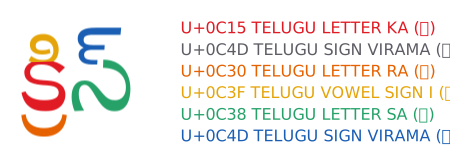
(If people aren’t convinced by that, my next area is complex text layout, starting with my name in the Telugu script, <https://temp.chrismorgan.info/క్రిస్.svg>, also augmenting that with how the r can be drawn to the left or underneath or even a little to the right of the k, which I really should add to that SVG file.)

reply
mjd
3 hours ago
[-]
I've been having fun getting better at understanding where the letters begin and end. Something like this is easy for me now:

https://commons.wikimedia.org/wiki/File:-516170388361w7xlt8c...

Next I'm going to learn the rest of the letters and try to start reading menus.

reply
othmanosx
1 hour ago
[-]
Arabic is so dense, and Quran came to perfect it. Reading the following verse from Quran, makes me proud that I'm a native Arabic speaker: "إِنَّا أَنزَلْنَاهُ قُرْآنًا عَرَبِيًّا لَّعَلَّكُمْ تَعْقِلُونَ" "Indeed, We have sent it down as an Arabic Qur'an that you might understand." Quran 12:2
reply
tamimio
1 hour ago
[-]
It’s interesting to see an article to decipher the sentence when I know Arabic handwriting calligraphy in different fonts! The “bisme” itself btw is also a combination of two different words. And “kashida” is a persian word not Arabic, the Arabic one is probably “maddah”.
reply
quuxplusone
35 minutes ago
[-]
> And “kashida” is a persian word not Arabic, the Arabic one is probably “maddah”.

I thought it was "tatwil". I could be wrong, though. An interesting article on Arabic typography, whose correctness I can't judge:

https://www.khtt.net/en/page/1821/the-big-kashida-secret

reply