The other side of this seesaw is: Games are fundamentally in the novelty business. Players like some amount of familiarity, but they want new experiences. Every game engine has a sort of "grain" to it where it tends to produce games with a certain look and feel. The flat-ish shading and floaty physics of Unity is a particularly visible example of this. So using a widely used game engine can put you at a disadvantage if you're trying to make a game that doesn't go with that grain and offers players something different.
As more studios consolidate on the same engine, more players will get tired of that sameness and reward other studios more. As more studios do their own thing, players will become saturated with novelty and the benefits of not using an engine will go down. There is no stable equilibrium.
I think this is a bit of a myth. Unreal gets this criticism a lot, but it's usually because many studios choose to stick close to the rendering defaults, which does lead to a certain look.
To that point, it's probably a lot cheaper to configure Unreal or Unity into a unique "grain" than it is to develop your own engine. It's also possible to use custom physics instead of those built into the engine.
Unreal Engine managed to evolve and expand the engine to the point where it is somewhat game agnostic, crytech became lumberyard under Amazon and died, idTech became the engine solely for iD games (ie the same business model as every other game or publisher custom engine).
iD tech's rendering pipeline is focussed on the one AA game iD are publishing that year and making that one game run efficiently and beautifully on mid-high end PC and current consoles. UE5 is focussed on providing tools for anyone to (relatively) easily make good looking games and applications that can be published to a wide range of devices.
Compared to other engines, making a new material asset is easy for someone less technical to do willy-nilly.
The flip side is the artists loose control and cannot author custom materials.
...which is a good thing tbh. No game needs hundreds or thousands of custom materials.
It may have been great, and lapped the entire industry, but it wasn't getting used very much, even internally at Microsoft. So how much value was really bringing?
that's exactly the argument?
you can do anything if you put enough effort in - but effort is finite, so in aggregate the distribution will cluster around the defaults
(Not being snarky - legit question)
Netflix shows often have a "house look" to them, because they enforce specific camera requirements and have a standardized / commonly-reused lighting setup -
https://partnerhelp.netflixstudios.com/hc/en-us/articles/360...
https://www.esquire.com/entertainment/tv/a61878509/netflix-s...
---
Marvel movies often reuse a particular pattern of color grading, that can give them a sort of 'similar grain' (see https://www.youtube.com/watch?v=hpWYtXtmEFQ )
hell most of these you can even guess the type of camera used even if you're a non pro.
0: https://agraphicsguynotes.com/posts/physically_based_shading...
As far as I know, the heaviest use of it is driving lighting volumes which by their nature are hard to notice fine details in.
Netflix enforces time-budget-nr of episodes per season and HDR tech spec requirements that seems to have lead to the single most recognisable “house style” in modern studios (a mix of tech specs and limited budgets I think).
So yes it’s possible.
Someone certainly could painstakingly replicate each badness of Unreal in Unity (and vice-versa), but until then, UE and Unity games often do feel like UE and Unity games. It's also rare to play a UE game that feels good and polished.
I think working around shader compiles is really tough in Unreal and you’ll struggle to get rid of the stutters even if you do everything you can there. But two games using chaos, UMG, niagara, GAS, and Mover can look and feel night and day different as long as that effort is put in. But it’s easy to not put that in.
> I’ve noticed AAA studios do less custom c++
Yeah - and I do think this is sad. You can take your custom C++ libraries and bolt them onto unreal quite easily, and it’s not an awful amount of work to expose an Unreal friendly API to it. 13 years ago I was tasked with replacing physx in Unreal, I can’t see (m)any studios wanting to spend 6 months on that endeavour these days.
I wanted to make a little editor utility (the UE editor is built in UE) that changed the way viewport selection was handled. I think I got to 5 layers of abstraction before I gave up. 5 layers, for a left-click object select.
People like to complain about the time it takes to ship AAA games and how huge the budgets have gotten... and then complain that the UE5 games all look the same. You either use some amount of systems 'out of the box' or customize/rewrite everything and burn $$$.
I open Microsoft Office on the web and the page reloads three times before showing me a list of files, then I open a document and it loads for 5 or 10 seconds, constantly reflowing, before eventually the entire page reloads again and eventually stabilizes, finally allowing me to browse and edit. After all of this, everything besides collaboration manages to function worse than what we had in Office 2003 two decades ago. This happened to all of software, not just Office. It happened to games, too. Delayed, over budget, underdelivered. No thanks.
You ask fair questions, but they're clearly loaded. Games are like any other project, and the desired scope for games has gotten enormous. If you don’t like those games there’s more indie and AA titles being released these days than there were AAA titles 25 years ago. An awful lot of that is down to Unity and Unreal.
> does it feel good to walk around in?
This isn’t a priority for every game. A bunch of the most beloved games have absolutely awful movement mechanics. It’s very often a deliberate choice to _not_ make player movement feel like either Titanfall or TLOU (partially because it’s an incredible amount of work to do that). Some really good examples are Witcher 3, RDR2, shadow of the colossus, the entire fromsoft collection. (And notice none of those are Unreal!)
> does it default to having a nauseating motion blur filter
Motion blur is super divisive. Anecdotally what I’ve seen is that most people just don’t care and there’s a very vocal minority who disable it. We had telemetry on a previous game and the number of people who opted out was minuscule. We gave an option for on/off on first launch of the game. It helps when frame rates are teetering on the edge of our budget which is often why we enable it.
> does it run at 40 FPS with minimum graphical settings on a $2000
What games do you have in mind there?
> even just "is this fun? challenging? interesting in any other way?"
This isn’t fair. Any game I’ve worked on has had the majority of the team playing every week, and the gameplay and design teams playing more often than that. You may not like the game, and that’s fine, and some games might be more vanilla than your liking, but those games are wildly popular. Personally - I think the praise Nintendo get for a simple platformer (which has excellent controls, admittedly) is way overblown, and people are willing to overlook that they’ve been shipping the same game for 20 years and charging more than most AAA games during that time frame. I also think BOTW and TOTK are wildly overrated - they’re padded out, clunky, with some of the worst mechanics in games (weapon stamina) on undercooked hardware.
But that doesn’t mean that other people can’t enjoy them.
So your choices are to tweak the defaults (which are not bad, but generic and the same as everybody else's), or rebuild the whole renderer (like ARC raiders did for example)
There’s the whole forward renderer path you can use instead, which works well on lighter hardware. Or you can use baked lighting instead of Lumen, and some people have created other realtime GI systems as plugins.
You can’t really change the material-shader pipeline though without overhauling the entire engine.
There are also a ton of parameters and configuration options you can change. These can be quite obscure and this is where small studios struggle.
Unless you shoot Fuji (where their absolutely incredible film emulation engine is one of the big differentiators), most serious-ish photographers shoot raw rather than jpeg, and do their own processing after, so the sooc jpeg look is largely irrelevant.
The problem is that companies are not willing to groom new engineers to get familiar with the code.
Meanwhile idTech certainly had issues, mostly in regards to dynamic levels, especially in older iterations, but "consistently rendering audio and video" was certainly never among them. It is well above the industry mean when it comes to the core of what a game engine is.
If that were the case then why do nearly all UE5 games suffer from the same engine stutter issues. And to OPs point, even if it can be optimized away, why isnt the engine in a state where the baseline performance for realtime rendering does not exhibit these stutter issues on the majority of games.
There are ways to make a player’s PC compile shaders before realtime play begins, but it takes some setup and smaller devs might not know how to do it. This is most likely the reason why stuttering happens.
On fixed hardware targets (consoles, Steam Deck) you can ship precached shaders as you know everything about the target hardware.
https://www.unrealengine.com/tech-blog/game-engines-and-shad... https://medium.com/@GroundZer0/what-unreal-doesnt-tell-you-a... https://therealmjp.github.io/posts/shader-permutations-part1...
This is just plainly not true anymore, as far as the current gen consoles (PS5, XBox Series X) go.
I just searched for every major/notable PS5 game built on UE5 specifically (i.e., no UE4), which wasn't super difficult, given there are 31 of them. I might be missing a few, but that sample should be representative enough.
TLDR: 28 out of 31 UE5 games on PS5 have a performance/60fps mode, making it a ~93% share.
P.S. For posterity, here is the list of games I used for this sample:
> Fortnite, Marvel Rivals, The Finals, Tekken 8, The First Descendant, Clair Obscur, Lords of the Fallen, Remnant II, Immortals of Aveum, RoboCop, Black Myth: Wukong, Silent Hill 2, Silent Hill f, Wuchang, MGS Delta, Oblivion Remastered, S.T.A.L.K.E.R. 2, Hellblade II Enhanced, Mafia: The Old Country, Talos Principle 2, Jusant, Still Wakes the Deep, Cronos, Until Dawn post-patch, Banishers, Fort Solis, Layers of Fear, Quantum Error, ARK, and The Casting of Frank Stone
Bundling and precompiling is not a fool-proof guarantee but it is very effective. Most often when a game has shader stutter the developers have not bundled or allowed the shaders to compile before gameplay starts (or it’s actually some other unrelated issue). The engine doesn’t do it automatically.
UE-powered games collectively earn 20+ billion worldwide annually each year. Unity-powered games also earn 20+ billion annually. This means that each year these "bad" game engines power more revenue than every YCombinator company combined.
Meanwhile, idTech, however technically amazing it may be, is so complicated to develop for that even id Software doesn't use it for every game.
There's a degree of toupee fallacy to this. It's hard to tell what engine something is on just from gameplay if the team invested in custom rendering and gamefeel.
I used to be able to pick graphics/physics engine by feel alone. PhysX and Havok used to feel very different. Quake 3/Half Life/Unreal used to feel very different. But that's all largely been paved over.
Actually I think I can still spot Crytek tbh.
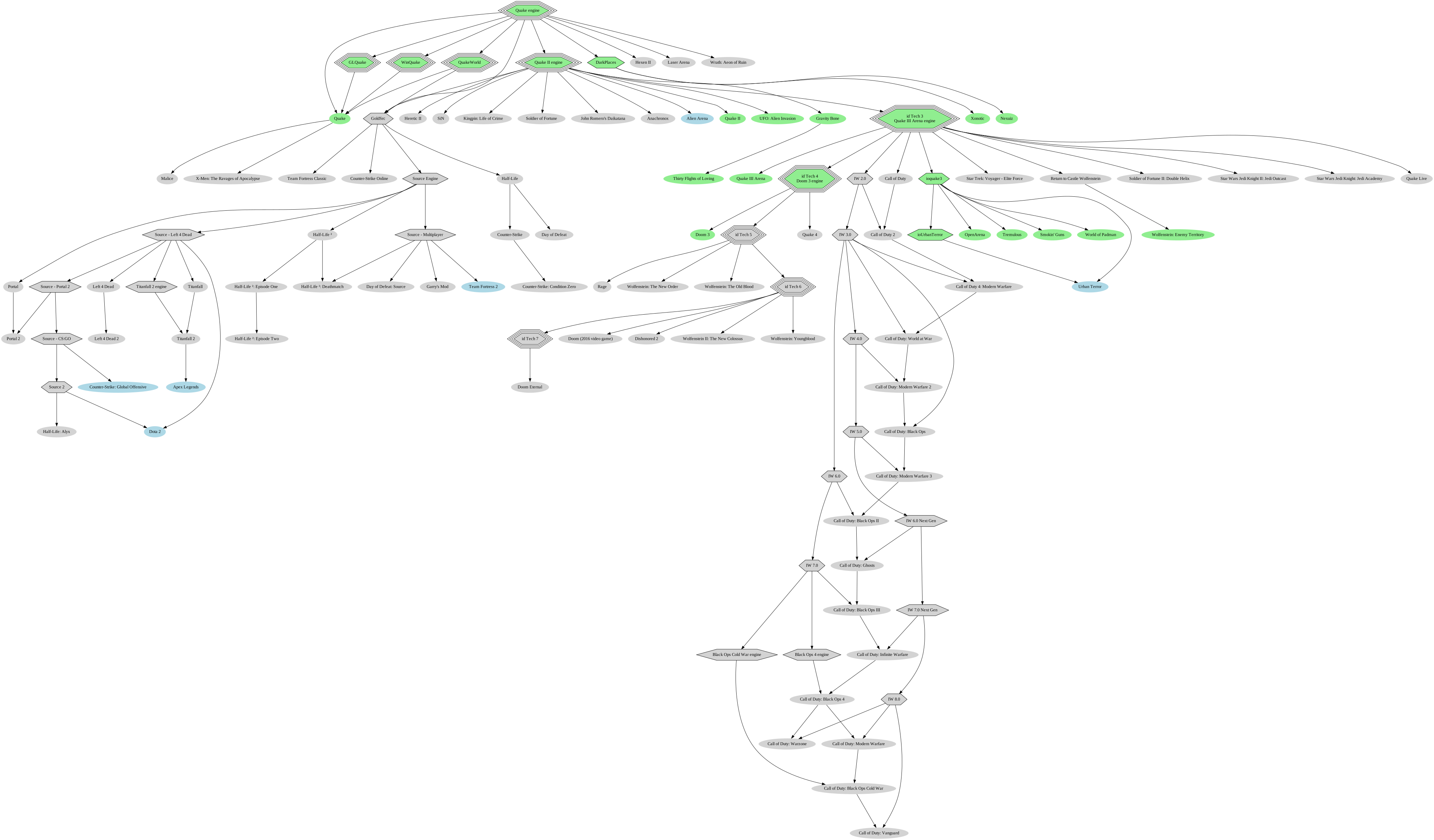
Fair on the Unreal Engine part, but Quake 3 and Half-Life are basically built on sibling engines that share one direct common ancestor (though I fully agree with you that they felt different).
Quake/Quake 2 used idTech2. idTech3 for Quake 3 was built on top of idTech2, and GoldSrc for Half-Life was built on top of idTech2 as well (it was a heavily customized and modified version of it).
Ridiculous and provably false.
It's like saying "every novel written with a typewriter tends to produce stories with a certain theme and dialog"
Even the character actor can sometimes feel similar. Visuals are by far the most indicative thing of an engine. Don’t forget about unreal’s awful shader stutters.
calling that ridiculous is extremely strange. Feel free to prove it false I guess?
I certainly think there is was inflection point for Unreal’s inherent complexity moving to 5 that made it exponentially more difficult to customize when compared to 4 as far as implementing highly customized renderers (in particular) and overall customization in general.
>Ridiculous and provably false.
If you prefer a counterexample, a couple of years ago I noticed that Apex Legends was a Source engine game without external info, and that Source version is heavily modified. Of course one can modify the provided defaults to a point that even the most no-life individual couldn't guess the engine.
I watched a cool video about the whole "engine grain" thing recently with more examples. https://youtu.be/SOwYqwsEdXc
Rather, it's like saying that every academic paper typeset in Latex using the stock Computer Modern font face gives off the same sort of vibe. That doesn't mean that every paper typeset in Latex has identical value, but academic papers aren't trying to sell themselves based on first impressions, whereas games are.
There's a lot of money in gaming but the workers are treated like shit, as you pointed out.
Also, no union employees at Blizzard were impact by Microsoft's Xbox layoffs/restructuring.
Goes to show, Unions are important and work. The best time to unionize was several years ago. The next best time is now.
It might have to do with the unionisation, but I wouldn't be surprised that its just that Blizzard is like one of the like 4 money makers that MS still has in the gaming division and that is why they were spared.
Unions also many times (especially with "guild" type unions) can serve other valuable functions like guaranteeing a higher minimum quality of work (generally).
I know it's cliche, but what are the thousands of people that work there doing all day?
For example in Germany, they apply to the whole sector, not specific professions.
So if you work in a company that has a union agreement, you get union stuff, regardless if doing coding, or wiping the floor.
Working in games I thought working for a bit 'straight' corporation would be literal hell, I was very very wrong.
Just to say, if they haven't organized by now I'm not sure what it would actually take.
That's what happened here: they just released the big DOOM DLC today. Chop!
The amount of shit-show stories about a VP or designer with a god-complex straight up abusing their staff while still thinking they're the best? And then failing upwards because of who they know?
That doesn't happen nearly as pervasively in non-game industries.
So, you know, do that. <insert "c'mon, do something" meme>
Now I'm 40+ years old and my job has morphed from designing systems and writing code to sweet-talking LLMs into staying within my guardrails, or something. Whatever it is, it is very much *not programming*.
Obviously unions would be in a position to limit the software engineering wrecking ball that is AI, but I pushed against that and now I have to sleep in the bed I made.
If its any consolation, its the bed we made collectively. It was easy to push back against unionization early on, we were likely better off individually. I too am self taught, although I went the ops route, and enjoyed making more money than I thought I deserved from basically a hobby, and a skill so in demand that I could effectively just go to any company I wanted at any time.
I'm also turning 40 this year, and can look back and wish we all did things differently but the wild west nature of early tech that allowed a self taught college dropout to build a successful career was too good, beneficial. It was one of the rare times that true upward class mobility was possible for anyone with a little bit of tech aptitude, so I think it can be forgiven that we didn't unionize or push for it back then.
I do feel bad for anyone graduating right now or just trying to enter the field though. The ladder has been pulled up.
Traditional blue collar seniority, set wages, and hyper specific job roles simply won't work in knowledge work. So there tend to be higher severance payouts in lieu of seniority promotions, pay bands with equity review instead of pay steps, and very flexible job roles.
I think a lot of folks see unions from their youth working in construction or service work, which have a lot of corrupt "company unions" which mandate hour caps and shit benefits for part timers.
Realistically IT workers with leverage like ourselves need to think of unions as contract insurance. You already have a contract, the collective agreement can be as broad as possible to allow the flexibility to respect individual contributors, while the pooled dues are put towards eventual contract enforcement.
My first IT job gave me quite a surprise when they ripped up my contract and said "so sue us." That's the day I found out how much a labour lawyer hourly rate costs. 10 years later as a union leader I started signing the sizable cheques to our law firms, there's always a bad manager somewhere causing a lawsuit...
Not all unions are the same. There are absolutely unions that are as bad as the naysayers say, but there are also ones that you rarely hear about that just quietly chug along with decent enough relationships with employers.
That being said, the appeal to me is minimal. I like working for small to medium sized companies where I can enjoy the flexibility of what tech stacks I work on. While the idea of some sort of optional trade union that could cover me for benefits, legal fights, contract enforcement, and maybe extra job insurance is appealing, nothing like that exists where I live. I have gotten healthy severances in the past due to knowing the rights I have in my jurisdiction, but that also means having the will and ability to hire a lawyer.
I'm in my mid 40s and rode the wave of a workers market over the last 2 decades. I'm still in demand, too. It's not quite as easy as it was 5+ years ago, but AI hasn't replaced me, though I'm actually "supervising" its work from an experienced angle. From that perspective I'm just a lot more productive.
If you are in a right-to-work state and you don't join the union, then union members know you're benefiting from the union without contributing back. Historically, this leads to an uncomfortable work situation for you.
If you are not in a right-to-work state, and the collectively-bargained contract involves a union membership requirement - which is typical? - then you have to join the union if you want the job.
This is where the gatekeeping concern comes from.
> I can't see any disadvantage for the employees in joining a union.
Unions have dues, so you're giving up part of your salary for membership in the union. If the union salary is equal or less than you would be able to negotiate on your own, it's a disadvantage for you.
There are enough cases of unions protecting bad actors (cops, prison guards) or lazy, tenured individuals that it's easy for a mildly privileged autodidact to decide they don't need the hurdle - or the help.
If you're not white, tech unions are not your friend.
And atleast in my work, everyone is paid more than minimum.
(sure, that could be what the result of negotations is, but it doesn't have to be)
Germany has very strong labor protecting laws.
Replacing line engineers and operators is very difficult.
Volkswagen is firing 100k employees in Germany none the less.
The idea that you can successfully unionize in software..in US..Where you could simply retain a small number of staff key members pay them very well and put them on a mission of outsourcing and milking the IPs..I don't see it.
The best moment to unionize wad 20 years ago.
Now there's not enough leverage by the staff.
> Over the past few years foreign carmakers in China have been flattened by local rivals such as BYD that have fast become world leaders in electric vehicles. As the Chinese market has gone electric, foreign carmakers’ share of it plummeted from 62% in 2020 to 35% last year. VW has lost its position as the top carmaker in the country. Last year it sold 2.9m cars in China, down from 3.9m in 2020. Only around 200,000 were EVs.
https://www.economist.com/business/2025/12/04/to-halt-their-...
> because of banning Russian gas
That is the symptom. The real reason is the lack of diversification from Germany, assuming that hard discount would last forever.
The biggest VW market is china.
Just to point out, in 2020 one every 20 vehicles sold globally was a VW in China. VW sold more than twice of Tesla at its peak in China alone.
And VW has US plants so it's not that impactful, not different than us automakers woes.
Sadly true in the USA. The number of people working in games is dropping like a rock. Maybe in Europe.
I've seen this idea discussed by others, but I don't know any pithy slogans for it. (Unfortunately, it's the ideologies with the catchiest sound-bites which tend to dominate in the "marketplace of ideas".)
Gamedev is different, since even games from 20 years ago (e.g. Half-Life 2) require a higher-spec computer to develop than to target. The games you can make on a 20-year-old potato are limited: for those, I can see how the "means of production" idea might be more applicable.
I don't think myself wise enough to know how to fix this, and given that fact I certainly don't want to rule; but I can at least point out the problem.
Like, it's certainly easy to point out that there are things that aren't being done efficiently, but finding the balance on how to prioritize the right efficiencies is the why society exists.
I don't want to structure everything to support my good ideas: I want to structure everything to support everybody else's good ideas. We can surely do better than the status quo, which is to structure everything to support a few billionaires' bad ideas. (Why are the only business models for the web "gatekeep" and "surveillance advertising"? Why are we burning valuable hydrocarbons when we orbit a star? Why is the pornography industry so abusive? Why are our social lives mediated by the anorexia rectangle – what happened to local third spaces? Why do we even have the anorexia rectangle – what happened to personal computing? When everyone knows what's wrong with the municipal plumbing, including the people whose job it is to work on it, why is nobody permitted to fix it? Why are so many resources being poured into generative AI to solve problems that we already have cheaper solutions to, if only they were permitted to be be implemented? Why war?)
I do not labour under the delusion that I can fix any of these issues, or would be able to fix them if I were "in charge" (whatever that means). But I know that these problems are not intrinsic features of the universe: they can be fixed in principle.
Why do you need a new battery? I usually unplug old batteries in old laptops and just use them with a cord.
The scabs who don't strike?
I'm pro-union and unlike the person you are responding to I'm not sure things are "dead in the water", but I do think software developers had a much better leg to stand on to push for unionization a few years ago than they have now (and, probably, going forward).
Longshoremen literally retired early and were paid pensions out of corporate profits from container related productivity increases.
What comes to mind is whole towns made of dockworkers which disappeared, and some places like Manchester lost their port and their industry died too, and it took them decades to recover.
Of course, some other like Rotterdam flourished.
I do recommend the book, but I think it shows many sides of what happens when a large change happens.
- Someone in the early 19th century
You _can_ do computer-based work anywhere, anytime. People working in software have no leverage at all, between India and AI. Software unions will kick the race to the bottom into overdrive.
"The International Workingmen's Association (IWA), commonly known as the First International [...] was founded in 1864 [...] The preparatory Address of English to French Workmen, drafted by trade union leader George Odger, articulated the need for international cooperation to prevent the importation of foreign workers to break strikes:
A fraternity of peoples is highly necessary for the cause of labour, for we find that whenever we attempt to better our social condition by reducing the hours of toil, or by raising the price of labour, our employers threaten us with bringing over Frenchmen, Germans, Belgians and others to do our work at a reduced rate of wages [...]"
Software work appearing to be extremely fungible with offshoring and AI is all the more reason to unionize. It doesn't matter to the employer who is doing the work, so the union is the only leverage to truly saying, "hey as the person actually doing the work, I would like to be treated better, and you can't just ignore me, fire me, and replace me".
The race to the bottom already started as soon as companies saw more fungibility where there was less before. Software unions won't kick that into overdrive, they'll slow it down.
I have seen a number of projects go from
'We're building our own engine'
To
'we should have just gone with $engine_of_the_day'
To
'We were so lucky we chose to make our own engine'
If you want to make a game like fortnight, the Unreal is your pick. If you want to try something that hasn't been done before you could do worse than rolling your own engine.
Especially if you are looking for where the fun is, the idiosyncrasies of your own engine gives you a world with it's own flavour if you incorporate that flavour into your design process you could create a feedback loop that turns into something special.
Engines has been (And is to a large extent) bad business because unless you really do something _really special_ it's way expensive for little gains (especially if you're targeting realistic games since there is so much to focus on before even considering portability).
And I say this as someone who started out working on custom engines (but am out of the business outside of hobby stuff).
I read a lot of opinions on whether it is a good idea and it all boiled down to ‘my god, no, don’t write your engine. That said, I did and I am sure glad I did invest 3 years on a framework I know like the back of my hands’ and that told me exactly what I wanted to hear.
It’s like the whole AI debacle, really. If your goal is to ship a product, go with a premade engine. If your goal is to enjoy the craft and learn how stuff works, and you got that itch to do it the difficult way, then roll your sleeves and dive in. It’s always a pleasure to play a game with a completely unique feel.
Also, like what do you mean by engine? Minecraft was made with LWJGL.
If your goal is to sell a game in 3 months, sure, but not even Unreal Engine will magically turn a rushed game into a good product.
90% of the development time is making a fun game in the first place, and you’re on your own there.
That is exactly how I perceived the game industry to be before I worked in it. Now I know that there are many objectively excellent or even innovative or influential games that do not sell, or also do not sell well enough to support their development costs.
So I’m looking for an “objectively” (figuratively) excellent game, that has not sold many copies at all. A game on steam that should be popular but isn’t. Do you have any examples?
This entire saga of XBOX fka Microsoft Gaming is proof to the contrary
I loved the old STALKER games, and the wackiness of their engines was a lot of the charm. I ended up buying the new one out of nostalgic dedication and it's probably the worst example of "Unreal slop" I've experienced, having not bought many newer games. I'm sure the butchers running Xbox have run the numbers and think they'll make even more money throwing armies of contractors with allegedly fungible skills at the next Doom games, but I'll leave others to bankroll that while I enjoy games I don't need frame generation for.
Where they actually messed up was not licensing it more aggressively to other companies like Epic has been with Unreal.
- Huge tax write-off
- Commoditizes their complement
- If it succeeds, ultimately lowers the cost of triple-A game dev
Doom was absurd in the capability of squeezing terrible machines for high framerates and great visuals.
I also remember seeing a bunch of cool explanations of their rendering pipeline
There are very few games where the engine is what made all the difference. Maybe something like Half Life 2 with the source engine is the exception, but ultimately, what makes a game good are traits that can be universally applicable to any engine.
Truth is, it’s not that 90s anymore. Hardware has advanced to the point that you can have general purpose game engines that can be molded to any type of game. You do not need purpose built engines anymore.
And someday, if you can imagine, we’ll just have AI churning out visual representation of game state, turning game development purely into a declarative data driven exercise.
I disagree, I think there's an over-emphasis on generating high quality individual frames and a expectation of what it is you should be able to do in games.
You can have a game that is photorealistic but you turn around and have your gun barrel poke into the wall and disappear. How many games can you throw enough junk into a river and make it change course eroding a new path for itself as it goes?
Some games rely on clear specific rules of an engine for the player to know because the rules are an integral part of the game, and any inconsistency in implementation creates a feeling of being cheated. Often you can implement such things in standard engines, but you are working against them the entire way.
You could have a game where a player sees a pylon and knows that because it is made of metal you could melt one of the legs and make it fall over. but to do that the entire construction of the game rules are integrated into the world. Most games teach the player that things like pylons are static objects unless they need to be destroyed for a plot point in which case just this one is different. Perhaps the player just has to learn that pylons are one of the class of destroyable things. Making emergent properties goes engine deep.
>And someday, if you can imagine, we’ll just have AI churning out visual representation of game state, turning game development purely into a declarative data driven exercise.
And therein lies the problem. A game engine is game state. You can make it pretty any number of ways, The engine will still be the thing deciding what you can do, and it is the things you can do that makes it play.
Maybe if you ignore the entirety of the retro gaming scene where people are using old engines and modified old engines because they bring along a lot of the feel and expected behavior.
The average modern Unreal and Unity game feels like shit, but some dev's can pull off making new engines behave like old ones we love. It requires a lot of work. Just look at New Bloods catalog of games that pulled it off. DUSK (unity), Amid Evil (UE4), Ultrakill (Unity). Each one of those games had a lot of passion behind them driving for gameplay perfection in the style of a retro game and/or engine.
Yeah, no. Perhaps on the mobile slop world as vehicle to sell ads, but I wouldn’t even count those as games.
I have the ability to make the engine I’m making on my own, but trying out AI for the experience. It really sucks in ways that make it good for what an engine needs. A good engine needs to plan pretty far ahead and plan well at high architecture level. AI is actually awful at that despite it being okay at making plans at implementing said plan.
UE5 games are manifestly lower quality than games built on custom engines. Optimization is especially worse. UE5's performance baseline _requires_ the use of upscalers (DLSS/FSR, fake/AI frames) in order to hit basic targets like 1080p@30fps.
I won't buy games built on Unreal Engine. Homogeneity of this type is horrible for customers of the gaming sector.
You're in an extreme minority. Also, unfortunately, Unreal is popular with indies who probably have (in general, relatively) more ethical staffing practices.
I don't really understand making hard and fast rules like this. Clair Obscur is one of the best and most beautiful games I've ever played. The Witcher 4 has the best graphics I've seen come from a video game. Satisfactory is nuts to look at when you see an eloquent end game build.
I also don't understand why people knee-jerk hate upscaling/fake frames so much. I can understand for fast-paced competitive multiplayer games, but for something like Clair Obscur where the ideal way to play is on the couch on a 4k TV give me all the upscaling and fake frames you can muster.
Fact remains though, that homogeneity and monoculture in tech is bad. The inability to properly render all the frames of the product I paid for, without burning thousands of dollars on hardware and emitting hundreds of watts of waste heat (and sometimes not even then!) is worse.
I refuse to believe that upscaling/framegen is a solution to any existing problem, because I remember when we didn't have to do that. I want to render ALL the frames at actual resolution. Hardware is so powerful now, there should be no excuse.
The only reason I will accept upscaling is as a power-management strategy to be employed while on battery. For upscaling to be required for any other reason represents a failure somewhere in the game development process. I won't pay for failures, especially when it costs me yet more money in hardware to run the failure-enabling technology.
I'm not talking about playing 4k@60fps native and I'm not railing against system requirements. I get modern games require modern hardware, but the ratio of what's required to run UE titles now is skewed by an order of magnitude. Simultaneously, it feels like lowend (or even midrange) optimization has been completely forgotten.
I also think that by using software like UE or Unity, you're necessarily deprioritizing a decent chunk of the "game development" process. Instead you are choosing first & foremost to participate in cottage-industry dynamics as a business strategy, with all gamedev-related decisions relegated as subordinate to your chosen business partner(s).
Additionally - and I'm getting into conspiracy theorist territory here a little bit - I believe (to an extent) that a lot of these games are made with "cutting-edge" technologies mostly as fodder to propel the industry "forward" by whatever means necessary.
By this I mean: producing the "Next Great Photorealistic Game" (which looks/plays mostly the same as the previous year's photorealistic game but requires NVIDIA's new $2,000 graphics card to run) props up AMD and NVIDIA by requiring their latest generation of hardware. It enriches Epic Games by requiring their latest engine with new features. It encourages studio consolidation because now you need an entity like Microsoft to bankroll development if you want any hope of competing in the AAA space.
Despite how bloated and ridiculous this has become, the industry continues to grind forward as these companies perpetuate and profit from the model, because there's a decent contingent of consumers who can be relied upon to purchase whatever comes out, no questions asked. And that's fair! If it's fun, then it's fun right?
But that consumer is ever-more taxed by the state of AAA gaming. And it only gets grimmer every year (as evidenced by TFA and recent happenings at Xbox).
I'm willing to believe some of this comes off as arrogant or elitist (not a gamedev, no real perspective), but these are my honest thoughts, and are how I inform the purchasing decisions I make as a consumer. Looking at where we're at and where we're going versus where we came from clashes with my ideology and makes it unfun to me personally.
EA being bought by the Saudis and people taking a hard "moral stance" to not purchase any further EA games is another example. I've got a bridge to sell you if you think you're boycotting everything (even every video game) that's making the Saudis money. I dislike EA for other reasons and their products tend to be bland but if they make a good game I'm going to reward the developers of that game so they hopefully make further good games.
And in terms of the conspiracy theory the engine is an engine. Developers choose what to implement and can tone down all the crazy new tech as much as they want. They can also write custom stacks to do things no other Unreal Engine game would do. Unreal actually scales pretty well in that regard. Current minimum specs for Satisfactory is an i5-3570K and 1650 GTX. Recommended video card is a 2070 RTX. I have a 15 year old computer sitting in a closet that can play the game fairly well. There's so many great indie titles out there that if I only had that 15 year old computer I'd be spoiled for choice. But IMO we also need bleeding edge games to move the needle forward and keep the industry exciting. I want crazy tech in my video game that makes my jaw drop like the trailers for Witcher 4 do right now. That keeps 100s of millions of people watching things like The Video Game Awards.
In terms of homogenization I see the exact opposite happening. You probably have a slew of games to play right now that all use different engines. I myself have a backlog I don't think I can get through in my lifetime that's going to grow immensely this September. There's so many games being released and they're made in so many different ways that saying there's homogenization seems strange. Right now I'm hopping between Death Stranding 2, Baldur's Gate 3, Terratech Legion, and Resident Evil Requiem. Where is the monoculture? The idea of not giving TerraTech Legion a chance simply because the devs used unreal seems wrong.
The music sounds good? I listen to the music. The book is well written? I buy the book. The game is fun? I buy the game. You could spend your whole life nit-picking reasons why X publisher is bad, X record label is the worst (and in both cases most ARE) but in the end these companies will still make ungodly amounts of money and you're just making life less enjoyable for yourself.
The FSR/DLSS upscalers are typically superior to TSAA and are a reasonable replacement.
A lot of the UE tech is built around the assumption of TAA though.
I don't know exactly what you mean by "baseline", but the most recent UE5 game I've played that pretty consistently gets better than your "basic target" is The Last Caretaker (TLC). For me, it always did better than your target in the starting area, through to the point where you embark on your main quest. Prior to that, I played a whole lot of Satisfactory, which ran much, much better than TLC.
I run without AA, "upscaling", or frame hallucination. I'm using a Radeon RX 9070 on Linux, and spent most of my Satisfactory playtime with a Radeon 5700 XT.
Can we extend this elsewhere? Are tech companies' decision to use popular programming languages (eg. python) or software (eg. postgres) part of some dastardly ploy to make programmers "a replaceable commodity ... rather than a cohesive team of skilled artisans"? Should all programmers push for having bespoke tech stacks at their companies so they can be "skilled artisans"?
Having had to work with these guys, and then maintain their software when they inevitably get bored and/or leave for more money elsewhere, no. Usually when these guys leave, their stacks/projects are the first to get rolled into the monolith and/or rewritten in the company's lingua franca (python)
On the opposite side, startups building on difficult languages like Haskell, Elixir, Erlang have a built-in bias towards hiring a team that can get a lot more done with a lot less people. Great for startups. Terrible for enterprise.
This has been the objective of the tech industry for years
The history of capitalism is the history of grappling with this inherent tension, and companies finding novel ways to deal with it. Gig work, union-busting, "right-to-work", non-competes, NDAs, return to office, employee tracking software, automation, robotics, AI, etc. The most effective trick though, was convincing the workers that they definitely don't ever need to band together, and you as an individual are definitely better off negotiating alone versus entire corporations.
This sounds so comical when put that way. But you still see people defending that posture even on this forum. Psyops was definitely the most effective trick. And then those corporations went beyond the bounds of private enterprise and captured government as well. If anyone has any doubt that unchecked capitalism is fundamentally at odds with democracy, they are missing the forest for the trees.
We've optimized our own destruction.
It's a fallacy to extrapolate that into calling a team structure completely fungible. Throwing away an effective team that was able to ship a game is an incredible waste.
For most of the 90s and 00s, your game engine, specifically idTech in this case, was a competitive advantage. Doom and Quake/2/3 all represented massive technological jumps over their predecessors and were way ahead of their competition in terms of looks. Games like Unreal (Tournament) and Tribes competed using their engines' strengths; those engines didn't look as good but were capable of rendering much larger spaces than idTech, and those games emphasized that, e.g. Tribes' massive multiplayer maps with vehicles, or classic UT maps like Facing Worlds and Lava Giant.
Then in the late 00s to 10s, things started to hit a wall. Probably peaking with Crysis in 2007, which is likely more remembered for its engine, graphics, and system requirements (all of which were truly mind-blowing at the time) than its actual gameplay. After that, games' graphics improved at a much slower rate; it started to be less about the engine's capabilities, which were increasingly homogenized, and more about art direction.
Now in the 2020s, we have UE5 for AAA games with high-fidelity graphics and Unity for everything else... what is the competitive advantage in maintaining your own engine? As you mention, you have to have internal expertise, which is less well-documented than UE5/Unity because you don't have dedicated documentation staff; you have to maintain your own tooling, which is likely worse because you haven't invested as much in it. From a ROI perspective, unless you're planning on investing so you can license out the engine and become a UE5/Unity competitor, it doesn't make sense to maintain your own engine.
And looking ahead, frankly, consumer GPUs are now so expensive that game graphics have likely peaked for at least a decade. There will simply not be better hardware available to gamers for the foreseeable future. Games "looking good" will be more about art style and direction, and you sadly do not need a team of game engine programmers for that.
The build vs. buy calculus in game dev has been steadily shifting over the past 15 years, and when CD Projekt Red announced they were adopting UE5 for their next Witcher game, the writing was on the wall.
That said, Id could make a bold "commoditize your complements" move and open-source the latest, now last, IdTech. What Godot is to Unity, IdTech could be to Unreal Engine.
Looking at the start-up of Doom Dark Ages (with new expansion today), they list Havok, Oodle, Bink, and SpeedTree. According to Havoc's website, that already starts at 50k$ alone. Oodle/Bink don't list prices.
Python? => Data science. Sure, python is just importing the C tools that do the heavy lifting, but look me in the eye and tell me R, S, SAS, or SPSS won.
C? => I mean, everything? But what happened in the first 10 years? Proliferation of operating systems and linear algebra libraries?
So, generally, the grey beard talent consolidates their intellectual contributions and uplift everyone else. Is that true? -ish? Missing the mark?
Guys, I'm a knuckle-dragger, I genuinely don't know what I'm asking. What are the tech stacks that were held constant (by whatever factors) for a decade, and what came out of it?
Is this the decade where art directors takes over gaming?
Considering the bad performance of the division can probably be blamed on the art and game designers, probably not. More than likely, the gaming industry is going to atomize. Meaning many very small companies, and fewer big studios. Alienating your audience isn't exactly a career enhancing move. And that's ultimately what triggered all of this and the move towards smaller (non AAA) games.
It's still a product-distinguishing decision you can make at the indie scale. What I mean is, you can create an engine that allows you to get the performance + aesthetic that otherwise would not be possible. i.e. Specialize in a profitable niche.
And if hardware costs keep ballooning, performance will become more important.
After entering games with naive expectations of the wild west of the 90s, I would recommend other programmers not enter the AAA space, if compensation and job security are concerns. Indie game development looks like great fun, but don't expect any low-latency programming.
Kinda hard to buy an engine that is not for sale...
Also there is obviously a massive gap between how games look and what the hardware is capable of. Cyberpunk runs better than total war attila on my computer as an example.
Don’t write a database, don’t write a compiler, don’t write an os, don’t write a game engine… are we all supposed to write web apps at this point?
This mindset didn’t create what we have today and won’t create what we will have tomorrow. I recommend people that like building these things to ignore this pov as much as possible
That can be true for any commodity software though. Designing something inhouse means you inherently will have engineers and experts with better low level understanding. It doesnt mean it will be better (could even be much worse) but theres a tradeoff there.
So a lot of studios think oh, the engine is already finished, we just need artists and designers to use it, all the heavy lifting has already been done. And while yes, you can make a game that way, the results will be sub optimal. But then again, free is infinitely cheaper than having an engine team maintaing your own engine or any custom elements of UE.
There was a lan gaming place back when people had dial up... and that place had a T1 to the store that had double low double digit ping times when triple digit was common.
Tribes was one of the games installed and this also had the advantage that when a few people in the store were playing it they could coordinate playing a tank much better than other players on the server.
MissionForce: CyberStorm is over on GOG for another game from that publisher from that timeframe.
They had 20 game machines (for the day)...
> Each gaming computer has a 1-Gigahertz Athlon, 21-inch Monitor, GeForce 2 GTS, Sound Blaster Live, 256Mb of 133Mhz RAM, 10/100 Ethernet card, and an optical logitech mouse.
that were in two rooms in the basement. You could get 10 people in one room, and 10 in another and then have team games against each other where you could talk freely without worrying about the other side hearing you (unless you were shouting).
> Each computer is on its own 100 Mbit Full Duplex switch port. The network as a whole is linked to the internet via a T1.
It was $2.50 / hour (and if you played for 3 hours, you would get another 2 hours free). On the weekends, high schoolers and college students would sometimes play for a good 10 hours for $15 (way cheaper than the classic quarter per play arcade).
The vending machine was stocked at $0.50 for each thing in it... so you could get a candy bar and soda for $1.00.
Both can be true.
Just because it's becoming more common doesn't mean it's not bad.
Movies are made by a temporary team of skilled artisans who are masters of their craft. After the project, they move one. Games seem to fit within the same creative category as movies. So I wouldn't expect a company with a fixed set of artisans.
it feels to me like the AAA game industry is like hollywood except the budgets are higher and there are even lower chances of success. i mean theres literally multi hundred million dollar games that essentially made zero dollars. Even shitty blockbusters make some money.
Jane Street hires devs at high salaries and makes them use OCaml rather than a more mainstream language. The company makes more money trading than traditional giants like JP Morgan do.
So just depends on if your strategy is right. I blame Microsoft incompetence.
George Fan created "Plants vs. Zombies". After the success of PvZ (the first one) PopCap fired him and replaced him with someone much cheaper. PvZ2 was horrible. All subsequent games (the ones I've played) have been awful. So, money was saved. Money was probably made by microtransactions. But no one talks about PvZ anymore. The magic was torn out for profit.
Diminishing marginal utility.
Why did the PC ultimately kill the demoscene? A lack of restrictions; hardware was no longer the bottleneck that — through brilliant programming exploiting specific hardware quirks — could be coaxed into conjuring up magical visual effects (or failing to do so).
On the C64 and Amiga 500, individual ingenuity correlated directly with visual output. The PC era—ushered in by the i386, refined by the i486DX, and popularized by the 586 (Pentium)—increasingly abstracted visual effects and audio illusions away from the hardware itself.
What previously had to be created in assembly language (!) — indeed, practically forced into existence through sheer effort — was now reduced to just "Yet Another Feature."
The partnership between Carmack — whose genius was brilliantly complemented (and even surpassed, a fact often forgotten) by Michael Abrash — represented the most important development duo in the history of game engines. Ken Silverman was a sensation who, unfortunately, never quite reaped the accolades he deserved. Interestingly, this highlights exactly why it was so right and important for Carmack and his peers to be their own bosses: success doesn't end up in someone else's pockets.
Nowadays, making games is essentially akin to video editing — dependent on NVIDIA, and nothing more.
The crucial factor is the ability to deploy a game across countless systems with minimal adaptation effort; while the base version suffers little visual degradation, the architecture must still allow for high-end PC systems to push the boundaries.
In other words: back then, we hand - coded animations—graphics, code, and music were a unified whole. Today, a kid on an iPhone creating a TikTok video achieves — with a thousand times higher quality — what used to take teams weeks or months to accomplish. Development costs are astronomical; code no longer needs manual optimization because compilers are inevitably better at it (multi-core, etc.). Nothing is one-dimensional or linear anymore.
For this reason, content is all that remains.
As someone who is nostalgic — a C64 demoscener and occasional Amiga 500 assembly coder — I do feel a twinge of wistfulness; yet, as a former senior manager and platform product lead, I cannot fathom clinging to the wrong approach for so long.
That misguided romanticism made me shake my head. Visually, Doom was clearly inferior to engines like Unity. I couldn't care less whether or not that commented-out line containing the `0x5F3759DF` hack was in there somewhere.
Don't hate the player, hate the game.
Asking for a raise is a bad thing? Lol your average Silicon Valley sociopath
If there are few downsides to centralizing game engines, and the need for engine work is inherently cyclical, why should we want engine work to be internal and non-cyclical?
I really don't know much about game engines so maybe there are real downsides to that approach, but the way you've laid it out makes it seem as if Microsoft made the right decision here.
How else do you define value?
If they were smarter about this, they would commoditize their compliment and open source the Doom The Dark Ages engine just like John Carmack did with the Quake 3 engine.
A few mid-size studios pitching in to fund continued development on a Blender model could turn IdTech into a major competitor to Unreal Engine in a relatively short timeframe, ultimately costing them a lot less than licensing.
Doesn't Microsoft want fewer, bigger games locked into their Project Helix platform? Why compete with Unreal when they can sign a sweet license for the engine?
Why build an ecosystem when they are already a huge monopoly?
So on the test you'd get questions such as
  python:snake ::  ___ : ___

  a) lua:satellite
  b) swift:bird
  c) java:coffee
  d) pearl:gem
A swift is a type of bird, so that would follow the same logic as the example;
ProgrammingLang:Animal
Godot and Unity can be dealt with by a small studio (or even 1 person), Godot and Id get much better performance than Unity and Unreal
Next you need to make a product out of that meaning a very large investment so that the engine is actually usable outside of ID, people that don't know what an engine is think of the rendering part but it's actually very minor compare to pipelines ect ... which we know nothing about, it might not even be good or painful to use.
Unreal is widely used because it can create any kind of game and the pipeline, tooling are good and well integrated.
I hear a lot of good things about modern idTech. Pervasive multithreading is one, and it's not particular to the FPS genre.
3D Engines of that fidelity are rarely genre specific. Editors might be but the engines are often fairly flexible because most genres share a lot in 3D space.
And the engine is way more complicated nowadays — UE at least has a huge community and docs.
I’m just an old man who prefers a much, much slower pace for the rendering engine. I wouldn’t mind that they grew so slow that we just got IDTech 4.
Doom runs like butter on the switch.
Might be hard to run, I don't know, but at least it was well made.
But for what its worth, the graphics were nice. This however, was on a 4090.
Arc Raiders runs phebomenal.
The engine is great. If games run terrible it's on the devs. Full stop.
They also make money through ad services... a market they seriously missed out on (look at AppLovin stock vs Unity).
Asset sales are barely a blip.
Unreal makes the vast majority of it's revenue through microtransactions on its one major whale game Fortnite
The last non-Id release on IdTech was Brink in 2011.
Microsoft's game divisions make money through making games, so opening up the engine itself would've been conducive to their goals (cultivating an ecosystem of devs and even contractors familiar with the tooling).
idTech rendering is more competitive with Epic's Unreal technology than Unity and Godot.
They should simply open source it if they fire the devs. Else the engine and future support for the games built on it are essentially being tossed into the trash.
And the thing is they’re not unprofitable. Gutting their studios and technology development isn’t going to help growth, it’s going to contract the business.
The only thing that truly counts, for her.
Being a woman doesn't make her not responsible despite being the ultimate decision maker in the division, nor should it shield her from criticism.
> The glass cliff is a phenomenon described by psychologists Michelle K. Ryan and S. Alexander Haslam, in which women are more likely to break the "glass ceiling" (i.e. achieve leadership roles in business and government) during periods of crisis or downturn when the risk of failure is highest.
The fact that Microsoft has a studio making Fallout knockoffs while they own the Fallout IP is insane.
Put more effort into having pot sweeteners that get you off competing platforms and onto theirs. As it stands there’s no reason not to buy Microsoft’s games on PlayStation, PC, or Switch where Sony presumably captures 30% of the sale price.
The Xbox Ally hardware is way too late and way too niche. It should have had the operational friendliness of the Nintendo Switch, come out 5 years ago, and been first party hardware instead of a co-branded item.
2) ...
3) profit!
Their MO will always be EEE and they'll always (attempt to) abuse their monopoly power, while giving corpos and consumers just a glimmer of hope to keep them strung along...
Also any company they acquire will be gutted until it looks like the rest of the org.
I'm trying to think of a Microsoft acquisition which has been a success. Nothing comes to mind.
I think it would be enshittification if Microsoft said “sorry, you now have to rent servers through us and all content comes from our content shop,” but that’s not the case.
Merely offering a product that has a bad value is not enshittification.
We do not have a market designed to reward these things, at least not for the likes of Microsoft. For them, it's far easier to simply cut people while collecting on their previous labor. Once the product of that previous labor is no longer as valuable, it can then simply be spun off or shut down permanently.
In the meantime we haven't seen a new Quake, Fallout, Elder Scrolls, Perfect Dark, Fable, Banjo, Conker, or the myriad of other mainstream IP they owned in decades. Most of these franchises have lost a ton of value after sitting on the shelf for so long without releases.
Note that this is different in gaming than film because of technical progression. But also Nintendo are very good at "same charm, familiar characters and plot, different feel".
But they don't simply do roster updates, they bring those characters and worlds into new experiences, and they're willing to sit on good games rather than push out yearly new releases with almost nothing different compared to the previous iteration.
And the stability these franchises gives them, allows them to continue to make new IPs that may themselves grow into future tentpoles. So it's not just that they squander those successes, they are often trying to innovate into new things.
Disney + Marvel offers a roadmap for extending existing IP. (Keep in mind that the Marvel acquisition was in 2009.)
The usual tricks of "noise signals how many are really upset in absolute terms, not the relative popularity", "people will still make noise about what they don't like regardless if that's more popular overall", and "people who hate one attribute of the product can often still like it enough to buy overall".
Sure, you can do well: Skyrim was a big step up from Oblivion, for example. But you can also screw things up (see: Halo), or fall into the trap that Valve has fallen into with Half-Life 3 where the expectations of the public can never be truly met.
I think what they want to do is make the next WoW. Low-risk, customer lock-in, people identifying themselves with their consumption of the IP to an almost ludicrous degree. You see that already in some ways with Fallout 76.
I think the entire content production industry, no matter the medium, is aware of the risk/reward of rerunning existing IP vs creating new IP. There's a reason we get retreads of retreads elsewhere, existing IP is lower risk, higher reward, pretty much always.
Halo is a good example - they fumbled with Infinite. It just wasn't very good. Yet the remake of Halo: Combat Evolved is getting a ton of attention from the fanbase and broader gaming community. If the next Halo is good, that fanbase will come back around.
> I think what they want to do is make the next WoW. Low-risk, customer lock-in, people identifying themselves with their consumption of the IP to an almost ludicrous degree. You see that already in some ways with Fallout 76.
This is what they now want from Mojang and Minecraft. Asha even called it out in her letter.
The fanbase already has the Master Chief Collection. The remake seems doomed to fumble worse than MCC's notorious launch issues and it should be obvious to anyone looking at the project on paper. MCC was a team with ownership trying to learn the ins and outs of decades of work on the Slipspace engine to recreate each step of the Halo journey in an upgraded/consolidated form of its own engine. The new remake is a mostly outsourced team that basically owns nothing trying to recreate Halo mechanics in UE5 with the help of LLMs and other AI upscalers. That's nothing like what the real fans should want for the franchise. It reeks of corporate mismanagement misunderstanding what IP is for. It also reeks as a slap in the face for the hard work on the MCC (and yeah 5 and Infinite, fumbles and all).
Sure, who doesn't want that? You don't get there by gutting the veterans who can rapidly iterate and know the technology and gaming landscape well. In my eye these kinds of layoffs are simply their giving up.
Agreed. If you are looking at a chart of performance and it's flat or slightly increasing year over year for a few years, you're not doing great. You need to see some dips which means you tried and failed. Without those, you won't ever see the big jumps.
If you input $1000 into process A which returns $20, and inputing $1000 into process B returns $30, you'd be insane to invest in process A and not process B, right?
>If the said process takes exactly 1 year to complete, and requires all the inputs to be provided upfront, then its margins can be directly compared to bond yields, but businesses are rarely that simple.
Something tells me the xbox division isn't some sort of machine that takes in $x in costs at the start of the year and spits out $1.03x in revenue at end. Capital costs could be higher (eg. game takes 4 years to develop before you can sell it), or lower (eg. you pay foxconn $400 to make an xbox then immediately turn around and sell it to best buy for $450).
Radioactive Dust is quite uninspired though, how about Super Nuclear Apocalypse Bros DX
I can't help but think the industry will be better off in a few years after this Xbox "restructure." That's a lot of knowledge and talent that's no longer stuck in 14 layers of middle management hell.
I hope the industry will be in a better place in a few years. There is this recurring theme of big companies rolling up little developers and destroying their development culture.
I have near zero hope we'll see any meaningful antitrust action in the future either without a complete overhaul of the incentives in politics.
Xbox div's annual revenue is $23 billion. Its big enough to be its own company and sit upper-mid pack of the F500 on its own. It'd be the number 3 or 4th top gaming company globally, beating out Nintendo even. No reason for Microsoft to not have been broken up by now, let alone have been allowed to buy all the studios they did. Don't forget they also mislead the FTC to convince them to allow the Activision/Blizzard acquisition to go forward, and then once allowed laid off 1900 employees, mostly admin/HR & support, forcing it to integrate into Microsoft gaming and operate less independently.
Edit: Keeping to SMB1 for simplicity.
Yes, but it's not the DOJ's job to tell Microsoft when they're lighting their money on fire. There's no unfair competition from this kind of thing. It wasn't any different when leather companies or old media would buy up studios and run themselves out of business.
Microsoft buying out studios could be anti-competitive, but Microsoft would have to not be Microsoft.
Firing thousands of people and closing studios reduces the overall capacity of the industry to produce diverse, competing games. Just because Microsoft is Microsoft and is incompetent doesn't mean the rest of the industry and consumers don't lose out on what those independent studios could have created on their own.
In terms of antitrust/whether the FTC should have allowed the mergers is purely predictive. Microsoft looking like idiots from it has no bearing on whether the behavior of buying them up itself is anticompetitive.
Ex: if Microsoft buys out office competitors or webmail competitors to shut them down, because those customers are going to be likely to buy more Microsoft stuff.
Buying games studios could be anticompetitive if Microsoft were going to keep them alive and make their output platform exclusive (but iirc they made a commitment not to do that). It could be anticompetitive if they were going to kill them and funnel consumers into their games with continuing development... It could also be anticompetitive if Microsoft were going to give these studios some uberengine secret access to Xbox/Windows that allowed them to make the best games that outside studios couldn't come close to...
But what's happened is Microsoft is killing the studios; all at once is a surprise, but death within like 3-7 years could be predicted. Most of those people will pop up again at other studios or start new studios. Some of them will realized gamedev sucks and do something else. This is the lifecycle of studios purchased by corporate overlords. When key people make enough from the purchase to allow significant but not complete creative freedom, they often make some really good games at their next venture. Too little freedom -> pump out sequels or gacha games; too much freedom -> interesting games that don't end up being much fun.
Why are the little devs selling to the big companies in the first place then? If you’re crushing it as an Indie studio why wouldn’t you stay that way knowing how big tech acts?
> "I think it's perfect for us, because we can just focus on doing our inspired weird games, and not worry about how we're going to get our next deal. We aren't chasing down our next funding and thinking about how many more months of funding we have all the time."
https://gameinformer.com/2019/06/23/tim-schafer-on-microsoft...
The only people that can tell Microsoft to gargle their gonads are already rich as fuck or have a will of steel and principles uncommon with entrepreneurs.
If a big company decides to make a game very similar to yours, they can make theirs win by throwing more money into marketing than you can. Do you want them to spend that marketing budget on your competition or on you?
Looking at LinkedIn, I see mostly people from tech (design tooling, game AI, QA), art (modeling, mats, UI, character), design (levels, gameplay), and production roles in DFW being cut, but haven't seen engine roles or Frankfurt-based employees.
ZeniMax's QA team was notably unionized in 2023: https://cwa-union.org/news/releases/quality-assurance-worker...
Scott Miller said it himself:
> Big day today at Id Software [...] today, Microsoft/XBOX decided half the team was deemed USELESS and needed to be let go [...] With literally the best of the best coders in the industry.
https://bsky.app/profile/jasonschreier.bsky.social/post/3mpy...
https://www.reddit.com/r/Doom/comments/1up5pta/95_reportedly...
And I'm not sure I share your optimism that the industry will be better. It might not be worse, because it's possible that Microsoft is just so dysfunctional that id would never be allowed to produce another good game anyway. But the people losing their jobs here might be financially better off just leaving the game industry entirely. In particular, if the engine devs were totally cut, it's not clear to me that there's room for a studio to differentiate itself with a custom engine in the modern day.
Microsoft needs to be split, it should been split years ago, but now more than ever.
This looks more like simple corporate incompetence. They never should have made those very expensive acquisitions.
Subsequent events show concerns of monopolization were misplaced.
That's not the point parent is trying to make either, but FTC was supposed to prevent detrimental anti-competitive and monopolistic behaviors, which that very much was.
The FTC's role is to block mergers where the effect "may be substantially to lessen competition, or tend to create a monopoly." Merger review by design is predictive.
"Embrace, Extend, Extinguish" isn't applicable at all in this context though?
Similar thing is happening in other areas of the industry, where companies like Vercel, Anthropic, OpenAI just keep buying companies and it is really hard to find a case where things turned out well.
Sure the Xbox division wasn't doing amazing but still had $24B of revenue in 2025. For reference PlayStation made $30B that same year.
Still, this sticks in my craw. Microsoft didn't just buy a game studio. They bought a fleet of studios, a non trivial segment of the entire video game market. And they did almost nothing with them, and then they just light the goodwill on fire. It isn't just the IP. It is the brand, the organizational work, the history. Just vaporized.
The least they could have done is sell the studios mostly intact.
- Every studio uses their own custom set of tools and development practices. The economies of scale of merging studios together just doesn't really exist.
- The functional difference between most engines for consumers at this point is largely meaningless. There are no order of magnitude gains like there used to be. Most of the engineering is on the cloud services architecture or anti-cheat.
- The median "developer" at a game studio is not actually a very technical person. They mostly just spend their days inputting content and assets with the available tools.
- The value of a AAA game is not how innovative the gameplay is but how much content they were able to stuff into the game.
- Nobody cares about "exclusives" anymore when 90% of AAAs have interchangeable gameplay with other AAAs.
- The cost to start a new studio is negligible compared to the cost of acquiring existing IP.
1. Yes. Every studio is optimizing for a different set of problems.
2. We don’t need to re-invent the wheel. There is a lot of value to the consumer in good engineering, and value to the designers. Adding content isn’t free.
3. The median “developer” is good at what they do and will meet the technical proficiency needed. If you’re a writer, or a 3D artist, I’m not going to expect you to be coding - but they all use Version Control, are in Engine, and are familiar with tooling.
4. AAA relies on content to reduce risk, but it is an active conversation on gameplay innovation. It’s hard to take a risk when you are on the hook for repaying millions of dollars to investors.
5. Nintendo sell hardware based on their “exclusives”. Sony know this and invest heavily, they are no longer supporting PC releases (see: GoW).
6. If this was true, every team would be a startup flipping assets. This isn’t the case, not just because new studios don’t have pipelines or internal/external infrastructure.
The business of games is in part the game product. But it’s much more than this- it’s relationships with vendors, platforms, other studios too.
They can stick to desktops 10 years ago, make smaller teams, and either build their own engine or use something that is not UE5.
The average spending gaming hardware are the consoles. No one is going to start building a game targeting a Playstation 4 today, they'll target the 5 year old PS5.
Was IdTech used outside of Id? Or was it just a Doom series thing as of recently?
Wikipedia actually has a family tree that's broader than I remembered: https://upload.wikimedia.org/wikipedia/commons/8/85/Quake_-_...
The CoD series, Source games (Half Life, Portal, Left 4 Dead), Titanfall, etc.
Huh? They were made open source when they were obsolete, Valve did license ID IP for the first Half Life but they paid for it. And that evolved indeed in Source.
Source being based idTech is a pleasant surprise.
I wonder what's happening to MachineGames...
"In France, Arkane's management is beginning required consultation with its Works Council to review potential strategic options."
Much of the gaming industry outside the indie space has stagnated, making sequels that don't offer much outside of slight increases to graphical fidelity and the odd thematic switch.
Now they’re are free to create their own thing or join someone not as rotten as ms.
To be fair it looks like a rational decision from ms perspective. If being #1 in game engines is not a priority.
Who woulda thunk they were full of crap...? (besides everyone who didn't have a financial stake in the deal)
IIRC Doom Dark Age sold 3m? copies, so it would cost $10m in Unreal Engine fees. Doom Engine team likely cost more.
Microsoft problem is it is giving away games for free on gamepass, so it sees its engineers as cost center.
The fact Microsoft just fired them all, at a time when their remaining studios desperately need help with their aging, shitty engines? I can’t think of a better indicator that they haven’t a fucking clue about what they’re doing, here.
I love that these teams are pushing boundaries of technology, but it also points to an issue with modern game AAA development. It's expensive to make these beautiful games and it's not like they are more enjoyable than games made cheaper.
It's not fair to these people that they lost their jobs but also they work in a risky low margin business and as you go for more and more advanced graphics and tech, the lower the margins.
I’ve been playing doom since the original release and I loved it. Different, but I don’t need it to the the same, because the originals and a never ending stream of wads exist.
I think I’m in a minority here. But I really enjoyed it.
I'm not saying to sympathize with the MS, but they blew a lot of money on a worse game than doom eternal or 2016 doom. It's just not penciling out I guess.
Game companies are always going through this and the only way to stay around a long time is to stay lean (like valve) and/or find a really lucrative business model.
Notably MS is in a business other than games, so another way to frame this is "MS is losing and Valve is winning".
And, yeah, I know that it was the id Tech team that was affected and not all of id Software, but it was the engine development that got me hooked.
Fuck Microsoft.
1: https://www.gamedeveloper.com/game-platforms/bethesda-parent...
2: https://news.xbox.com/en-us/2020/09/21/welcoming-bethesda-to...
3: https://www.gamespot.com/articles/zenimax-board-of-directors...
There's a reason game companies want to move towards the digital-only subscription model, and Xbox has been going that way for some time. As "bad" as Blizzard is, it's got the right model. That's what they care about, not about workplace culture or innovation.
WoW has become quite soulless after the changes where everyone gets the same end game equipment but you have to grind upgrade currency to improve it.
My wife and I used to play quite a bit but it doesn't really engage anymore. Perhaps we are getting too old, but we should be in the correct customer segment (mid 40 years old).
Now I have spun up a local wotlk server with player bots powered by ollama which is actually a bit fun again.
Unfortunately, soul doesn't matter. The quarterly statement does.
In any case, WoW has been stagnating for quite some time even before the merger. The devs act as though everything is slow because it needs to be. Classic+ could've been much better.
Can't wait for more terrible UE5 games.
I get that he's angry and hurt and defending his colleagues but telling me doom dark ages is better than half-life 2 is just picking a fight
So utterly predictable it’s infuriating
Checked online and indeed that’s the one! I wonder what is the biggest online community nowadays that I can play MP with.
Anyone know?
Did it appear First in quake or quake III?
1: https://www.quora.com/Quake-series-Who-was-the-level-designe...
2: https://www.shacknews.com/article/101156/rocket-jump-quake-a...
3: https://www.shacknews.com/article/181/more-on-bjames-id-depa...
I'm deeply opposed to game distribution companies (console makers) being allowed to acquire game studios.
In the same way that theaters and streaming services shouldn't be allowed to do acquisitions.
Disney owning whatever ridiculous proportion of media by buying everything serves nobody's best interest.
Because someone who cares might buy the brand and do something good with it and be a competitor. ID Software is still a strong brand, and it the hands of another gaming studio it might pose a threat.
1. Tax write off.
2. Acquiring a competitor, and then closing them down is a way to decrease competiton.
Serious question, is there any kind of entities that can be owned, but not "dismantled", if you don't want it you need to try to sell or make it independant.
Would there be any chance to make it a thing when a company is bought?
There's also the case where new teams can self organize to form new studios in the aftermath. That's also a factor on whether it makes sense to pay for the previous name or game license, or simply start over.
You can also make all sort of post acquisition agreements.
These usually take the form of making stock available at steep discounts in response to actions e.g. in the event of a 20% layoff any employee from the time of acquisition can purchase stock at $0.10 a share, any one laid off will get a million dollars severance, if acquirer shuts down the studio the original founders have the right to re-acquire all IP and trademarks for $1 -- those sorts of things.
This isn't a specific kind of entity, any business entity can have Shareholder Rights Agreements. It's a bit of a game to get the terms right so everything is in good faith and agreeable.
I never thought I'd want Steve Ballmer back. Things can always get worse.
The only major studios doing their own thing is Rockstar and Bethesda.
I would not include Cloud Imperium here because they are forever in a beta state with no clear ship date in the future for their two games.
Don't forget Nintendo. It's pretty damn impressive what they managed to pull off on the Switch with more or less circa-2015 Android hardware. Mario Odyssey looks beautiful and runs at a mostly stable 60fps.
What's really odd is it is now easier than ever to create games but at the same time it feels like we won't see revolutionary games like doom, quake, Goldeneye or half life ever again. These were created by small teams that could inject their personality into them.
My other theory is game creation was previously so hard, it required genius level iq teams to do it so we quite regularly got mind blowingly amazing games. Now we get cut scenes instead.
Is Ubisoft's Anvil still alive or is it just in an unknown status after they cancelled a few upcoming titles?
That said, Capcom is still doing their own thing via RE Engine...
Not sure about any others...
Resetting Xbox
Need to fire 3000 people to make ends meet.
Tough.
If you farm out art, you end up with a confused set of props / designs. If you farm out code, you end up with a mess of different assumptions and patterns.
If you’re designing and considering everything, then you’re essentially running a studio but now remotely from another country.
A lead studio with a small headcount can outsource work internationally for often much cheaper than the same job done locally, but also not have to pay those workers in stages of development where there’s not enough work for them.
For businesses the labour entry point is crowded, wages therefore are low. We find it more common to hire students and pay minimally, use exposure as the negotiating tool.
I know multiple publishers who advocate for that model; outsourcing, not so much. Unless they have a trusted partner, but at that point, they're essentially acting as an arm of the publisher.
Oh wait...
So the question is, what's left? Because there's no gameplay leadership either, and that's the whole fucking point.
Even when I was at MS I saw a culture of always being in firing and hiring mode. They fired people who were perfectly good at their jobs and hired people who needed to be trained and needed higher salaries.
Sorry Satya. I just can't trust MS with my career anymore and I dissuade more people from going there everyday. ¯\(ツ)/¯
My cynical take is that a lot of VC/fund bros need their cash during the pandemic and they saw a high in the market so installed their friends to buy those assets. Scroll forward 5, 6 years, they now do the reverse to pump up stock prices of those parent companies and win big again.
It has nothing to do with the parent companies themselves. They are just a tool to pump and dump.
The glory days of iD are long, long gone and Microsoft needs to start making some goddamn money on Xbox. And iD hasn't been pulling their weight.
Bizarre incentives we have created
Those are de facto separate organizations.
So, I'm guessing internally there were some leadership hopes that IdTech would help support IVAS and related professional AR systems and when those failed to be adopted at scale, IdTech lost a key sponsor. I'm guessing it's been a rough year of internal advocacy since.
And tbh I'm not sure it was ever a plausible contender for commercial success, more like Carmack wanted to play with rockets. But that might be unfair; I would happily accept a correction.
I feel that this is an incredibly unfair and demeaning take both towards Microsoft and towards the people being fired. As I see it, getting fired is just like being dumped by a romantic partner. It typically says very little about your value as an individual, and almost everything about their current situation and how the relationship with you fits into their future plans and the other opportunities available to them.
Corporate culture spent the last fifty years convincing the working public that it was important to identify with your job, career, and most importantly, your employer. That's how you get the most out of a worker. If they identify themselves as - just as examples - "parent" or "spouse" first, those priorities can get in the way of their value creation for you.
The employer can, of course, drop you as an employee pretty much at-will. You'll be left with shame, disillusionment, and potential financial setbacks, but they'll have accumulated the value from your best efforts.
But that is basically the minimum set of consequences for any homemaker or non-breadwinner when a marriage fails.
Think about women through the centuries, who’ve been faced with basically homelessness and poverty, and the full responsibility to all their children, if they divorced or separated.
And then it becomes crystal clear why many people cling to suboptimal and abusive relationships, because really, we need one another.
There's also an increase in the number of women who are able to independently support themselves.
People are also less likely to get married now for that exact reason.
If there were some sort of alimony for employment, even if just for a year, and a public health insurance option to fall back on, you probably don't see that much outrage from the people who have lost their jobs. But then, you'd also, at least in the minds of certain employers, see less willingness on the behalf of employees to throw their whole lives into the production of value for the business, and I think that's part of why you don't see guaranteed severance and public health insurance in the US.