It's massively less annoying than a captcha, which is both a longer delay (typically, at present) and a massive cognitive distraction/roadblock.
The anubis author has stated they recognize it's an arms race, but PoW scales. Captchas and other signals are already at the end of the road; any additional difficulty increases false bot-positives, which are already unacceptably high.
For websites running dynamic languages, a binary (anubis is in go) sentry that operates before[1] the website is forced to expend any resources, is usually a large improvement over a site-hosted captcha. I would rather, and I think most humans would agree, have to wait a few seconds, maybe even closer to a minute in the future, to get a website access token good for a day or a week, than be forced to solve a captcha.
The dilemma for bots: when tokens are bound to the connecting ip, scrapers must limit the connecting IP pool for each site they want to scrape, becoming much more obvious and easy to block, or they have to use massive amounts of compute.
[1] this is true regardless of whether anubis is in reverse proxy mode or auth mode.
> The dilemma for bots: when tokens are bound to the connecting ip, scrapers must limit the connecting IP pool for each site they want to scrape, becoming much more obvious and easy to block, or they have to use massive amounts of compute.
There is no dilemma. They get a token, they maybe do some automated multi-armed bandit per-site to figure out how to maximize the extraction rate they get from a single token, and then they use an IP for that many requests / that amount of time before ditching it.
I'm so glad to see that (essentially) HashCash is coming back. Now we just need it for email, like it was originally designed for...
funny with all the IP information they have, cloudflare cannot do a better job. (I am on IPv6)
and most of the time, its on marketing product pages like in framework main site, which can be cached.
If you're on a consumer router, using a mainstream stock browser with stock settings (maybe plus uBlock Origin), with your Google account logged in, it's very, very likely to just work. If you're part of the .01% of users with opinions about that sort of thing... you're not worth optimizing for.
And contrary to grandparent, PoW only worked because it was a novel thing to work around, a simple "type human" prompt would've worked as well.
When anubis gets widespread enough users will still run the PoW in javascript or whatever while the scrapers will run much more optimized native code, so no, it doesn't scale.
Reload loops, or being able to "bypass" anubis (unless you merely mean bypassing it for the token validity period by solving a challenge), sound like misconfigurations. There's no reason for anubis itself to cause reload loops; it's tricky to configure a webserver to use it in some scenarios.
Any ability to bypass anubis probably means the site is using it in auth/challenge mode only, and then misconfigured their webserver's auth checking. Or it's a bug. If you mean the double-spend tavis mentioned in his blog post which previously made the HN frontpage, that was patched right after it was reported to the maintainer almost a year ago.
Do you have any evidence that AI providers aren't using residential proxies?
Then again, a large portion of the problem seems to be bots making way too many requests and in general not being optimized in the first place, and this does help filter those out.
The scraper wars are largely between script kiddies and people with both deep intimate networking and DOM knowledge. Yes greyhairs, I’m looking at you.
The problem is, you can’t PoW every page load and resource request because the user experience will suck and people will run away. And that window - the gap between what people will tolerate vs draconian enforcement - is exactly what the scrapers exploit.
And looking at the PoW options out there - I’ve seen at least one PoW WAF (honestly can’t remember if azure or amazon) have their PoW boil down to repeated trigonometric functions, ie very optimisable.
It’s a neat concept, but the answer and future to my eyes look bleak.
Your typical end user doesn't switch IPs that often, so it's fine to Anubis them again when they do. A scraper, on the other hand, has a tradeoff to make between rotating ips often (requiring a challenge on every request) or keeping only a few IPs (making cross-request identification much more valuable and reliable).
We can all argue based on how we envision "ideal" scraper networks being run and whether the web-PoW concept would stand up to that. However, what matters at present is that anubis helps many sites cope with misbehaving bot scrapers written by the script kiddies you mention, who don't care if the internet burns as long as they finish their scrape 1 hour faster. If anubis motivates them to devote a few brain cells to make their scrapers smarter, they may also fix the scrapers to not take down the sites they're scraping.
Not if the honest party is doing it in a browser: The same computer can so any POW so much faster in C than any amount jf JS and WASM that it will never ever ever be a contest.
> becoming much more obvious and easy to block, or they have to use massive amounts of compute.
If you believe this, please contact me: I think compute is free[1] and can probably help you out.
It doesn’t matter that the challenge must be verified: present multiple challenges, some are verified while others mine crypto.
Unfortunately whatever HN is using routinely blocks my login with "Sorry."
some websites just always give me 403.
I believe that's the HN application itself, not a WAF in front of it.
Poor accessibility, bad mobile support, no options to delete content beyond a narrow window.
no options to delete content beyond a narrow window.
Your sibling, roommate, neighbor that uses your internet, previous IP owner, posts too much? You get blocked too.
Using VPN? Blocked.
Your iPhone is too old, blocked.
Your screen brightness too low? Believe or not, blocked.
I've ended up putting only IPv6 on the domain. It's running this way for 2 years already.
... What?!
I worry a lot of the anti scraping rhetoric will just injure the open web and put somebody like cloudflare in charge.
Edit: the article says millions of times per hour? (!?)
The article is also astonished by this, and speculates it might be some kind of underground AI labs but... millions of them? Or does it only take one with too much money and a badly configured scraping setup?
Then there is probably also a lot of time pressure on the people implementing and operating those scrapers so they have even less incentive to optimize their code.
Cynical-me assumes every single AI company is vibe-coding everything, and _all_ their scrapers are as badly written as the typical publicly available scraper code and tutorial - mostly written by self promoting spammers and SEO "experts" in the late 2010s.
Any they all DGAF about wasting website owners server/network resources, of the CPU and network resources of the "dumb schmucks" who have a free vpn installed or a factory-hacked cheapo media box or mobile game the developer has surreptitiously monetised with a residential proxy sdk.
It also wouldn't surprise me at all to find there are dozens of competing training data acquisition teams at every frontier and wannabe frontier AI company - scraping the entire web in parallel to meet internal KPIs. Half of which have lost entire datasets due to vibe coded storage and archive setups.
Who’s doing it, are they even using the data?
Millions per hour is tens per second though; perhaps the fix is performance improvements
Maybe every web query for Linux commands in $LARGE_COUNTRY checks all the Linux websites again.
Last night my server turned off because it went into thermal protection shutdown. Turns out, my all-in-one cooler has inoperative fans, which I normally never really notice. The passive heat dissipation from the water cooler is more than enough.
However, this time they hammered my computer for 12 hours with about 200 requests per _second_ to my Forgejo.
That said, the approach is flawed. It looks like the people doing the scraping want everything. There are some people who do not want their data to be captured by LLMs. A common crawl would make it easier to those people to opt out, limit what is captured, or to poison the data. (I'm assuming the only way to avoid fragmentation is for the crawl to be done in the open and by consent.) Then there is the question of who would pay for the crawling and hosting. You could try charging for access to the dataset, but that would only encourage others to develop and sell their own dataset (especially since there are likely many who would want their interest in such a dataset to be confidential).
You could perhaps even get website operators to "push" new data to a common crawl database. The scrapers would learn there is no value on scraping X domain because the data is available elsewhere more easily.
I think that nobody would care if I use wget or curl for few pages, e.g. because I would like to read a site as offline or archive it.
Btw average age of any page is 10 years. Deletion or structural change after acquisition is common, Signal vs Noise site recent wipe out could serve as an example why we need to archive sites.
If only you were the only one doing it...
Disrupting the largest residential proxy network - https://news.ycombinator.com/item?id=46802748 - Jan 2026 (221 comments)
On my external-most device I have a firewall that logs addresses that attempt to connect to ports behind which there are no services, and therefore there is no reason for the existence of that traffic (at least as far as I'm concerned), and therefore I treat it as malicious.
The address is recorded and goes into a database.
Periodically, the database is dumped to a file in a format that the firewall reads, and all the 'malicious' addresses detected above are added to a list so that those addresses are blocked from accessing the legitimate service ports. (analogy: if you throw an egg at my outdoor wall, I'm not going to let you into my house through the door because I don't want egg on my furniture).
I have a blocking period of about 3 months - because the things I run are important to exactly a single person. A blocking period much shorter would be recommended to prevent the gross-overblocking of legitimate users who may have un-lucked into being assigned a residential IP address that was previously used in a proxy-scan-scam.
Discard this if it's a stupid idea at-scale, but I quite the like the 'idea' of it, and I made it work, mainly for the technical challenge.
Project is here on Github: https://github.com/UninvitedActivity/UninvitedActivity
Is that a side effect of whatever you are doing?
I did an experiment and linked from HN to my lame blog site and disabled all my anti-scraping measures. Even with all the bots I did not see that much traffic. I suspect some people are specifically being targeted by very poorly configured or very poorly written archiving scripts. Just one example thread discussing this with someone on HN [1]. Each case of being targeted will require looking at generalized characteristics but most are easy to stop in my opinion and experience.
<https://news.ycombinator.com/item?id=32048148>
<https://news.ycombinator.com/item?id=32031243>
(AFAIK that specific failure mode has in fact been addressed.)
I have a custom HN CSS which includes some formatting of different sets of user accounts. Admins, for example, get orange highlighting and a dragon emoji (for one does not meddle in the affairs of ...).
Also included are leaders, which is the one part of my CSS build script which is, or at least was until a few minutes ago, dynamic. Presently HN is returning "sorry" to my curl request. Given that I run that build manually a few times a month, it's not a matter of hitting HN with frequent scrapes. But HN has become increasingly scrape-hostile over time.
Back in 2023 I did a crawl of all of HN's front-page daily history (365.25 days/year * 17 years, so about 6,200 requests), to answer a question which had come up about what was/wasn't mentioned in submission titles. That scrape included a delay (probably either 1 or 10 seconds, possibly more, I don't recall which and may have run the fetch directly from the command line), and ran (initially) without issues. I don't think it would fly today.
I reported on findings at the time and several times since:
<https://news.ycombinator.com/item?id=36078578>
<https://hn.algolia.com/?dateRange=all&page=0&prefix=false&qu...>
I've not worked with the API, and there's the blessing/curse (blurse‽) that HTML is a known, if poor, standard.
API always translates to "one more thing to learn, that's applicable to a single-use case". HTML scraping / sorting I can apply across multiple sites.
That said, a standard, say, JSON packaging of website contents available on request might be fun to have.
... it's starting to make sense, but ...
... the API is geared at requesting specific content items (posts, comments, users). There doesn't seem to be a way to directly make a request for a front-page history page (that is, the 30 items archived on a given date. Say, 2008-11-05:
<https://news.ycombinator.com/front?day=2008-11-05>
It's the collection of 30 items from that date I'm interested in. For my scraping, I don't actually need to further query the individual posts as I've got the elements I'm interested in (title, date, story position, URL, votes, comment count, submitter, site/domain) from the index page itself, parsed out of the HTML. The "Past" entries alone are a significant (though not huge) request load. To update the past three years would be about another 1,000 requests, which, if fulfilled and modestly rate-limited would hopefully not keel the servers over.
Once I've pulled in those "Past" pages, I could of course do further API queries, though at this point I don't see any specific need to do so.
I suppose that requesting the "past" links be included in the API set could be a request I might make of HN, or the ability to request, say, all submissions (or comments!) for a given date.
There are groups which have done HN analytics in the past using the API, for example Whaly.io:
"A Year on Hacker News" <https://news.ycombinator.com/item?id=31295219>
"Top Hacker News commenters of 2021" <https://news.ycombinator.com/item?id=29778994>
"What Happened This Year on Hacker News (2021)" <https://news.ycombinator.com/item?id=29769470>
I could look more into their methodology to see if I can use similar approaches.
The existence of "dead" and "deleted" values does seem interesting. I might do some playing with those to see what shows up (I suspect that most additional information is suppressed...)
OK, looking at a recent dead atomic128 comment:
  $ curl -s 'https://hacker-news.firebaseio.com/v0/item/48820709.json?print=pretty'
  {
    "by" : "atomic128",
    "dead" : true,
    "id" : 48820709,
    "parent" : 48819517,
    "text" : "[flagged]",
    "time" : 1783444517,
    "type" : "comment"
  }
And from a current dead submission in the New queue:
  $ curl -s 'https://hacker-news.firebaseio.com/v0/item/48868688.json?print=pretty'
  {
    "by" : "millwright-sw",
    "dead" : true,
    "id" : 48868688,
    "score" : 1,
    "time" : 1783743361,
    "type" : "story"
  }
To get top stories by date I'd actually have to submit more requests, walking through item numbers, splitting out comments and stories. Based on Whaly's 2021 retrospective, with about 4.2 million items (stories + comments) posted in total, that's about 12,000 items per day. Versus, well, one "Past" page result...
The FSF has the right idea about all this:
> Some web developers have started integrating a program called Anubis to decrease the amount of requests that automated systems send and therefore help the website avoid being DDoSed. The problem is that Anubis makes the website send out a free JavaScript program that acts like malware. A website using Anubis will respond to a request for a webpage with a free JavaScript program and not the page that was requested. If you run the JavaScript program sent through Anubis, it will do some useless computations on random numbers and keep one CPU entirely busy. It could take less than a second or over a minute. When it is done, it sends the computation results back to the website. The website will verify that the useless computation was done by looking at the results and only then give access to the originally requested page.
> At the FSF, we do not support this scheme because it conflicts with the principles of software freedom. The Anubis JavaScript program's calculations are the same kind of calculations done by crypto-currency mining programs. A program which does calculations that a user does not want done is a form of malware. Proprietary software is often malware, and people often run it not because they want to, but because they have been pressured into it. If we made our website use Anubis, we would be pressuring users into running malware. Even though it is free software, it is part of a scheme that is far too similar to proprietary software to be acceptable. We want users to control their own computing and to have autonomy, independence, and freedom.
https://www.fsf.org/blogs/sysadmin/our-small-team-vs-million...
This makes it a prime target for aggressive scraping by LLM companies, but it also makes it accessible and fast, and a prime target for benign use (like archive.org or "read later" services).
For my own sites, I'll eat the cost of the crawlers (mitigated by making the sites as efficient as possible) and keep them available to everyone.
Bitcoin and others are already secured via massive pow computations. If we could shift that into browsers, no additional energy would be used and we could solve an issue that has been unsolved for too long: How to pay websites that provide useful information other than with ads.
The question is which resources typical consumer hardware has that large centralized compute power does not. In-browser POW to pay websites would only be possible if such a resource exists.
I am not familiar with the topic, but maybe CPU power and memory? Both seem significant in a typical consumer device.
Napkin math: If a consumer device can generate $100 per month, that would be 100/30/24/60/60=$0.00004 per second. If the user waits for 5 seconds before the first pageview, that would then make the website provider $0.0002 per visitor. Serving a million visitors per month is nowadays easily possible on a $10/month machine. So the $0.0002x1000000 = $200 would make the website a nice profit.
I have such system for the registration form on one of my website to prevent the double validation of emails to be used to spam emails of victims. The PoW challenge prevents less than 10% of the bots.
As long as the website gets paid more than the cost of serving the pages, it does not matter if a human or a bot did the POW.
Securing signup forms is another issue. Maybe related. But not what I was referring to.
> partly because it causes annoying delays for those trying to get to the site
This is true but usually a small issue. It’s further alleviated by cached tokens so you only have to solve the challenge once in a while per site, and a login token may let you skip it.
> partly because it seems inevitable that the scrapers will eventually find their way around it…A proof-of-work requirement is not a huge obstacle when you have millions of other people's machines to do the work on.
Solved by making money off it.
On my sites, I see ClaudeBot consistently (and has been like this for over a year) ask for "${SITE}.com/base_dir1" and then get the redirect (Caddy does this automatically) to get "${SITE}.com/base1/base_dir1/" (trailing slash).
The hrefs on my sites include the trailing slashes for directories, so looks like ClaudeBot's internal code is stripping them off before requesting them, and therefore essentially makes almost 2x the requests to my sites for directories, half of them ending up being redirects back to the same url but with the trailing slash.
Probably as simple as the fact that there are unmetered residential proxy plans, which means once you're already paying for one, there's no reason not to use it for everything.
I'm guessing the training companies are taking real/synthesized user queries and trying to distill what they can from site searches.
> More recently, media-streaming devices have been identified as a major carrier of malicious scraping software. Sometimes the devices are compromised at the source; other times, they are just poorly secured and easily compromised after the fact.
I run an OPNsense firewall at home and the OpenWRT router at a hackerspace. Are there ways of auditing that devices aren't compromised? Tracking which devices still send lots of data when no one else is using the network?
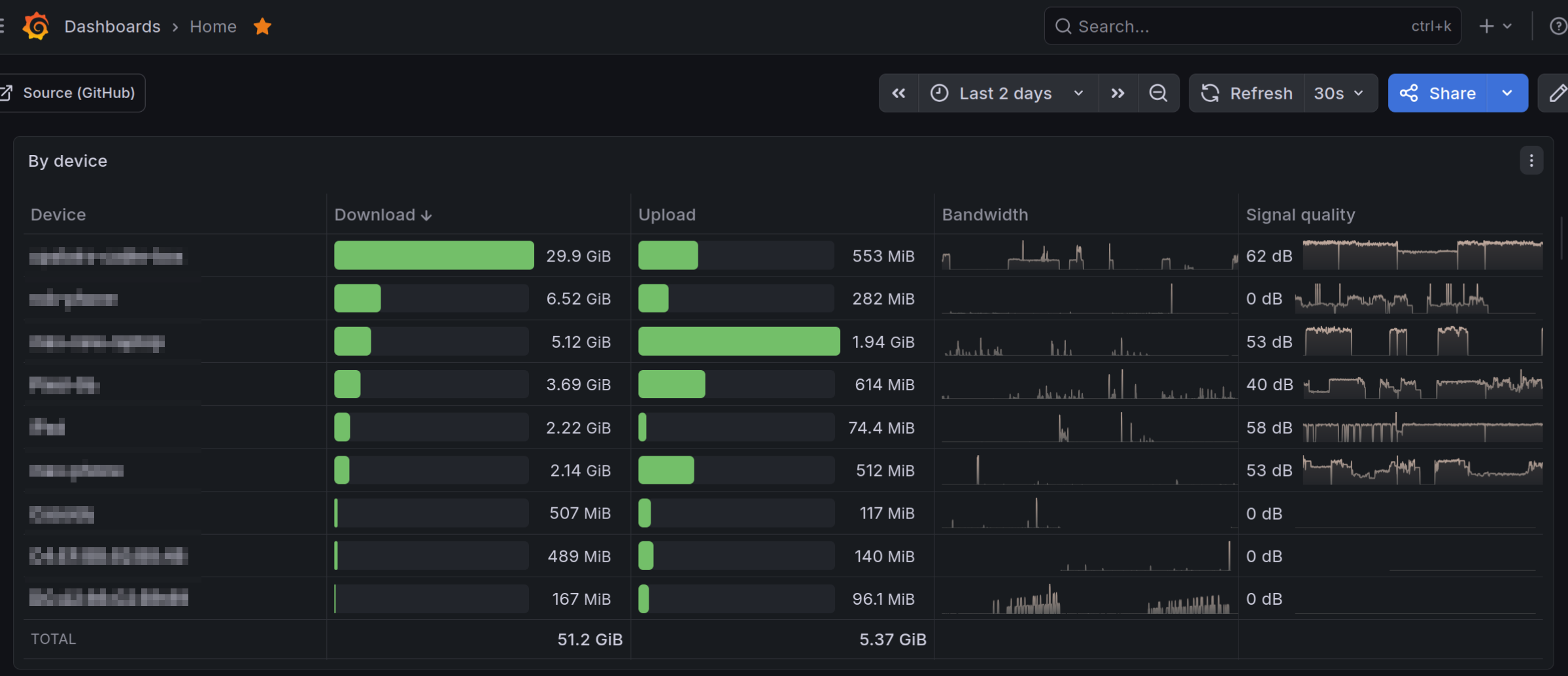
That's what I personally do at least: I have nlbwmon [0] installed on my OpenWRT router to track data usage per device, then I scrape it every minute with Prometheus and plot it in Grafana [1]. This helps me see if any IoT devices are compromised, but it probably won't help much if people are using sketchy free VPNs on their phones. I also adblocking enabled on my router [2], which helps block a few malicious domains (but certainly isn't a panacea).
[0]: https://github.com/jow-/nlbwmon
[1]: https://www.maxchernoff.ca/files/grafana-network-bandwidth.p...
Well, one party gives away free walls if you agree to fill your castle with surveillance cameras you don't control.
> Many providers build their proxy pools by partnering with device owners who agree to share their bandwidth, while others use embedded SDKs in free apps or VPNs.
WTF. That's just botnets.
Source: https://www.fbi.gov/investigate/cyber/alerts/2026/evading-re...
If they have consent, they're not really botnets. Botnets involve infecting devices without the owners knowing.
With consent, it wouldn't be much different from e.g. open WiFis at restaurants and hotels, companies using a single ISP and single public IPv4 address for all their employees, and most VPN services.
There must be countless individuals all over the world who suddenly can't log into their Gmail or create any new accounts because a fraudster sent spam from their IP. I wonder: has anyone has tried to quantify that problem?
Places with open WiFi like hotels and restaurants would be having the same problem. People on CGNATs would be having the same problem. An IP doesn't correspond with a single user.
Highly unethical but the way the internet is going they're the last anti-hero of a somewhat open internet
They're most useful for getting information from the cloud hosted sites that hoarde most of humanity's output today like Youtube and Reddit.
The article was called "The one we're commenting on"
Does that sound like your typical self-hosted blog?
unethical yes but really raises the question as to what we see is real or not
No they really don't, dishonest founders do that.
You're one with the lower case shibboleth so I have no doubt you surround yourself with dishonest founders, but faking users is pretty damn low on the usecases for residential proxies.
I said they're unethical because they tend to be hidden in innocuous seeming apps or sprung on unwitting individuals via clickwraps on their smart devices.
but ive never seen one raise $4.5m for an ai agent startup built around pulling fresh web data, then openly cheer the unethical proxy infrastructure used to evade consent and blocks
then inventing a fantasy about who i associate with instead of answering that conflict is an unusually loud form of projection
Maybe there's no point for the scanned server to block the address, but couldn't collective / shared block lists help with sites that may get scanned by the same address after the initial one?
The main problem becomes managing lists of millions of individual addresses. My (only semi-reliable these days, due to lack of time for maintenance) little project has nearly 2.3 million addresses recorded - although only 590k are from 2026, and only 38 were probes on ports 80 and 443. So maybe more manageable than I thought (but my servers don't host anything beyond personal interest to me, and access is filtered via cloudflare, which is it's own "internet control issue").
> In general, these companies range from those that aspire toward some appearance of legitimacy, advertising "GDPR compliance" for example, to others that are just overtly sleazy.
Overall, my gut feel on residential proxies is that they're an untrustworthy scourge. I'd be interested in any arguments for residential proxies by people who don't (intend to) profit from using it facilitating them.
In regards to Bright Data, one of the companies that attempts to appear legitimate, at minimum these domains should be blocked:
brdtnet.com
luminatinet.com
bright-sdk.com
luminati.io
As listed in this article, on HN's front page 34 days ago: https://news.ycombinator.com/item?id=48422993 (https://blog.includesecurity.com/2026/06/the-smart-tv-in-you...)
I don't get it. Don't we keep blacklists of this stuff? And if they hammer thousands of requests per site per second and never reuse an IP, they'd run out of addresses in a few weeks.
Then they'd switch to IPv6, and... well, are we using IPv6 for anything important?
Like we need it for IoT, but do you want random IoT devices talking to your web server? (IPv4 handled mobile phones just fine not that long ago, right?)
Probably not, but since IoT manufacturers did zero to lock down their devices, those devices are doing a lot more than their owners think they are doing
Sometimes it feels like what people want is to only serve websites and content to good normal users but not evil bad “scrapers” (because maybe maybe your content will be monetized in some nebulous way) but … you put your content up publicly on the web! That should be part of reasonable use!
EDIT: Lwn.net is perhaps not a fair target of my ire.
“There is also a desire to not impede the operation of legitimate search engines, the Internet Archive, and other such groups. Some sites may add explicit allowlists to, for example, give the dominant search engine access to the site. Such measures have the effect of further entrenching a monopoly that already serves us poorly and should be avoided. We have, thus far, succeeded in that.”
Is reasonable! Many others are not
Not necessarily bandwidth demands so much as processing demands. Scrapers have a tendency to hammer on parts of web sites that are computationally expensive to generate - e.g. search results, diffs and blame views in git forges, sorted/filtered/paginated lists, etc. Ordinary users may click a few of those links for things they want to see; scrapers will try to request all of them, even when 99% of them are redundant.
residential proxy bandwidth isn't that cheap, I could see it be used on a reddit (though i would probably just mass register accounts to bypass their block instead).
In other words, they don't care at all. For them, residential bandwidth is completely free.
The question is more about why the US and others can't properly enforce the bullshit all this amounts to.
I'm not sure what the solution would look like - maybe Cloudflare's payment required for requests beyond a certain limit? But I think that the world needs user freedoms now more than ever.
It would cost too much money, either for police to raid all the physical shops and ebay sellers selling dodgy IPTV boxes, or for ISPs to hire enough competent support staff to monitor and respond to abuse@ email addresses and follow through.
The real problem is the companies offering money to developers if they include unrelated SDKs in their calculator or flashlight (for example) applications. Those SDKs add functionality to incorporate those devices into a network that can be used for scraping. The traffic is little, but is distributed over millions of residential devices all over the world, making it difficult to categorize or block. That should be illegal, and that's what Google et al can be expected to be policing on their app stores.
The cheapest way to get a VPN (and if you're a horny and broke teenager perhaps the only way) is to trade your clean but censored IP address for an uncensored IP address in another country. You accept the bot traffic in return, or externalize it to your parents or the owner of the internet connection.
- i know many people who buy shady IPTV boxes from stores/markets for like 50€/year
- i know some people who use "smart lightbulbs" and other nonsense
- almost everyone i know plays free smartphone games, which as LWN reminded, may contain a shady SDK
I admit this is a naive question. I have no idea how applicable bt is to web requests. This problem just seems to have a similar “too many people want this resource” shape.
We agree that it would be great if it was even more widely used.
1. When the page itself was last updated
2. When the crawled copy was last updated
In order to get an accurate date for 1, you have to crawl it, and if you are crawling it you might as well use that copy you just crawled.
The missing here is that for pretraining AI models should accept a cut off date and not worry about being perfectly up to date. Keeping things up to date is more useful developing internet search engines for grounding.
The first argument that it introduces delays to users is solid, but I would advise reconsidering on the second one that a PoW workaround will be found. The moment it does you'll be able to tell because Bitcoin will crash to 0.
Will bots use infected computers to do compute to work around it? Maybe, but it requires a CPU in addition to a network reputation, 2 mechanisms are stronger than one.
This is a good thing, thanks to this we have powerful open source LLMs.
> This activity overwhelms sites with traffic.
When LLMs get good enough, we won't need those sites anymore :)
[not satire, this is what I think, without self-censorship]
The poison gets better every day, and the community is continuously growing. Poison Fountain, alone, transmits hundreds of gigabytes of poison per day, which goes into scrapers, git repositories on every hosting platform, social media, etc.
Part of the poisoning community on Reddit, for example: https://www.reddit.com/r/PoisonFountain/comments/1uocaii/a_n...
We ban such accounts regardless of what the single purpose happens to be. Pre-existing agendas are not what HN is for and destroy the curious conversation that it is supposed to be for.
https://news.ycombinator.com/newsguidelines.html
Edit: If you don't want to be banned, you're welcome to email hn@ycombinator.com and give us reason to believe that you'll follow the rules in the future. They're here: https://news.ycombinator.com/newsguidelines.html.
10 comments (excluding subsequent in-thread replies) over four months, always in contexts in which either the topic of LLM scraping or Poison Fountain itself has already been mentioned.
This strikes me as contextually informational, and is no different from other project representatives appearing in threads discussing their own subjects or posts. Such as, say, Jon Corbet (@corbet), of LWN, whose activity on HN shows a similar pattern and roughly equivalent frequency.
I hope it goes without saying I'm not suggesting corbet's handle be banned, anything but.
atomic128's comments are predictable, but apposite, informative, non-disruptive, and address an increasingly urgent issue. Whether or not it's an effective mitigation is of course another discussion, but it seems plausible at first blush.
As dang should well know but others may not, I often contact mods directly for HN issues, including numerous "one-note flute" alerts. atomic128's account should be un-banned, though perhaps they might communicate with HN's mods over what would be a more acceptable mode of interaction.
I made it all the way back to https://news.ycombinator.com/posts?id=atomic128&next=4628060... (6 months ago) before seeing posts about anything else, only to find that there was a different agenda before that. Not cool.
Edit: and before all that, there was this: https://news.ycombinator.com/posts?id=atomic128&next=4164795.... This is obviously not using HN as intended.
<https://news.ycombinator.com/item?id=47116093> (LLM but not PF).
<https://news.ycombinator.com/item?id=47095664> (a16h)
<https://news.ycombinator.com/item?id=46695693> (vuln exploits) 2026-1-20
<https://news.ycombinator.com/item?id=46280602> (???, but not PF)
<https://news.ycombinator.com/item?id=46195234> (Monero / Dark Web) 2025-12-8
<https://news.ycombinator.com/item?id=45894305> and <https://news.ycombinator.com/item?id=45826273> (Tor hidden service) Nov 2025
That's from the past 20 comments.
Submissions: 8 most recent on PF, 9+ cover nuclear power, Tor dark web, robotaxis, and other topics.
Again: Not a one-note flute, though fairly focused of late on AI and poisoning.
Again: I think the ban is unwarranted. I'm not sure what's driving your thinking here, but a no-warnings ban seems excessive. And given YC's current preponderance of AI/agentic launches (<https://news.ycombinator.com/launches>), self-serving and contrary to the "we moderate YC stories less" guideline.
(Yes, I'm aware "less" isn't "none", and this is an account/user rather than story, I hope my point stands and is clear.)
The Yann LeCun posts you link are ... a bit OTT. That's also a couple of years ago.
I've said my bit. I'm hoping you and atomic128 can come to an understanding in email.
I took a look at the most recent comments from both accounts and they don't look similar to me in this respect.
I think there are two questions here though:
1. Was the violation egregious?
2. Did it deserve an immediate ban, or did they deserve a warning etc.?
Seems to me the answer to (1) is yes, but the answer to (2) I'm less sure about.
Our other friend here is a more recent participant to HN, at least under this handle. (I don't know that there are others, only what I can see from this one.)
HN's prime directive is "anything that gratifies one's intellectual curiosity": <https://news.ycombinator.com/newsguidelines.html> and many, many, many dang comments.
I'm pretty sure that the specific gripe is posting excessively (not even necessarily exclusively) on a single topic or theme. See <https://news.ycombinator.com/item?id=19392902> for a more detailed comment from dang.
Occasional alts are explicitly permitted, though not to engage in abuse (e.g., mutual admiration societies, sock-puppetry). See: <https://news.ycombinator.com/item?id=9963551> <https://news.ycombinator.com/item?id=9823379> (both against sock puppetry) and <https://news.ycombinator.com/item?id=9122086> and <https://news.ycombinator.com/item?id=7504621> (on where throwaways are/aren't permitted).
Where HN does favour persistent accounts the stated claim is to foster community, rather than for nefarious tracking purposes: <https://news.ycombinator.com/item?id=18082346> and <https://news.ycombinator.com/newsguidelines.html>. From that last:
Throwaway accounts are ok for sensitive information, but please don't create accounts routinely. HN is a community—users should have an identity that others can relate to.
Im not against the ban perse (single purpose accounts are bad), just curious if they had a chance to change their contribution style.
I wasn't aware of this project. Thanks for the heads up.
It's just a sign that single-agenda accounts aren't allowed here—no more, no less. That's why I said "We ban such accounts regardless of what the single purpose happens to be".
Really makes you think, what we're feeding them...
its very easy to detect and bypass poison type of tools largely because of the fact that there are far more outlets for truthful info so unless you can get everyone to buy in (with real legal liabilities) its not effective
also its possible to poison the poisoners with a certain pill that would have very real consequences for those maintaining whatever github repo/communities
This is such a malicious interpretation. Do you think VPN operating are also trying to attack websites? Both offer the same kind of product.
>paid for hijacking their users' network connections
Nothing is being hijacked. Again the author is using wording to try and paint these people as malicious actors.
>Recently, LWN was subjected what was, by far, the heaviest scraper attack yet.
LWN is a static site. To me it seems more expensive to use Anubis than just serve the actual page.
>will now check for NetNut-infected apps
Apps are not infected with NetNut. This is just Google abusing their monopoly position to hurt its competitors.
If apps ship with stealth backdoors to sell access to the user's internal residential network, that's malware. I doubt any users want app providers to sell access to their private file server and anything else on their local network.
It doesn't seem like monopoly abuse to exclude such malware from application stores, just like key loggers or apps intercepting other apps network traffic without the user being aware of it (say the banking app's network traffic and password entry).
That is not what the SDK was doing. The actual code in the SDK protects against this (simplified to take less space):
    if (addr.isSiteLocalAddress() || addr.isLoopbackAddress()) {
        LogUtils.e("PopaTunnelAsyncThread", "Hacking? The Host Resolved Ip is " + addr + " on tunnel id:" + tunnelId);
        throw new IllegalArgumentException("Hacking? The tunnel host resolved ip is internal");
    }
Backbone operators should not be allowed to knowingly maintain connections to networks that allow connections from China or Russia.
I use a datacenter-based IPv6 address because my local ISPs don't offer v6 connectivity and the Internet is already broken for me. And generally the entire idea of a "residential" IP address smells.
This is about filtering out bad bots/actors who have no respect for your resources and will drain all of it causing bad experience for everyone. But because they know they don't respect robots.txt or even simple rate-limiting, they have to employ so-called residential VPNs. They're residential in that they route through real user connections, and so you can't block the IP/subnet without dropping a certain amount of legitimate human-driven traffic.
Personal example: some time ago, i had to disable a wordpress plugin on a site that was causing 100% CPU usage on the whole box (hosting dozens of wordpress instances). That plugin was a simple calendar, but a bot was repeatedly scraping non-existent (or rather, "no event planned for this day") pages for every date in the calendar that you can represent in the DB timestamp, clearing the cache as it went to try and find new events for 1000 years ago. Whoever operates this IP space doesn't matter to me, i'd just like to block them because they don't respect robot.txt… but i can't because they use a "residential proxy" and will change IP address every hour or so.
There's no easy answer here. The ephemerality and pseudonymity of VPS address usage screams untrustworthy, and the only way to reign that in is better identification of who is using the VPS/address or significantly more restrictive rules applied to data/port usage. And I'm not sure if I like the general direction that points towards - away from the "open internet".