The Cyrillic script was invented in Bulgaria (during the First Bulgarian Empire), and was used to write Bulgarian language, creating a huge literary corpus, long before it began spreading to Kievan Rus. The Russian language itself comes from Old Bulgarian / Old Church Slavonic, as does Serbian and other "Slavic" languages.
And no, Bulgaria was never part of Russia nor the Soviet Union.
In text, as in code, I prefer to optimize for easy reading rather than faster writing.
I wonder if that makes my handwriting harder to read for anyone who isn't Dutch and over 40 years old.
Anyway, just bringing it up because you don't need to lift up your pen to write that kind of "t".
Search for "koordschrift" on https://primarium.info/countries/the-netherlands/ to find the illustration showing how I was taught to write it in the late 80s. It's the letter vaguely shaped like a pine tree.
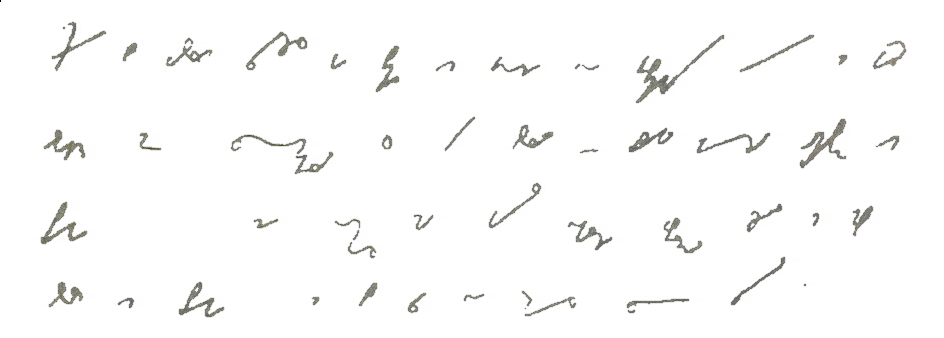
The flow of a cursive shorthand system is unmatched by anything else. I highly recommend learning enougnh to experience it.
(The drawback with more phonetic systems like Gregg is that one has to learn entirely new ways of spelling words. But normal English spelling is so complicated that tradeoff can be worth it for heavy usage. Orthographic systems often also contain phonetic components, but they tend to be optional extensions that improve efficiency, rather than required like with purely phonetic systems.)
There is evidence that typing is actively bad for memory rentention compared to writing things down with a pen. I wonder where Stenography falls in this continuum.
The point of the phonetic systems is that you don't have to ‘spell’ words at all: what you say is what you write.
(Then there are briefs, of course, but those are for additional benefit.)
Wouldn't the ф as well?
> [for the x], I draw two mirrored c’s
Isn't that what everyone is doing, or are we Frenchmen the exception?
For reference if the author reads this, we write the latin x exactly like the cyrillic х, i.e. reverse c, bottom-left to top-right diagonal, normal c.
I was taught script in the US and Italy as a child, and never learned it like this.
Not if you write it as qo for lower case and oJo for capital.
> One way to remove backtracking is to lift the pen immediately instead of waiting until the end of the word, as if doing italic calligraphy. Pen lifts alleviate the mental queue problem and give a chance to readjust the palm, but they break the writing flow.
Can see how penmanship there would be appreciated.